Showing posts with label African American History. Show all posts

Thursday, March 16, 2023

Art Eyewitness Review: Black Founders, the Forten Family of Philadelphia


Black Founders, the Forten Family of Philadelphia 

The Museum of the American Revolution

February 11, 2023 - November 26, 2023

Reviewed by Ed Voves

Bethel African Methodist Episcopal (A.M.E.) Church is one of the most historic buildings in Philadelphia – and the United States. Founded in 1794, Mother Bethel, as the church is popularly known, was the site of a crucial meeting in early U.S. history. Three thousand African American men assembled there on January 15, 1817 to discuss a proposal for emigration to a site in West Africa where a colony, free of racial discrimination, would be founded.

To the surprise of the clergymen and civic leaders who had convened the meeting, the proposal was emphatically rejected. Virtually without dissent, the answer shouted from the church pews was a ‘tremendous no.”


Ed  Voves, Photo (2023)
Nathan Alford Tate, who portrays James Forten at the Museum of the American Revolution, posing with a pew from Mother Bethel Church. 

Many of the three thousand African-Americans crowding into Mother Bethel were native-born and a number had fought in the Revolutionary War. The United States was their country, their home. They would not leave their land. 

One of the most prominent participants at the Mother Bethel meeting was a Revolutionary War hero named James Forten. The Museum of the American Revolution, located in Philadelphia, has recently opened a special exhibition entitled Black Founders, devoted to James Forten and his extraordinary family. 

James Forten (1766-1842) was born in Philadelphia, a member of the city’s free Black population. As a young boy, he heard the Declaration of Independence proclaimed on July 8, 1776. After witnessing a regiment of African-American and Native-American troops of George Washington’s army march en route to the siege of Yorktown in 1781, the young Forten determined to join the Patriot cause. 


Ed  Voves, Photo (2023)
Gallery view of the Black Founders exhibition, showing
 Don Troiani's painting, Brave Men as Ever Fought, 2020

This moment is celebrated by a painting by Don Troiani, whose accurate depictions of the American Revolution were featured in an earlier Art Eyewitness review.


Ed  Voves, Photo (2023)
A ship model for a prototype vessel for the Continental Navy, made in 1777 by Joshua Humphreys of Philadelphia.

Forten enlisted in the American navy. The ship he served on, the Royal Louis, was captured by the British and Forten endured a harsh captivity on a prison ship moored in New York Harbor. And that was just the beginning of his extraordinary life story!

After the Revolution, Forten worked his way to owning a maritime supply company making sails and rope for the merchant ships based in Philadelphia. A partial reconstruction of Forten's sail loft is the centerpiece of the exhibition at the Museum of the American Revolution.


Ed  Voves, Photo (2023)
Gallery view of the Black Founders exhibition, showing a recreated sail loft similar to James Forten's. 

Following this business success, Forten dedicated himself to the struggle to end slavery in the U.S.  In 1813, Forten wrote a  pamphlet, Letters from a Man of Colour, which powerfully argued the case for emancipation and opposed measures of discrimination against free African Americans which were being implemented in Northern states, including Pennsylvania. 

As well as documenting Forten’s life, the exhibition extends his family’s story to the Civil War era of the 1860’s. Forten's wife, children and grand daughter, Charlotte Forten Grimke (1837-1914), who compiled an important diary of the Civil War years, were ardent activists in the anti-slavery cause. 


Ed  Voves, Photo (2023)
A portrait photo of Charlotte Forten Grimke

Along with the rise of the Abolitionist movement in the U.S., the exhibition also surveys social life, entrepreneurship and “self-reliance” in the African-American community during the early Republic era.

History is often a frustratingly complex subject. One would think that the life of a patriot like James Forten and the anti-slavery cause might evade some of the moral entanglements which feature in other historical incidents.  However, James Forten was actually one of the leaders who initially favored the African colonization scheme. He was the presiding officer at the Mother Bethel meeting and one of the recipients of the ‘tremendous no.”

The Mother Bethel meeting was a lesson in democracy. Forten and fellow African American leaders were amazed by the unanimous decision of "rank-and-file" citizens not to relinquish their birthright of liberty for a "promise" of greater prosperity elsewhere. And it is to Forten's credit that he listened and followed their lead.

With renewed determination, Forten joined in the resistance to the colonization scheme. Years later, he wrote with quiet conviction, "We are contented in the land that gave us birth and which many of us fought for during the war which established our Independence."

The topics covered so brilliantly in the Black Founders exhibit are, for the most part, political and social ones. However, a number of the artifacts on view provide insight into the visual art scene in the U.S. during the first decades of the nineteenth century. This was a time of considerable difficulty as many promising American artists went to Europe and remained there, sometimes for life. Little of what we might now deem as “fine” art was created, though there were some tentative efforts in landscape painting. Art related to the lives of African Americans was extremely rare.


Attributed to John Rose (1752/53-1820)
Music and Dance in Beaufort County, S.C.
from the collection of the Colonial Williamsburg Foundation

Despite these unpromising conditions, a vigorous, “homespun” art began to develop in the United States during the early 1800’s. Thus, the exhibition objects on view in Black Founders are hugely important. These artifacts document the African American experience and the efforts of American artists to gain recognition on their home turf. 

The most significant feature of the Black Founders exhibit is its demonstration of how "material culture", treasured personal items or the objects of daily life, relates to high-sounding concepts. One can recite "Life, Liberty and the Pursuit of Happiness" but the sight of a family Bible or a regimental battle flag supplies a tangible reality to these noble words.


Ed  Voves, Photo (2023)
Holy Bible, printed in 1838, owned by the Forten Family  


Ed  Voves, Photo (2023)
Detail of the Regimental flag of the 127th U.S. Colored Troops 

The signature work of the exhibition is an impressive portrait in profile of an African-American gentleman. It is on loan from the collection of the Historical Society of Pennsylvania. Dating to around the time of the Mother Bethel meeting, it has long be regarded as a portrait of James Forten. However, it lacks any formal title and is not signed on the back of the canvas. 


Artist unknown, Presumed Portrait of James Forten, c. 1820

Is it James Forten? We know that Forten’s wife treasured a portrait of him after he died in 1842. Charlotte Vandine Forten lived until 1884, so that there was no need to identify the painting on her behalf. By the time the portrait reached the Historical Society of Pennsylvania, its reputation as being a likeness of Forten was secure.

That is far from the kind of exacting detail required by art historians. The curators of the Black Founders exhibit are quite forthright about the lack of positive documentation. Two other works, one of them an early photo, are also considered. Judging from the evidence, neither of these is likely to portray Forten.

From a purely artistic point of view, the profile portrait is a professional caliber, though second-rank, painting. It is exactly the kind of work that an affluent, “self-made” man like Forten would have favored. A fair likeness and a good investment! 

This is also the type of portrait, typical of American painters working in the domestic market during the early 1800's. These "limners", often unknown today and under-appreciated, laid the foundation for subsequent American art. 

With other works of art on view in Black Founders, we are on firmer ground when it comes to proof and provenance. Thanks to the generosity of descendants of James Forten, a table from the Forten home, the Forten family Bible and needlepoint "samplers" by his daughters, Mary and Margaretta, are on view in the exhibition.


Ed  Voves, Photo (2023)
Gallery view of the Black Founders exhibition, showing
 a table owned by James Forten, made in Phila., c. 1790-1805


Margaretta Forten Sampler, Collection of Marcus & Lorri Huey

Such examples of the "material culture" of social life in the early Republic are priceless. These works underscore the identification of African American citizens like James Forten with American culture and the democratic values of the nation.


Ed  Voves, Photo (2023)
Silver Urn presented to Capt. Isaac Hull, 
commander of USS Constitution, 1812

James Forten was a seafaring man and a business executive involved with maritime trade. When the news of the naval victory of the USS Constitution over the British warship Guerriere during the War of 1812 reached Philadelphia, Forten subscribed to a fund to present a silver urn honoring Captain Isaac Hull, the commander of "Old Ironsides".

Along with the Civil War battle flag of the 127th U.S. Colored Troops (shown above), this silver urn reinforces and reminds us of the patriotism of James Forten and African American heroes like him. The Museum of the American Revolution is devoted to such noble sentiments. But there is much more involved here than merely placing relics of the past in glass cases.

In an impressive initiative, the curators of the Museum of the American Revolution are teaming with Ancestry® to make available an archive of 200 documents relating to African American and Native American soldiers who served during the Revolutionary War. These primary sources of historical record - muster rolls, pay vouchers, enlistment papers, and discharge forms - will soon be available for online searching, free of charge.


Ed Voves Photo (2023)
Detail of Don Troiani's, Brave Men as Ever Fought, 
showing the young James Forten in 1781

James Forten was born ten years before the Declaration of Independence and died twenty years before the Emancipation Proclamation. His life -and the superb exhibition at the Museum of the American Revolution - bring to mind the memorable words of John Adams in 1818. 

Long before the first shots at the battles of Lexington and Concord, "the radical change in the principles, opinions, sentiments and affections of the people" had already occurred. This, Adams wrote, "was the real American Revolution." 

One of the hearts where this "real American Revolution" took place was James Forten's.

***
Text: Copyright of Ed Voves, all rights reserved                                                                                           
Introductory image:
Ed Voves, Photo (2023) The logo and signature image of the Black Founders, the Forten Family of Philadelphia exhibition at the Museum of the American Revolution.

Ed Voves, Photo (2023) Nathan Alford Tate, who portrays James Forten at the Museum of the American Revolution. A pew from  Mother Bethel A.M.E. Church is shown in this gallery view of the Black Founders exhibition.

Ed Voves, Photo (2023) Gallery view of the Black Founders exhibition, showing Don Troiani's painting, Brave Men as Ever Fought, 2020 (collection of the Museum of the American Revolution).

Ed Voves, Photo (2023) A ship model for a prototype vessel for the Continental Navy, made by Joshua Humphreys of Philadelphia, 1777. Independence National Historical Park Collection, Philadelphia, PA.

Ed Voves, Photo (2023) Gallery view of the Black Founders exhibition, showing a recreated sail loft similar to James Forten's. 

Ed Voves, Photo (2023) A portrait photo of Charlotte Forten Grimke. Collection of the New York Public Library.

Attributed to John Rose (1752/53-1820) Music and Dance in Beaufort County, c. 1785. Watercolor on laid paper: 11 11/16 in. x 17 7/8 in. The collection of the Colonial Williamsburg Foundation. Gift of Abby Aldrich Rockefeller. #1935 301.3 A&B

Ed Voves, Photo (2023) Holy Bible, printed in 1838, owned by the Forten Family. Collection of Atwood "Kip" Forten Jacobs.

Ed Voves, Photo (2023) Detail of the Regimental flag of the 127th U.S. Colored Troops. Collection of the Kenan Research Center at the Atlanta Historical Center.

Artist unknown (Perhaps Robert Douglass Jr.) Presumed Portrait of James Forten, c. 1820. Oil on paper. Leon Gardner collection, Historical Society of Pennsylvania. #0008.

Ed Voves, Photo (2023) Gallery view of the Black Founders  exhibition, showing  a table owned by James Forten, made in Philadelphia, c, 1790-1805. Collection of Marcus & Lorri Huey,

Margaretta Forten Sampler, Collection of Marcus & Lorri Huey. Image courtesy of Marcus & Lorri Huey and Museum of the American Revolution.

Ed Voves, Photo (2023) Silver Urn presented to Capt. Isaac Hull, commander of USS Constitution, 1812. Created by Thomas Fetcher and Sidney Gardner, Philadelphia silversmiths. Sterling silver: 29.5 in. (height) x 22 in. (width) x 12 in. (depth). Private collection, on loan to USS Constitution Museum.

Ed Voves Photo (2023) Detail of Don Troiani's, Brave Men as Ever Fought (2020), showing the young James Forten in 1781.

Sunday, June 23, 2019

Augusta Savage: Renaissance Woman at the New York Historical Society


Augusta Savage: Renaissance Woman 


New York Historical Society, New York City 
May 3- July 28, 2019

Reviewed by Ed Voves

Augusta Savage (1892-1962) was one of the greatest artists affiliated with the Harlem Renaissance, the pivital moment of cultural awakening and racial equality during the 1920's and 1930's. Savage's impressive sculptural work literally embodied the ideas and ideals of the distinguished literary figures of the Harlem movement, such as Alain Locke and Langston Hughes. 

The use of the term "Renaissance" is also fitting since Savage inspired, taught or mentored many fellow African-American artists who carried on her work during the years of the Civil Rights Movement and beyond. Savage was a Renaissance master as Andrea del Verrocchio and Luca della Robbia had been during the 1400's, passing on skill, knowledge and enthusiasm to students and aspiring artists. Gwendolyn Knight, Jacob Lawrence and Norman Lewis were just a few of the African-American artists who acknowledged their debt to Savage.


Unidentified photographer, Augusta Savage, c. 1930

Augusta Savage recognized that the legacy she passed on to the post-Harlem Renaissance generation might well be more valued than her actual art.

"I have created nothing really beautiful, really lasting," Savage declared in 1935, "but if I can inspire one of these youngsters to develop the talent I know they possess, then my monument will be in their work."

Augusta Savage's self-criticism was much too harsh, as we can see in this remarkable exhibit.


Ed Voves, Photo (2019)
 Gallery view of the Augusta Savage: Renaissance Woman exhibition. 
Augusta Savage's Boy on a Stump, c. 1930, appears in the foreground.

Augusta Savage: Renaissance Woman is a collaborative effort of the New York Historical Society (NYHS) and the Cummer Museum of Art in Jacksonsville, Florida. The exhibition curators have assembled a remarkable array of Savage's oeuvre, as well as photographs and letters exploring her singular career.
  
This is also an exhibition which documents the "collective" story of twentieth century  African-American artists. Taking their lead from Savage, painters and sculptors like William Artis smashed the barriers of racial prejudice and asserted their creative talent. Signature works by these artists, whom Savage inspired, are prominently displayed in the exhibition.


William Artis, A Mother's Love, 1963


Jacob Lawrence, The Card Game, 1953

Savage's greatest work of art is conspicuous by its absence - physical absence that is. The spiritual resonance of Savage's The Harp, conveyed by a large format photo and a much smaller bronze version is so palpable that you will swear that the original is  on view at the NYHS.


Ed Voves, Photo (2019) 
Gallery view of the Augusta Savage: Renaissance Woman exhibition.
 A miniature bronze version of Savage's The Harp appears in the foreground.

After nearly two decades of struggle in the New York art scene, Savage enjoyed a hard-won moment of success when she was selected to create a monumental sculpture for the 1939 New York World's Fair. The Harp was inspired by the hymn, Lift Every Voice and Sing, and took nearly two years to complete. Like most of the art made for the 1939 World's Fair, The Harp was subsequently destroyed. Yet, it continues to dominate the NYHS exhibit gallery by the sheer memory of its brilliance.

Such is the power of art - and the will to create art.

Augusta Savage's art sprang from the red clay of Florida which she modeled into figurines and small portraits. Savage's father, a Methodist minister, was infuriated at her disregard for the Biblical injunction against making "graven images."

"My father licked me four or five times a week," Savage later recalled, "and almost whipped all the art out of me."

Almost but not quite. Savage's early life was marked by great travail. She was married three times, two husbands dying young, the third marriage ending in divorce. In 1919, she won a prize at the West Palm Beach County Fair for a sculpture group. This success revived her determination to achieve a career in the arts. She joined the Great Migration to the north, arriving in New York City in 1921 with $4.60 in her purse.

Taking a job as an apartment house caretaker, Savage enrolled in the Cooper Union School of Art. Her skill and work ethic enabled her to complete the four-year course in three years. Savage next gained a scholarship from the Fontainebleau School of Fine Arts to study in France. Then, when the American officials selecting students for Fontainebleu discovered that Savage was "colored," the scholarship was cancelled.

Savage's disgraceful treatment by these Fontainebleau administrators was quickly noted by the redoubtable W.E.B. Du Bois. Launching a crusade on her behalf in the NAACP magazine, The Crisis, Du Bois directly challenged the Fontainebleau trustees. Responding to Du Bois' relentless criticism, J. Monroe Hewlett lamely replied that the rejection of Savage to travel and study in Europe "was due quite as much to consideration for her as to any other thought or feeling."

Unable to get the Fontainbleau decision reversed, Du Bois continued to advocate Savage's right to a scholarship to Europe. Eventually, in 1929, the Julius Rosenwald Fund awarded Savage a two-year scholarship to study in France. Six years had been lost, however. As David Levering Lewis, Du Bois' biographer, astutely noted the "steep learning curve" of Savage, now aged 37, "would have begun to flatten after so much time wasted waiting and deprived of expert mentoring."

This perceptive remark needs to be considered in relation to Savage's already sensational talent. There can be no doubt as to the exceptional level of her skill and to her determination to create realistic portraits of African-Americans. These likenesses exude self-awareness and pride - of artist and subject - quite at odds with the caricatures or patronizing stereotypes of African-Americans in the mainstream media of the 1920's. 


Augusta Savage, Gamin, c.1930

Savage's Gamin is a case in point. This portrait of a young African-American boy was the piece submitted with the application for the Rosenwald scholarship. Savage used her nephew as the model, creating a work that succeeds as a unique portrait and as an idealization of African-American identity. The Rosenwald judges were so impressed that they increased Savage's scholarship stipend from $1,500 to $1,800.

Gamin is Savage's most famous surviving work, but I was even more impressed with a later piece, from the collection of the Museum of Fine Arts in Boston, Portrait of John Henry. 


Augusta Savage, Portrait of John Henry, c.1940

Portrait of John Henry was created around 1940 and shows Savage at the height of her powers. It is an exceptional work, establishing a living presence even in an exhibition gallery crowded with other masterpieces. The eyes of John Henry, often the most problematical element of a portrait sculpture, sparkle with life force and intelligence.

There is a shadow to Portrait of John Henry. This work represents the peak of Savage's artistic career. From 1940 on, the number of works created by Savage dwindled and after a few years all but stopped. The reasons for this are complex and need to be addressed in some detail.

The year 1940 should have marked another upward thrust in Savage's career trajectory - and she had every to believe so.

After returning from studying in France in 1932, Savage established the Savage Studio of Arts and Crafts in Harlem, offering free art classes. Savage's community-based focus secured her the appointment as the first director of the Harlem Community Art Center, funded by the W.P.A., in 1937. In 1939, with The Harp gaining acclaim at the World's Fair, Savage opened the first African-American art gallery, the Salon of Contemporary Negro Art, with a major exhibition, June 8th to June 22nd, 1939.


Unidentified photographer
Augusta Savage viewing two of her sculptures, Susie Q and Truckin, c. 1939

This moment of triumph, following so much dedicated work, quickly vanished. Instead of being Savage's "breakout" year, 1940 saw the breakdown of her career. The Salon of Contemporary Negro Art soon closed for lack of support and Savage was sidelined from her directorship of the Harlem Community Art Center. Savage did not even have enough funds to place The Harp in storage until it could be cast in bronze and sold to a museum. 
As a result, The Harp was destroyed when the World's Fair closed in 1940.

Savage's career went into an eclipse from which she never really recovered. Most African-Americans during the 1940's lacked the degree of affluence to collect the art on view at the Salon of Contemporary Negro Art. Sympathetic White supporters increasingly became focused on charitable work related to the Second World War. Those who continued to collect art in the 1940's increasingly looked to Abstract Expressionism, what would soon be called the New York School. 


Augusta Savage, Gwendolyn Knight, 1934-35

After struggling against poverty and racism, Augusta Savage fell victim to the impact of Modernism on American art. Indeed, she had experienced a premonition of this threat years before.

Lewis, in his biography of Du Bois, recounted how Savage, when considered for a scholarship to Italy in 1926, discovered that the tide of opinion in the art world was shifting from her traditional handling of the human body to more avant garde styles. Savage wrote to Du Bois about the reaction of the Italian countess who interviewed her.

"I think she was a trifle disappointed to find that I am a realist instead of a modernist," Savage informed Du Bois.


In 1940, the Nazi Blitzkrieg sent a wave of refugee European modernists to the United States. Many young American artists began to follow the lead of Piet Mondrian and Fernand Leger. Realist art, especially in sculpture, lost out to Surrealism and "Ab-Ex." 

Augusta Savage, along with artists like Malvina Hoffman, another brilliant woman realist sculptor, were casualties of this shift in technique and taste. Hoffman continued to receive some major, war-monument commissions. Interest in Savage's work evaporated.


Augusta Savage,  Portrait of a Baby, 1942

Of great poignancy, one of the last of Savage's pieces on view in the New York Historical Society exhibition is a portrait of an unnamed baby. This supremely accomplished work of art was created in terracotta, unlike the plaster and bronze which Savage used on most of her other sculptures. Portrait of a Baby recalls the red clay that the young artist had first grasped in her fingers long years before.

Augusta Savage, like Zora Neale Hurston, experienced decades of obscurity after a few fleeting moments of success during the 1930's. Hopefully, just as Hurston's literary accomplishments are now recognized, so will Augusta Savage's achievements as an artist and a teacher finally receive their due. 

Augusta Savage: Renaissance Woman at the New York Historical Society is certainly a big step forward in her "renaissance" as a major figure in American art.

***
Text: Copyright of Ed Voves, all rights reserved                                                                                           
Images courtesy of the New York Historical Society

Introductory Image:
Ed Voves, Photo (2019) Gallery view of the Augusta Savage: Renaissance Woman, exhibition at the the New York Historical Society. A miniature bronze version of The Harp is displayed in front of a photograph of Augusta Savage working on the original. The photograph is from the New York Public Library (NYPL), Manuscript and Archives Division, Astor, Lenox and Tilden Foundations, New York Worlds Fair 1939-40 Records, 1654255

Unidentified photographer. Augusta Savage, 1930. Gelatin silver print: 6 x 4 in. Schomburg Center for Research in Black Culture, NYPL, Photographs and Prints Division, Augusta Savage Portrait Collection, 83-1053 Public domain. 

Ed Voves, Photo (2018) Gallery view of Augusta Savage: Renaissance Woman, exhibition at the the New York Historical Society. Photo shows Augusta Savage's Boy on a Stump, c. 1930, in the foreground.

William Artis (American, 1914-77) A Mother's Love, 1963. Limestone: 32 1/2 x 17 3/4 x 14 1/2 in. Clark Atlanta University Collection,1963.007

Jacob Lawrence (American, 1917-2000) The Card Game, 1953. Tempora on board, 19 x 23 1/2 in. Savannah College of Art and Design, Museum of Art Permanent Collection. Gift of Walter O. Evans and Mrs. Linda Evans.

Ed Voves, Photo (2019) Gallery view of the Augusta Savage: Renaissance Woman, exhibition at the the New York Historical Society. 

Augusta Savage (American, 1892-62) Gamin, ca. 1930. The Cummer Museum of Art and Gardens, Painted plaster: 9 1/4 x 6 x 4 in. Purchased with funds from the Morton Hirschberg Bequest, AP.2013.1.1

Augusta Savage (American, 1892-62) Portrait Head of John Henry, c. 1940. Patinated plaster: 6 5/8 x 3 1/2 x 4 3/4 in. Museum of Fine Arts, Boston, The John Axelrod Collection—Frank B. Bemis Fund, Charles H. Bayley Fund, and The Heritage Fund for a Diverse Collection, 2011.1813, Photograph © 2018 Museum of Fine Arts Boston

Unidentified photographer. Augusta Savage viewing two of her sculptures, Susie Q and Truckin, c.1939. Gelatin silver print: 10 x 8 in. Schomburg Center for Research in Black Culture, NYPL, Photographs and Prints Division-Prophet, Nancy-Stull, Henry, Portrait Collection, 92-0360 Public domain.

Augusta Savage (American, 1892-62) Gwendolyn Knight, 1934-35, recast 2001. Bronze: 
18 1/2 x 8 1/2 x 9 in. Walter O. Evans Collection of African American Art. 

Augusta Savage (American, 1892-62) Portrait of a Baby, 1942. Terracotta, 10 x 8 1/2 x 8 inches. Courtesy of Michael Rosenfeld Gallery LLC, New York, NY Public Domain.

Sunday, September 30, 2018

Between Worlds: The Art of Bill Traylor at the Smithsonian American Art Museum


Between Worlds: The Art of Bill Traylor  

Smithsonian American Art Museum 


September 28, 2018 - March 17, 2019

By Ed Voves


This brilliant retrospective of the work by the African-American artist, Bill Traylor is aptly named "Between Worlds."

William "Bill" Traylor was born during the last years of the world of slavery and died in 1949 just before the Civil Rights movement began. Traylor's vision was also "other-worldly," combining  elements of African spiritual traditions, evangelical Christianity and personal experience.

A splendid array of Traylor's art is on view at the Smithsonian American Art Museum. This is certainly the most inclusive exhibition of Traylor's drawings and paintings, dealing with all of his major themes. There is so much to see here and so much to try and figure out.


Bill Traylor, Untitled (Radio), ca. 1940-1942

Traylor's art defies ready-made labels and aesthetic categorization. Born into slavery in 1853 (or 1854), Traylor created a uniquely, powerful style all of his own. Drawing and painting on scrap paper or cast-off pieces of cardboard (as in the work above), he created a vast body of work, of which approximately 1,500 pieces survive. There is nothing "primitive" about Traylor's art, though he was entirely self-trained. Although there are surreal elements in his paintings and drawings, Traylor was not a Surrealist.

The greatest insight into Bill Traylor comes from a revealing answer he made to an inquisitive question about the source of his art:

"It just come to me."

Traylor divulged little else. Beyond a handful of obvious points - the resilience of  the African-American community, the impact of suffering and violence - much of what Traylor depicted eludes easy explanation. Why should it have been otherwise? During the Jim Crow years, the very act of making art by African Americans could be perceived as dangerous self-assertion.


Ed Voves Photo (2018), Gallery view of Between Worlds: the Art of Bill Traylor

As I walked through the exhibition, it occurred to me that Traylor's art works are best explained by the questions they raise rather than the answers we formulate. But to raise these questions, we need to provide the context for Traylor's art-making


After a life spent as a sharecropper, Traylor moved to Montgomery, Alabama in 1928 to look for work. A year later, his son, Will, was killed by two white policemen in Birmingham, allegedly for attempting a night-time robbery. The official verdict was “justifiable homicide.” 

These watershed events would certainly have created a breakdown of Traylor's familiar world and a shattering crisis of faith in the future, at least for his son. Traylor was illiterate and therefore could not grapple with his feelings by writing a memoir. He could express himself with drawings and paintings. At some point in the early-1930's, he began doing exactly that. 


Bill Traylor, Black Smith Shop, 1939–40

The most significant "question" to be raised about Traylor's art is whether he was engaged in merely documenting his life story or something more primal. Was Traylor aiming to illustrate the cosmic world view of African American people at a pivotal moment in their history?

The two aims are not contradictory. Traylor could supply a narrative of his own struggles, in a codified manner to evade white lynch law. Sitting at his daily place in front of a blacksmith shop in Montgomery, Alabama, Traylor recorded the world as it passed by him on Monroe Street and offered a subtle critique of society. 


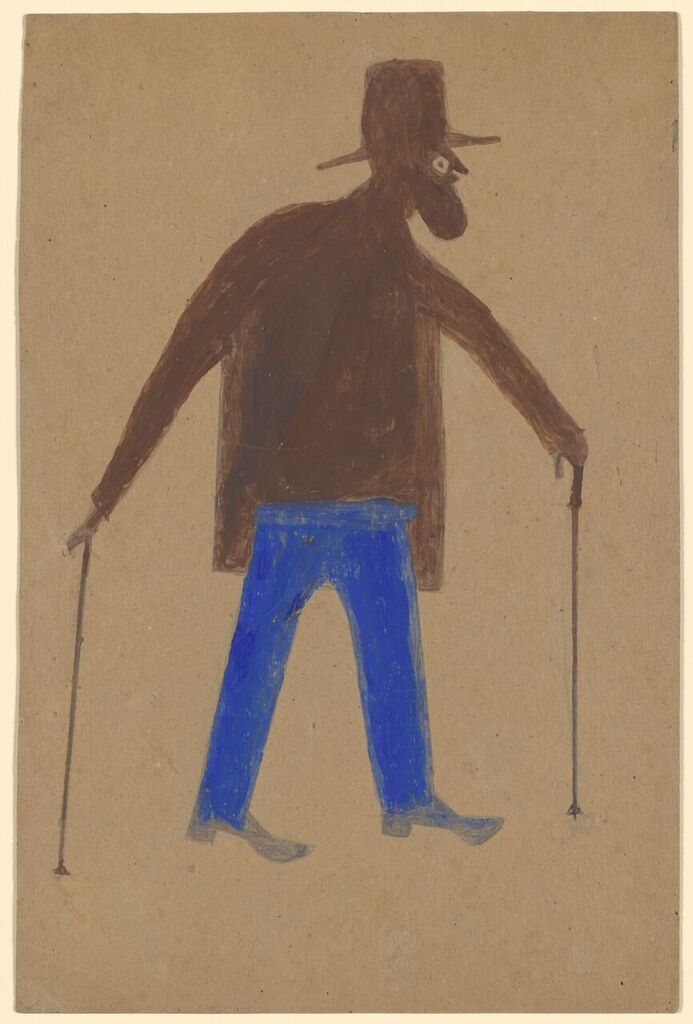
Bill Traylor, Self-Portrait, 1939–40

There is no doubt that Traylor included himself in the drama or human comedy that he sketched and painted. We see a frequent figure in these works, a fellow wearing a tall crowned hat and sometimes leaning on walking canes or crutches. That is Bill Traylor portraying himself.

The evidence of his more cryptic works, however, leads one to conclude that Traylor aimed to do much more than chronicle his life and times. Bill Traylor's "eyes were watching God" and doing so from a vantage point that stretched back to Africa. 


Bill Traylor, Leg Forms with Bird, ca. 1939-40

Let's consider Traylor's enigmatic Leg Forms with Bird.

Here we see two well-shod legs. Traylor was a shoe-repairman late in life and valued well-made boots and fashionable clothes. Yet here, the legs are moving in opposite directions and sprouting roots or trees. In the middle is a small bird at repose. Does this bird recall the sacred Sankofa from Ghana in West Africa? The Sankofa symbolized the act of looking to the past in order to search for knowledge useful for future life. 

Denied proper education and health care, African Americans carefully preserved traditional African folk remedies and wisdom literature, called by various names, conjure or hoodoo. These traditions fused with evangelical Christianity to create a support system and world view for African Americans independent of mainstream American life. Leg Forms with Bird testifies to this great truth.
 

Bill Traylor, Man with Yoke, ca.1939–40 

We can see in many of Traylor's works fascinating examples of the way that African spirituality negotiated its way into the consciousness of America. In Man with a Yoke, Traylor depicted a man wrestling with his conscience. It was a familiar theme, often seen in cartoons and advertisements. Traylor may have been influenced by these angel/devil on the shoulder pictures. A far more potent factor was a spiritual concept that had survived the terrible journey from Africa aboard the slave ships.

From West Africa came the potent ideal of the "little me within the big me." The "little me" was the immortal soul, tried and tested by adversity, able to "trabel" in ecstatic vision experiences to the gates of hell and back. What seems like a "good angel, naughty devil" caricature is in fact a powerful expression of the journey of the soul.

The more that one studies the art of Bill Traylor, the greater is the realization that he was not an "outsider" artist as he is often described. Traylor was firmly "inside" the African American cultural tradition. He was also a major spiritual figure and much of his art needs to be interpreted from a religious perspective.


Ed Voves Photo (2018), Bill Traylor's Black Jesus, ca. ca.1939–42

Traylor's profoundly moving Black Jesus is one one of the highlights of Between Worlds.  Given the heart-piercing power of this work, it defies the need for commentary. If any of Traylor's works speak plainly and without ambiguity, Black Jesus is it.

When it comes to the many works featuring animals and birds, interpretation is needed. In the case of the bird in Leg Forms with Bird, an educated guess can be made. This is true of Traylor's Rabbit, as well. Rabbits and hares figure prominently in West African folklore, as trickster figures. Small and vulnerable, the rabbit survives by his cunning and speed. He outwits the predator, living to have the last laugh.


Bill Traylor, Rabbit, ca. 1940-1942

The hare/rabbit trickster reappears in African American folk tales as the clever Br'er Rabbit, who "outfoxes" Br'er Fox. Interestingly, Native Americans of the southern states such as the Cherokee feature a trickster rabbit in their stories as well. Traylor's Rabbit, scrambling for its life, has a long - and distinguished - pedigree.


Bill Traylor, Figures and Construction with Cat, ca. 1939–40 

Other works, such as Figures and Construction with Cat, speak from a level of spirituality beyond our comprehension. Here a cat with a "thousand-yard stare" looks beyond a scene of mayhem, folly and cruelty. The cat sits in what appears to be a coffin, while behind him a crucifix is being "constructed." Perhaps in the fullness of time, Traylor's meaning will be discerned, but I am not the person to try.

"Food for thought" is plentiful in Between Worlds at the Smithsonian American Art Museum. Curator Leslie Umberger has spent over five years on this exhibition of Traylor's art. Wisely organized on a thematic plan, the abundant examples of Traylor's works she has selected are easier to grasp, even if the meaning of many is still elusive. 


Ed Voves Photo (2018), Gallery view of Between Worlds: the Art of Bill Traylor

Two standout features of the exhibition deserve to highlighted. Umberger, during her exhaustive research, found a short color film of Montgomery, Alabama, dated to 1940-41. A movie screen prominently displays this film, enabling us to see the very people and buildings that Traylor saw and sketched. Sadly, there is not a glimpse of the artist himself, but he is there in "spirit."  

No artist lives and works in a vacuum. Traylor was befriended by a young white artist named Charles Shannon, who supplied him with art supplies and collected his works. With a group of other progressive artists, Shannon organized an exhibit at the New South Gallery in Montgomery during 1940. A commemorative booklet with hand-lithographed prints was made for the exhibition and a rare surviving copy is on view in the Beyond Worlds galleries.


Ed Voves Photo (2018), Booklet from Bill Traylor's Exhibit at the New South Gallery

As you behold this singular work of art, the residual power of Traylor's amazing personality is very evident. Conjure, the special magic of African-American spirituality, is on view in that display case, along with the booklet. There is no need of further commentary here, just as I mentioned with Black Jesus.

Just look, just listen in the silence. The meaning of Traylor's art will soon be apparent. It will - to quote Traylor - "just come" to you.   

***
Text: Copyright of Ed Voves, all rights reserved 

Introductory Image:  
Bill Traylor (American, 1853/54–1949) House, ca. 1941. Watercolor and graphite on cardboard: 22 1/4 × 14 1/8 inches. Montgomery Museum of Fine Arts, Montgomery, Alabama, Gift of Charles and Eugenia Shannon, 1982.4.29

Bill Traylor  (American, 1853/54–1949)  Untitled (Radio), ca. 1940-1942. Opaque watercolor and pencil on printed advertising paperboard: 32 1/2 × 24 1/2 in. (82.6 × 62.2 cm) Smithsonian American Art Museum. Museum purchase through the Luisita L. and Franz H. Denghausen Endowment.Object Number 2016.14.4

Ed Voves, Photo (2018) Gallery view of Between Worlds: the Art of Bill Traylor, exhibition at the Smithsonian American Art Museum. Photo shows Bill Traylor's Man and Large Dog, ca. 1939-1942.

Bill Traylor (American 1853/54–1949) Black Smith Shop, ca. 1939–40. Pencil on cardboard:13 3/8 x 26 1/4 in. (34 x 66.7 cm) Metropolitan Museum of Art. Gift of Eugenia and Charles Shannon, 1995. Accession Number:1995.399  Image: © The Metropolitan Museum of Art, New York

Bill Traylor (American, 1853/54–1949) Self-Portrait,  ca. 1939–40.  Gouache and pencil on cardboard:  17 1/4 × 11 3/8 inches. Courtesy of The Metropolitan Museum of Art, Promised Gift of Charles E. and Eugenia C. Shannon. © The Metropolitan Museum of Art, New York

Bill Traylor (American, 1853/54–1949) Leg Forms with Bird, ca. 1939-1940. Charcoal on cardboard: 13 × 7 1/2 inches. Private Collection.

Ed Voves, Photo (2018) Bill Traylor's Black Jesus, ca. 1939–40. Gouache and pencil on cardboard: 13 3/4 inches × 10 inches. Courtesy of The Metropolitan Museum of Art, Promised Gift of Charles E. and Eugenia C. Shannon

Bill Traylor (American, 1853/54–1949) Rabbit, ca. 1940-1942. Watercolor and graphite on cardboard: 8 3/8 × 11 1/8 inches. Montgomery Museum of Fine Arts, Montgomery, Alabama, Gift of Charles and Eugenia Shannon, 1982.4.10.

Bill Traylor (American, 1853/54–1949) Figures and Construction with Cat: ca. 1939–40    gouache and pencil on cardboard:   13 7/8 × 9 1/8 inches. Courtesy of The Metropolitan Museum of Art, Promised Gift of Charles E. and Eugenia C. Shannon. © The Metropolitan Museum of Art, New York   

Ed Voves, Photo (2018) Gallery view of Between Worlds: the Art of Bill Traylor, exhibition at the Smithsonian American Art Museum.     

Ed Voves, Photo (2018) Booklet from Bill Traylor's Exhibit at the New South Gallery, Montgomery, Alabama, 1940. On view in the  Between Worlds: the Art of Bill Traylor exhibition at the Smithsonian American Art Museum.