Saturday, March 25, 2023

Art Eyewitness Review: Lives of the Gods: Divinity in Maya Art


Lives of the Gods: Divinity in Maya Art

Metropolitan Museum of Art, Nov. 2022 - April 2, 2023

Kimbell Art Museum, Fort Worth TX, May 7 - Sept. 3, 2023

Reviewed by Ed Voves

Original photography by Anne Lloyd

To compare ancient peoples, separated by thousands of miles and hundreds of years, is always problematical. The danger of emphasizing superficial resemblances between two cultures can easily lead to dubious or untenable conclusions.

Despite this risk, I think that the astonishing Mayan kingdoms of southern Mexico and Central America rank with the ancient Greeks as the most dynamic cultures of their respective regions. What the Greeks were to the lands bordering the Mediterranean Sea, the Maya equaled in their influence on the Mesoamerican world.

After visiting the Lives of the Gods: Divinity in Maya Art exhibition, now in its final weeks at the Metropolitan Museum, one is struck by the singular nature of Mayan civilization. The parallels with Greece, however, are certainly interesting. The small Mayan kingdoms, like the Greek city-states, never formed a united coalition or empire. But that can be said of other native peoples of the Americas as well, like the Moche of Peru.


Anne Lloyd, Photo (2022)
 Gallery view of the Lives of the Gods Art exhibit,
 showing Column, from Campeche, Mexico, c. 800-900

The fundamental influence of religion on both the Maya and the Greeks is what really counts in comparing the two cultures. As the subtitle of the Met's exhibition, Divinity in Maya Art, affirms, religion was fundamental to the Mayan peoples.

Lives of the Gods: Divinity in Maya Art is a superb exhibition, very much in the grand tradition of the Met. Inevitably, it will be compared with the 2018 Golden Kingdoms exhibit which presented 200 treasures, notably exquisite gold jewelry, of the Aztecs, Incas and Mayas. There is little glitter in the 100 works of art on view in Lives of the Gods, but visitors should not be disappointed. The Maya regarded jade as far more valuable than gold and they honored their gods with a another precious substance which cannot be put on view in a modern art museum: blood.


Anne Lloyd, Photo (2022)
 Maya jade pendants, 7th-9th century

Mayan gods were powerful, capricious beings, willful and cruel like Zeus and company. But they were different, too. Mayan gods, especially the youthful and much-loved Maize God, could perish and be reborn. 


Anne Lloyd, Photo (2022 )
 Gallery view of Lives of the Gods, showing Maize God, from Copan, 715

The gallery devoted to images of the Maize God is centered on a sensational limestone carving from Copan in Honduras. The exhibition text, expressed in almost poetical terms, deserves quotation here because it demonstrates the emotional appeal of certain aspects of Mayan religion:

The Maize God is an eternally youthful being who endures trials and overcomes the forces of death. Maya artists portrayed him as a graceful young man with glossy skin and a sloping forehead, his elongated head resembling a maize cob crowned with silky, long locks of hair... Formally appealing and conceptually rich, the Maize God’s transit through death and his subsequent rebirth were metaphors for regeneration and resilience.

Not all of Mayan cosmology touched the hearts of the people with the reassuring symbolism of the Maize God. Religion for the Maya was an awe-inspiring, often terrifying system of belief.


Anne Lloyd, Photo (2022)
 Censer Stand, from Palenque, Mexico, c. 690–720
 
Among the first images to greet visitors to Lives of the Gods are fearsome-looking censer stands, on the top of which were placed vessels of smoldering incense. Often these censers bore the image of jaguar gods, incarnations of nocturnal menace. Jaguars, stealthy predators lurking in the jungles surrounding the Mayan cities, were an obvious choice to symbolize divine wrath.


Anne Lloyd, Photo (2022)
 Jaguar God Censer Stand, from Palenque, 7th–8th century

The terrifying aspect of statues and paintings of the Mayan gods was emulated by the kings or ajaws of Mayan states like Palenque or Tikal. This wasn't just "dress-up" on the part of Mayan rulers like the formidable King Jaguar Bird Tapir of Tonina in southern Mexico. The rulers of Mayan kingdoms assumed the personality of gods for important ceremonial and religious functions.


Anne Lloyd, Photo (2022)
 King Jaguar Bird Tapir, from Tonina, Mexico, early 7th century
 
For all of the "divine-right" authority with which Jaguar Bird Tapir and his peers were invested, being a Mayan monarch was no easy task. And of all the royal burdens of state, none was more significant than keeping the gods "happy."

Due to the challenging natural environment of the Mayan world, which the Met exhibition evokes with brilliant video and sound clips, the gods of the Maya needed to be constantly placated.


Anne Lloyd, Photo (2022)
 Gallery view of the Lives of the Gods exhibit,
 showing video of Tikal and El Mirador, filmed by Ricky Lopez Bruni

The Mayas - like their northern rivals in the great city of Teotihuacan in central Mexico, lived in danger of frequent droughts, the annual hurricane season, periodic earthquakes and the occasional volcanic eruption. These disasters involved the anger of deities like Chahk, the god of rain and storms, or K’awiil, the celestial lord of lightning. These heavenly overlords lashed out when provoked by human failure to pay them due homage.

To keep the gods pleased required rich gifts, chiefly of human blood. This sacrificial bloodletting is not pleasant to consider but it is necessary given the role it played in Mayan religion.

Blood sacrifice among the Maya came in two forms. The first involved the ritual execution of captives, an almost universal practice by the peoples of Mesoamerica. We will address this briefly later in the essay.

The other form involved shedding one's own blood, an act largely reserved for the Mayan kings, queens and nobility at moments of high importance, such as transition points on the calendar cycle or the opening of a military campaign. This act of personal mutilation was known as ch'ahb' meaning "penance" and was often inflicted by stabbing with a stingray spine.


Anne Lloyd, Photo (2022) 
Lady K'abal Xook Conjuring a Supernatural Warrior, Yaxchilan, Mexico, 725

One of the key works of art in the exhibition is a carved limestone lintel which depicts such an act of blood sacrifice. It is entitled Lady K'abal Xook Conjuring the Spirit of a Warrior. Lady K’abal Xook, was the wife of Shield Jaguar III, king of Yaxchilan, located on the border of Chiapas, southern Mexico, and Guatemala.


In this work from the British Museum collection, Lady K'abal Xook has pieced her tongue and is bleeding into a bowl containing pieces of cloth. These, most likely made of cotton fabric, will absorb the blood and then be burned as an offering. Weakened by bleeding and related rituals such as fasting, Lady K’abal Xook will be enabled to enter into a trance state and commune with the other world.


This is exactly what is depicted in the detail above. A spirit warrior, armed with shield and spear, emerges from a giant serpent's mouth, in order to converse with Lady K'abal Xook. The scene most likely refers to preparations for war, as her husband's kingdom, Yaxchilan, was one of the most aggressive Mayan states.

The impressive carving of Lady K'abal Xook and the spirit warrior bears a few faint traces of the vivid colors with which it was painted when created around the year 725. Whatever guidance she received in her vision ultimately failed to help Lady K'abal Xook's homeland. The population of Yaxchilan, worn-down by constant warfare and drought, abandoned the city a century later, during the widespread collapse of the Classical Mayan kingdoms.


Anne Lloyd, Photo (2022) 
Gallery view of the Lives of the Gods exhibit,
 showing Throne Back, from Mexico or Guatemala, 7th-9th century

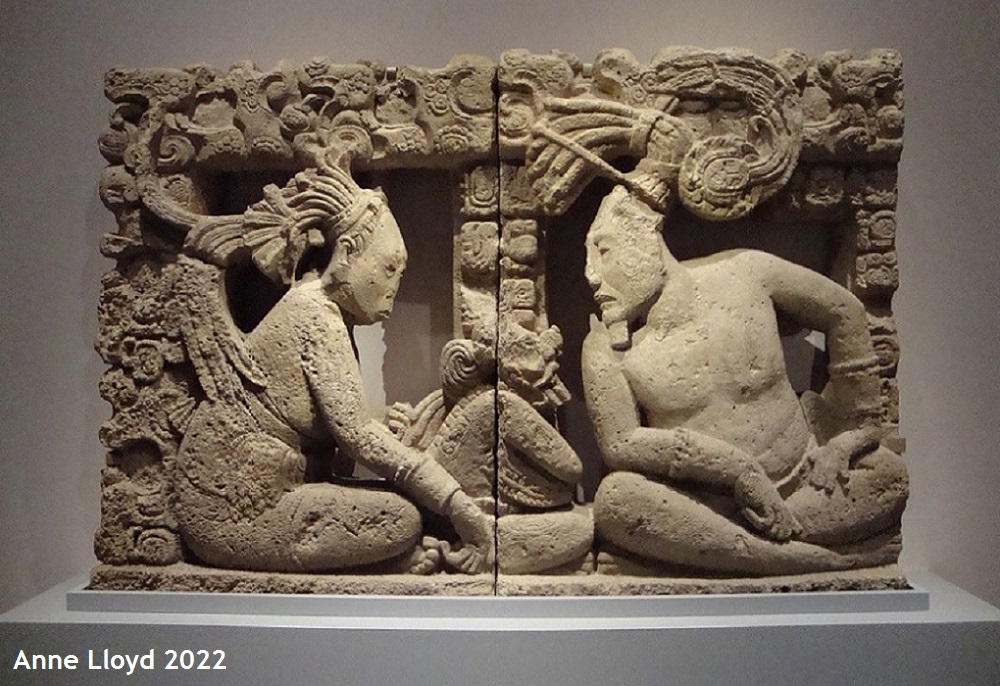
A very different visit by a celestial being was carved into the upright back panel of a throne  (above). It was discovered in Guatemala, at a site on the Usumacinta River not far from Yaxchilan. The date of its creation is unknown, but is projected as occurring between the seventh and ninth centuries. I don't profess to being an expert in Mayan art, but I suspect that this wondrous work of art (my favorite in the exhibition) was created in the earlier range of these dates.

This carved backrest to a throne shows a Mayan king (at right) conversing with a small, supernatural visitor (center). This unearthly creature has the face of a jaguar deity and wings. His upward gaze meets that of the Mayan ajaw. It is truly a meeting of two worlds.
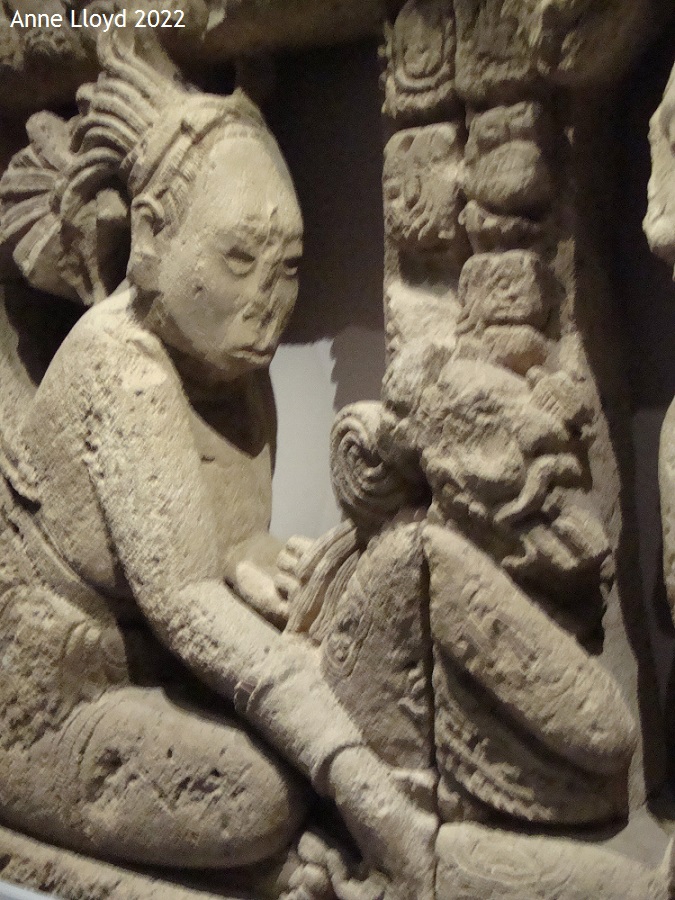


Details of Throne Back, 7th-9th century

Oddly enough, the face of the jaguar deity resembles that of a shipwrecked Spanish sailor, though centuries before Columbus. Behind him, a royal attendant takes in the interview, perhaps mystified, as we are, at what is going on.

What message does the jaguar deity impart to the intently-listening king? Of course, we cannot know. But experts in Mayan art and religion locate the scene to a cave, sacred places to the Maya. Whatever communication is being given, it is certainly of importance. 

What impresses me with this magnificent carving is the tone of a style and presentation. It is free of the frightful imagery which we see on carvings from the eighth and ninth centuries when the Mayan kingdoms were in their death spiral. That is why I surmise that it should be dated earlier, before the fatal steps to the dissolution of the Classical Mayan age had been taken.

Indeed, Mayan art of the earlier periods, (proto-Classical and early Classical, third-fifth centuries) often demonstrates humane values and a sense of humor. There are quite a few examples of early Mayan art on view in Lives of the Gods, making this part of the exhibition a very enjoyable and compelling trip back in time.


Anne Lloyd, Photo (2022) Whistling Vessel, 5th century

Displayed close to the Throne Back carving is a whistling device showing another mythical scene. Activated by being filled with water, the ceramic vessel mounts a vignette showing  a trickster tale. A fearsome bird deity confronts a kneeling human being, unaware of a cat climbing-up the side of the vessel, ready to pounce.

Other ceramic masterworks on view comprise a group of lidded vessels for feast days, topped with animal knobs or handles. Howler monkeys, a peccary and a turtle with a grinning man's head emerging from its mouth attest to the Maya kinship with the animal realm and a generous helping of fun. It's hard to resist a smile when looking at these wonderful examples of Mayan pottery.


Anne Lloyd, Photo (2022) Lidded vessel with Peccary Handle, 4th century


Anne Lloyd, Photo (2022)
 Lidded Vessel with Mythological Turtle, 4th century

As the timeline of Lives of the Gods reaches the eighth and ninth centuries, the  Mayan success story began to turn to ashes. The complex turn of event, drought, soaring population, hardening class distinctions are still being studied by historians. One thing can be certain, during the 700's, the time of Lady K’abal Xook's vision quest, warfare in the Mayan world escalated from low-intensity raids to secure a few captives for sacrifice to rampaging campaigns of wholesale destruction.


Anne Lloyd, Photo (2022)
 Gallery view of Lives of the Gods, showing statues of captive warriors

The terrible eclipse of Classical Mayan civilization is evoked in the carved images of bound prisoners awaiting execution. As part of his humiliation, a captive warrior named Yak Ahk' has been dressed as a jaguar deity, who had been tortured and killed in a tale from Mayan myth. 


Anne Lloyd, Photo (2023)  
Yak Ahk' as Captive, Impersonating a Jaguar Deity, c. 700

The precise chronology of the Maya wars is still incomplete and likely to remain so. Looking at this one carving is quite sufficient, however, to illustrate the suicide of the Classical Maya kingdoms. The image of Yak Ahk's suffering recalls the haunting 1971 photo of a young Vietnamese girl, Phan Thi Kim Phuc, set aflame by napalm. One picture tells us all we need to know.

The Mayan people proved able to survive the apocalypse of the Classical kingdoms. After the great cities were abandoned, by the year 900, Mayan life reconfigured on a localized, village basis. This decentralized community structure produced less in the way of great art, but enabled the Maya to survive the Spanish invasions of the 1500's and the epidemic diseases which followed in the footsteps of the Conquistadors.

The Met exhibit pays tribute to contemporary Maya life with a colorful video clip of a modern day festival. Dance of the Macaws in the Santa Cruz Verapaz, Guatemala, was filmed by Ricky Lopez Bruni. Dance of the Macaws exudes the life and spirit of the Maya, filling the exhibition gallery with incandescent light - and a palpable feeling of life!


Anne Lloyd, Photo (2022) 
Gallery View of the Lives of the Gods exhibit, showing
 Dance of the Macaws, filmed by Ricky Lopez Bruni

The survival of the Maya over the ages and their still-flourishing folk-culture is as remarkable a phenomenon as the pyramids, statues and paintings their ancestors created over twelve hundred years ago.

Happily, Lives of the Gods: Divinity in Mayan Art will be traveling to the Kimbell Art Museum, Fort Worth, Texas,  after it closes at The Met. This year marks the 50th anniversary of the Kimbell Museum and I can't conceive of better company for this celebration than the Maya, ancient and modern.

 ***

Text: Copyright of Ed Voves, all rights reserved                                                      

Original photography, copyright of Anne Lloyd

Introductory Image: Anne Lloyd, Photo (2022) Maize God, 715, from the British Museum. Details below.

Anne Lloyd, Photo (2022) Gallery view of the Lives of the Gods: Divinity in Maya Art exhibit, showing Column, from Campeche, Mexico, c. 800-900. Limestone: H. 68 3/4 x 29 in. Metropolitan Museum of Art. 

Anne Lloyd, Photo (2022) Gallery view of the Lives of the Gods exhibit, showing Maya jade pendants, 7th-9th century. Collection of the Metropolitan Museum of Art. 

Anne Lloyd, Photo (2022 ) Gallery view of the Lives of the Gods exhibit, showing Maize God, from Copan, Honduras, 715. Limestone: H. 35 1/16 x W. 22 1/4 in. x D. 11 13/16 in. 264.6  lbs. British Museum.

Anne Lloyd, Photo (2022 ) Censer Stand, from Palenque, Mexico, c. 690–720. Ceramic, traces of pigments: H. 44 × W. 22 × D. 12 1/4 in.,103 lb. (111.8 × 55.9 × 31.1 cm, 46.7 kg) Kimbell Art Museum, Fort Worth, TX

Anne Lloyd, Photo (2022 ) Jaguar God Censer Stand, from Palenque, Mexico, 7th–8th century. Ceramic: H. 26 × W. 14 9/16 × D. 6 5/16 in., 132.3 lb. (66 × 37 × 16 cm, 60 kg) Museo de Sitio de Palenque Alberto Ruz

Anne Lloyd, Photo (2022 ) King Jaguar Bird Tapir, from Tonina in Chiapas, Mexico, early 7th century. Limestone: 8 ft 5 9/16 in. x 28 3/4 in. x 20 1/16 in. 881.8 lb. Museo de Sitio de Tonina, Mexico.

Anne Lloyd, Photo (2022 ) Gallery view of the Lives of the Gods exhibit, showing video of Tikal and El Mirador, Guatemala, filmed by Ricky Lopez Bruni.

Anne Lloyd, Photo (2022) Lady K'abal Xook Conjuring a Supernatural Warrior, Yaxchilan, Mexico, 725. Limestone: H. 47 5/8 × W. 33 11/16 × D. 5 5/16 in., 509.3 lb. (121 × 85.5 × 13.5 cm, 231 kg) British Museum.

Anne Lloyd, Photo (2022) Detail views of Lady K'abal Xook Conjuring a Supernatural Warrior.

Anne Lloyd, Photo (2022) Gallery view of the Lives of the Gods exhibit, showing Throne Back, from Mexico or Guatemala, 7th-9th century. Limestone: H. 43 11/16 x W. 65 3/8 x D. 9 1/4 in. 937 lb. Museo Amparo Collection, Puebla, Mexico

Anne Lloyd, Photo (2022) Detail views of Throne Back (See above). 

Anne Lloyd, Photo (2022) Whistling Vessel, from Guatemala or Mexico, 5th century. Ceramic: H. 11 7/8 x W.  7 3/4 x D. 5 1/4 in. Metropolitan Museum of Art

Anne Lloyd, Photo (2022) Lidded vessel with Peccary Handle, from Guatemala, 4th century. Ceramic: H. 10 5/8 x Diam. 12 5/8 inches. Museo de Nacional Arqueologia & Ethologia, Guatemala.

Anne Lloyd, Photo (2022) Lidded Vessel with Mythological Turtle, 4th century. Ceramic: H. 9 5/8 x Diam. 10 7/16 inches. Museo de Nacional Arqueologia & Ethnologia, Guatemala.                                                                                                                                                                                                             Anne Lloyd, Photo (2022) Gallery view of the Lives of the Gods exhibit, showing statues of captive warriors, Yak Ahk' (left) and Muwaan Bahlam,     

Anne Lloyd, Photo (2023)  Yak Ahk' as Captive, Impersonating a Jaguar Deity, c. 700. Sandstone: H. 22 7/16 x W. 18 1/8 x D. 4 5/16 in. 176.4 lb. Museo de Sitio de Tonina, Mexico.

Anne Lloyd, Photo (2022) Gallery view of the Lives of the Gods exhibit, showing video clip of Dance of the Macaws. Filmed by Ricky Lopez Bruni. 


Thursday, March 16, 2023

Art Eyewitness Review: Black Founders, the Forten Family of Philadelphia


Black Founders, the Forten Family of Philadelphia 

The Museum of the American Revolution

February 11, 2023 - November 26, 2023

Reviewed by Ed Voves

Bethel African Methodist Episcopal (A.M.E.) Church is one of the most historic buildings in Philadelphia – and the United States. Founded in 1794, Mother Bethel, as the church is popularly known, was the site of a crucial meeting in early U.S. history. Three thousand African American men assembled there on January 15, 1817 to discuss a proposal for emigration to a site in West Africa where a colony, free of racial discrimination, would be founded.

To the surprise of the clergymen and civic leaders who had convened the meeting, the proposal was emphatically rejected. Virtually without dissent, the answer shouted from the church pews was a ‘tremendous no.”


Ed  Voves, Photo (2023)
Nathan Alford Tate, who portrays James Forten at the Museum of the American Revolution, posing with a pew from Mother Bethel Church. 

Many of the three thousand African-Americans crowding into Mother Bethel were native-born and a number had fought in the Revolutionary War. The United States was their country, their home. They would not leave their land. 

One of the most prominent participants at the Mother Bethel meeting was a Revolutionary War hero named James Forten. The Museum of the American Revolution, located in Philadelphia, has recently opened a special exhibition entitled Black Founders, devoted to James Forten and his extraordinary family. 

James Forten (1766-1842) was born in Philadelphia, a member of the city’s free Black population. As a young boy, he heard the Declaration of Independence proclaimed on July 8, 1776. After witnessing a regiment of African-American and Native-American troops of George Washington’s army march en route to the siege of Yorktown in 1781, the young Forten determined to join the Patriot cause. 


Ed  Voves, Photo (2023)
Gallery view of the Black Founders exhibition, showing
 Don Troiani's painting, Brave Men as Ever Fought, 2020

This moment is celebrated by a painting by Don Troiani, whose accurate depictions of the American Revolution were featured in an earlier Art Eyewitness review.


Ed  Voves, Photo (2023)
A ship model for a prototype vessel for the Continental Navy, made in 1777 by Joshua Humphreys of Philadelphia.

Forten enlisted in the American navy. The ship he served on, the Royal Louis, was captured by the British and Forten endured a harsh captivity on a prison ship moored in New York Harbor. And that was just the beginning of his extraordinary life story!

After the Revolution, Forten worked his way to owning a maritime supply company making sails and rope for the merchant ships based in Philadelphia. A partial reconstruction of Forten's sail loft is the centerpiece of the exhibition at the Museum of the American Revolution.


Ed  Voves, Photo (2023)
Gallery view of the Black Founders exhibition, showing a recreated sail loft similar to James Forten's. 

Following this business success, Forten dedicated himself to the struggle to end slavery in the U.S.  In 1813, Forten wrote a  pamphlet, Letters from a Man of Colour, which powerfully argued the case for emancipation and opposed measures of discrimination against free African Americans which were being implemented in Northern states, including Pennsylvania. 

As well as documenting Forten’s life, the exhibition extends his family’s story to the Civil War era of the 1860’s. Forten's wife, children and grand daughter, Charlotte Forten Grimke (1837-1914), who compiled an important diary of the Civil War years, were ardent activists in the anti-slavery cause. 


Ed  Voves, Photo (2023)
A portrait photo of Charlotte Forten Grimke

Along with the rise of the Abolitionist movement in the U.S., the exhibition also surveys social life, entrepreneurship and “self-reliance” in the African-American community during the early Republic era.

History is often a frustratingly complex subject. One would think that the life of a patriot like James Forten and the anti-slavery cause might evade some of the moral entanglements which feature in other historical incidents.  However, James Forten was actually one of the leaders who initially favored the African colonization scheme. He was the presiding officer at the Mother Bethel meeting and one of the recipients of the ‘tremendous no.”

The Mother Bethel meeting was a lesson in democracy. Forten and fellow African American leaders were amazed by the unanimous decision of "rank-and-file" citizens not to relinquish their birthright of liberty for a "promise" of greater prosperity elsewhere. And it is to Forten's credit that he listened and followed their lead.

With renewed determination, Forten joined in the resistance to the colonization scheme. Years later, he wrote with quiet conviction, "We are contented in the land that gave us birth and which many of us fought for during the war which established our Independence."

The topics covered so brilliantly in the Black Founders exhibit are, for the most part, political and social ones. However, a number of the artifacts on view provide insight into the visual art scene in the U.S. during the first decades of the nineteenth century. This was a time of considerable difficulty as many promising American artists went to Europe and remained there, sometimes for life. Little of what we might now deem as “fine” art was created, though there were some tentative efforts in landscape painting. Art related to the lives of African Americans was extremely rare.


Attributed to John Rose (1752/53-1820)
Music and Dance in Beaufort County, S.C.
from the collection of the Colonial Williamsburg Foundation

Despite these unpromising conditions, a vigorous, “homespun” art began to develop in the United States during the early 1800’s. Thus, the exhibition objects on view in Black Founders are hugely important. These artifacts document the African American experience and the efforts of American artists to gain recognition on their home turf. 

The most significant feature of the Black Founders exhibit is its demonstration of how "material culture", treasured personal items or the objects of daily life, relates to high-sounding concepts. One can recite "Life, Liberty and the Pursuit of Happiness" but the sight of a family Bible or a regimental battle flag supplies a tangible reality to these noble words.


Ed  Voves, Photo (2023)
Holy Bible, printed in 1838, owned by the Forten Family  


Ed  Voves, Photo (2023)
Detail of the Regimental flag of the 127th U.S. Colored Troops 

The signature work of the exhibition is an impressive portrait in profile of an African-American gentleman. It is on loan from the collection of the Historical Society of Pennsylvania. Dating to around the time of the Mother Bethel meeting, it has long be regarded as a portrait of James Forten. However, it lacks any formal title and is not signed on the back of the canvas. 


Artist unknown, Presumed Portrait of James Forten, c. 1820

Is it James Forten? We know that Forten’s wife treasured a portrait of him after he died in 1842. Charlotte Vandine Forten lived until 1884, so that there was no need to identify the painting on her behalf. By the time the portrait reached the Historical Society of Pennsylvania, its reputation as being a likeness of Forten was secure.

That is far from the kind of exacting detail required by art historians. The curators of the Black Founders exhibit are quite forthright about the lack of positive documentation. Two other works, one of them an early photo, are also considered. Judging from the evidence, neither of these is likely to portray Forten.

From a purely artistic point of view, the profile portrait is a professional caliber, though second-rank, painting. It is exactly the kind of work that an affluent, “self-made” man like Forten would have favored. A fair likeness and a good investment! 

This is also the type of portrait, typical of American painters working in the domestic market during the early 1800's. These "limners", often unknown today and under-appreciated, laid the foundation for subsequent American art. 

With other works of art on view in Black Founders, we are on firmer ground when it comes to proof and provenance. Thanks to the generosity of descendants of James Forten, a table from the Forten home, the Forten family Bible and needlepoint "samplers" by his daughters, Mary and Margaretta, are on view in the exhibition.


Ed  Voves, Photo (2023)
Gallery view of the Black Founders exhibition, showing
 a table owned by James Forten, made in Phila., c. 1790-1805


Margaretta Forten Sampler, Collection of Marcus & Lorri Huey

Such examples of the "material culture" of social life in the early Republic are priceless. These works underscore the identification of African American citizens like James Forten with American culture and the democratic values of the nation.


Ed  Voves, Photo (2023)
Silver Urn presented to Capt. Isaac Hull, 
commander of USS Constitution, 1812

James Forten was a seafaring man and a business executive involved with maritime trade. When the news of the naval victory of the USS Constitution over the British warship Guerriere during the War of 1812 reached Philadelphia, Forten subscribed to a fund to present a silver urn honoring Captain Isaac Hull, the commander of "Old Ironsides".

Along with the Civil War battle flag of the 127th U.S. Colored Troops (shown above), this silver urn reinforces and reminds us of the patriotism of James Forten and African American heroes like him. The Museum of the American Revolution is devoted to such noble sentiments. But there is much more involved here than merely placing relics of the past in glass cases.

In an impressive initiative, the curators of the Museum of the American Revolution are teaming with Ancestry® to make available an archive of 200 documents relating to African American and Native American soldiers who served during the Revolutionary War. These primary sources of historical record - muster rolls, pay vouchers, enlistment papers, and discharge forms - will soon be available for online searching, free of charge.


Ed Voves Photo (2023)
Detail of Don Troiani's, Brave Men as Ever Fought, 
showing the young James Forten in 1781

James Forten was born ten years before the Declaration of Independence and died twenty years before the Emancipation Proclamation. His life -and the superb exhibition at the Museum of the American Revolution - bring to mind the memorable words of John Adams in 1818. 

Long before the first shots at the battles of Lexington and Concord, "the radical change in the principles, opinions, sentiments and affections of the people" had already occurred. This, Adams wrote, "was the real American Revolution." 

One of the hearts where this "real American Revolution" took place was James Forten's.

***
Text: Copyright of Ed Voves, all rights reserved                                                                                           
Introductory image:
Ed Voves, Photo (2023) The logo and signature image of the Black Founders, the Forten Family of Philadelphia exhibition at the Museum of the American Revolution.

Ed Voves, Photo (2023) Nathan Alford Tate, who portrays James Forten at the Museum of the American Revolution. A pew from  Mother Bethel A.M.E. Church is shown in this gallery view of the Black Founders exhibition.

Ed Voves, Photo (2023) Gallery view of the Black Founders exhibition, showing Don Troiani's painting, Brave Men as Ever Fought, 2020 (collection of the Museum of the American Revolution).

Ed Voves, Photo (2023) A ship model for a prototype vessel for the Continental Navy, made by Joshua Humphreys of Philadelphia, 1777. Independence National Historical Park Collection, Philadelphia, PA.

Ed Voves, Photo (2023) Gallery view of the Black Founders exhibition, showing a recreated sail loft similar to James Forten's. 

Ed Voves, Photo (2023) A portrait photo of Charlotte Forten Grimke. Collection of the New York Public Library.

Attributed to John Rose (1752/53-1820) Music and Dance in Beaufort County, c. 1785. Watercolor on laid paper: 11 11/16 in. x 17 7/8 in. The collection of the Colonial Williamsburg Foundation. Gift of Abby Aldrich Rockefeller. #1935 301.3 A&B

Ed Voves, Photo (2023) Holy Bible, printed in 1838, owned by the Forten Family. Collection of Atwood "Kip" Forten Jacobs.

Ed Voves, Photo (2023) Detail of the Regimental flag of the 127th U.S. Colored Troops. Collection of the Kenan Research Center at the Atlanta Historical Center.

Artist unknown (Perhaps Robert Douglass Jr.) Presumed Portrait of James Forten, c. 1820. Oil on paper. Leon Gardner collection, Historical Society of Pennsylvania. #0008.

Ed Voves, Photo (2023) Gallery view of the Black Founders  exhibition, showing  a table owned by James Forten, made in Philadelphia, c, 1790-1805. Collection of Marcus & Lorri Huey,

Margaretta Forten Sampler, Collection of Marcus & Lorri Huey. Image courtesy of Marcus & Lorri Huey and Museum of the American Revolution.

Ed Voves, Photo (2023) Silver Urn presented to Capt. Isaac Hull, commander of USS Constitution, 1812. Created by Thomas Fetcher and Sidney Gardner, Philadelphia silversmiths. Sterling silver: 29.5 in. (height) x 22 in. (width) x 12 in. (depth). Private collection, on loan to USS Constitution Museum.

Ed Voves Photo (2023) Detail of Don Troiani's, Brave Men as Ever Fought (2020), showing the young James Forten in 1781.

Sunday, February 19, 2023

Art Eyewitness Review: She Who Wrote: Enheduanna at the Morgan Library


She Who Wrote:
 Enheduanna & Women of Mesopotamia, ca. 3400-2000 BC

Morgan Library & Museum
October 2022 - February 19, 2023

Reviewed by Ed Voves

Over the years, the Morgan Library and Museum has mounted a number of outstanding exhibitions highlighting the brilliant achievements of women writers and artists.

Here are just a few of these Morgan presentations that spring to mind: A Woman's Wit: Jane Austin's Life and Legacy (2009-2010); I'm Nobody! Who are You? the Life and Poetry of Emily Dickinson (2017); and one of my "top ten" exhibits, Charlotte Bronte: an Independent Will (2016-2017).

During 2020-2021, many centennial events were planned by museums in tribute to the 19th Amendment giving American women the right to vote. It was only to be expected that the curators at the Morgan would mount an exhibition to celebrate a notable woman or a theme related to women's history - and indeed they did have one scheduled for the autumn of 2021. Their choice of topic was brilliant, if unusual: the story of Enheduanna, history's first writer.


Ed  Voves, Photo (2022)
 Entrance to She Who Wrote: Enheduanna and Women of Mesopotamia, at the Morgan Library & Museum

Let us underscore this fact, Enheduanna, a noble woman from ancient Mesopotamia, was the first author, male or female, to be recorded in the annals of civilization. 

Events - in the shape of the Covid-19 pandemic - interfered with the Morgan's exhibition. Entitled She Who Wrote: Enheduanna and Women of Mesopotamia, ca. 3400-2000 BC, it was delayed until October 2022. The  exhibit, now in its final days, is a splendid one, but Enhedeuanna's long wait for recognition is actually a very long story and a rather complicated one.


Ed  Voves, Photo (2022) Gallery view of
 She Who Wrote: Enheduanna and Women of Mesopotamia

Enheduanna was the daughter of Sargon of Akkad, the conquering warlord who united the city states of Mesopotamia into what many regard as history's first empire. 


Ed  Voves, Photo (2022) Enheduanna's Name in Cuneiform 

Enheduanna, whose name means "high priestess, ornament of heaven," lived around 2300 BC. She was a politically powerful figure during her lifetime and remained influential through her writings for many centuries afterward.


Ed  Voves, Photo (2022)
 The Disk of Enheduanna, 2300 BC

Eventually, Enheduanna faded into the dust of the past. Then, in 1927, a  circular stone object was uncovered in an archaeological "dig" in present day Iraq. Measuring 10 1/8 inches (25 cm) in diameter and 2 3/4 inches (7 cm) thick, the alabaster Disk of Enheduanna had been smashed into fragments thousands of years ago. But once it was pieced together, it portrayed Enheduanna, in a profile view, showing her as a priestess engaged in a religious ritual.  

A cuneiform tablet, created at a later date in antiquity, displayed a poem written by Enheduanna, The Exaltation of Inanna.


Ed  Voves, Photo (2022)
 Tablet inscribed with The Exaltation of Inanna

These archaeological finds are immensely important, proving that Enheduanna was a major writer, many centuries before Homer or Herodotus. Yet, it has taken decades since these discoveries for her status and literary stature to be fully recognized.

The announcement of firm, archaeological evidence of the first author in history should have been a "stop the presses" event. Had the identity been that of an already well-known figure like Sargon or a person in some way related to the Holy Bible, the event would have almost certainly received greater publicity. 

As a woman, virtually unknown to history, Enheduanna had one strike - a big one - against her. Two more strikes made it even more difficult for her to get the credit she deserves. 

In 1922, the discovery of the tomb of King Tutankamun raised the bar of ancient celebrity status to a very high degree. And then, in the same year that the Disk of Enheduanna was unearthed, another dramatic discovery was made, this time at Ur, Enheduanna's own "backyard." This revelation all but consigned her to the footnotes of the annual archaeological reports of field work in Mesopotamia. 


Ed Voves, Photo (2022) Queen Puabi’s Funerary Ensemble

In 1927, Leonard Woolley, the same archaeologist who found the battered pieces of the Disk of Enheduanna, excavated the tomb of Queen Puabi, filled with exquisite treasures including her glittering headdress, ear rings and necklaces, believed by some art lovers to be the most beautiful royal regalia in all of history. 


Ed  Voves, Photo (2022) Gallery view of the Enheduanna exhibition  showing Queen Puabi’s Funerary Ensemble

One of the major incentives in visiting the Morgan exhibition is the impressive display of Puabi's "crown" or headdress, on loan from the University of Pennsylvania Museum. In a sense, Puabi is upstaging Enheduanna again, as the breathtakingly beautiful ensemble of gold jewelry and precious stone beads dominates much of the exhibition gallery. But thanks to the Morgan's curator, Sidney Babcock, Enheduanna eventually asserts her own royal presence.


Ed  Voves, Photo (2022)
 Curator Sidney Babcock, with The Disk of Enheduanna

Throughout much of in the twentieth century, Enheduanna languished in the shadows of the fine print of scholarly journals. Then in 1968, a very detailed study of Enheduanna's poem, The Exaltatation of Inanna, was made by a noted scholar, William Hallo, assisted by J.J.A. van Dijk. Hallo's book is the kind of academic work almost never read by the public, but it established beyond doubt that Enheduanna was one ot the pioneers of world literature:

...at or near the beginning of classical Sumerian literature, we can now discern a corpus of poetry of the very first rank which not only reveals its author's name, but delineates the author for us in truly autobiographical fashion. In the person of Enheduanna, we are confronted by a woman who was at once princess, priestess and poetess, a personality who set the standards in all of her roles for many succeeding centuries, and whose merits were recognized, in singular Mesopotamian fashion, long after.

This is precisely what the Morgan exhibition asserts, so memorably and cogently, with a trove of treasures related to Enheduanna and the women of Mesopotamia.


Ed  Voves, Photo (2022) Gallery view of
 She Who Wrote: Enheduanna and Women of Mesopotamia

Queen Puabi lived around 2500 BC, approximately two centuries before Enheduanna. Both women resided in the city of Ur and were Akkadians, that is members of the Semitic-speaking nobility, rather than the indigenous Sumerians, who had been subjected to Akkadian rule. Although the focus of the Morgan's exhibit is the role of women in Mesopotamia, a subtext - which cannot be ignored - is the dynastic politics which directly engaged both Puabi and Enheduanna.

When Sargon completed the Akkadian take-over of Mesopotamia, Enheduanna was installed as high priestess of the cult of the moon god, Nanna, of Ur. But her most important duty was to promote the assimilation of Sumerian religious beliefs to those of the Akkadian ruling elite. 

Enheduanna the poet is given credit for a major poem or hymn, The Exaltation of Inanna. To Akkadians like Enheduanna, Inanna was known as Ishtar or Istar. Over the centuries, Inanna/Ishtar would reappear in the Greek world as Aphrodite, goddess of love. Inanna/Ishtar certainly promoted beauty and fertility in Mesopotamia but, especially as Ishtar, this goddess was also a terrifying exponent of war.

The dual faces of Inanna/Ishtar are brilliantly contrasted in the Morgan exhibition by two important artifacts. 


Ed  Voves, Photo (2022)
 Fragment of a Vessel with Frontal Image of a Goddess, ca. 2400 BC

The first is a fragment of a vessel showing a Sumerian goddess, probably Inanna. Dating to ca. 2400 BC, this divine being reveals an earth goddess character. It evokes the nourishing, life-sustaining agricultural revolution which made Sumer the template for all of the later Mesopotamian - and Western - societies.


Ed  Voves, Photo (2022) Cylinder seal & modern impression
 The Goddesses Ninishkun and Ishtar, ca. 2334–2154 BC

Ishtar, as she is appears in an impression made by a cylinder seal, is very different. Her face, masterfully carved by the intaglio process, so that the diminutive seal could be pressed into clay, projects an impassive savagery. This withering look is reinforced by the lion she grips by a leash and the battle-axe or mace which she holds in her other hand. 


Enheduanna's own words, as set-down in cuneiform on a one-tablet edition of The Exaltation of Inanna, dating to 1750 BC, reveal the shifts from nurture to aggression which could happen without warning. At first, we are regaled with visions of Inanna's benevolence.

Queen of all cosmic powers, bright light shining from above,              

Steadfast woman, arrayed in splendor, beloved of earth and sky,

In the second stanza, the mood shifts to images of destruction and war.

You spew venom on a country, like a dragon.                                    

Wherever you raise your voice, like a tempest, no crop is left standing.

These are hardly the comforting, humane sentiments provided by the Morgan's exhibitions on Jane Austin and Emily Dickinson! Needless-to-say, Enheduanna's era was very different from England and America during the 1800's. It was a very violent world. The foot of Ishtar, firmly planted on the lion's rump on the cylinder seal impression (above), likely symbolizes the military campaigns waged by Sargon and his successors to repel raiders from the deserts surrounding Mesopotamia

Enheduanna composed hymn poems to appease Inanna/Ishtar, who could turn from a caring, protective deity to a wrathful one with the suddenness of a river in flood or a blinding sandstorm. Enheduanna knew from personal experience what rapid shifts in political fortune could bring. At one point, she was driven into exile when a usurper seized control of Ur.

The Morgan curators utilize the surviving archaeological evidence to confirm what Hallo asserted back in 1968. Enheduanna, as "princess, priestess and poetess" did "set the standards in all of her roles for many succeeding centuries..."


Ed  Voves, Photo (2022) Gallery view of
 She Who Wrote: Enheduanna and Women of Mesopotamia

Two principal means of illustrating Enheduanna's life and times are used: a brilliant selection of cylinder seals with modern-day impressions and an imposing array of statues and figurines depicting the women of Mesopotamia, perhaps Enheduanna herself.


Ed  Voves, Photo (2022) Detail of The Disk of Enheduanna

It is almost a miracle that Enheduanna's image in profile survived the smash-up of the Disk of Enheduanna. This was certainly an act of politically-motivated vandalism. Enheduanna is shown to be an older, full-faced woman on the Disk. It is tempting to think that perhaps the serene Seated Female Figure with Vessel in Hands, from Ur, III period (ca. 2112–2004 BC) might be a representation of Enheduanna. 


Ed  Voves, Photo (2022)
 Seated Female Figure with Vessel in Hands,
 ca. 2112–2004 BC

Could the fragmentary statuette of a woman with arching "Frida Kahlo" eyebrows be Enheduanna? Or might she be the formidable High Priestess with glaring inlaid eyes?


Ed  Voves, Photo (2022)
 Fragment of a Statuette of a Female Figure, 2334-2154 BC


Ed  Voves, Photo (2022) 
Head of a High Priestess, ca. 2334–2154 BC

All this is idle, almost silly, speculation. What these small statues identify is not a particular person but the strength, intelligence and resilience of the women of Mesopotamia, talents which Enheduanna certainly exemplified.

Resilience, most of all. The ability to endure hard work, the constant risk of famine or floods and the ever-present threat of war characterized the lives of the women of the ancient Sumerian cities. 


Ed Voves Photo (2022) 
Standing Female Figure, from Assur, ca. 2400 BC

This durability seems to have rubbed-off on the striking alabaster figure of a be-robed woman, found by German archaeologists in a temple complex in Assur, the birthplace of the later Assyrian Empire. This lady worshiper, battered but unbowed, survived the destruction of the Assyrian strongholds during the seventh century BC. Then, after being unearthed shortly before World War I, she nearly succumbed to the aerial bombardment and Soviet assault on Berlin during World War II. That's a lot of history to endure!

While these statues anchor the Morgan exhibition (along with Puabi's regalia), perhaps the most important works to complement The Disk of Enheduanna are the amazing cylinder seals. 

When pressed into clay or other substances, the cylinder (carved into a rare, precious stone like lapis lazuli) created a sealing bond over documents, vessels, containers, even doors, a bond that could not be broken except when properly mandated.


Ed  Voves, Photo (2022) 
 Cylinder seal and modern impression
 Shumshani, High Priestess of the Sun God, ca. 2250 BC

Cylinder seals thus provided testimonials that the rule of law, instituted by the gods and the monarch-priests who served them, was being obeyed.  As a priestess, Enheduanna devoted herself to uphold correct forms of social conduct, as well as religious belief. This was no easy task. Inanna/Ishtar, as mentioned earlier, was a capricious, unpredictable goddess. Enheduanna composed hymn poems to appease the gods and keep their rage at bay.


Ed  Voves, Photo (2022) 
 Cylinder seal and modern impression
 Ishtar receiving Worshipper: Hero Combating Lion, 2250 BC

The scenes which emerge, as if by magic, when the cylinder is rolled over clay illustrate Enheduanna's beliefs and poems, in short, her world. There is no better way to comprehend Enheduanna and Mesopotamian culture than to spend time studying cylinder seals, of which the Morgan possesses one of the finest collections among American museums.


 It is some regret to me that I was only able to make one short visit to She Who Wrote: Enheduanna and Women of Mesopotamia, and post a last-minute review. But the Morgan exhibition is so brilliant that I could not let it go without the notice and praise which it deserves.

Thanks to She Who Wrote: Enheduanna and Women of Mesopotamia at the Morgan Library and Museum, Enheduanna's honored place in literature and history now seems secure. That could change, however. Our world, built on apparently secure foundations is actually a fragile edifice, as Enheduanna well knew. 

Vulnerable to desert storms, political folly and human forgetfulness, civilization can soon return to the sands.

***

Text: Copyright of Ed Voves, all rights reserved                                

Introductory image courtesy of the  Morgan Library & Museum and the Louvre

Introductory Image:

Seated Female Figure with Vessel in Hands. Mesopotamia, Neo-Sumerian, Girsu (modern Tello) Ur III period (ca. 2112–2004 BC). Musée d' Louvre © MN-Grand Palais

Ed  Voves, Photo (2022) Entrance to the exhibition, She Who Wrote: Enheduanna and Women of Mesopotamia, ca. 3400-2000 BC, at the Morgan Library and Museum.

Ed  Voves, Photo (2022) Gallery view of She Who Wrote: Enheduanna and Women of Mesopotamia, ca. 3400-2000 BC at the Morgan Library and Museum.

Ed  Voves, Photo (2022) Enheduanna's Name in Cuneiform from the gallery of the Morgan exhibition, She Who Wrote: Enheduanna and Women of Mesopotamia, ca. 3400-2000 BC. 

Ed  Voves, Photo (2022) The Disk of Enheduanna. Mesopotamia, Akkadian, Ur (modern Tell el- Muqayyar), gipar, ca. 2300 BC.  Collection  the University of Pennsylvania Museum of Archaeology & Anthropology.

Ed  Voves, Photo (2022) Tablet inscribed with The Exaltation of Inanna, poem by Enheduanna. Mesopotamia, Nippur (modern Nuffar), ca. 1750 BC. Collection the University of Pennsylvania Museum.

Ed  Voves, Photo (2022) Queen Puabi’s Funerary Ensemble. Mesopotamia, Sumerian, Ur (modern Tell el-Muqayyar), Early Dynastic IIIa period,ca. 2500 BC. Collection of the University of Pennsylvania Museum. 

Ed  Voves, Photo (2022) Gallery view of the Enheduanna exhibition at the Morgan Library and Museum showing Queen Puabi’s Funerary Ensemble.  

Ed  Voves, Photo (2022) Sidney Babcock of of the Morgan Library and Museum, with The Disk of Enheduanna.  

Ed  Voves, Photo (2022) Gallery view of She Who Wrote: Enheduanna and Women of Mesopotamia, ca. 3400-2000 BC at the Morgan Library and Museum.

Ed  Voves, Photo (2022) Fragment of a Vessel with Frontal Image of a Goddess. Mesopotamia, Sumerian, Early Dynastic, IIIb period, ca. 2400 BC. Collection of the Staatliche Museen zu Berlin-Vorderasiatisches Museum.

Ed  Voves, Photo (2022) Cylinder seal (and modern impression) The Goddesses Ninishkun and Ishtar. Mesopotamia, Akkadian, ca. 2334–2154 BC. Collection of the Oriental Institute of the University of Chicago. 

Ed  Voves, Photo (2022) Gallery view of She Who Wrote: Enheduanna and Women of Mesopotamia, with a votive figurine in the foreground and Queen Puabi’s Funerary Ensemble.  

Ed  Voves, Photo (2022) Detail of The Disk of Enheduanna.

Ed  Voves, Photo (2022) Seated Female Fgure with Vessel in Hands, ca. 2112–2004 BC. (Details above). Collection of the Musée d' Louvre. 

Ed  Voves, Photo (2022) Fragment of a Statuette of a Female Figure, possibly from Umma (modern Tell Jokha). Akkadian period, 2334-2154 BC) Collection of the Musée d' Louvre. 

Ed  Voves, Photo (2022) Head of a High Priestess (?) with inlaid eyes. Mesopotamia, Akkadian, Ur (modern Tell el-Muqayyar), ca. 2334–2154 BC. Collection of the University of Pennsylvania Museum. 

Ed Voves Photo (2022) Standing Female Figure. Mesopotamia. Assur, Ishtar Temple, ca. 2400 BC. Alabaster. Collection of the Staatliche Museen zu Berlin-Vorderasiatisches Museum

Ed  Voves, Photo (2022) Cylinder seal (and modern impression) Shumshani, High Priestess of the Sun God. Mesopotamia, Akkadian, Sippar (modern Tell Abu Habbah) , ca. 2250 BC. Lapis Lazuli. Collection of the Morgan Library and Museum.

Ed  Voves, Photo (2022)  Cylinder seal (and modern impression) Ishtar Receiving Worshipper: Hero Combating Lion. Mesopotamia, Akkadian, ca. 2250 BC. Lapis lazili. Collection of the Staatliche Museen zu Berlin-Vorderasiatisches Museum

Ed  Voves, Photo (2022) Cylinder seal (and modern impression) Shumshani, High Priestess of the Sun God (as above).