Wednesday, September 29, 2021

Art Eyewitness Essay: Samuel Palmer's Mystical Landscapes


Art Eyewitness Essay: 

Samuel Palmer's Mystical Landscapes

By Ed Voves

If you speak to hunting or fishing enthusiasts, it isn't the deer or the trout that they "bag" which really resonates in their recollections. It is the "one that got away."

The same is true for art lovers. Of the special exhibitions that I could not manage to visit, the Metropolitan Museum's 2006 exhibition of the art of Samuel Palmer sticks in my mind as "one that got away."

In early June 2021, my wife and I went to New York for a visit, to the headquarters of the auction company, Sotheby's. We went specifically to see a collection of manuscripts and literary works relating to the celebrated Brontë family.  Among the objects on view was a rare draft of poems, composed and written by Emily Brontë, which inspired the eventual decision of the Brontë sisters to publish their epic novels.

Another gallery at Sotheby's featured an exhibition, Fine Line: Master Works on Paper from Five Centuries. Anne and I peeked in and were surprised to find that we had the gallery to ourselves. 


Anne Lloyd, Photo (2020)
 Samuel Palmer's A Shepherd leading his flock under the full moon.
 C. 1829-1830

Even more amazing was the presence of a watercolor by Samuel Palmer (1805-1881). Moreover, this signature work dated to Palmer's fabled years when he lived and worked in the "valley of vision" of Shoreham, Kent. 

The Palmer watercolor on view at Sotheby's was one of his darkly-hued "Blacks" or "moonshines." It is entitled A Shepherd Leading His Flock under the Full Moon, painted in 1829-1830.

Palmer often painted such works entirely with black and brown watercolors, sometimes with touches of India ink. Occasionally, Palmer mixed gum arabic with his colors to give added definition and texture to his works which deliberately reflected his love of medieval art. 


Anne Lloyd, Photo (2020) 
Detail of A Shepherd leading his flock under the full moon,1829-1830

Not surprisingly, Palmer's compositions usually depicted the the hours of twilight or night with the moon prominently overhead. Palmer was a vigorous and expert - practitioner of scratching-out the light areas in these nocturnal paintings, thus letting the heavy paper or card stock provide the color of moonlight or the lingering rays of the setting sun.

A Shepherd Leading His Flock under the Full Moon was on view at Sotheby's for a very practical reason. It was being advertised for sale at an upcoming auction, to be held in London. The appraisal price was £700,000 to £900,000. When the final bid was made and the gavel sounded on July 7, 2021, Palmer's "moonshine" had sold for £1,588,000, twice the low estimate. 

Such an astronomical sum would have been inconceivable to Samuel Palmer. He regarded the London art market as a disagreeable "pit." During his years in rural Shoreham,1825-1833, Palmer aimed to use a small financial legacy to create a haven for idealistic artists where "the beautiful was loved for itself." 

Among Palmer's closest friends and a frequent visitor to Shoreham was George Richmond, who later created a celebrated portrait of Charlotte Brontë. He did the same for Palmer, complete with the "biblical" beard and flowing hair which he affected during the Shoreham years.


George Richmond, Samuel Palmer, c. 1829

Palmer's vision, however, soon had to compete with reality. Frequent rejection of his "primitive" paintings by the Royal Academy led, remorselessly, to the dwindling of his funds and the eventual dispersal of the "Ancients" as his band of brother artists called themselves.  

I might have regarded my one-on-one encounter with Samuel Palmer at Sotheby's as a similarly brief, if rewarding, episode. But another incident soon revived my interest in this fascinating, mystical artist.

Shortly before 11:30 PM on September 14th, I glanced up at the night sky from our front porch. I was stunned to see the moon, very-low to the horizon, to the southwest of our home. It appeared to be setting, though it was far too early and in the wrong place for that to be happening. The moon, blood orange in color, appeared to be skewed by the diagonal shadow over its upper reaches. 


Anne Lloyd, Photo (2021)
View of the Moon over Philadelphia, September 14, 2021

It was an eerie, unsettling image. Anne gamely took a couple of photos for the record. Neither of us could remember ever seeing the moon that low, that color, in that position at that time in the evening.

No doubt there is a scientific explanation for the moon's appearance on September 14th. But I did not pursue the matter because my thoughts were already turning to Samuel Palmer. It was "moonshines" like this which stimulated him to create singular, unforgettable works of art such as the one I studied at Sotheby's.


Samuel Palmer, Cornfield by Moonlight, with the Evening Star, c.1830

Samuel Palmer came of age during the aftermath of the Napoleonic Wars when the first, disturbing implications of industrialization were becoming impossible to deny. It was a very unsettled era, much like our own, two centuries later.

Born in 1805, Palmer early displayed notable artistic promise. Beginning in 1819, he had landscape paintings in watercolor accepted for display at the Royal Academy. But this great success at such an early age did not lead to the expected step of formally enrolling in the Royal Academy or working in the studio of one of the RA's leading painters.

A deeply sensitive youth, Palmer was consumed by a classic religious faith/doubt struggle. Then, on October 9, 1824, Palmer was introduced to William Blake. Palmer's outlook on life, art and spiritual destiny shifted onto a high, transcendental, plateau after meeting Blake, the "prophet" of British art. This encounter set him on the path to Shoreham, Kent, twenty miles to the south of London, where he founded his now famous art colony.

At this point, I want to recognize the great research into Palmer's life by William Vaughn, the noted British art scholar, who was the co-curator of the 2006 Metropolitan Museum exhibit. Vaughn is also the author of the definitive book, Samuel Palmer: Shadows on the Wall, published in 2015, by Yale University Press. It is a little late to do a book review, but this magnificent volume needs to be acknowledged as foundational for understanding Palmer and appreciating his art.   

It is not my intention to write a biographical essay on Palmer by drawing upon Vaughn's intensive study and brilliant commentary. Rather, I am offering some reflections on why Palmer's art is so appealing in troubled times.

Palmer's reputation, of limited influence while he lived, was revitalized by a landmark exhibition in 1926. Palmer's mystical landscapes struck a chord with the "Lost Generation" of World War I. In 1947, with London still devastated by the World War II "Blitz", a major study of Palmer's years at Shoreham sparked a second revival. In an age marked by pandemics and global strife, we now find ourselves searching for answers, psychologically in need of a new "Samuel Palmer moment." 

Two centuries ago, Palmer was in a similar state of doubt and anxiety. In a particularly insightful chapter of his book, Vaughn analyzes a rare, surviving sketchbook of Palmer's. Filled with pithy "notes to self" as well as drawings, it is a revelatory document, opening a window to the young Palmer's mind and soul.

The seventy-seven page sketchbook, dates to 1824-25, the period when Palmer was befriended by Blake. There are certainly Blake-like elements among the sketches, but the notes show Palmer to have been less a disciple of Blake than a kindred soul.

Palmer's notes and sketches can be studied online, via the website of the British Museum, where the actual sketchbook resides. The range of Palmer's ideas and observations is truly remarkable. Detailed, minute study shares the pages with visionary observations. Palmer recorded useful data, the texture of tree bark and the shape of leaves, along with thoughtful, often humorous, "memoranda" to spur himself on.


Samuel Palmer
Studies, formerly in a sketch-book of 77 sketches, c. 1824

This sense of Palmer's individualism is key to comprehending him. He was truly a singular artist and a unique human being. Conventional accounts describe him differently, as a disciple of Blake and as the leader of the Ancients. Once Blake died and the Ancients went their separate ways, Palmer's early promise faded away. So say the textbooks.

Palmer, however, is not easily bracketed with other artists. His art was similar to Blake's in spirit rather than in form. As Vaughn shows, Richmond and the others in the group only visited Shoreham for brief intervals. The Ancients never formed a "united front" in the way that the Pre-Raphaelite Brotherhood did, during the 1850's.

Palmer was always his own man and his own artist. Like many devout Christians, he was convinced that the hand of God could be seen in the natural world. John Constable likewise affirmed his belief in this idea of "intelligent design" when he asserted that "nature is congenial with the elements of the planet itself ... We are no doubt placed in a paradise here if we choose to make it such …"

Read closely, there is a secular, earth-focused note to Constable's statement. Palmer would not have disagreed with making "a paradise here." However his artistic - and cosmic - vision reached beyond to where "nature has properties which lie still deeper, and when they are brought out the picture must be most elaborate and full of matter ... and be what would have pleased men in the early ages, when poetry was at its acme, and yet men lived in a simple, pastoral way."


Samuel Palmer, The Harvest Moon, 1833

Palmer envisioned using images of shepherds, plowmen and other county folk to promote traditional social values and Christian religious ideals. It was no easy task as the Industrial Revolution propelled Britain on an increasingly mechanized and urbanized course of development.

In 1832, political events challenged Palmer's hopes for a "a paradise here" and in the hereafter. The Great Reform Bill brought political power to the British middle-class. The rural land-owning aristocrats and the Church of England had to adapt -and so did Palmer.

The Shoreham experiment came to an end. Most biographies of Palmer effectively conclude at this point, with a brief afterward on his "disappointing" London-based career. While Vaughn extols the soulful, moonlit landscapes of the Shoreham years as works of special brilliance, he does not regard Palmer's later years as devoid of achievement.

Two points need to be emphasized in considering the "later" Palmer. 


Samuel Palmer, Near Underriver, Sevenoaks, Kent, c. 1843

As Palmer adapted to the dictates of the Victorian art market, he displayed exceptional talent and versatility. Due to his lack of formal, Royal Academy training, portrait painting was not an option. Yet his landscapes compare favorably with other major British artists. Whether paintings like Near Underriver, Sevenoaks, Kent (painted in watercolor in 1843 after Palmer decided  to concentrate on that medium) or etchings which he took-up in the 1850's, Palmer demonstrated a high level of mastery, indeed.


Samuel Palmer, The Herdsman's Cottage, 1850

The second point is perhaps more significant. Although he no longer embraced the "wonted outlandishness" of the Shoreham years, Palmer never ceased experimenting with new, unconventional techniques. As a result, he was accused of eccentricity and of "excesses" similar to those of J.M.W. Turner. Palmer was perhaps quietly pleased at this last rebuke, as he always had high regard for Turner.

Implicit in such criticism is the fact that Palmer always found a way to impart some form of mysticism, some element of spirituality to his later works of art, paintings or etchings. In a world of conformity, hedged in by High Victorian materialism and Social Darwinism, Palmer continued to reserve a place where human beings could commune with God under the light of the moon. 


Samuel Palmer, The Lonely Tower, c. 1880-81

"I have beheld as in the spirit, such nooks," Palmer confided to George Richmond, "caught such glimpses of the perfumed and enchanted twilight - of natural midsummer."

Palmer made this revelation in 1827, early-on during the Shoreham years. And though he left his Kentish refuge in 1833, this experience of the presence of God in nature, traveled with him. 

Such a "nook", the place in which human beings encounter divinity, can be found anywhere. Wherever the Spirit dwells, there this meeting may occur. In a moon-lit garden or in the night sky above your home, there God is.

***

Text: Copyright of Ed Voves, all rights reserved. Original photos by Anne Lloyd, all rights reserved. 

Introductory image: Samuel Palmer (British, 1805-1881) In a Shoreham Garden, c. 1829. India ink, with watercolor and gouach: : 28.2 cm x  22.3cm. Victoria and Albert Museum.

Anne Lloyd, Photo (2020) Samuel Palmer's A Shepherd leading his flock under the full moon. Ca. 1829-1830. Black watercolor over black chalk; heightened with scratching out on card: 148 x 178 mm. Sold for £ 1,588,000 GBP on July 7, 2021 at the Sotheby auction, Fine Line: Master Works on Paper from Five Centuries.

Anne Lloyd, Photo (2020) Detail of Samuel Palmer's A Shepherd leading his flock under the full moon,1829-1830.

George Richmond (British, 1809-1896) Samuel Palmer, c. 1829. Pencil, pen and ink: 9 3/8 in. x 8 in. (238 mm x 203 mm) National Portrait Gallery, London. Given by Misses F.M. and E. Redgrave, 1927. NPG 2154

Anne Lloyd, Photo (2021) View of the Moon over Philadelphia, September 14, 2021.

Samuel Palmer (British, 1805-1881) Cornfield by Moonlight, with the Evening Star; bundles of corn and a farmer with staff in the foreground, c.1830. Watercolour and bodycolour, with pen and ink. varnished: : 197 mm x  298 mm. British Museum, 1985,0504.1 © The Trustees of the British Museum.

Samuel Palmer (British, 1805-1881) Studies, formerly in a sketch-book of 77 sketches bound originally in sheep-skin, c. 1824.Tower and head,at left a tower surmounted by a weather-vane, crescent moon behind, at right the profile of an old man, c.1824 Pen and brown ink. © The Trustees of the British Museum

Samuel Palmer (British, 1805-1881) Studies, formerly in a sketch-book of 77 sketches bound originally in sheep-skin, c. 1824 Studies of trees, three large, one small, in a lightly indicated landscape, c.1824 Pen and brown ink. © The Trustees of the British Museum

Samuel Palmer (British, 1805-1881) The Harvest Moon, 1833. Oil and tempera: 22.1 x 27.7 cm. Yale Center for British Art

Samuel Palmer (British,1805-1881) Near Underriver, Sevenoaks, Kent, ca. 1843. Watercolor and opaque watercolor applied with brush, and ink and pen:10 3/4 x 15 1/8 inches. Rhode Island School of Design # 69.154.13

Samuel Palmer (British,1805-1881) The Herdsman's Cottage, 1850. Etching: Plate:  4 7/8 x 4 inches (12.4 x 10.1 cm) Sheet: 13 7/16 x 9 5/16 inches (34.1 x 23.6 cm). Philadelphia Museum of Art. #1985-52-22830

Samuel Palmer (British, 1805-1881) The Lonely Tower, c. 1880-81. Opaque watercolor over traces of graphite on board:  6 5/8 × 9 1/4 in. (16.8 × 23.5 cm.) Huntington Library, Art Museum, and Botanical Gardens. Gilbert Davis Collection. #: 59.55.984


Saturday, September 11, 2021

Art Eyewitness Book Review: Barbara Hepworth: Art and Life


Barbara Hepworth: Art and Life

By Eleanor Clayton

Thames & Hudson/288 pages/$39.95

Reviewed by Ed Voves

Barbara Hepworth was born on January 10, 1903. Britain's Edwardian Age, with its great affluence, class divisions and growing concern about the threat of war in Europe, was in full flower. It was also the year when the Wright Brothers took to the air in their flying machine. It was a momentous year to be born.

Hepworth, one of the greatest sculptors of the modern age, is currently being celebrated by a major exhibition in her home town, Wakefield, Yorkshire, and in a splendid biography by Eleanor Clayton.

Barbara Hepworth: Art and Life, exhibition and book, could not be better timed. Hepworth's career calls for a reappraisal. She was such an accomplished artist and - during the last years of her life - a very successful one that she became something of an "establishment" figure. Respectfully placed in a niche of honor, Hepworth has in recent years been taken for granted, a victim of her own achievements.

The story of Hepworth's life and art deserves better and Clayton's biography restores her as a dynamic presence in modern art. I am sure the same can be said for the Hepworth Wakefield exhibition, judging by the photos I have seen of this impressive survey of Hepworth's oeuvre.


Installation image of Barbara Hepworth: Art and Life at The Hepworth Wakefield, 2021. Photo by Lewis Ronald Plastiques

Hepworth's intriguing, shape-shifting sculptures visually define the seismic alterations which have occurred since the certainties of the Edwardian era gave way to the world of constant change of the late twentieth century. Clayton wisely establishes the foundational tenets of Hepworth the sculptor in the opening pages of the book. In this way, we can better comprehend how Hepworth the person - public and private - responded to the world around her.

As briefly stated in Clayton's introduction, Hepworth delineated three basic, primal "forms" with which she created her sculptures.

Firstly, Hepworth utilized the single vertical form representing "the human figure standing in landscape." Second, she positioned two forms next to each other which evoke "the tender relationship of one entity to another." Last in her repertoire was the "closed form" which could be oval, spherical or "pierced"- with at least part of the center area being carved to provide empty space. The closed form, for Hepworth, represented "the feeling or the embrace of living things."

Thus defined, Hepworth's procedures are reduced to essential precepts. But that does not mean that there was anything simplistic about her art. These "forms" served as the structural elements for configurations of astonishing variety and integration. 

The intelligence and versatility which Hepworth devoted to her sculptures is evident in Three Forms (1935), where even the shadows cast by the egg-like objects are used to create a powerful sense of presence, and in her starkly-moving model  for a monument to the anti-Fascist forces fighting in the Spanish Civil War.


Barbara Hepworth's sculpture record for Three Forms (1935) and Project - Monument to the Spanish War (1938-39)

Hepworth's focus on these basic forms began during her Edwardian childhood. Her father was County Surveyor, one of the first government officials in Yorkshire to travel by automobile in the course of his duties. His daughter often accompanied him on these "motoring" expeditions.

As the Hepworths, father and daughter, traveled along in these rural "rides," the young Barbara caught sight of rocky outcrops, some of monumental size. Such "crags" thrusting from the rolling surface of the Yorkshire moors had inspired the epic novels of the Brontë sisters, only a few decades earlier.

Hepworth's artistic talent and her parents' enlightened attitude to female education enabled her to kindle the creative spark from these early journeys.  Clayton relates how the precocious Hepworth benefited from a steady infusion of guidance, encouragement and support as she progressed through the levels of British art education. Hepworth's dedication to her craft was duly rewarded in 1921 when she was accepted into the Royal Academy of Art.


Barbara Hepworth (center) with fellow students 
at the Royal College of Art, London, c. 1921–23

As this beautifully-illustrated biography reveals, Hepworth was accomplished in drawing and watercolor by her late teens. However, she chose sculpture as her primary artistic medium. Working in stone and wood, (often rare hardwoods which are a challenge to even veteran sculptors), Hepworth quickly demonstrated a level of mastery rivaling that of her fellow Yorkshireman (and close friend), Henry Moore.

From very early in her career, Hepworth was drawn to avant garde circles in Britain, notably the Unit One group, founded in 1933. The name was unintentionally ironic, as only one exhibition was mounted by the short-lived band of modernists.

To be fair to the young artists involved, their joint exhibit did travel around Britain, after showing in London. Yet, it was the companion book to the exhibition which insured that Unit One would be heard and remembered. Each of the contributing painters and sculptors was responsible for an artist's statement. Hepworth rose to the challenge. Her essay revealed impressive writing ability which brilliantly explained her work ethic, practical and visionary in equal measure:

Carving is interrelated masses conveying an emotion; a perfect relationship between the mind and the colour, light and weight which is the stone, made by the hand which feels. It must be so essentially sculpture that it can exist in no other way, something completely the right size but which has growth, something still and yet having movement, so very quiet and yet with a real vitality.

By the time that Hepworth submitted her Unit One essay, she had moved from evoking the human figure in almost spiritual manifestations to experiments in Abstraction. These might be sculpted "biomorphic" forms or  carved oval 'hemispheres" pierced with glaring, eye-like holes with which Hepworth affirmed that vision "is the perception of the mind."

If body and soul kept emerging from Hepworth's sculptures, regardless of their forms and shapes, so too did the natural world assert itself in her work. The landscape and the sea made their presence felt, especially after Hepworth relocated to St. Ives in Cornwall with her children to escape the bombing of London during World War II.


Barbara Hepworth carving outside Chy-an-Kerris, 
Carbis Bay, Cornwall, 1948

 As noted, Hepworth was skillful in articulating her views on art. It might, therefore, be expected that she would also write essays rebelling against the male "patriarchy" of art officialdom and press reviewers. She certainly resented the patronizing comments about the "little woman who sculpts" which appeared in art reviews, especially in the early, prewar years. Yet, Hepworth responded with quite determination by producing an astonishing body of work, rather than polemical tracts.


In this outstanding biography, Eleanor Clayton balences her commentary on Hepworth's art with telling insight into her private life. Hepworth was married twice, to artists John Skeaping and Ben Nicolson. Both marriages ended in divorce but she remained on good terms with both Skeaping and Nicolson. And through years of war and rationing, she managed to raise four children, a son by Skeaping and a set of triplets by Nicolson.

One of the triplets, Sarah, was frequently ill during her childhood, with Hepworth spending much time in doctor's offices and hospitals. By 1947, her own health began to break down under the relentless strain and the onset of rhematism, an "occupational" bane of sculptors. In a remarkable "gift" of adversity, Hepworth was offered the opportunity to observe an operation by her daughter's surgeon.

The result was a series of stunning sketches and paintings of medical procedures, executed in 1947-1948. Apart from the fact that Hepworth was able to continue working while recuperating from her own ailments, she was able to represent the ideals of her primal, sculptural forms in linear fashion. 


Barbara Hepworth, Tibia Graft (1949)

In masterful works like Tibia Graft, our attention is almost entirely drawn to the eyes and hands of the doctors and nurses whom Hepworth so carefully observed.

Whether creating an Abstract sculpture or recording the intense focus of a surgeon's eyes, Hepworth embraced both carefully-defined form and a sense of the infinite potential of human beings. Clayton certainly does justice to Hepworth's artistic ability and the spiritual, humane values which underpinned Hepworth's life and work.

That being said, there is a difficulty in making a detailed appraisal of Hepworth's actual works of art, especially for American art lovers. The overwhelming majority of Hepworth's creative output is housed in British museums, chiefly Hepworth Wakefield and her studio at St. Ives, now part of the Tate Museum network. Also, international exhibitions of sculpture are much more difficult to mount than those devoted to paintings and works on paper.

Some of the major U.S. museums do have works by Hepworth in their collections, though rarely displaying more than one or two at the same time. As I read Clayton's superb biography, I was fortunate in being able to visit the Rodin Museum in Philadelphia, which is affiliated with the Philadelphia Museum of Art. Currently on view at the Rodin is Hepworth's 1956 bronze entitled Involute.


Anne Lloyd, Photo (2021) Barbara Hepworth, Involute (1956)
at the Rodin Museum, Philadelphia

If only one of Hepworth's art works is available for close study, Involute is a very good example, indeed.  The term "involute" refers to a spiral curve. Involute exemplifies Hepworth's "closed form" which represents "the feeling or the embrace of living things." Any number of objects or emotions can be associated with Involute, a mollusk's shell, the billowing waves of the ocean near to her studio in St. Ives or the merging together of kindred souls.


Also noteworthy of the Involute form is that Hepworth used and reused it in different media, sculpted stone in 1946 and several bronze versions in subsequent years. The Rodin Museum's Involute was created by making a cast of an armature consisting of a folded sheet of aluminum covered with plaster.

Hepworth, of course, need studio assistants to created such works. but once again, she made a virtue of necessity. This enabled her to "go big" with casts of her work, notably the memorial to Dag Hammerskjold, the Secretary General of the United Nations who was killed in a plane crash while trying to restore peace during the Congo civil strife in 1962.

Hammerskjold had been close friend of Hepworth's and his death was a shocking blow. This was in no small part because it compounded the terrible effect of the 1953 death of Hepworth's son, Paul Skeaping, killed in an air accident while serving in the Royal Air Force. And little could she know that her life would end in a tragic accident, a studio fire in 1975.


Barbara Hepworth with the plaster Single Form  
at the Morris Singer Foundry, May 1963

Hepworth's monumental tribute to Hammerskjold has been on display in front of the United Nations headquarters in New York since its unveiling in 1964. Seeing Hepworth "dwarfed" next to the plaster prototype for the bronze cast of Single Form (Memorial) is unsettling. She herself was dubious about the size, especially as Hammerskjold, a deeply sensitive man had rejected "all that might veer towards the grandiose and pompous."

Never-the-less, Single Form (Memorial) is a moving and appropriate work of art. You have to arch you back a bit to focus on the entire expanse of the bronze surface. The irregular, "biomorphic" form with its circular opening, its eye, gives it a human feeling, with a touch of god's grandeur.

Single Form (Memorial) drew inspiration from each of the primal forms which Hepworth used throughout her long, productive career. The first, "the human figure standing in landscape" and the third, the "closed form" pierced by an opening in the surface, are obvious.

The second form is particularly important, though it may take sometime to grasp. There are in fact two forms here, two beings, two "entities" in a tender relationship. Who are they? It is the viewer beholding the mighty work and the spirit of the great artist who created it, resonating from within.

The same sense of communion is very much a part of the reading experience of Barbara Hepworth: Art and Life. Eleanor Clayton has summoned Hepworth back to life - and her presence lingers like the sensation of "the embrace of living things."

***

Text: Copyright of Ed Voves, all rights reserved.

Barbara Hepworth: Art & Life is published to accompany a major exhibition at The Hepworth Wakefield from May 21, 2021 through February 27, 2022.

Book cover image Courtesy of Thames & Hudson

Introductory Image: Barbara Hepworth with The Cosdon Head, 1949 The Hepworth Photograph Collection Courtesy Bowness Photograph: Hans Wild

Installation image of Barbara Hepworth: Art & Life at The Hepworth Wakefield, 2021. Photograph by Lewis Ronald Plastiques

Barbara Hepworth (center) studying on a Yorkshire Senior County Art Scholarship, with fellow students at the Royal College of Art, London, c. 1921–23 The Hepworth Photograph Collection Courtesy Bowness

Barbara Hepworth’s sculpture record for Three Forms (1935) Gift to The Hepworth Wakefield from the Hepworth Estate, 2013 Photograph: Barbara Hepworth © Bowness

Barbara Hepworth, Project – Monument to the Spanish War (1938–39) Photograph: Barbara Hepworth © Bowness 

Barbara Hepworth, Tibia Graft (1949) Wakefield Permanent Art Collection Purchased by Wakefield Corporation, 1951) © Bowness Photograph: Jerry Hardman-Jones

Anne Lloyd, Photo (20200 Barbara Hepworth's Involute (1956) at the Rodin Museum, Philadelphia.

Barbara Hepworth with the plaster Single Form at the Morris Singer Foundry, May 1963 The Hepworth Photograph Collection  Courtesy Bowness Photograph: Morgan Wells


Thursday, August 5, 2021

Cézanne Drawing at the Museum of Modern Art, New York City


Cézanne Drawing 

Museum of Modern Art, New York

June 6, 2021 - September 25, 2021

Reviewed by Ed Voves

Paul Cézanne wrote two letters to Emil Bernard which directly relate to the stupendous exhibition currently on view at the Museum of Modern Art in New York City. 

Since Cézanne Drawing at MOMA confounds the popular image of Cézanne as primarily a painter rather than a master draftsman, it is worth a few moments to consider the insights he offered to Bernard.

The first letter to Bernard is Cézanne's most famous, dated July 15, 1904. Cézanne counselled Bernard - and through him, a rising generation of artists - "to deal with nature by means of the cylinder, the sphere and the cone, all placed in perspective ..." 

This famous advice, however, was not the call to revolution that many consider it.  Rather, it was an emphatic affirmation for adhering to the fundamentals of artistic form. 


Ed Voves, Photo (2021) Cézanne's Self-Portrait and Apple, 1880-1884

A year later, October 23, 1905, Cézanne again returned to the importance of focusing and observation, of rendering "what we actually see, forgetting everything that appeared before our time." He concluded the letter to Bernard with "a warm hand-clasp and push ahead. The visual sense, as it develops in us by dint of study, teaches us to see."

These profound words, however you interpret them, all point to the pivotal role of drawing for Cézanne. His development as an artist and his sense of human awareness were stimulated by devotion to constant sketching.


Ed Voves, Photo (2021) 
Gallery view of the Cézanne Drawing exhibition at MOMA

Cézanne Drawing at MOMA is a vast exhibition. Over two hundred works of art are on display. The majority are drawings, complemented by an impressive array of watercolors. There are also several oil paintings (chiefly for comparative purposes) on view. 

Quite a number of the exhibited works appear in series of similar drawings, many of these with themes rooted in classical art. Cézanne often drew copies of the sculptures in the Louvre, such as Jean-Baptiste Pigalle's marble statue (1744) of Mercury. 


Paul Cézanne, Mercury after Pigalle. c. 1890

The repetition of such traditional images may come as something of a surprise, given Cézanne's reputation. But, as I will comment upon shortly, Cézanne nurtured the flame of the human spirit deep within himself and the works of art in this wonderful exhibition open a portal to his mind and soul.

Cézanne Drawing begins by examining pages filled with multiple drawings, seemingly unrelated in subject. These study sheets, for the most part,  were originally bound in the nineteen sketchbooks which Cézanne is known to have used over the course of his career. 

Interestingly, Cézanne did not regularly complete a sketchbook and then proceed to a new one, filled with unused pages. Instead, as the spirit moved him, he would refer to  older sketchbooks with some open space and fill in the blank area with a new drawing. When I read about this unusual work habit, I smiled to myself that Cézanne's French peasant roots were showing, seeking to make use of every bit of paper. 

This, however, was not the case - or a least not all the time. Often, Cézanne was actually creating underlying structure and thematic patterns on his multiple sketch sheets, with intriguing combinations of images. Several of these study sheets include self-portraits which bring us, the viewers, into a dialog with Cézanne and the objects and natural surroundings he is drawing.


Paul Cézanne (French, 1839-1906) 
Studies of Three Figures, c. 1876, 1883, 1885

Whether this process was the result of Cézanne's conscious decisions or following inner impulses, is a matter of speculation. What can be said is that many of these pages of multiple imagery were not created merely as record of objects and shapes, intended for later use. Instead, these were part of a process, an interaction between Cézanne and the objects he drew.

"Objects penetrate one another," Cézanne told Joachim Gasquet, the noted poet who wrote an early biography of him."They never cease being alive."

This insight is key to understanding Cezanne and his work practice. And, for enabling us to grasp this point, praise and acknowledgment is due to Jodi Hauptman, who organized Cézanne Drawing. The level of curatorial skill which Hauptman devoted to the exhibition is of the highest order. The wall texts accompanying the works of art are hugely rewarding, filled with essential insights. 


Ed Voves, Photo (2021) 
Gallery view of Cézanne Drawing at MOMA, showing two self-portraits

Cézanne's drawings make for fascinating viewing. Some of these, as noted, deal with related subjects which explain why Cézanne went back and forth filling in empty spaces. A composite sheet from the collection of the Albertina in Vienna, with drawings, front and back, is filled with superb character studies of the artist's young son. Paul.


Paul Cézanne, Studies and Portraits of the Artist's son, 1877-78

Before leaping to absolute conclusions about such composite works, it should also be noted that Cézanne sketched a small cooking vessel, a casserole, along with these portraits of young Paul. Perhaps there was an element of humor in these juxtaposed images, or perhaps it was simply a case of Cézanne drawing what interested him.


Ed Voves, Photo (2021) 
Gallery view of Cézanne Drawing, showing a Study Sheet by Paul Cézanne, including a portrait of Francisco Goya, 1877-1880

Another composite, study sheet shows a superb copy of a self-portrait of Francisco Goya, originally used to introduce his "Los Caprichos" illustrations. The same sheet presents a beautifully shaded apple, several figure studies and a glowering self-portrait of Cézanne. If you want a signature sketch for this MOMA exhibition, showing Cézanne's range of mind and drawing ability, this is an excellent choice.

Cézanne's portrait sketches assert a powerful degree of psychological depth which is lacking in some of his portraits-in-oil. This was not due to any lack of ability on Cézanne's part, but rather due to his excruciating slowness as a painter. Several bona fide masterpieces - if they had been completed - testify to that. Cézanne's portait of the art writer, Gustave Geffroy, which was displayed in the National Gallery's 2018 Cézanne exhibiton, is perhaps the most notable example of the artist's over-exactitude.


Ed Voves, Photo (2021) 
Detail of Paul Cézanne Fils as a Harlequin, c.1888

With his portrait sketches, such as the one he did of his son, dressed for Mardi Gras, Cézanne showed what he was capable of in the realm of character delineation.

Following the trail of Cézanne's work habits, the exhibition also explores the possibility that he created composite oil studies. It is speculated that he then divided the canvases into independent works of art, intended for sale. 

A pair of still life paintings, on view in the exhibition, are believed to have been painted on the same canvas and then, carefully cut into separate works. There is a fascinating video detailing this thesis, which MOMA conservators are seeking to confirm with further testing.


Ed Voves, Photo (2021) Gallery view of Cézanne Drawing.
 From left, Glass and Apples & Still Life with Apples, late 1870's

Cézanne's still life compositions occupy a prominent place in the exhibition, especially those created with watercolor. With this medium, Cezanne was able to explore the fluid nature of liquid substances, water, wine, even ink, held in containers and displayed on the flat surfaces of his still lives. 


Paul Cézanne, Still Life with Blue Pot, 1900-1906

Cézanne, by virtue of constant practice, became a master of using blank space in his sketches and still lifes. This enabled him to evoke a sense of solid materiality with a few deft strokes of graphite or traces of pigment on an otherwise unpainted surface. We see this virtuoso ability displayed in the table cloth and white jug in his Still Life with a Blue Pot, one of the "show-stopper" works in the exhibition, on loan from the Getty Museum.

Cézanne did not just make "something out of nothing." He also  utilized unworked space or "unfinish" in the figures of the people he sketched.


Paul Cézanne, Hortense Fiquet (Madame Cézanne) Sewing, c. 1880

This is spectacularly evident in the way that Cézanne depicted his wife, intent on her sewing. Her body seems to materialize from the blank area in the center of the drawing. Yet, this is not a void or empty spot. It is rather the very core of the picture, the glowing heart of his wife, Hortense. 

The more that you look at Cézanne's sketches, the more you realize that he was attempting to get to the "region of the spirit" of his subjects. His drawings are a record of his feelings, as much as of the objects, people and places he drew.

“I paint as I see, as I feel,” Cézanne announced early in his career, “and I have very strong sensations.” 

That these sensations may still be palpable was brought home to me by an incident which occurred during my time in the Cézanne Drawing galleries, I was particularly struck by a two-sided work, executed with pencil and watercolor. On one side (recto), there was an interesting, almost abstract study of a vase of flowers.


Paul Cézanne, Vase of Flowers (recto), c. 1887-90

When I walked to the other side of the display frame to see the verso, I was stopped in my tracks. The English title of the verso image is Study of Trees, but the original French version does it full justice. Clairière. Clearing. 


Paul Cézanne, Study of Trees (Clairière) (verso), 1885-88

Clairière. This is the still heart of the forest. Just as the body of the sewing Hortense materializes from the glowing center of the sketch above, so the trees rise up, framing an ethereal woodland clearing. Here one can pause, bask in the sun's rays, listen to the breeze rustling the leaves above. Cézanne has once again made brilliant use of the blank space of the paper to create an almost numinous feeling that God, spirit of the universe, is present.

I could not take my eyes off this stunning work of art. And when I forced myself to go to nearby galleries to see the rest of the exhibit, I kept being drawn back. Finally, after returning a third or fourth time, a fellow art-lover came up and said, "This is one of my favorite Cézannes, too."

"I've never seen it before," I replied. "There's a spiritual quality, here, which I can feel but is hard to describe."


Ed Voves, Photo (2021) 
Gallery view of the Cézanne Drawing exhibition,
showing Cézanne's Study of Trees (Clairière) c.1885-88

"People say that Cézanne was the least emotional of the Impressionists," the woman sagely noted, "but I think he was the most emotional of them all."

To think of Cézanne in these terms, as an artist with an open-heart, as well as a probing mind, helps us understand just how important drawing was to his life - and to his art. Indeed, it would be almost impossible to separate the two.

Yet, to concentrate entirely on Cézanne's spiritual qualities, runs the risk of neglecting his role as "Father of Modern Art." The MOMA exhibition certainly displays examples of Cézanne's oeuvre which reveal his interest in modern subjects. Geology especially fascinated him and he went to great lengths to incorporate natural forms as the building blocks in his landscape works.


Paul Cézanne, Rocks Near the Château Noir, 1895-1900

Cézanne's investigation of nature began early in his life. A close school friend, Antoine-Fortuné Marion (1846–1900) later became one of France's greatest geologists. Marion accompanied Cezanne on nature walks and contributed some scientific drawings to his sketchbooks, including a depiction of a trilobite fossil. From these rambles with Marion to the last rain-soaked painting session which led to his death in 1906, Cezanne never stopped observing, drawing and painting the hills of home. 


Paul Cézanne, Mont Sainte-Victoire, 1902–06

Details of the topography of Provence figure on Cezanne's study sheets and sketchbooks, the result of long hours of study at the Bibémus quarry and of his beloved Mont Sainte-Victoire. 


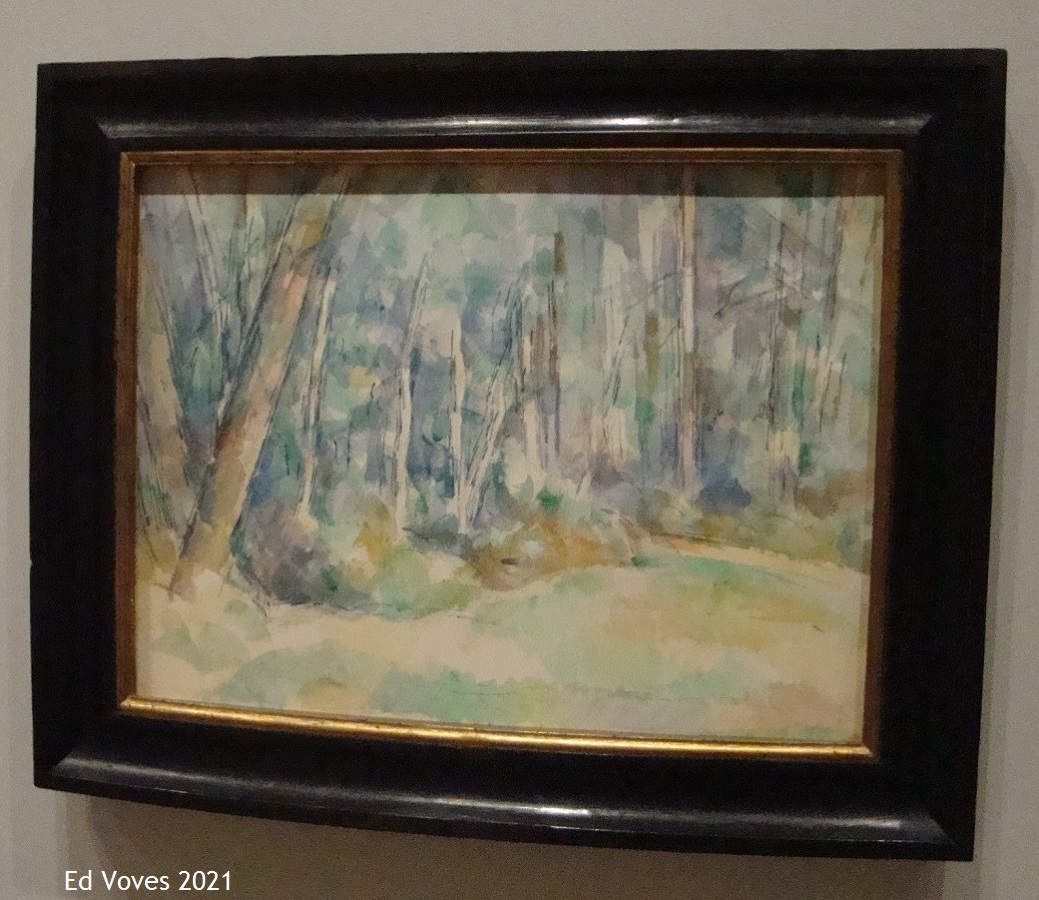
Ed Voves, Photo (2021) Paul Cézanne's Forest Landscape, 1904-1906

And then there were the trees, majestic groves, studies of roots and branches, masses of leaves. The MOMA wall text notes a contemporary comment which stated that Cézanne "had no real friends except for trees."

Remarks like this fueled the legend of Cézanne the irascible, artist/hermit who had fled the Paris art scene to commune with nature. Cézanne certainly preferred his own company while engaged in art. But it is safer to say that when Cézanne took his backpack of easel, canvas, sketchbook, tubes of paint, pencils and brushes and trudged up toward Mont Sainte-Victoire, he was not trying to escape from the world. Rather, he sought to embrace it with his art.

***

Text: Copyright of Ed Voves, all rights reserved. Cézanne Drawing exhibition images courtesy of the Museum of Modern Art , New York City

Introductory Image: Paul Cézanne (French, 1839-1906)  Foliage, 1900–04. Watercolor and pencil on wove paper, 17 5/8 × 22 3/8″ (44.8 × 56.8 cm). The Museum of Modern Art, New York. Lillie P. Bliss Collection. Photo © 2021 MOMA, NY

Ed Voves, Photo (2021) Paul Cézanne's Self-Portrait and Apple, 1880-1884. Pencil on paper: 6 13/16 × 9 1/16" (17.3 × 23 cm) Cincinnati Art Museum.

Ed Voves, Photo (2021) Gallery view of the Cézanne Drawing exhibition at the Museum of Modern Art, New York. 

Paul Cézanne (French, 1839-1906) Mercury after Pigalle. c. 1890. Pencil on paper, 15 x 11″ (38.1 x 27.9 cm). The Museum of Modern Art. The Joan and Lester Avnet Fund © 2021 The Museum of Modern Art, Imaging and Visual Resources, photo Peter Butler

Paul Cézanne (French, 1839-1906) Studies of Three Figures, Including a Self-portrait, c. 1876, 1883, 1885 Pencil on laid paper: 19 1/8 × 12 5/8" (48.5 × 32 cm) Museum Boijmans Van Beuningen, Rotterdam. 

Ed Voves, Photo (2021) Gallery view of Cézanne Drawing at MOMA, showing two self-portraits.

Paul Cézanne (French, 1839-1906) Studies and Portraits of the Artist's son (recto); Studies, Including a Head and a Small Casserole (verso), 1877-1878 (recto); c. 1878 (verso). Pencil on paper: 9 3/4 × 12 1/8" (24.8 × 30.8 cm) Albertina, Vienna

Ed Voves, Photo (2021) Gallery view of the Cézanne Drawing exhibition, showing a Study Sheet by Paul Cézanne, including a portrait of Francisco Goya (recto), 1877-1880. Pencil on paper: 19 11/16 × 11 13/16" (50 × 30 cm) From a private collection, NY.

Ed Voves, Photo (2021) Detail of Cézanne's drawing, Paul Cézanne Fils as a Harlequin, Studies for Mardi Gras, c. 1888. Pencil on paper: 7 15/16 × 10 11/16" (20.1 × 27.2 cm) Kunstmuseum Basel

Ed Voves, Photo (2021) Gallery view of the Cézanne Drawing exhibition, showing a Cézanne's Glass and Apples, Oil on canvas: 12 3/8 × 15 3/4" inches. Collection Rudolf Staechelin, Basel, and Cézanne's Still Life with Apples, c. 1878. Oil on canvas: 7 1/2 × 10 1/2" (19 × 26.7 cm) Fitzwilliam Museum, Cambridge, UK. 

Paul Cézanne (French, 1839-1906) Still Life with Blue Pot, 1900-1906. Pencil and watercolor on paper: 18 15/16 × 24 7/8" (48.1 × 63.2 cm). The J. Paul Getty Museum, Los Angeles.

Paul Cézanne (French, 1839-1906) Hortense Fiquet (Madame Cézanne) Sewing, c. 1880. Pencil on laid paper: 18 9/16 × 12 3/16" (47.2 × 30.9 cm) The Samuel Courtauld Trust, The Courtauld Gallery, London. Princes Gate Bequest

Paul Cézanne (French, 1839-1906) Vase of Flowers (recto), c. 1885-88; Study of Trees (Clairière) (verso), 1887-90.  Pencil and watercolor on paper: 18 3/8 × 11 13/16" (46.6 × 30 cm) Fitzwilliam Museum, Cambridge, UK. Bequest of Captain Stanley W. Sykes.

Ed Voves, Photo (2021) Gallery view of the Cézanne Drawing exhibition, showing Cézanne's Study of Trees (Clairière) c. 1885-88.

Paul Cézanne (French, 1839-1906) Rocks Near the Château Noir, 1895-1900. Watercolor on paper. 18 3/16 × 11 15/16″ (46.2 × 30.3 cm). Private collection

Paul Cézanne (French, 1839-1906) Mont Sainte-Victoire, 1902–06. Watercolor and pencil on wove paper: 16 3/4 x 21 3/8″ (42.5 x 54.2 cm). The Museum of Modern Art, New York. Gift of Mr. and Mrs. David Rockefeller. Photo © 2021 MoMA, NY

Ed Voves, Photo (2021) Paul Cézanne's Forest Landscape, 1904-1906. Pencil and watercolor on paper: 18 5/8 × 23 5/8 inches. Private collection