Showing posts with label Animals in Art. Show all posts

Wednesday, June 12, 2019

The Life of Animals in Japanese Art at the National Gallery of Art, Washington D.C.


The Life of Animals in Japanese Art


National Gallery of Art, Washington D.C.
June 2, 2019 - August 18, 2019

Reviewed by Ed Voves
Original photos by Anne Lloyd

When the National Gallery of Art announced the recently-opened exhibition, The Life of Animals in Japanese Art, I was tremendously excited. The National Gallery of Art (NGA), working with the Los Angeles County Museum of Art (LACMA) and art museums in Japan, is displaying over three hundred rare works of art, spanning seventeen centuries of Japanese history.

As if the scope of the timeline of this wondrous exhibition was not audacious enough, the premise of its theme was even more so. Can a nation’s history be interpreted with art works depicting animals and their role in the national saga? The Life of Animals in Japanese Art answers that question with a resounding yes!


Anne Lloyd, Photo (2019)
Gallery view of The Life of Animals in Japanese Art exhibition

Displayed in the NGA’s renovated East Wing, The Life of Animals in Japanese Art traces the course of Japan’s cultural history and identification with animal life from the iconic Haniwa earthenware sculptures of the 5th–7th centuries to colorful 21st century animal “companions” created by Kusama Yayoi. Many of the 180 art works lent by museums and collectors in Japan are so delicate and light sensitive that they will be displayed in a two-phased rotation, the second presentation occurring in mid-July.


Anne Lloyd, Photo (2019) Haniwa Horse, 6th century


Anne Lloyd, Photo (2019)
Art works by Kusama Yayoi, Megu-chan (left) & Sho-chan 

The exhibition was organized by Robert T. Singer, curator of Japanese art, LACMA, and Masatomo Kawai, director, Chiba City Museum of Art. The Natonal Gallery does not collect in the subject area of Asian art, which is left in the capable hands of the nearby Freer-Sackler Galleries. The vast scale of The Life of Animals in Japanese Art would have overwhelmed the Freer-Sackler exhibit space. Also, the National Gallery has a tradition of mounting great touting exhibitions of Japanese art, including the memorable Japan: The Shaping of Daimyo Culture, back in 1988.

In their introductory remarks, Robert Singer and Masatomo Kawai commented on the very significant factor of human co-existence with animals and nature in Japanese culture.

This sense of compassion and respect for the animals which share the earth with us is exemplified by a painting by Kanō Eitai (died 1842) which shows an actual event in which devout Buddhists release captured animals to allow them to live in freedom. Especially noteworthy in this moving work of art is the act of liberation in which one fisherman returns turtles and fish back to the sea while another releases carp into a freshwater lake.


Kanō Eitai, Ritual of Releasing Captured Animals, early 19th century

In American history, by contrast, the emphasis was on the conquest of nature. This idea struck a particularly sensitive chord with me, so much so that I had to wrestle with this idea before I could begin to write this review.

As I reflected on this theme, I remembered a book which I had read as a child, Animals that Made U.S. History by Edith Dorian (1964). The author, who also wrote sensitively on Native American themes, narrated how the economic use – and abuse – of the beaver, salmon, buffalo, the longhorn cow and other animals had shaped the American nation. 

As the exhibition affirms, animals have also made Japan's history. If not as spectacular as the story Dorian told over a half-century ago, The Life of Animals in Japanese Art has vital lessons to teach.The Japanese learned over the course of centuries not to take animals for granted. This more benign attitude is reflected in their mythology, religion, life style and art.


Anne Lloyd, Photo (2019)    
   View of Utagawa Kuniyoshi's Bravery Matched with the Twelve Zodiac Signs, 
woodblock print scroll series, c. 1840

All the same, the Japanese empathy for animals is a hard-won attribute. At the entrance to the exhibition, scenes of the relationship of humans and animals are displayed in large woodblock prints made during the nineteenth century by Utagawa Kuniyoshi. The animals in question are the twelve zodiac animals


Anne Lloyd, Photo (2019)
 Utagawa Kuniyoshi's Tiger and Kashiwade no Omi Hatebe, c.1840

Some of the scenes are quite violent such as the one depicting the warrior, Kashiwade no Omi Hatebe, killing a tiger in Korea which had slain his child. Others scenes in this series, Bravery Matched with the Twelve Zodiac Signs, show animals and humans using brain rather than brawn, as in the case of the monkey king, Sun Wukong, who outwits an enemy pig.

Animals in Japanese folklore and culture are a force to be reckoned. And no animal exemplifies this more than the fox. If there is a four-legged hero in the exhibition, it is the bushy-tailed kitsune. 

Foxes are regarded as a spiritual animal as we see in Utagawa Hiroshige's 1857 woodblock print, New Year's Eve Foxfires at the Changing Tree. According to Japanese folklore, foxes travel to the shrine of the god of the rice harvest, Inari, to pay homage on the last night of the year. From the breath of the foxes, tongues of flame are emitted which the foxes use to guide their journey through the darkness.


Utagawa Hiroshige, New Year's Eve Foxfires at the Changing Tree, ji,
from the series One Hundred Famous Views of Edo,1857

These lantern-like foxfires or kitsunebi were regarded by farmers in ancient Japan as a providential sign that the rice harvest would be a good one. Or so the story goes.

Foxes are multi-taskers in Japanese myth and folklore. Along with being acolytes to Inari, foxes can play a trickster role, like the coyote in Native American cosmology. According to Masatomo Kawai's commentary, foxes were reputed to be shape-shifters, taking on human guise to tempt and mislead humans, especially innocent Buddhist monks. In extreme cases, foxes could be malevolent, vampire-like predators of human beings.


Anne Lloyd, Photo (2019) Sacred Foxes, 14th century

Looking at this pair of rare wooden fox statues which have been displayed since the 1300's at the shrine of Inari at Kiyama, is an unsettling experience. Nature, like the crafty expression of these foxes, is not something to dismiss as benign on all occasions.

The two principal religions of Japan, Shintoism and Buddhism, are the key determinants of the Japanese attitude to animal life. The more ancient of the two, Shinto, is native to Japan and stresses animals as messengers between humans and the divine forces residing in nature known as kami. Buddhism arrived from India and China via Korea in the sixth century. Buddhism, based on the principle of the rebirth of the soul, calls for kinship and compassion to animals. The souls of animals may indeed be the reborn souls of human beings trying to reach the ultimate state of salvation or nirvana.


Anne Lloyd, Photo (2019)
 Kōen's Monju Bosatsu Seated on a Lion, with Standing Attendants,1273

Asian animals, unknown in Japan, were often depicted in Buddhist art works. Buddhist deities like Fugen and Monju Bosatsu are often shown riding an an elephant or a lion.

Horses are a more conventional mount for humans but they too figure as spiritual beings. One of the center pieces of the NGA exhibition is the Sacred Horse sculpture, dated to the 1500's, Made from wood and lacquer with crystal eyes, this nearly life-sized steed was presented to the Sannosha shrine, in place of the gift of a living horse as was often done.


Anne Lloyd, Photo (2019)
Gallery view of The Life of Animals in Japanese Art exhibition,
 showing Sacred Horse,16th century

The color of horses was linked to rainfall and special prayers were said in conjunction with their presence. No doubt this was influenced by the Shinto concept of animal envoys to the divine kami. Prayers conveyed by dark-hued horses were held to be able to bring rain. When white horses were involved in these prayer rites, storms would cease.
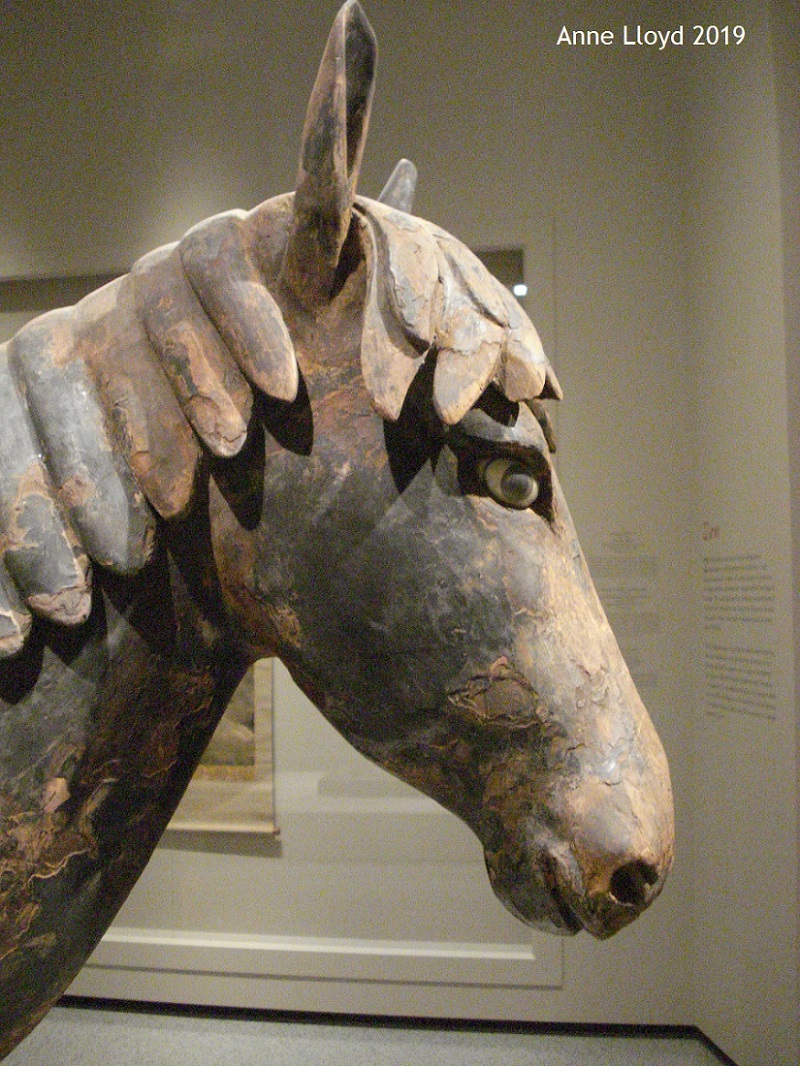

Whatever effect this horse sculpture had on the weather around the Sannosha shrine, it exudes an uncanny sense of real life in the NGA gallery. Stand in its presence for a while and truly you will believe in the life force of this horse - in the now,in the present moment.  The attraction of this incredible sculpture drew me back repeatedly during my visit to the exhibit.

I truly believe that there is an energy field throughout the exhibition galleries of The Life of Animals in Japanese Art at the NGA. I felt a similar sensation at the wonderful Tale of Genji exhibit at the Metropolitan Museum of Art, which also explored the intertwined nature of religion and culture in Japan.

The scope of The Life of Animals in Japanese Art is so great that even an extended review like this one can only convey an introductory survey. I have not even touched upon the spectacular screen paintings or the enchanting illustrated kimonos. These and other masterpieces of Japanese art I will leave for another essay, timed to coincide with the second rotation of art works in the exhibition.


Anne Lloyd, Photo (2016)
 Deer Bearing Symbols of the Kasuga Deities,14th century

For now, I will leave you with the image of one of the greatest of all the masterpieces on display in The Life of Animals in Japanese Art. This is the bronze statue, Deer Bearing Symbols of the Kasuga Deities. Cherished as an "important cultural property" of the Japanese nation, this beautifully sculpted work of art combines elements of Shinto and Buddhist religious beliefs. 

In Japanese legend, a deity named Kasuga Myojin, mounted upon this deer, flew through the air from Hitachi to Nara, where deer are revered to this day. You can believe this legend or not. Yet, an air of serenity surrounds this wondrous animal. An ineffable "something" about it is so palpable that one's belief in divine forces is indeed stirred.  

Stand for a while in front of Deer Bearing Symbols of the Kasuga Deities or Hiroshige's New Year's Eve Foxfires at the Changing Tree or any work of art you may choose from the NGA exhibition. You will soon forget that you are in a museum.

Instead, you will feel that you are standing upon holy ground - as indeed you are.

***
Text: Copyright of Ed Voves. Original Photos: Anne Lloyd. All rights reserved                                                                                           
Images courtesy of the National Gallery of Art, Washington D.C.

Introductory Image:

Anne Lloyd, Photo (2019) Detail of Tani Bunchō's Tiger Family and Magpies, 1807. Painted scroll; ink and color on silk: 61 15/16 × 33 3/4 in. (157.3 × 85.7 cm) Collection of the Los Angeles County Museum of Art (LACMA).

Anne Lloyd, Photo (2019) Gallery view of The Life of Animals in Japanese Art exhibition at The National Gallery of Art, Washington D.C.

Anne Lloyd, Photo (2019) Haniwa Horse, Kofun period, 6th century. Earthenware: 121.3 × 116.2 × 41.3 cm (47 3/4 × 45 3/4 × 16 1/4 in.) Los Angeles County Museum of Art collection.

Anne Lloyd, Photo (2019) Art works by Kusama Yayoi, Megu-chan, 2014. (fiberglass-reinforced plastic; paint,  80 × 48 × 101 cm (31 1/2 × 18 7/8 × 39 3/4 in., collection of Cori and Tony Bates); Sho-chan, 2013. (fiberglass-reinforced plastic; paint, overall: 68 × 28 × 88 cm (26 3/4 × 11 × 34 5/8 in., private collection.

Kanō Eitai (Japanese, died 1842) Ritual of Releasing Captured Animals, Edo period, early 19th century. Hanging scroll; ink and color on silk: 28 × 56.2 cm (50 3/8 × 22 1/8 in.)  Private collection.

Anne Lloyd, Photo (2019) Gallery view of The Life of Animals in Japanese Art exhibition, showing Utagawa Kuniyoshi's Bravery Matched with the Twelve Zodiac Signs, woodblock print scroll series, c. 1840. Arthur M. Sackler Gallery collection, Smithsonian Institution. 

Anne Lloyd, Photo (2019) Utagawa Kuniyoshi's Tiger and Kashiwade no Omi Hatebe, c. 1840. (Woodblock print: 36.7 × 12.5 cm (14 7/16 × 4 15/16 in.) Arthur M. Sackler Gallery collection.


Utagawa Hiroshige (Japanese, 1797-1858) New Year's Eve Foxfires at the Changing Tree, ji, from the series One Hundred Famous Views of Edo, Edo period, 1857. Woodblock print: 33.7 x 21.7 cm (13 1/4 x 8 9/16 in.)  Los Angeles County Museum of Art, Gift of Caroline and Jarred Morse. photo © Museum Associates/LACMA.

Anne Lloyd, Photo (2019) Sacred Foxes, Kamakura-Nanbokuchō periods, 14th century. (Wood with pigments: right statue, with a ball in mouth: (20 7/8 × 15 3/4 × 8 11/16 in.; left statue, with a key in mouth: 20 1/2 × 15 9/16 × 8 1/4 in.) Kiyama Jinja, Okayama Prefecture.

Anne Lloyd, Photo (2019) Gallery view of The Life of Animals in Japanese Art exhibition, showing Kōen's Monju Bosatsu Seated on a Lion, with Standing Attendants, Kamakura period, 1273. (Set of five statues; wood with pigments, meta leaves, crystal eyes.) Tokyo National Museum.

Anne Lloyd, Photo (2019) Gallery view of The Life of Animals in Japanese Art exhibition, showing Sacred Horse, Muromachi period, 16th century. Wood, lacquer, crystal eyes: height 60  5/8 inches, length 70 inches. Sensoji, Tokyo.

Anne Lloyd, Photo (2019) Gallery view of The Life of Animals in Japanese Art exhibition, showing Deer Bearing Symbols of the Kasuga Deities, Nanbokuchō period, 14th century. (Bronze, wood with pigments: 42 1/2 in., height) Hosomi Museum, Kyoto.


Wednesday, December 19, 2018

Art Eyewitness Book Review: The Face and Bestiary from the British Museum


       The Face: Our Human Story by Debra Mancoff         
 Thames & Hudson/303 pages/$24.95

Bestiary: Animals in Art from the Ice Age to Our Age by Christopher Matthews
Thames & Hudson/256 pages/$24.95


Reviewed by Ed Voves

"Sir, when a man is tired of London, he is tired of life," Dr. Samuel Johnson proclaimed  to his boon companion James Boswell, "for there is in London all that life can afford."

The date was September 20, 1777. Eighteen years before Boswell recorded this famous remark, one of the prime attractions of London had opened its doors, offering examples of "all that life can afford" to Londoners and visitors alike. The world's first public museum, it was located in the Bloomsbury section of London and was called the British Museum. The name was something of a misnomer in Johnson's day and for many years afterward since there was very little on display that pertained to the British Isles.

Today, the British Museum exhibits art and artifacts from every period of history and from every continent and almost every nation of the world. This mighty institution has joined with the publishing firm, Thames and Hudson, to produce two books highlighting its vast holdings. These handsome, insightful volumes are each based upon a key theme, the human portrait and the relationship of people with animals. 

The Face: Our Human Story by Debra Mancoff and Bestiary: Animals in Art from the Ice Age to Our Age by Christopher Matthews complement each other splendidly. To an amazing degree, human beings have masked or garbed  themselves in animal-themed motifs. Furthermore, the experience of our fellow creatures in the animal kingdom has inspired and elevated the mind - and - especially - the emotions of  men and women since time immemorial.


    Marble bust of a sleeping child, possibly placed on the child's tomb,
 1st-2nd century AD

These two books are beautifully illustrated and have engaging, provocative texts. Mancoff's prose is almost poetic as she evokes the many moods of human life and the masks we wear to try and conceal our true selves:

Our faces function as a window to our thoughts and feelings and as a mirror of social attitudes and expectations; they connect our inner life to our outward experience... All these factors - meanings, identity, emotion and connection - have made the human face the most potent and persistent subject in the history of art.

Perhaps the human face is a little too potent. For that reason, humans have created masks or disguises to cover the "shocking" truth of our lives. 

     Unknown artist. Roman military parade mask, c. 2nd century AD

During the later Roman Empire, soldiers wore elaborate masks with the features of the gods of the Pantheon or Amazons (as in the above example). These masks were a feature of dress parades or dazzling displays of horsemanship rather than providing protection from enemy arrows. For the whole point was to maintain the fiction that the Celts, Germans or other "barbarians" serving in the legions were  real-live Romans, when in fact actual Romans were in ever-shorter supply.

One of the opening images of The Face is this striking, almost nightmarish, face from ancient Mexico, likely Xiuhtecuhtli of the Aztec culture, around 1500.   


    Unknown artist, The Turquoise Mosaics, c. 1400-1521


The "Turquoise Lord," Xiuhtecuhtli, is a somewhat shadowy figure in Mesoamerican myth. This frightening mask would have been worn by a temple priest in one of the many ceremonies invoking the help of the gods to nurture Aztec crops in the extremely weather-sensitive environment of Mexico.

Masks are not always intended to conceal or to overawe.  Sometimes a "change of face" denotes a major cultural or religious transition.


Unknown artist, The Satala Aphrodite (Anahita), c. 1st century BC. 

One of the most fascinating images in The Face is the seemingly conventional countenance of a Greek goddess. Its museum name is The Satala AphroditeBut this is not Aphrodite or Artemis, either. Rather it is the Persian goddess Anahita, whose lineage can be traced back to the even more ancient divinity, Ishtar, of Babylon. 

The features of Anahita were reworked with recognizably European features, making her more acceptable to new devotees as her cult moved westward, as so many "mystery" religions did under the Roman Empire. This remarkable work was  discovered in 1873 in modern-day Turkey in the cultural transfer zone (and often battle zone) on the border of the Roman and Persian empires. 
  
However fascinating masks and "guises" are, the unconcealed human face always takes the prize. The many illustrations in The Face convey the incredible range of expressions, intentions and obsessions which are displayed on our face. Try as we might, we cannot wipe away our inner self from registering on our outward countenance.

Ironically, we are never so hard to "read" as when we throw pretense to the winds and just "be" ourselves.

Look at the remarkable portrait drawing of Isabella Brant by her husband, Peter Paul Rubens. Isabella Brant (1591-1626) was no conventional beauty by the standards of her age or ours. Her face in Ruben's sketch, however, is filled with vivacity, charm and self-awareness. What was she thinking about while her husband sketched away?


Peter Paul Rubens, Portrait of Isabella Brant, c. 1621/1622

Perhaps this enigmatic woman was aware of how precious was the moment she and her artist-husband shared together. We will never know what interior dialog was playing out in her mind -and on her face. That is one of the charms of this magnificent rendering of the mystery of human  feeling. 

What we do know about Isabella Brant is that she died four years after this sketch was completed. She was cut-down by bubonic plague, still a fearsome killer three hundred years after the Black Death. We can only hope that Rubens' love for his wife helped her find peace in her tragic final hour.

Human empathy is based on a sense of shared experience and the ties of kinship. We can better relate to other people because we a aware that they strive, struggle, suffer as we do. That is true of relationship of humans with animals. 

Human beings identify with the inhabitants of the Animal Kingdom and have done so since time before time - before the cave art of Chauvet.  


In Bestiary, we see one of the most compelling works in the collection of the British Museum.  A piece of Mammoth tusk has been inscribed with the depiction of two reindeer swimming across a river. It was created about 13,000 years ago and was discovered in France, the source of much of the surviving Ice Age art.

As the caption text surmises, this incredible art work was likely created to record an incident of a hunt, the memory of which could be invoked to help promote a sense of "mastery over the creature through its representation."


Unknown artist, Magdalenian era,The Swimming Reindeer, 11,000 BC

Yet, if you look closely at the features of the reindeer you cannot but feel the artist's appreciation of the life force, the animating "animal" power, of these beasts as they struggle against the current of the river and of the forces of existence. 

After all, the daily experience of Ice Age tribesmen, wandering the bleak earth in search of food, was little different from that of the animals they hunted.

Closer in time and to the spirit of modern society is the golden panel screen painted by Maruyama Ōkyo (1733-1795). One of the greatest painters of traditional Japan, Ōkyo was well aware of Western techniques and incorporated them into time-honored genres like Kano painting. His Tigers Swimming a River, painted around 1781, reveals a modern sensibility as these fearsome predators show the characteristics of house cats.

Ōkyo, unlike the unknown carver of the swimming reindeer, never saw a living tiger. Japanese samurai, however, had hunted tigers during the bloody war in Korea during the 1590's and the big cats continued to fascinate the Japanese long after the war.


             Maruyama Ōkyo, Tigers Crossing a River, c. 1781

Tiger skins remained a much sought-after item in Japan. But a preserved tiger pelt has a flattened head and this is how Ōkyo painted his swimming felines as they ford the golden river. Given the mystical setting of the tigers' journey, this hardly seems a defect.

As the emotional distance increases between animals in the wild and people living in cities, the greater is the compulsion to project human attributes upon animals. The Victorian artist, Alfred Crowquill (in real life Alfred Henry Forester), was a master of caricature, using animals, "dressed to the nines," to poke fun at people with their lengthy list of social distinctions. 


Alfred Crowquill, A Monkey Dressed as a Man,1844

"Fashion is but One Creature Apeing Another" Crowquill affirmed in this hilarious send-up of the nineteenth century British gentleman. However, animals are different from humans. They do not smoke pipes or play board games. Christopher Matthews, in the text of Bestiary, wisely notes that animals "in the flesh would bite, scratch or simply bolt."

With animals proving so illusive, so impossible to ever fully-understand, humans have created whole categories of hybrid beasts. These weird, wonderful creatures represent the "wild side" of nature, but with a human attribute that we can focus upon in order to tell "our" story in myth and legend. The final chapter of Bestiary brilliantly surveys this  "zoology of the imagination," from  the Sphinx of Egypt to the dragons of China to the Sea-Spirit figure from the Solomon Islands of the South Pacific.


Unknown artist, Solomon Islands, Sea spirit wooden figure, pre-1893

Perhaps the greatest insight of these two wonderful British Museum books relates to the extraordinary explosion of fantasy literature in modern society. The human genome is being decoded and the Hubble Space Telescope is sending back images of Deep Space  - but we keep looking.  As fast as science provides answers, human beings discover new, uncharted realms in themselves and in the world around them.

The more we "know", the more there is to explore. And that is a very good thing.

***
Text: Copyright of Ed Voves, all rights reserved
Images courtesy of the British Museum and Thames & Hudson publishers.


Introductory image:                                                                                                          Cover of The Face: Our Human Story by Debra Mancoff (Thames & Hudson, 2018)

Unknown artist, Marble bust of a sleeping child wearing crepundia (amulets and charms) on a cord across his chest. Possibly placed on child’s tomb.,1st-2nd Century ADPurchased from the estate of Charles Townley, 1805. Marble: 26 cm. (Height)  British Museum Reg. # 1805,0703.110

Unknown artist, Roman Imperial era. Bronze parade mask with a woman’s (Amazon’s) face, c.  2nd century AD. Excavated at Nola, Southern Italy during the 18th century. Bronze: 25.5 cm (height) British Museum Reg. # 1824,0407.10


Unknown artist, Mixtec or Aztec. The Turquoise Mosaics. Mask, possibly of Xiuhtecuhtli, 1400-1521.Found in Mexico. Carved from cedro wood and covered in turquoise mosaic with scattered turquoise cabochons, mother-of-pearl eyes and teeth made of conch shell: 16.8 cm. (height) x 15.2 cm. (width) x 13.5 cm (depth) British Museum Reg. # Am,St.400


Unknown artist, Hellenistic Greek. The Satala Aphrodite, c. 1st century BC. Found in Turkey, 1872. Bronze head from a cult statue of Anahita in the guise of Aphrodite or Artemis: 38.1 cm. (height) British Museum Reg. # 1873,0820.1


Peter Paul Rubens (Flemish,1577-1640), Portrait of Isabella Brant, c. 1621/1622. Drawing with black and red chalk, with brown wash, on paper: 381 mm. (height) x 294 mm. (width) British Museum Reg. # 1893,0731.21

Cover of Bestiary: Animals in Art from the Ice Age to Our Age by Christopher Matthews (Thames & Hudson, 2018)

Unknown artist, Late Magdalenian period, The Swimming Reindeer, 11,000 BC. Excavated at Montastruc, France. Incised on Mammoth ivory: 207 mm. (length) x 30 mm. (height) x 27 mm. (width) British Museum Reg. # Palart. 550


Maruyama Ōkyo, Tigers Crossing a River, c. 1781. Painting, six-panel folding screen. Ink, colour and gold-leaf on paper. Signed and sealed. 153.5 cm. (height) x 352.8 cm. (width) British Museum Reg. # 2006,0424,0.1

Alfred Crowquill (Alfred Henry Forrester) (British, 1804-1872) Printed by Samuel Bentley. Satirical print of a Monkey dressed as a Man, 1844. Glyphography: 120 cm. (height) x 105 cm. (width) British Museum Reg. # 1866,0407.146


Unknown artist, Solomon Islands, Pacific Ocean. Found at Makira. Sea spirit wooden figure with fish attributes and with collar of white feathers, pre-1893. Carved wood, with feathers: 72 cm. (height) British Museum Reg. # Oc1904,0621.14