Showing posts with label Jennifer Thompson. Show all posts

Tuesday, July 28, 2026

Art Eyewitness Review: Van Gogh's Sunflowers at the Philadelphia Museum of Art


Van Gogh's Sunflowers

Philadelphia Museum of Art 

June 6 - October 11, 2026

Reviewed by Ed Voves

Original Photography by Anne Lloyd and Ed Voves

Two of Vincent van Gogh's paintings are currently hanging side-by-side in Gallery 251 at the Philadelphia Museum of Art. The Colket Gallery 251 is a relatively small display space and the two paintings by Van Gogh are the only actual works of art currently on view there. The accompanying wall text is complemented by several illustrations of other sunflower paintings by Van Gogh. 

That's all you'll see in Gallery 251, making this a perfect example of what museum curators call a "focused exhibition."

The two paintings, depicting earthenware vases filled with sunflowers, rank very high among Van Gogh's masterpieces. Moreover, each of these oil paintings is a signature work for their home museum, the National Gallery, London, and the Philadelphia Museum of Art (PMA).


Anne Lloyd, Photo (2026)
 Van Gogh's Sunflowers at the Philadelphia Museum of Art (PMA)
 The Sunflowers from the National Gallery (London) appears at left;
at right, the Sunflowers from the PMA collection.

Van Gogh's Sunflowers are presented simply, even modestly, together. There is no room for elaborate or intriguing display techniques in Gallery 251. Nor is there any need. These powerful works of art - dare I say "icons" - can speak for themselves. And they do speak, directly to us and on several levels of communication.

The two Sunflowers in Gallery 251 date from the Dutch painter's sojourn in Provence, 1888-1889. Technically speaking, these paintings are very much of the still-life genre. Nature morte is how they would be described in French. Dead nature.


Ed Voves, Photo (2026)
Gallery view of Van Gogh's Sunflowers at the PMA

Very few people crowding into the PMA's Gallery 251 would, I think, categorize either of the two Sunflower paintings as examples of "dead nature." 


Anne Lloyd, Photo (2026)
 Gallery view of Van Gogh's Sunflowers at the PMA. Illustrations of all seven of   
Vincent van Gogh's Sunflowers are shown here.

These remarkable works of art and five other paintings of sunflowers were executed in two bursts of creative energy. The first occurred in August 1888, with Van Gogh painting four works intended to decorate the Studio of the South in Arles. All four were painted within the span of a single week.

Later, following the disastrous break with Gauguin, Van Gogh painted three additional Sunflowers in January 1889. These were repetitions of the earlier works from the summer, done from memory!

The seven Van Gogh Sunflowers confound their status as still-life paintings. Yes, they are depictions of flowers, severed from their roots, and placed in a vase. Yet, as the two paintings on view in Gallery 251 demonstrate, they exude a life force that is palpable.


Anne Lloyd, Photo (2026)
 Vincent van Gogh's Sunflowers from the PMA collection

Standing in front of the Philadelphia Museum's Sunflowers can be an uncanny experience. There is a sense of "being" to the painting, difficult to locate but very much there. It is like feeling the presence of another person or creature before you see them. 


Anne Lloyd, Photo (2026)
 Gallery view of Van Gogh's Sunflowers at the PMA

In the case of one of the August 1888 Sunflowers, the work itself no longer exists. The version with a striking dark blue background had been purchased by a Japanese admirer of Van Gogh in 1920. During the final days of World War II, this Sunflowers was destroyed in the bombardment of Osaka by the U.S. Air Force.


Ed Voves, Photo (2026)
A color photo, taken in 1921, of Vincent van Gogh’s Sunflowers,1888.
 The original painting was destroyed in 1945 during World War II.

Incredibly, an early color photo had been taken of the Sunflowers before its destruction. The photo was then lost from view for decades. In 2013, the art scholar, Martin Bailey, discovered the photo while researching his book on Van Gogh, The Sunflowers are Mine.


Ed Voves, Photo (2026)
Gallery view of Van Gogh's Sunflowers at the PMA

Van Gogh's Sunflowers pack incredible power in whatever configuration they appear. These astonishing works of art also show that the emotional highs and lows of Van Gogh's life did not determine the quality - and quantity - of his paintings. 


Anne Lloyd, Photo (2026)
Van Gogh's Sunflowers from the National Gallery (London) collection

The National Gallery's Sunflowers, arguably the most important of the entire series, was painted in August 1888. When Van Gogh set to work on the initial group of Sunflowers, he was in an optimistic mood and at the height of his powers. Plans for the Studio of the South were underway and he was about to paint the luminous Starry Night on the Rhone  and Cafe Terrace at Night.

Van Gogh was in a very different frame of mind in January 1889, when he painted a trio of "renditions" of the summer 1888 Sunflowers. The resulting paintings restated the earlier works without being exact copies. The Philadelphia Sunflowers evokes the version in the Neue Pinakothek Munich, one of the first of Van Gogh's paintings to enter a major museum collection. 


Anne Lloyd, Photo (2026)
 Color illustrations contrasting the Sunflowers from the Neue Pinakothek Munich, 1888 (at left), with the PMA's Sunflowers, 1889

Despite the anguish of his time in the mental hospitals of Arles and St. Remy, Van Gogh continued to make plans for new paintings and arrangements of his work.


In a May 1889 letter to Theo, illustrated with a quick sketch, Van Gogh outlined his plans to use his Sunflowers to greater effect.

Van Gogh explained that he intended to use two of the paintings in tandem with a portrait of the wife of Joseph-Etienne Roulin, the postal inspector from Arles. The triptych. would evoke the reverence to motherhood accorded to the Virgin Mary, albeit arranged in a more secularized format.

With either the Munich or the PMA version to one side and the National Gallery painting on the other, Madam Roulin is placed in the middle. She is shown holding the rope used in rocking an infant's cradle, earning her the title of "berceuse." This can be translated as "lullaby" or singer of a lullaby.


Vincent van Gogh, La Berceuse, 1889
 Courtesy of the Metropolitan Museum of Art, NYC

Van Gogh never had the opportunity to publicly display his triptych. That had to wait until 2024, when the National Gallery in London celebrated its bicentennial.  

The British art community had been slow to appreciate the Impressionists and Post-Impressionists, including Vincent van Gogh. As the 100th anniversary of the venerable museum on Trafalgar Square approached in 1924, the National Gallery's director, Charles John Holmes, determined to rectify the situation.

With the financial support of the textile magnate Samuel Courtauld, Holmes entered into negotiation with Van Gogh's sister-in-law and guardian of his oeuvre, Jo van Gogh-Bonger. The complicated incident is best described in the recent biography of van Gogh-Bonger by Hans Luijten.

When the ink dried on the contract, the National Gallery had succeeded in purchasing Sunflowers and another Van Gogh masterpiece, Van Gogh's Chair. The Van Gogh family was handsomely paid for its treasures. Happy ending!

For its 200th anniversary, the National Gallery mounted Van Gogh: Poets and Lovers. The highlight of the show was the exhibition of the Sunflowers/La Berceuse triptych.  Van Gogh's dream had finally come true.

Yet, Van Gogh would likely have found grounds for comment, if not complaint. Of necessity, the curators at the National Gallery had to display the three paintings in their ornate frames, set at spacious intervals. Van Gogh conceived the arrangement much more simply, the three works grouped closely together.


Anne Lloyd, Photos, left & right (2026)
 An imagined view of Van Gogh's Sunflowers/La Berceuse triptych

To provide closure, I created an imaginative digital display more in keeping with Van Gogh's conception, as outlined in his letter to Theo.

The National Gallery has sent its Sunflowers to help the Philadelphia Museum of Art celebrate its 150th anniversary. Jennifer Thompson, the PMA curator of the exhibition, wisely decided against attempting the triptych format again. 


Anne Lloyd, Photo (2026)
 Jennifer Thompson, curator of Van Gogh's Sunflowers

Thompson, recently promoted to Deputy Director of Collections and Exhibitions at the PMA, is one of today's great scholars of Impressionist and Post-Impressionist art. She well knows the "back-story" of the Philadelphia Sunflowers.and the importance of allowing this masterpiece to tell its side of the story.

Unlike London, Philadelphia during the 1920's had plenty of Post-Impressionist paintings. Unfortunately, the majority of these works were in the collection of Dr. Albert Barnes. These were "off-limits" to everyone, except the students enrolled in the Barnes Foundation. We won't repeat this controversial story here, but suffice to say that lovers of Van Gogh's paintings had little to see at the PMA until Carroll S.Tyson Jr. came to rescue.

Tyson (1878-1956) was a cousin of John Singer Sargent. A business and civic leader in Philadelphia, Tyson was also a very accomplished artist. His paintings of American bird species gained him such acclaim that his carefully selected art collection was hardly noticed. Upon his death, Tyson's Impressionist and Post-Impressionist masterpieces were donated to the PMA.

With Renoir's Great Bathers, Cezanne's Millstone in the Park of the Chateau Noir and Van Gogh's Sunflowers hanging on its walls, the PMA now ranked as one of the greatest collections of French 19th century art.

With paintings of this caliber from the Tyson Collection, it seems almost a sacrilege to present them except in the direct, unpretentious manner with which the PMA's Sunflowers is currently displayed. The same is true for the National Gallery Sunflowers by its side.

Van Gogh said that he wished to create "a symphony in blue and yellow" with his Sunflowers. He certainly achieved that goal. But, in addition, he managed to capture the golden sun of Provence and added it to his palette. 


Ed Voves, Photo (2026)
Gallery view of Van Gogh's Sunflowers at the PMA

Painting on Size 30 canvas sheets, Vincent van Gogh created the two astonishing works of art now hanging on the walls of Gallery 251 of the Philadelphia Museum of Art. The sun light of Provence is shining from them still.

***

Text: Copyright of Ed Voves, all rights reserved.

Original photography: Copyright of Anne Lloyd and Ed Voves, all rights reserved.

Introductory Image: Vincent van Gogh’s Sunflowers. At left, is the National Gallery, London, Sunflowers, August 1888. At right, the Philadelphia Museum of Art’s Sunflowers, January 1889.

Anne Lloyd (2026) and Ed Voves (2026) Various gallery views of Van Gogh’s Sunflowers at the Philadelphia Museum of Art, Colket Gallery 251.

Anne Lloyd (2026) Vincent van Gogh’s Sunflowers, August 1888. Oil on canvas: 36.2 x 28.7 in. (92.1 x 73 cm) National Gallery (London).

Anne Lloyd (2026) Vincent van Gogh’s Sunflowers, January 1889. Oil on canvas: 36 3/8 x 28 in. (92.4 x 73.1 cm) Philadelphia Museum of Art collection.

Anne Lloyd (2026) Color illustration of Vincent van Gogh’s Sunflowers, August 1888. Oil on canvas, mounted on panel: 36 1/4 x 28 3/8 in. (92 x 73 cm.) Neue Pinakothek, Munich, collection.

Ed Voves, Photo (2026) Color illustration of Vincent van Gogh’s Sunflowers, August 1888. Oil on canvas, mounted on panel: 38 9/16 x 27 1/8 in. ( 98 x 69 cm.) Destroyed 1945 in Allied bombing of Japan. This color photo was published in 1921. Archives of Mushakoji Saneatsu Museum, Tokyo.

Vincent van Gogh (Dutch, 1853-1890) Excerpt of a letter to Theo van Gogh, from St. Remy, Provence, on or about May 23, 1889. Wikimedia Commons: Letter 592. (
Letter is listed as #776 in Vincent van Gogh, a Life in Letters, published by Thames & Hudson, 2020. 

Vincent van Gogh (Dutch, 1853-1890) La Berceuse (Woman Rocking a Cradle, Augustine-Alix Roulin, 1851-1930) Oil on canvas: 36 1/2 x 29 in. (92.7 x 73.7 cm.) Metropolitan Museum of Art, NYC.

Friday, June 30, 2023

Art Eyewitness Review: Whistler's Mother at the Philadelphia Museum of Art


The Artist's Mother: Whistler and Philadelphia

Philadelphia Museum of Art
June 10 - October 29, 2023

Reviewed by Ed Voves

Original Photography by Anne Lloyd

It's been a long interlude between visits. The last time Anna Matilda McNeil Whistler - or rather her famous portrait - came to Philadelphia was 142 years ago. The occasion was an exhibition at the Pennsylvania Academy of the Fine Arts of the painting by her son, now universally called Whistler's Mother

A.K.A. Arrangement in Grey and Black: Portrait of the Artist's Mother, the celebrated painting by James McNeil Whistler is back in the City of Brotherly Love. A true icon of American art, Whistler's Mother highlights a special exhibition at the Philadelphia Museum of Art, organized by Jennifer Thompson, the museum's curator of European Art. The exhibit will be on view until October 29, 2023. 

It is important to note that the official designation of Whistler's Mother, noted above, is actually the anglicized translation of its French title, Arrangement en gris et noir n° 1. That is an important distinction since the French government bought the painting in 1891, ten years after its first sojourn in Philadelphia. 


Anne Lloyd, Photo (2023)
James Whistler's Arrangement in Grey and Black:
 Portrait of the Artist's Mother (1871)

Arrangement en gris et noir was the first acquisition of a painting by an American painter for the Louvre's collection. Initially, it was put on display in the Luxembourg Museum, until Whistler died twelve years later. The galleries of the Louvre were reserved for deceased artists, who were deemed worthy to share the museum walls with Leonardo, Watteau and Gericault.

Thanks to a far-sighted French art critic, Gustave Geffroy (one of the first to appreciate Cezanne, as well), James Abbott McNeil Whistler (1834-1903) joined the company of the "immortals" of art in the Louvre. And, as we will see, the help of Anna Whistler was of crucial importance for securing the fame and fortune of her son!


Anne Lloyd, Photo (2023)
Gallery view of Whistler's Mother at the Philadelphia Museum of Art

Whistler's Mother is now the center of attraction at the Philadelphia Museum of Art. But it shares the stage with eight other works of art focusing on the theme of motherhood. Each of the eclectic cast of major artists, Cecilia Beaux, Henry Ossawa Tanner, John Sloan, Dox Thrash, Alice Neel and Sidney Goodman, follows Whistler's lead, but in their own unique way. 

All the artists have Philadelphia backgrounds, with the exception of a Venetian engraver, Francesco Novelli (1764-1836) who skillfully copied an etching by Rembrandt of his mother. Novelli's etching is believed to have influenced Whistler when he painted his mother's portrait in 1871.


Francesco Novelli (1792), after Rembrandt's 
The Artist's Mother Seated, in an Oriental Headress, 1631

Arrangement in Grey and Black received indifferent reviews during its exhibition at the Pennsylvania Academy of Art (PAFA) in 1881. The museum directors refused to purchase the painting, which, surprisingly, was for sale. Whistler was deeply in debt, following his disastrous libel suit against John Ruskin. Another effort to find a buyer likewise failed, this time in New York.

It is ironical for a painting which has come to symbolize Motherhood, that Whistler was "shopping" his mother's portrait around the U.S., looking for a sale. 

Anna Whistler had died on January 3, 1881, only a short time before Whistler returned to the U.S. from England. One would have suspected that Whistler would try and keep this painting, of all his oeuvre, as a testimonial to his beloved mother. Not so! Whistler exhibited a baffling, mercurial mix of emotions, making it difficult to probe his true feelings. 

In fact, Whistler had posed his mother only when the young woman he was scheduled to paint that day failed to appear.  Rather than discard a prepared canvas, Whistler decided to use it for a portrait of his mother.


Anne Lloyd, Photo(2023)
James Whistler's Arrangement in Grey and Black (detail)

It's a sobering thought that Whistler's Mother began its storied career as an "also ran."

Anna Whistler was accustomed to her son's mood swings and changing priorities. She had supported her dear "Jemmie" with long-suffering patience, including his dismissal from the United States Military Academy. But even her forbearance had limits. 

After several days of standing for her portrait, the exhausted Anna insisted on sitting down. Whistler changed the orientation of the painting, with results which, thanks to the Philadelphia Museum of Art, we can now study close at hand.


Anne Lloyd, Photo(2023)
 Jennifer Thompson discussing the kimono wall hanging depicted in James Whistler's Arrangement in Grey and Black

As the artistic skill devoted to his portrait of his mother began to stir popular interest, Whistler professed himself bemused:

Take the picture of my mother, exhibited at the Royal Academy as "an Arrangement in Grey and Black." Now that is what it is. To me it is interesting as a picture of my mother; but what can or ought the public to care about the identity of the portrait?

The "public" in America responded to Whistler's portrait of his mother with ever -increasing regard. In part this was due to the fact that the French had anointed the painting as worthy of the Louvre. But nostalgia played a major role, too. The U.S. in the 1890's was undergoing massive social changes, many very unsettling. Frontier America was passing, the big industrial cities taking its place. A symbol of bedrock national values was needed. What better image, representing the moral absolutes of the U.S.A., could there be than a painting of an American mother?

Anna McNeil Whistler provided the human face, even if painted in profile, to the movement to create a national holiday in honor of American mothers. The first Mothers Day was celebrated in 1908 and, in 1934, the U.S. Postal Service issued a stamp, graced by a rather sanitized reworking of Whistler's Mother. 

Neither the artist or his mother were acknowledged by name on the stamp. To make matters worse, a vase of flowers was added to the image of the unidentified matriarch. Then, along with a sentimental inscription, appeared the incredibly crass notification: three cents.

Whatever value the U.S. Postal Service placed on motherhood, Philadelphia artists responded very quickly and favorably to Whistler's Mother, following its display at PAFA in 1881. The current exhibition at the Philadelphia Museum of Art brilliantly underscores the influence of Whistler on succeeding generations of American artists. But the crucial point of this legacy is that none of these later works of art is a direct "quotation" of Arrangement in Grey and Black. 


Anne Lloyd, Photo(2023)
Henry Ossawa Tanner's Portrait of the Artist's Mother (detail)

The work which most closely follows Whistler, is Henry Ossawa Tanner's Portrait of the Artist's Mother, but there are major differences.

Tanner saw Arrangement in Grey and Black in 1881. He was a student at PAFA at the time. Tanner then went to France for further study, eventually settling there. He would have seen Whistler's increasingly famous painting at the Luxemborg, as well.

In 1897, during a trip home to Philadelphia, Tanner posed his own mother for a portrait. The warm tones of brown, amber and the golden fabric of the shawl evoke feelings of life and well-being, in contrast to the somber, almost funereal, hues of Whistler's painting. Likewise, the relaxed, meditative gaze of Tanner's mother creates a mood vastly different from the frozen profile of Anna Whistler.


Anne Lloyd, Photo(2023)
 Jennifer Thompson discussing Cecilia Beaux's early masterpiece,
The Last Days of Childhood, 1883-1885

Sharing the gallery wall with Tanner's Portrait of the Artist's Mother is Cecilia Beaux's The Last Days of Childhood. Painted over the course of two years, 1883-85, this deeply moving work of art established Beaux's reputation as one of America's premier artists.

The Last Days of Childhood shares enough elements of setting and composition with Arrangement in Grey and Black that we can be fairly certain that Beaux saw and studied the Whistler painting during its display at PAFA, where she was taking classes. Beaux, a strong-willed and immensely talented young woman, later asserted that she had not been influenced by Whistler. But the evidence points to the contrary.

At the press preview, Jennifer Thompson discussed the "backstory" of The Last Days of Childhood. The protagonists of Beaux's painting were her elder sister, Etta, and Etta's son, Henry. That would seem to technically disqualify Beaux's painting from inclusion in an exhibition dedicated to artists and their mothers, but Thompson detects a strong affinity with Whistler's masterpiece.

Indirectly, Beaux's mother is very much present in the The Last Days of Childhood. The French title of the painting uses the word "enfance" and the translation might more appropriately be The Last Days of Infancy. That is certainly in keeping with Henry's age and Beaux's own life story.

Beaux's mother had died when her infant daughter, Cecilia, was only twelve days old. Beaux directed her sister to wear a black dress for the painting sessions. According to social conventions in America at the time, such attire was a sign of mourning. However, Etta, unlike Anna Whistler, was not a widow. The black dress may therefore be interpreted as a memorial of their long-dead mother.


Anne Lloyd, Photo(2023)
Cecilia Beaux's The Last Days of Childhood (detail)

What really impressed me about The Last Days of Childhood is Beaux's ability to reprise the narrative of the entire work in "a painting within the painting." This is her astonishing treatment of the hands of the child, resting on those of his mother, which are folded over his body in an embrace of enduring love. Childhood may be passing but the bond of mother and son will never break. 


Following the progression of magisterial paintings from Whistler to Beaux and Tanner, the exhibition shifts gears to three smaller works, Sunday Morning by Dox Thrash (c. 1939), Aritist's Mother I by Sidney Goodman (1994) and Mother by John Sloan (1906). The works by Thrash and Sloan are etchings, Goodman's is a charcoal and pastel drawing on cream paper.


Dox Thrash, Sunday Morning, c. 1939


 Sidney Goodman, Aritist's Mother I, 1994


John Sloan, Mother, 1906

This trio may appear to be quite a "comedown" from the preceding oil paintings, but careful study validates their inclusion in the exhibition. All three are "arrangements in gray and black" worthy of Whistler's color scheme. Yet, the emotion-based sentiments underpinning each of these works of art is what merits them a place in the exhibition.

Dox Thrash created this loving image of his mother, Ophelia, on her way to church, shortly after she died in 1936. Thrash's mother, like Whistler's, is shown in profile, but there is an incredible degree of mobility in this etching, a sense of serene progress through life which the many obstacles placed across his mother's path could never impede.

The works by Sloan and Goodman present the two faces of motherhood which  linger in the memories of their children. Sloan shows lively, animated interest in the expression of his mother, no doubt listening to the latest news about his life and career. Goodman's drawing, showing his mother arise from her sick bed, depicts the heroic efforts of ill, elderly mothers to keep living, keep striving on behalf of their loved ones.

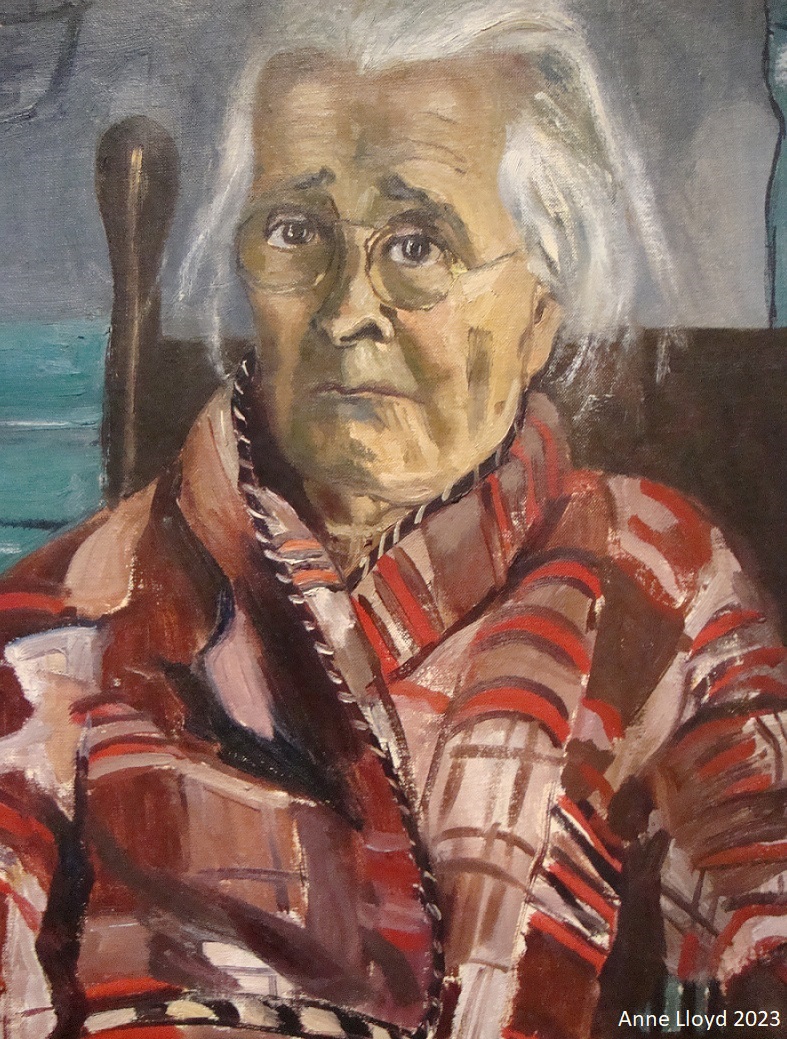
Goodman's Artist's Mother I sets the stage for the final work of art in the exhibition, Alice Neel's Last Sickness (1953). The painting is a loving, yet unsparing examination of the effect of age and illness on an "alert, tart woman" as Neel described her mother, who died the following year.

Those fortunate to visit the Metropolitan Museum of Art's sensational 2021 exhibition of Alice Neel's paintings will recall numerous examples of Neel's clear-eyed empathy for people of all ages and races, but especially those sick in body and in spirit. For those who were unable to visit the Met's Alice Neel: People Come First, the magnificent portrait on view at the Philadelphia Museum of Art provides the opportunity to see a life of artistic genius distilled into one superlative work of art.


 Anne Lloyd, Photo (2023)
 Alice Neel's Last Sickness, 1953 


The look of recognition of life's short span which we see on the face of Alice Neel's mother brings The Artist's Mother exhibition full circle. Anna Whistler's face, seen in profile, betrayed no such emotion. But no one knows what she was thinking, as her son fumed and muttered about the difficulties he faced to get the look he wanted on the canvas.


Anne Lloyd, Photo (2023)
 Gallery view of The Artist's Mother: Whistler and Philadelphia

Some commentators say that Anna Whistler was praying during the painting sessions that "Jemmie" would succeed with his portrait. If so, her prayers were answered.

So too, are the prayers of those - like me - who never had an opportunity to view Arrangement in Grey and Black: Portrait of the Artist's Mother in person. Seeing this magnificent painting is like being accorded an audience with a queen or a beloved author or actress.

My wife, Annie, said it best, during a pause in her picture-taking.

"When you enter the gallery where Whistler's Mother is displayed, you just don't go to see it," Anne said. "You are admitted into her presence."

***

Text: Copyright of Ed Voves. Original Photos: Copyright of Anne Lloyd.

Introductory Image: Anne Lloyd, Photo (2023) James Whistler's Arrangement in Grey and Black: Portrait of the Artist's Mother (detail)1871.

Anne Lloyd, Photo (2023) James Whistler's Arrangement in Grey and Black: Portrait of the Artist's Mother. Oil on canvas: 144.3 x 162.5 cm (56 3/4 x 64"). Musée d'Orsay, Paris, RF 699.

Anne Lloyd, Photo (2023) Gallery view of The Artist's Mother: Whistler and Philadelphia exhibition at the Philadelphia Museum of Art.

Francesco Novelli (Italian, 1764-1836) After Rembrandt van Rijn's The Artist's Mother Seated, in an Oriental Headdress: Half Length, 1792. Etching: 5 1/4 x 5 1/16 inches ( 13.4 x 12.9 cm.) Philadelphia Museum of Art, 1928-42-4413

Anne Lloyd, Photo (2023) Jennifer Thompson of the Philadelphia Museum of Art discussing the kimono wall hanging depicted Whistler's Arrangement in Grey and Black: Portrait of the Artist's Mother. 

Anne Lloyd, Photo (2023) Henry Ossawa Tanner's Portrait of the Artist's Mother (detail), 1897. Oil on canvas: 29 1/4 x 39 1/2 inches ( 74.3 x 100.3 cm.) Philadelphia Museum of Art  EW1993-61-1

Anne Lloyd, Photo (2023) Jennifer Thompson of the Philadelphia Museum of Art discussing Cecilia Beaux's early masterpiece, The Last Days of Childhood, 1993-85.

Anne Lloyd, Photo (2023) Cecilia Beaux's The Last Days of Childhood, 1883-85Oil on canvas: 116.2 x 137.16 cm (45 3/4 x 54 inches). Pennsylvania Academy of the Fine Arts. 1989.21

Dox Thrash (American, 1893–1965) Sunday Morning, around 1939. Etching: 8 7/8 x 8 inches (22.5 x 20.3 cm.) Philadelphia Museum of Art, 1941-53-378

Sidney Goodman (American, 1936-2013) Artist's Mother I, 1994. Charcoal and pastel on cream wove paper: 52 3/4 x 41 3/16 inches (134 x 104.6 cm.) Philadelphia Museum of Art2009-216-1

Anne Lloyd, Photo (2023) John Sloan's Mother, 1906. Etching:  9 x 7 1/2 inches (22.9 x 19.1 cm.) Philadelphia Museum of Art1956-35-73f

Anne Lloyd, Photo (2023) Alice Neel's Last Sickness, 1953. Oil on canvas: 30 x 22 inches (76.2 x 55.9 cm.) Philadelphia Museum of Art, 2003-148-1

Anne Lloyd, Photo (2023) Gallery view of The Artist's Mother: Whistler and Philadelphia exhibition at the Philadelphia Museum of Art..