Showing posts with label James McNeil Whistler. Show all posts

Thursday, January 11, 2024

Art Eyewitness Looks at the Art Scene in 2023


Reflections on the Art Scene during 2023

Text by Ed Voves

Photography by Anne Lloyd

Every year presents a new lineup of special exhibitions. These are occasions of great expectation when they are announced and growing anticipation as opening day looms. Usually, the first "look-see" at the finished, mounted exhibition is a thrilling event, deeply satisfying and richly rewarding in memories for further reflection.

In the case of 2022, the number of spectacular exhibitions was so remarkable that in January of 2023 we at Art Eyewitness were still trying to cram one last visit to Matisse in the 1930's, Modigliani Up Close, and Tudors: Art and Majesty. 

There was a real sense of loss as the final day for these "once in a lifetime" exhibits approached. 


Anne Lloyd, Photo (2023)
 Gallery view of Matisse in the 1930's
at the Philadelphia Museum of Art

The "show" in the art world, as for the theater, must go on.

When the museum press releases for the spring/summer 2023 exhibitions arrived, it was clear that there were some unusual and enticing viewing opportunities in store. 

Among the exhibits for the spring of 2023 was The Sassoons at the Jewish Museum in New York. This brilliantly curated exhibit displayed a rich array of rare books, Old Master paintings and Judaica collected by the Sassoon family during the nineteenth and early twentieth centuries.


Ed Voves, Photo (2023)
 Gallery view of The Sassoons at the Jewish Museum, New York

Interwoven with the narrative of the rise and fall of the ambitious - and in many respects, admirable - Sassoon family was a question which challenges some basic assumptions about the process of collecting art.

Much of the wealth of the Sassoon family came from the opium trade. This inhumane commerce, by modern ethical standards, was not illegal during most of the period which the exhibition so brilliantly brought to life. But the opium trade was certainly controversial during the 1800's. Were the Sassoons and the splendid art collections they amassed tainted by the moral ambiguities of their commercial dealings?

Similar instances of dubious business practices, with profits funneled into art collections and museum endowments, happen all too frequently today. What place has consideration of such questionable conduct in art exhibitions? 

This isn't a matter to be easily brushed away, as an autumn/winter exhibition at the Morgan Library & Museum showed, Medieval Money, Merchants and Morality.


Ed Voves, Photo (2023)
 Gallery view of Medieval Money, Merchants and Morality
 at the Morgan Library and Museum

Medieval Money, Merchants and Morality tells the story of the Mercantile Revolution of the late Middle Ages and the troubled response of people in Europe to this seismic shift in human affairs. All of the coins, florins and thalers, used as a means of exchange, were loaned at rates of interest in contradiction to Christian religious doctrine. Ledger books, based on Italian innovations in accounting, recorded these transactions, meticulously compiling assets and debts, especially the latter. 


Ed Voves, Photo (2023)
Frontispiece from a Register of Creditors, ca.1394-95,
illuminated by Nicolo da Bologna, Morgan Library & Museum 

To people of faith, double-entry accounting and bankers' strong boxes clashed with Jesus' teaching, the Sermon on the Mount. It was a real dilemma, reflected in countless illustrations in medieval religious tracts, superb examples of which are on view at the Morgan exhibition. 

I am planning a review in coming weeks of this fascinating exhibit and its insights into the interface of finance and fine art during the late Middle Ages. Through the prism of the past, we might just gain a more objective awareness of our own attitudes and actions.


Anne Lloyd, Photo (2023)
 Gallery view of Van Gogh's Cypresses at the Metropolitan Museum of Art

Along with these provocative exhibits, 2023's "scorecard" was a mix of hits and misses. 

Van Gogh's Cypresses at The Met was sure to be a crowd pleaser, as indeed it was. Several other exhibitions were disappointments. Despite high standards of presentation, something seemed lacking with these exhibits.  

In the case of any of the 2023 exhibitions which left me perplexed, I elected not to post a review. I never want to risk discouraging patrons from visiting an exhibit, unless there is a glaring cause for concern.

Moreover, the planning and organizational challenges which museum curators face, under normal circumstances, have been compounded by the difficulties of doing so during the recent Covid-19 pandemic and its aftermath. 


Anne Lloyd, Photo (2023)
   Auguste Rodin's Thought, Philadelphia Museum of Art

It is vital not to forget the heroic efforts of museum curators, as I emphasized in the tenth anniversary essay of Art Eyewitness, posted in July 2023. One of my favorite works by Auguste Rodin, Thought, exemplifies the effort which goes into works of art, by the artists who create and the curators who preserve and display these treasures - for us and for future generations.

That being so, during 2023, I grappled with several problematic "concerns."  I will share some of my thoughts about these, but not because of any unique fault in the exhibitions I discuss here. These are being used as case studies to focus on issues which I see in the broad scheme of art "matters."

Judith Joy Ross appeared at the Philadelphia Museum of Art, April-August 2023. Ross is a contemporary Pennsylvania-born photographer, whose oeuvre recalls the 1930's portraiture by Walker Evans. The exhibition was a major retrospective of her work to date.


Anne Lloyd, Photo (2023)
Judith Joy Ross photo & detail, Untitled, from the series, Portraits at the Vietnam Veterans Memorial, Washington, D.C., 1984 

Ross is masterful in capturing thoughtful and provocative images of "ordinary" Americans, in day-to-day situations and in moments of deep grief. I was especially moved by the photos of people visiting the Vietnam Veterans Memorial in Washington D.C.

The difficulty with the Judith Joy Ross exhibition was not quality but quantity. There were approximately 200 photos on view, most of the prints are in the 10 x 8 inch range, and all but a very few in black & white.


Anne Lloyd, Photo (2023)
 Gallery view of Judith Joy Ross at the Philadelphia Museum of Art

Judith Joy Ross filled the vast space of the Dorrance Galleries at the Philadelphia Museum of Art. By mid-point of my - several - visits to the exhibition, a real sense of "image saturation" set-in, making it difficult for me to do justice to the individual photos. 

The initial galleries of Judith Joy Ross concentrated on portraits of children and young people. These were posed in the informal setting of summer relaxation, kids just "hanging out." There were some fantastic images among them, but the number and general similarity of these pictures detracted from their impact. The same held true for most of the later galleries, though the display of photos of people observing the 9/11 wreckage of the World Trade Center was unforgettable.

With so much in Judith Joy Ross worthy of praise, I was left at a loss to explain the exhibition's blunted impact. 

Searching for answers, I recalled The Met's Diane Arbus: In the Beginning. This 2016 exhibit, even though it was presented in the dungeon-like confines of the old Whitney during The Met's brief tenure, was a memorable success. The Met curators restrained their selection to 100 photos and adjusted its focus to Arbus' early years. I wish a similar policy had been implemented for Judith Joy Ross.

In an earlier "incarnation", I was a photo archive librarian for the Philadelphia Inquirer and Daily News newspapers. I learned to appreciate each photograph as a unique documentation of an event, person or place. 

In this state of mind, a bond of understanding is created with each work of art, be it photo, painting, sculpture, etc. From this, a feeling of empathy soon follows. When that occurs, we start to hear what Andre Malraux called "the voices of silence."


Anne Lloyd, Photo (2023) 
Wall Painting with Christ and a Nubian Dignitary   
    on view in the Africa and Byzantium exhibit, Metropolitan Museum      
                          
Once I began to reflect on the effectiveness of major retrospective exhibits of photographs, I naturally began to question modes of display of other genres of art, as well. This can lead to "subversive" thinking, not exactly a bad thing.

There was such a moment at the press preview of The Met's magnificent Manet/Degas. This was a huge exhibition. With an itinerary of celebrated works. Manet/Degas maintained an incredible momentum and irresistible allure. It did't quit.

Yet, for one special moment at least, there was a pause in the excitement of the Manet/Degas press preview.


Anne Lloyd Photo (2023)
 Gallery view of Manet/Degas at the Metropolitan Museum of Art, 
showing Édouard Manet's The Balcony, 1868-69

The speaker's podium was unoccupied and, except for a single art lover, nobody was paying much attention to one of Manet's greatest paintings, The Balcony. This group portrait shows Berthe Morisot, seated holding a fan, the landscaper painter Antoine Guillemat (looking very pleased with himself) and the violinist Fanny Claus, lost in thought. 


Anne Lloyd Photo (2023)
Édouard Manet's The Balcony (detail), 1868-69

None of these three is really looking out from picture, trying to engage us, the viewers. Yet, the painting itself is trying to do exactly that, to catch our eye. This landmark of nineteenth century art is reaching out to grab hold of our attention and keep us looking at it for a little while longer than the average of seventeen seconds which museum goers devote to a work of art. 


Anne Lloyd Photo (2023)
Berthe Morisot in Édouard Manet's The Balcony , 1868-69

Posing behind the empty podium at The Met, The Balcony appeared about to speak. Manet's masterpiece, like Berthe Morisot in the picture, was composing its "thoughts" before conversing with us.

"I'd like to say a few words to you," The Balcony declares. "Let's ignore the art critics, the bloggers, even the curators. I want to speak to you - directly."

As silly as this may initially seem, works of art do speak to us - and we do reply! The dialogue takes place in a state of mindfulness. 

Back in 2015, Art Eyewitness reviewed Looking at Mindfulness: 25 Ways to Live in the Moment through Art. This wonderful book, written by a French psychiatrist, Christophe André, helps readers meditate through art to "restore our capacity for introspection and reconnect with ourselves, rather than sustaining ourselves with a constant drip-feed of external orders, distractions and activations."

The process of utilizing art to enter into a state of mindfulness is not easy and, increasingly, art museums are making things more difficult with sound tracts and special effects which belong in a movie multiplex. 


Anne Lloyd, Photo (2023)
 The Great Hall of the Metropolitan Museum with
Jacolby Satterwhite's A Metta Prayer featured in the background.

The Met's recent The Great Hall Commission, A Metta Prayer, by Jacolby Satterwhite, struck an unsettling note with me, the inverse of its stated intention. 

In this multi-media extravaganza (according to The Met's publicity blurb):

Satterwhite draws inspiration from the Buddhist Metta prayer, a mantra of loving-kindness, to build a narrative that rebels against the conventions of commercial video games. Rather than perpetuating violence, the characters in A Metta Prayer dance, perform, and pose.  

Praiseworthy in its goal, A Metta Prayer had, for me, the opposite effect. I was able to endure it for only a bit more than the average of seventeen seconds, mentioned above.

For the most part, art museums remain sanctuaries of calm reflection and inspiration. Special exhibitions, despite the crowds, can provide space for restoring "our capacity for introspection and reconnect with ourselves."


Anne Lloyd, (Photo 2023)
Prayer service at the press preview of Tree & Serpent, 
conducted by monks from the New York Buddhist Vihara 

Of all the major 2023 exhibitions, Tree and Serpent: Early Buddhist Art in India, provided an almost perfect atmosphere for cultivating spiritual harmony for oneself and empathy for our fellow creatures. On the surface, an exhibition devoted to the earliest Buddhist art would seem so geared to the topic of mindfulness that it is counterproductive to use it to illustrate this theme. That was not the case with Tree and Serpent, which was organized by one of the great curators of the present age, John Guy of The Met.


Anne Lloyd, (Photo 2023)
Gallery view of Tree & Serpent, showing a red sandstone statue 
of the Goddess of Abundance, Sri Lakshmi, 2nd century 

Many of the art works on display in Tree and Serpent predated the more familiar statues of the meditating Buddha, signature images of this now-global religion. Ancient Buddhism grew from a nurturing subsoil of fertility cults and deities, including protective cobras! The transcendental enlightenment of the Buddha has led to spiritual awakening for millions but it was - and is - a long process, based on constant practice. 

My expectations for Tree and Serpent  were indeed high, based upon my memories of an earlier exhibition at The Met, Lost Kingdoms Hindu-Buddhist Sculpture of Early Southeast Asia. Yet, the fulfillment of my hopes was greater still. This was not merely a "once in a lifetime" exhibition but one: to treasure for a lifetime.


Anne Lloyd Photo (2023)
 Gallery view of The Artist's Mother: Whistler and Philadelphia 
at the Philadelphia Museum of Art

A second "once in a lifetime" opportunity presented itself in 2023.  The Philadelphia Museum of Art hosted The Artist's Mother: Whistler and Philadelphia in a "focused" exhibition, June to October 2023. Over the course of nearly five months, Anne and I visited with "Le Mere de Whistler" and related paintings of artists' mothers by Celia Beaux, Alice Neel and others.

We went so often to the gallery where Whistler's Mother was displayed that it became a place of pilgrimage.


Anne Lloyd Photo (2023), 
James Whistler's Arrangement in Grey and Black:
 Portrait of the Artist's Mother (1871)

 To repeatedly enter into the presence of a great work of art is a rare privilege. It gives us the opportunity to study it, in all its facets, all the details of its artistic life. And its spiritual life? Do works of art have spiritual lives?

If artists devote mind and muscle, give heart and soul to create a painting or a sculpture and we respond in kind, then, yes, works of art are spiritual "beings" of a sort. We can  "commune" with them and the experience helps nurture bonds of empathy, which heighten our appreciate of other works of art, of other people.

Like the relationships we have with fellow humans, it is good to have a few old friends in the world of art. These are trusted companions who never fail us and are there when the "once in a lifetime" exhibitions have closed their doors.


Anne Lloyd Photo (2022)
 Auguste Rodin's Orpheus and Eurydice, 1893

Auguste  Rodin's exquisite sculpture, Orpheus and Eurydice,, is one of our most beloved, most trusted friends at The Met. Anne has even begun taking photos of Orpheus and Eurydice In sepia mode, which add a stark, other-worldly - and very fitting - nuance to this work. 


Like Orpheus and Eurydice, we are forging onward in this uncertain new year. Illness delayed this post by a few days, but we are looking forward, not looking back.

On the horizon for 2024 is the centennial of the Morgan Library and Museum, with major exhibitions celebrating Beatrix Potter and Belle da Costa Greene. The Philadelphia Museum of Art is preparing a major show highlighting Mary Cassatt's artistic technique, scheduled to open in May.

We at Art Eyewitness wish all a happy 2024, a year filled with great art and ever stronger bonds of empathy.

Text: Copyright of Ed Voves, all rights reserved                                                  

Original photography, copyright of Anne Lloyd

Introductory Image:                                                                                                                        Anne Lloyd, Photo (2023) Gallery view of Van Gogh's Cypresses at the Metropolitan Museum of Art. New York City, showing Vincent van Gogh's Country Road in Provence by Night,1890.


Anne Lloyd, Photo (2023 ) Gallery view of the Matisse in the 1930's exhibition at the Philadelphia Museum of Art. 

Ed Voves, Photo (2023 ) Gallery view of the Sassoons exhibition at the Jewish Museum, New York City.

Ed Voves, Photo (2023 ) Gallery view of Medieval Money, Merchants and Morality at the Morgan Library and Museum.

Ed Voves, Photo (2023 ) Frontispiece from a Register of Creditors, ca.1394-95, illuminated by Nicolo da Bologna, Morgan Library & Museum Collection.

Anne Lloyd, Photo (2023 ) Gallery view of the Van Gogh's Cypresses at the Metropolitan Museum. 

Anne Lloyd, Photo (2023) Auguste Rodin's Thought, modeled,1895, carved by Camille Raynaud, c.1900, Marble, 29 1/8 x 17 1/16 x 18 1/8 inches (74 x 43.4 x 46.1 cm). Philadelphia Museum of Art, John G. Johnson Collection, 1917.

Anne Lloyd, Photo (2023) Judith Joy Ross photo & detail, Untitled, from the series, Portraits at the Vietnam Veterans Memorial, Washington, D.C. Gelatin silver print. 1984.

Anne Lloyd, Photo (2023 ) Gallery view of the Judith Joy Ross exhibition at the Philadelphia Museum of Art.

Anne Lloyd, Photo (2023 ) Wall Painting with Christ and a Nubian Dignitary on view in the Africa and Byzantium exhibit at the Metropolitan Museum of Art.

Anne Lloyd, Photo (2023 ) Gallery view of the Manet/Degas exhibit at the Metropolitan Museum, showing Édouard Manet’s The Balcony, 1868–69.

Anne Lloyd, Photo (2023 )  Édouard Manet’s The Balcony (detail), 1868–69.

Anne Lloyd, Photo (2023) The Great Hall of the Metropolitan Museum with Jacolby Satterwhite's A Metta Prayer featured in the background. 

Anne Lloyd, (Photo 2023) Prayer ceremony at the press preview of Tree & Serpent, conducted by the monks from the New York Buddhist Vihara Foundation.

Anne Lloyd, (Photo 2023) Gallery view of Tree and Serpent, showing a red sandstone statue of the Goddess of Abundance, Sri Lakshmi, 2nd century.  Lent by the National Museum, New Delhi.

Anne Lloyd, (Photo 2023) Gallery view of The Artist's Mother: Whistler and Philadelphia exhibition at the Philadelphia Museum of Art.

Anne Lloyd, Photo (2023) James Whistler's Arrangement in Grey and Black: Portrait of the Artist's Mother, 1871.. Oil on canvas: 144.3 x 162.5 cm (56 3/4 x 64"). Musée d'Orsay, Paris, RF 699.

Anne Lloyd Photo (2017), Gallery view of at the Metropolitan Museum of Art, New York City, showing 
Auguste Rodin's Orpheus and Eurydice, modeled ca. 1887, carved 1893. Marble: 48 3/4 × 31 1/8 × 25 3/8 in., 856 lb. (123.8 × 79.1 × 64.5 cm, 388.3 kg) Metropolitan Museum of Art, Gift of Thomas F. Ryan, 1910. Accession Number:10.63.2


Friday, June 30, 2023

Art Eyewitness Review: Whistler's Mother at the Philadelphia Museum of Art


The Artist's Mother: Whistler and Philadelphia

Philadelphia Museum of Art
June 10 - October 29, 2023

Reviewed by Ed Voves

Original Photography by Anne Lloyd

It's been a long interlude between visits. The last time Anna Matilda McNeil Whistler - or rather her famous portrait - came to Philadelphia was 142 years ago. The occasion was an exhibition at the Pennsylvania Academy of the Fine Arts of the painting by her son, now universally called Whistler's Mother. 

A.K.A. Arrangement in Grey and Black: Portrait of the Artist's Mother, the celebrated painting by James McNeil Whistler is back in the City of Brotherly Love. A true icon of American art, Whistler's Mother highlights a special exhibition at the Philadelphia Museum of Art, organized by Jennifer Thompson, the museum's curator of European Art. The exhibit will be on view until October 29, 2023. 

It is important to note that the official designation of Whistler's Mother, noted above, is actually the anglicized translation of its French title, Arrangement en gris et noir n° 1. That is an important distinction since the French government bought the painting in 1891, ten years after its first sojourn in Philadelphia. 


Anne Lloyd, Photo (2023)
James Whistler's Arrangement in Grey and Black:
 Portrait of the Artist's Mother (1871)

Arrangement en gris et noir was the first acquisition of a painting by an American painter for the Louvre's collection. Initially, it was put on display in the Luxembourg Museum, until Whistler died twelve years later. The galleries of the Louvre were reserved for deceased artists, who were deemed worthy to share the museum walls with Leonardo, Watteau and Gericault.

Thanks to a far-sighted French art critic, Gustave Geffroy (one of the first to appreciate Cezanne, as well), James Abbott McNeil Whistler (1834-1903) joined the company of the "immortals" of art in the Louvre. And, as we will see, the help of Anna Whistler was of crucial importance for securing the fame and fortune of her son!


Anne Lloyd, Photo (2023)
Gallery view of Whistler's Mother at the Philadelphia Museum of Art

Whistler's Mother is now the center of attraction at the Philadelphia Museum of Art. But it shares the stage with eight other works of art focusing on the theme of motherhood. Each of the eclectic cast of major artists, Cecilia Beaux, Henry Ossawa Tanner, John Sloan, Dox Thrash, Alice Neel and Sidney Goodman, follows Whistler's lead, but in their own unique way. 

All the artists have Philadelphia backgrounds, with the exception of a Venetian engraver, Francesco Novelli (1764-1836) who skillfully copied an etching by Rembrandt of his mother. Novelli's etching is believed to have influenced Whistler when he painted his mother's portrait in 1871.


Francesco Novelli (1792), after Rembrandt's 
The Artist's Mother Seated, in an Oriental Headress, 1631

Arrangement in Grey and Black received indifferent reviews during its exhibition at the Pennsylvania Academy of Art (PAFA) in 1881. The museum directors refused to purchase the painting, which, surprisingly, was for sale. Whistler was deeply in debt, following his disastrous libel suit against John Ruskin. Another effort to find a buyer likewise failed, this time in New York.

It is ironical for a painting which has come to symbolize Motherhood, that Whistler was "shopping" his mother's portrait around the U.S., looking for a sale. 

Anna Whistler had died on January 3, 1881, only a short time before Whistler returned to the U.S. from England. One would have suspected that Whistler would try and keep this painting, of all his oeuvre, as a testimonial to his beloved mother. Not so! Whistler exhibited a baffling, mercurial mix of emotions, making it difficult to probe his true feelings. 

In fact, Whistler had posed his mother only when the young woman he was scheduled to paint that day failed to appear.  Rather than discard a prepared canvas, Whistler decided to use it for a portrait of his mother.


Anne Lloyd, Photo(2023)
James Whistler's Arrangement in Grey and Black (detail)

It's a sobering thought that Whistler's Mother began its storied career as an "also ran."

Anna Whistler was accustomed to her son's mood swings and changing priorities. She had supported her dear "Jemmie" with long-suffering patience, including his dismissal from the United States Military Academy. But even her forbearance had limits. 

After several days of standing for her portrait, the exhausted Anna insisted on sitting down. Whistler changed the orientation of the painting, with results which, thanks to the Philadelphia Museum of Art, we can now study close at hand.


Anne Lloyd, Photo(2023)
 Jennifer Thompson discussing the kimono wall hanging depicted in James Whistler's Arrangement in Grey and Black

As the artistic skill devoted to his portrait of his mother began to stir popular interest, Whistler professed himself bemused:

Take the picture of my mother, exhibited at the Royal Academy as "an Arrangement in Grey and Black." Now that is what it is. To me it is interesting as a picture of my mother; but what can or ought the public to care about the identity of the portrait?

The "public" in America responded to Whistler's portrait of his mother with ever -increasing regard. In part this was due to the fact that the French had anointed the painting as worthy of the Louvre. But nostalgia played a major role, too. The U.S. in the 1890's was undergoing massive social changes, many very unsettling. Frontier America was passing, the big industrial cities taking its place. A symbol of bedrock national values was needed. What better image, representing the moral absolutes of the U.S.A., could there be than a painting of an American mother?

Anna McNeil Whistler provided the human face, even if painted in profile, to the movement to create a national holiday in honor of American mothers. The first Mothers Day was celebrated in 1908 and, in 1934, the U.S. Postal Service issued a stamp, graced by a rather sanitized reworking of Whistler's Mother. 

Neither the artist or his mother were acknowledged by name on the stamp. To make matters worse, a vase of flowers was added to the image of the unidentified matriarch. Then, along with a sentimental inscription, appeared the incredibly crass notification: three cents.

Whatever value the U.S. Postal Service placed on motherhood, Philadelphia artists responded very quickly and favorably to Whistler's Mother, following its display at PAFA in 1881. The current exhibition at the Philadelphia Museum of Art brilliantly underscores the influence of Whistler on succeeding generations of American artists. But the crucial point of this legacy is that none of these later works of art is a direct "quotation" of Arrangement in Grey and Black. 


Anne Lloyd, Photo(2023)
Henry Ossawa Tanner's Portrait of the Artist's Mother (detail)

The work which most closely follows Whistler, is Henry Ossawa Tanner's Portrait of the Artist's Mother, but there are major differences.

Tanner saw Arrangement in Grey and Black in 1881. He was a student at PAFA at the time. Tanner then went to France for further study, eventually settling there. He would have seen Whistler's increasingly famous painting at the Luxemborg, as well.

In 1897, during a trip home to Philadelphia, Tanner posed his own mother for a portrait. The warm tones of brown, amber and the golden fabric of the shawl evoke feelings of life and well-being, in contrast to the somber, almost funereal, hues of Whistler's painting. Likewise, the relaxed, meditative gaze of Tanner's mother creates a mood vastly different from the frozen profile of Anna Whistler.


Anne Lloyd, Photo(2023)
 Jennifer Thompson discussing Cecilia Beaux's early masterpiece,
The Last Days of Childhood, 1883-1885

Sharing the gallery wall with Tanner's Portrait of the Artist's Mother is Cecilia Beaux's The Last Days of Childhood. Painted over the course of two years, 1883-85, this deeply moving work of art established Beaux's reputation as one of America's premier artists.

The Last Days of Childhood shares enough elements of setting and composition with Arrangement in Grey and Black that we can be fairly certain that Beaux saw and studied the Whistler painting during its display at PAFA, where she was taking classes. Beaux, a strong-willed and immensely talented young woman, later asserted that she had not been influenced by Whistler. But the evidence points to the contrary.

At the press preview, Jennifer Thompson discussed the "backstory" of The Last Days of Childhood. The protagonists of Beaux's painting were her elder sister, Etta, and Etta's son, Henry. That would seem to technically disqualify Beaux's painting from inclusion in an exhibition dedicated to artists and their mothers, but Thompson detects a strong affinity with Whistler's masterpiece.

Indirectly, Beaux's mother is very much present in the The Last Days of Childhood. The French title of the painting uses the word "enfance" and the translation might more appropriately be The Last Days of Infancy. That is certainly in keeping with Henry's age and Beaux's own life story.

Beaux's mother had died when her infant daughter, Cecilia, was only twelve days old. Beaux directed her sister to wear a black dress for the painting sessions. According to social conventions in America at the time, such attire was a sign of mourning. However, Etta, unlike Anna Whistler, was not a widow. The black dress may therefore be interpreted as a memorial of their long-dead mother.


Anne Lloyd, Photo(2023)
Cecilia Beaux's The Last Days of Childhood (detail)

What really impressed me about The Last Days of Childhood is Beaux's ability to reprise the narrative of the entire work in "a painting within the painting." This is her astonishing treatment of the hands of the child, resting on those of his mother, which are folded over his body in an embrace of enduring love. Childhood may be passing but the bond of mother and son will never break. 


Following the progression of magisterial paintings from Whistler to Beaux and Tanner, the exhibition shifts gears to three smaller works, Sunday Morning by Dox Thrash (c. 1939), Aritist's Mother I by Sidney Goodman (1994) and Mother by John Sloan (1906). The works by Thrash and Sloan are etchings, Goodman's is a charcoal and pastel drawing on cream paper.


Dox Thrash, Sunday Morning, c. 1939


 Sidney Goodman, Aritist's Mother I, 1994


John Sloan, Mother, 1906

This trio may appear to be quite a "comedown" from the preceding oil paintings, but careful study validates their inclusion in the exhibition. All three are "arrangements in gray and black" worthy of Whistler's color scheme. Yet, the emotion-based sentiments underpinning each of these works of art is what merits them a place in the exhibition.

Dox Thrash created this loving image of his mother, Ophelia, on her way to church, shortly after she died in 1936. Thrash's mother, like Whistler's, is shown in profile, but there is an incredible degree of mobility in this etching, a sense of serene progress through life which the many obstacles placed across his mother's path could never impede.

The works by Sloan and Goodman present the two faces of motherhood which  linger in the memories of their children. Sloan shows lively, animated interest in the expression of his mother, no doubt listening to the latest news about his life and career. Goodman's drawing, showing his mother arise from her sick bed, depicts the heroic efforts of ill, elderly mothers to keep living, keep striving on behalf of their loved ones.

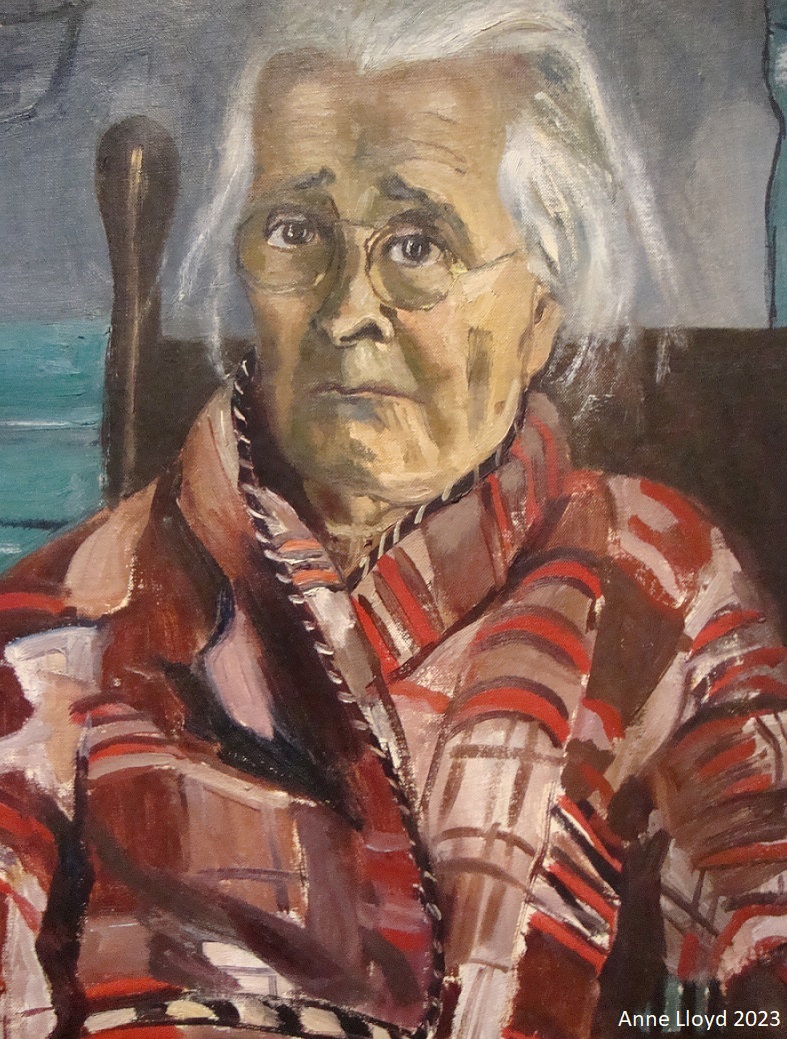
Goodman's Artist's Mother I sets the stage for the final work of art in the exhibition, Alice Neel's Last Sickness (1953). The painting is a loving, yet unsparing examination of the effect of age and illness on an "alert, tart woman" as Neel described her mother, who died the following year.

Those fortunate to visit the Metropolitan Museum of Art's sensational 2021 exhibition of Alice Neel's paintings will recall numerous examples of Neel's clear-eyed empathy for people of all ages and races, but especially those sick in body and in spirit. For those who were unable to visit the Met's Alice Neel: People Come First, the magnificent portrait on view at the Philadelphia Museum of Art provides the opportunity to see a life of artistic genius distilled into one superlative work of art.


 Anne Lloyd, Photo (2023)
 Alice Neel's Last Sickness, 1953 


The look of recognition of life's short span which we see on the face of Alice Neel's mother brings The Artist's Mother exhibition full circle. Anna Whistler's face, seen in profile, betrayed no such emotion. But no one knows what she was thinking, as her son fumed and muttered about the difficulties he faced to get the look he wanted on the canvas.


Anne Lloyd, Photo (2023)
 Gallery view of The Artist's Mother: Whistler and Philadelphia

Some commentators say that Anna Whistler was praying during the painting sessions that "Jemmie" would succeed with his portrait. If so, her prayers were answered.

So too, are the prayers of those - like me - who never had an opportunity to view Arrangement in Grey and Black: Portrait of the Artist's Mother in person. Seeing this magnificent painting is like being accorded an audience with a queen or a beloved author or actress.

My wife, Annie, said it best, during a pause in her picture-taking.

"When you enter the gallery where Whistler's Mother is displayed, you just don't go to see it," Anne said. "You are admitted into her presence."

***

Text: Copyright of Ed Voves. Original Photos: Copyright of Anne Lloyd.

Introductory Image: Anne Lloyd, Photo (2023) James Whistler's Arrangement in Grey and Black: Portrait of the Artist's Mother (detail), 1871.

Anne Lloyd, Photo (2023) James Whistler's Arrangement in Grey and Black: Portrait of the Artist's Mother. Oil on canvas: 144.3 x 162.5 cm (56 3/4 x 64"). Musée d'Orsay, Paris, RF 699.

Anne Lloyd, Photo (2023) Gallery view of The Artist's Mother: Whistler and Philadelphia exhibition at the Philadelphia Museum of Art.

Francesco Novelli (Italian, 1764-1836) After Rembrandt van Rijn's The Artist's Mother Seated, in an Oriental Headdress: Half Length, 1792. Etching: 5 1/4 x 5 1/16 inches ( 13.4 x 12.9 cm.) Philadelphia Museum of Art, 1928-42-4413

Anne Lloyd, Photo (2023) Jennifer Thompson of the Philadelphia Museum of Art discussing the kimono wall hanging depicted Whistler's Arrangement in Grey and Black: Portrait of the Artist's Mother. 

Anne Lloyd, Photo (2023) Henry Ossawa Tanner's Portrait of the Artist's Mother (detail), 1897. Oil on canvas: 29 1/4 x 39 1/2 inches ( 74.3 x 100.3 cm.) Philadelphia Museum of Art  EW1993-61-1

Anne Lloyd, Photo (2023) Jennifer Thompson of the Philadelphia Museum of Art discussing Cecilia Beaux's early masterpiece, The Last Days of Childhood, 1993-85.

Anne Lloyd, Photo (2023) Cecilia Beaux's The Last Days of Childhood, 1883-85. Oil on canvas: 116.2 x 137.16 cm (45 3/4 x 54 inches). Pennsylvania Academy of the Fine Arts. 1989.21

Dox Thrash (American, 1893–1965) Sunday Morning, around 1939. Etching: 8 7/8 x 8 inches (22.5 x 20.3 cm.) Philadelphia Museum of Art, 1941-53-378

Sidney Goodman (American, 1936-2013) Artist's Mother I, 1994. Charcoal and pastel on cream wove paper: 52 3/4 x 41 3/16 inches (134 x 104.6 cm.) Philadelphia Museum of Art, 2009-216-1

Anne Lloyd, Photo (2023) John Sloan's Mother, 1906. Etching:  9 x 7 1/2 inches (22.9 x 19.1 cm.) Philadelphia Museum of Art, 1956-35-73f

Anne Lloyd, Photo (2023) Alice Neel's Last Sickness, 1953. Oil on canvas: 30 x 22 inches (76.2 x 55.9 cm.) Philadelphia Museum of Art, 2003-148-1

Anne Lloyd, Photo (2023) Gallery view of The Artist's Mother: Whistler and Philadelphia exhibition at the Philadelphia Museum of Art..