Showing posts with label Dutch Golden Age. Show all posts

Tuesday, November 30, 2021

Art Eyewitness Book Review: Rembrandt in Amsterdam

 Rembrandt in Amsterdam

Edited by Stephanie S. Dickey & Jochen Sander 

Yale University Press//384 pages

Städel Museum, Frankfurt, October 6, 2021- January 30, 2022

Reviewed by Ed Voves

Every time I visit the Frick Collection in New York City, I make a point to "check-in" with Nicolaes Ruts (1573-1638). This somber-faced merchant lived in Amsterdam, with trading contacts extending all the way to Russia via the North Sea, around the Arctic coast of northern Norway and then down to the ice-free port of Archangel. The letter in his hand might bring news of a safely-landed cargo of precious furs from Siberia or a ship lost in the storm-tossed seas.


Rembrandt van Rijn, Nicolaes Ruts, 1631

The magnificent likeness of Nicolaes Ruts which we see at the Frick was the first significant portrait painted by Rembrandt van Rijn. The year of its creation was 1631. 

So successful was Rembrandt's image of Ruts, and other portraits executed soon after, that the trajectory of the young painter's life changed forever. Rembrandt had just purchased a sizable plot of ground, with garden, in his home town of Leiden. But commissions to paint wealthy merchants like Ruts were glittering opportunities which could not be forsaken. Rembrandt relocated his studio - and his life - to Amsterdam.

Rembrandt in Amsterdam: Creativity and Competition tells the story of how Rembrandt ventured to the rising center of trade and commerce of the Netherlands during the mid-1600's. The exhibition is currently on view at the Städel Museum in Frankfurt am Main, Germany. Earlier, it appeared in a Covid-19 interrupted presentation at the National Gallery of Canada, Ottawa.

The superbly illustrated catalog to Rembrandt in Amsterdam was edited by the curators of the exhibition, Stephanie S. Dickey & Jochen Sander, with contributions by a team of scholars. Dickey wrote the opening, biographical essay and several studies on important aspects of Rembrandt's oeuvre, including the way he treated the life of Jesus in several powerful works. Sander focused on how Rembrandt created his own distinctive style or "brand" according to twenty-first century usage.


Gallery view of the Rembrandt in Amsterdam exhibition at the 
Städel Museum, Frankfurt am Main, Germany

Rembrandt's life is a three-part drama, of rise, triumph and tragedy. This brilliant exhibition deals with the second chapter, Rembrandt's golden hour of fame and fortune. It ably complements Rembrandt: the Late Works at the National Gallery in London (2014), thus providing a wide-ranging reappraisal of the Dutch master's life and career.

However, Rembrandt in Amsterdam is not a story exclusively dealing with Rembrandt. Paintings by other notable Dutch "Golden Age" artists are also presented, making for a "crowded canvas" in the exhibition galleries and the pages of the accompanying catalog.

Gerard van Honthorst, Govert Flinck, Ferdinand Bol, Carel Fabritius and Jacob Backer are some of painters who share the stage in Rembrandt in Amsterdam. They proved to be worthy competitors, especially in the portrait trade. 

From the 1640's, these rivals gained lucrative commissions, many of which would otherwise have gone to Rembrandt. In some respects, this was a case of being victimized by his own success. Rembrandt had trained a number of these artists, including Flinck, Bol and Fabritius, in his own studio. 

These younger artists benefited mightily from Rembrandt's teaching and example. They kept an eye on changes in taste among the art-buying public, as can be seen in Jacob Backer's elegant, bejeweled Portrait of a Woman, painted around 1647.
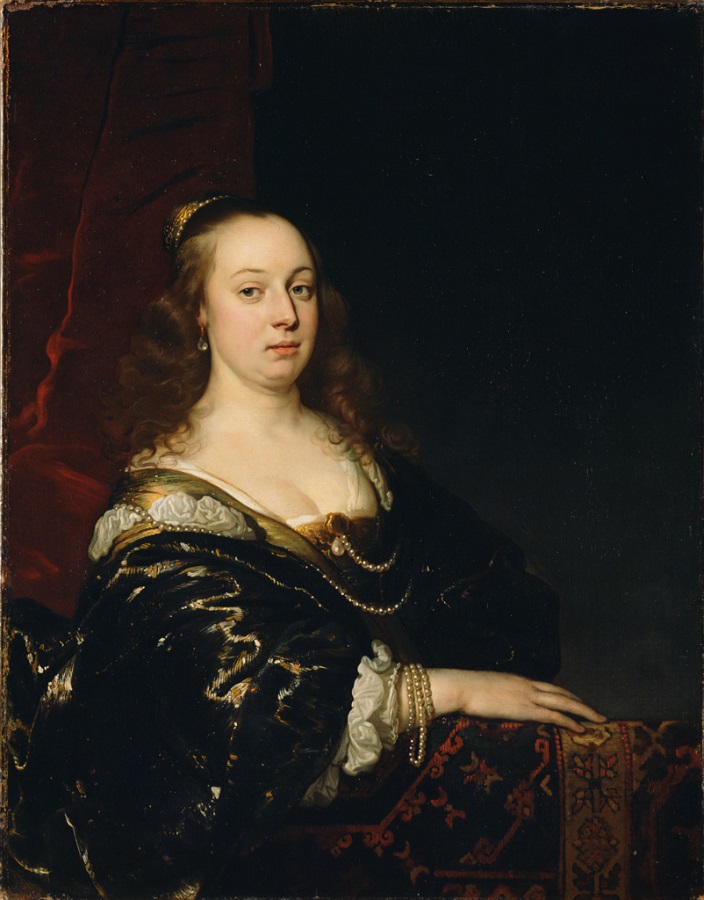


Jacob Backer, Portrait of a Woman, ca. 1647

This shift to an easier-on-the-eye mode of painting became known as the "bright style." Flinck, as noted in the exhibition catalog, was a pioneer of the lighter tones and close attention to surface detail which soon "supplanted Rembrandt's earthy palette and rough brushwork as the choice of a newly sophisticated clientele."

Rembrandt ignored these fickle alterations of taste. He took his teaching duties seriously, working so closely with his students that it is often difficult to ascertain who was the primary painter of some of the most celebrated works attributed to him. One of the "icons" of the National Gallery of Art in Washington D.C., A Girl with a Broom, was almost certainly completed by Carel Fabritius around 1651. 


           Rembrandt van Rijn, A Girl with a Broom, ca. 1646/1648;        
  completed 1651, possibly by Carel Fabritius

Rembrandt's willful, heedless character also played a significant part in his undoing.  Boldly signing his canvases with his first name only, Rembrandt claimed a place at the pinnacle of the Dutch cultural elite. It was a rarefied, vulnerable position for a miller's son, with a steep drop and no safety net should he fail and fall.

One of the principal themes of Rembrandt in Amsterdam is the process by which Rembrandt established his "brand" to use modern terminology. His successful transition to Amsterdam was based on his evolution from being primarily a "history" painter to embracing "the ideal of the universal master, proficient in all aspects of his craft."

Though a recognizable brand, a Rembrandt painting was never a standardized, "pre-fab" production. As Stephanie Dickey notes, Rembrandt's "approach was disruptively fluid: group portraits became action scenes, lofty historical figures were brought down to earth and the flat Dutch landscape gained a numinous mystery through nuanced effects of light."


Rembrandt van Rijn, Landscape with Stone Bridge, 1638

Rembrandt's life-sized portrait of Andries de Graeff (1611-1677) is a notable example of his "disruptively fluid" approach to painting. What appears to be a forthright likeness of an imperious, worldly gentleman is loaded with complex, contrarian details. 


Rembrandt van Rijn, 
Portrait of a Standing Man (Andries de Graef), 1639

De Graef came from a very prominent, powerful family. His austere black garments proclaim his wealth, as the color black was difficult and expensive to dye on to cloth. His simple, linen collar (as opposed to an elaborate neck "ruff") shows de Graef's allegiance to the populist political faction who were opposed to granting too much power to the central government led by the Stadtholder.

Likewise, de Graef's glove, fallen to the ground, might represent a nonchalant disregard for formality. Or, it might suggest a gauntlet thrown down as a challenge. De Graef, who rose to be finance minister of Holland, 1652-57 and mayor of Amsterdam, 1657-1672, was certainly a man to be reckoned with. Rembrandt's bravura portrait clearly asserts this, even as he leaves us to ponder  some of the puzzling details of the painting and its protagonist.

The exploration of character, of the man or woman behind the mask of facial features, is the supreme attribute of Rembrandt's portraits. The work from Rembrandt's early career which best exemplifies this is Portrait of a Man Holding a Black Hat (1637). 


Rembrandt van Rijn, Portrait of a Man Holding a Black Hat, 1637 

The skillful interplay of light and shadow on the garments of this unknown man is matched by the duality of Rembrandt's handling of his face. The competing aspects of human character, of our capacity for good or evil, are here delineated in portrait painting at the very summit of artistic skill.

Rembrandt's productivity as a portrait painter began to lapse in the 1640's. Instead, he continued with character explorations, increasingly of family members or of himself. These now rank among the greatest glories of world art.


Rembrandt van Rijn, Portrait of Hendrickje Stoffels, ca. 1654-56

However, portraits of his wife, Saskia, or later of his mistress, Hendrickje Stoffels, were not commercially viable works of art. This was especially true of paintings of Hendrickje, by then Rembrandt's common-law wife, who was denounced in 1654 by Dutch Reformed Church officials for living as a "whore."

As Rembrandt rose in the world, so did his taste for the finer things of life and for the money to pay for them. This led him to make a serious miscalculation, centered on one of the major works on view in Rembrandt in Amsterdam.

In January 1639, Rembrandt wrote to Constantijn Huygens (1596-1687), the secretary to the Statholder, Frederik Hendrik, announcing that he had finished an official commission of two paintings depicting the death and resurrection of Jesus. Huygens had been an early admirer of Rembrandt and had done much to advance his career. In the letter, Rembrandt mentioned that he was sending a major work of art by way of thanking Huygens for his patronage.


Gallery view of Rembrandt in Amsterdam,
showing The Blinding of Samson (left) and Venus and Cupid Lamenting the Dead Adonis by Cornelis Holsteyn, 1655    

The gratis painting was The Blinding of Samson, created in 1636. It is a spectacular work of art, as can be seen in the exhibition gallery at the Städel Museum. It is also a singularly unpleasant painting, graphically depicting one of the most notorious acts of betrayal and cruelty in the Bible. 


Rembrandt van Rijn, The Blinding of Samson, 1636

Although technically brilliant, The Blinding of Samson is so repellent that Rembrandt's reason for selecting it as a gift to Huygens needs to be questioned. 

Was Rembrandt's motive in sending the painting really a demonstration of gratitude? Or was he aiming to add Huygens to the list of influential patrons with a "Rembrandt" in their collection? Rembrandt actually had the temerity to advise Huygens how to hang The Blinding of Samson on the walls of his home. Once installed, bragging-rights and enhanced sales would be insured.

Huygens, in fact, declined the gift, most likely because it could be interpreted as a bribe. Yet Rembrandt insisted that he accept the painting. It is not certain that Huygens did so, though Christopher White, one of Rembrandt's most knowledgeable biographers, believes he did. If so, it was a costly victory for, as White notes, Huygens completely ignored Rembrandt "for the last thirty years of his life."

This unfortunate incident occurred in the same year that Rembrandt purchased a palatial house in Amsterdam. To do so, Rembrandt secured the first of many loans to pay the 13,000 guiders needed to buy his new home. If Rembrandt considered the idea that he should trim his personal expense account or paint more portraits to stay out of debt, he soon brushed the thought aside.

Rembrandt clearly was tempting fate by offending Huygens and by living  beyond his means. But such foolhardy conduct needs to be considered in light of his incredible artistic output and the awesome level of achievement which occurred as he began edging toward financial and personal disaster in the years before his 1656 bankruptcy.

Although his portrait production diminished over the course of the 1640's, Rembrandt created some of the most awesome paintings of his career during this decade, including The Night Watch (1642) and Christ and the Woman Taken in Adultery (1644). The magnitude of these works need to be considered alongside Rembrandt's investment of time, talent and effort in the wide-ranging sketching and printmaking of these years.

Not since Albrecht Dürer had any artist attempted to create prints of such profound beauty and technical sophistication.  No artist, since Rembrandt, has even come close to the measure of the Dutch master's success in works on paper. 

It is one of the many virtues of the exhibition catalog, published to the highest production values by Yale University Press, that Rembrandt's drawings and etchings are given equal prominence to his paintings. The selection of these works on paper and the detail and clarity on the pages of the catalog is superlative.


Rembrandt  van Rijn, The Three Trees, 1643

The Three Trees, 1643, deserves special consideration, as it unites several strands of thought and study regarding Rembrandt as his troubles continued to mount. It is an elaborate work, an etching with drypoint and engraving on laid paper. Does it represent an actual location visited and sketched by Rembrandt?

Rembrandt is known to have gone on walking/sketching rambles but the hundreds of drawings he made as strolled along the streets of Amsterdam or hiked about its suburbs rarely served as direct sources for commercial works like his etchings. The thatched cottages is this pen and brown ink drawing, now in the Getty Museum collection, almost certainly were on-the-spot depictions of humble dwellings.


Rembrandt  van Rijn,
Two Thatched Cottages with Figures at a Window, ca. 1640. 

Rembrandt most likely did see and sketch a copse of trees, similar to these cottages. These drawings were stored in binders - and in his memory - for future reference. But Rembrandt's landscapes, whether The Three Trees or the earlier oil painting, Landscape with Stone Bridge, are imagined spaces, typical rather than topographically accurate landscapes.

As Rembrandt sketched from nature, he likely communed with the spirit of his beloved Saskia, or at least brooded on her passing in 1642. The catalog includes a very poignant drawing of Saskia Asleep in Bed, dating to the time of her last illness. It may, indeed, show Saskia on her deathbed.

The Three Trees is an "imagined" landscape, a place of emotional solace as Rembrandt grappled with Saskia's death and his other woes. 


Rembrandt  van RijnThe Three Trees, 1643
 (detail from the Metropolitan Museum of Art version of the etching)

With this incomparable etching, Rembrandt attempted to depict an ideal setting, where earth and sky join "hands" and thoughts on human mortality could be seen from a more enduring perspective. The Three Trees, perhaps, represents a vision of paradise transplanted to a field on the outskirts of Amsterdam.

God made the world, as the old proverb proclaims, but the dike-building, marsh-draining Dutch created Holland. Reflecting on The Three Trees, its hard to resist the conclusion that Rembrandt was trying to lend a hand to God and the Dutch in both endeavors.

***

Text: Copyright of Ed Voves, all rights reserved

Introductory image: Rembrandt van Rijn (Dutch, 1606-1669) Self-portrait in a Velvet Beret,1634. Oil on oak panel:  58.3 cm (22.9 in) x  47.4 cm (18.6 in). Staatliche Museum zu Berlin, Gemäldegalerie #810.

Rembrandt van Rijn (Dutch, 1606–1669) Nicolaes Ruts, 1631. Oil on panel: 46 x 34 3/8 in. (116.8 x 87.3 cm). Purchased by The Frick Collection, 1943. #1943.1.150

Gallery view of the Rembrandt in Amsterdam exhibition at the Städel Museum, Frankfurt am Main, Germany. Photo courtesy of the Städel Museum.

Jacob Backer (Dutch, 1608-1651) Portrait of a Woman, ca. 1647. Oil on canvas: 95.3 × 74.9 cm (37 1/2 × 29 1/2 in.) Getty Museum. Gift of J. Paul Getty. #71.PA.18

Rembrandt van Rijn (Dutch, 1606-1669)  A Girl with a Broom, probably begun 1646/1648 and completed 1651, possibly by Carel Fabritius. Oil on canvas: 107.3 x 91.4 cm (42 1/4 x 36 in.)  National Gallery of Art. Andrew W. Mellon Collection.  Accession Number 1937.1.74

Rembrandt van Rijn (Dutch, 1606-1669) Landscape with Stone Bridge, 1638. Oil on panel: 29.5 cm × width 42.5 cm × depth 5.5 cm. Rijksmuseum, Amsterdam. Purchased 1900 SK-A-1935

Rembrandt van Rijn (Dutch, 1606-1669) Portrait of a Standing Man (Andries de Graef), 1639. Oil on canvas: 200 cm (78.7 in) x 124.2 cm (48.8 in). Hessen Kassel Gemaldegalerie Alte Meister. #GK 239.

Rembrandt van Rijn (Dutch, 1606-1669) Portrait of a Man Holding a Black Hat, 1637. Oil on panel: 31 5/16 x 27 5/16 in. (79.5 x 69.4 cm). The Armand Hammer Collection, Gift of the Armand Hammer Foundation. Hammer Museum, Los Angeles, AH.90.59

Rembrandt van Rijn (Dutch, 1606-1669) Portrait of Hendrickje Stoffels, ca. 1654-56. Oil on canvas: 101.9 x 83.7 cm. National Gallery, London. Bought with a contribution from the Art Fund, 1976. Inventory number NG6432

Gallery view of Rembrandt in Amsterdam, showing The Blinding of Samson (left) and Venus and Cupid Lamenting the Dead Adonis by Cornelis Holsteyn, 1655. Photo courtesy of the Städel Museum.

Rembrandt van Rijn (Dutch, 1606-1669) The Blinding of Samson, 1636. Oil on canvas:  219.3 x 305 cm. Städel Museum, Frankfurt am Main. Inventory #  1383.

Rembrandt van Rijn (Dutch, 1606-1669) The Three Trees, 1643. Etching with drypoint and engraving on laid paper: 21.8 x 28.7 cm; plate: 20.8 x 28 cm. National Gallery of Canada, Ottawa, purchased 1939.

Rembrandt van Rijn (Dutch, 1606-1669) Two Thatched Cottages with Figures at a Window, ca. 1640. Pen and brown ink, corrected with white gouache: 13.3 × 20.2 cm (5 1/4 × 7 15/16 in.). Getty Museum. Object # 85.GA.93.

Rembrandt van Rijn (Dutch, 1606-1669) The Three Trees, 1643. (Detail from the version of the etching in the collection of the Metropolitan Museum of Art, NYC.

Monday, October 23, 2017

Vermeer and the Masters of Genre Painting at the National Gallery, Washington D.C.


Vermeer and the Masters of Genre Painting: Inspiration and Rivalry 


National Gallery of Art, October 22, 2017 - January 21, 2018

Reviewed by Ed Voves

During the 1600's, the Dutch often compared themselves to the outnumbered Israelites battling against the Philistine hosts. After fighting for eighty years against the mighty Spanish Hapsburg empire, the United Provinces could be excused for a moment of self-congratulation in 1648. When the Treaty of Munster brought hostilities to an end that year, the Dutch had triumphed. David of the Netherlands had slain the Spanish Goliath.

The Dutch art of the Golden Age reflects that incredible victory - but in an unexpected way.  

Following the Treaty of Munster, depictions of military campaigns, never a major facet in Dutch art,  fell out of favor.  The popularity of Biblical scenes, a big feature of Rembrandt's early career, likewise declined. Instead, Dutch Gouden Eeuw artists evoked quiet harmony. Peaceful, "homey" moments for people grown tired of war were the order of the day.

These Dutch masters are the subject of a major exhibition at the National Gallery of Art (NGA) in Washington D.C., Vermeer and the Masters of Genre Painting: Inspiration and Rivalry. The National Gallery is the final venue for this exhibit, following earlier displays at the Louvre, Paris, and the National Gallery of Ireland in Dublin.

If Vermeer is the headline artist that is because the enigmatic painter from Delft has come to overshadow the other Dutch genre painters in this wonderful exhibit. 

Some of the finest examples of Vermeer's limited oeuvre, like Louvre's The Lacemaker, are on view in this wondrous exhibition. For three months, the Gouden Eeuw will live again and every art lover who can, should journey back in time, via the National Gallery in Washington D.C., to the age of Vermeer.

The NGA exhibit, for all of its celebration of Vermeer, does us the great service of seeing him within the context of his era.


Ed Voves, Photo (2017) Gallery view of Vermeer and the Masters of Genre Painting 

Vermeer actually represents the culmination of the post-Eighty Years War passion for genre painting. Throngs of people rush to see works by Vermeer but they should pay more attention to Gerhard ter Borch, Gerrit Dou, Frans van Mieris and the other Dutch genre painters. Thanks to the NGA exhibition, art lovers will be able to do exactly that.

Several surprises await them.

Gerhard ter Borch (1617-1681) is the unexpected "star" of the NGA exhibit and his works impressed me greatly. I find myself in complete agreement with the curator of the exhibition, Arthur Wheelock Jr, that ter Borch "is in many ways the most intriguing painter in the exhibition and the one who had the greatest impact on his colleagues." 
Wheelock further notes in the exhibition catalog:

Ter Borch mined gestures and expressions of figures to convey emotion, sometimes love or compassion, but also those fleeting moments of uncertainty that usually pass unnoticed by even the most observant friends and family. With these intimate scenes, which emphasised the inner life of his figures, ter Borch transformed the notion of "modern" in Dutch genre painting.

As well as providing new insights, Vermeer and the Masters of Genre Painting is a valedictory tribute to the great series of Dutch Golden Age exhibits that the NGA has hosted over recent years. These began with the celebrated Vermeer retrospective of 1995-1996. This incredible exhibit displayed 22 of the the 35 known works by Joannes Vermeer, including the  "Mona Lisa of the North," The Girl with the Pearl Earring

The 1995-96 Vermeer exhibit was anything but a harmonious affair. The US Government lurched to a halt during the budget feud between Congress and the Clinton administration. Along with a huge snow storm in January 1996, the galleries of the NGA were closed for nineteen days of the Vermeer exhibit's three month schedule. 

The Girl with the Pearl Earring is not making an appearance at this exhibition but a very impressive array of ten other Vermeer paintings are included. There are thirteen works by ter Borch on display, as well as superb examples of the other major Dutch genre painters,  including Gabriel Metsu, Pieter de Hooch, Caspar Netscher and Nicolaes Maes.

It is only natural that the NGA capitalizes upon Vermeer's current superstar status. And most of his works really do stand-out above the rest, though several of ter Borch's paintings more than hold their own. 


Ed Voves, Photo (2017) Johannes Vermeer's Woman with a Pearl Necklace, c. 1662-65

Looking down the galleries of the exhibit, I was amazed to see Vermeer's Woman with a Pearl Necklace glowing in the distance. It was, of course, a brilliant manipulation of overhead lighting to achieve such an effect. But it was the sheer brilliance of Vermeer's handling of natural light over three centuries ago that makes possible such a display of curatorial skill. 


Ed Voves, Photo (2017) Video frame from Vermeer and the Masters of Genre Painting

The exhibiton presents a short video enabling a "compare-contrast" of Vermeer's paintings with those of the other genre masters. It is clear that Vermeer's Lady Writing, painted around 1665-67, was created with a deep awareness of ter Borch's Woman Writing a Letter.  

Ter Borch's masterpiece dates to a decade earlier. It is a superlative work, with his sister, Gesina, posing as a model. She was a gifted painter and poet in her own right. 


Gerhard ter Borch, Woman Writing a Letter, c. 1655-56

Whether Vermeer, who seldom ventured far from Delft, saw ter Borch's Woman Writing a Letter is a difficult question to answer. But as a member of the Delft-branch of the artist's association, the Guild of St. Luke, Vermeer must have been familiar with the work of ter Borch (who lived in distant Devanter), at least by reputation. 


Johannes Vermeer, Lady Writing, c. 1665

The major difference between these two paintings is the direct gaze of Vermeer's protagonist. She is regarding us, the viewers, rather than being absorbed writing a letter as Gesina ter Borch was.  However, comparison of these works by Vermeer and ter Borch gains in fascination if we include another painting by the latter artist in the discussion.


Ed Voves, Photo (2017) Gerard ter Borch's Two Women Making Music, with a Page

This is ter Borch's Two Women Making Music, with a Page, painted about 1657. Gesina ter Borch apparently posed for the singer in the middle of the painting. 

However, it is the page who is the figure of real interest. The adolescent page boy, gingerly bringing in a carafe of beer or cider, looks directly toward us the viewer, just as Vermeer's Lady Writing would do nearly a decade later. 


Ed Voves, Photo (2017) Detail of Ter Borch's Two Women Making Music, with a Page

The bemused look on the page boy's face is so similar to that of Vermeer's Lady that it is almost inconceivable that Vermeer had not seen ter Borch's painting before beginning work on his.

Such is the lack of documentation about Vermeer's life that we are unlikely ever to know if he had the opportunity to travel around Holland to see the work of his contemporaries. We may think that Vermeer was influenced by ter Borch as other Dutch artists were. Yet, we don't know for certain.

We are on much firmer ground to emphasize the cultural connections of these Dutch genre masters during the years following the Treaty of Munster. To a remarkable degree, the shared aspirations and similar standards of work and play among the Dutch people created an emotional atmosphere favoring the creation of these genre paintings.

In his book, Paragons of Virtue, Wayne E. Frantis emphasized the importance of the everyday life and culture of the Dutch people during the Gouden Eeuw. Earlier scholars had been obsessed with “decoding” the symbolism and allegorical references that they saw depicted in Dutch art. 

These didactic elements certainly existed, as can be seen in many of Vermeer's paintings. The painting of the Last Judgment in the background of Woman Holding a Balance, c. 1664, is a good example of this subtle moralizing. However, Dutch art from the 1650's onward was firmly grounded in the realities of contemporary Dutch society, which no longer displayed the kind of Calvinistic religious fervor that had characterized the war years. Genre paintings reflected the new intimacy and self-indulgence of Dutch society.

Frantis, one of today's leading scholars of Gouden Eeuw art, broadened the scope of his investigation beyond the visual arts. Frantis found that Dutch literature and music of the period also reflected a “realistic style” as well. Frantis quotes the preface of the Great Songbook of 1622, revealing how the practical, sensible world view of the Dutch permeated even the soaring, impassioned realm of music

Gerbrandt Bredero, (1585-1618) poet, playwright and song composer, wrote in the Great Songbook of 1622 (which was actually published four years after his death) that:

As for me, I have learned from one book only, the book of practice; if I have made some mistakes because of my insufficient knowledge of foreign languages, sciences, and arts, I, unscholarly layman, beg your pardon; be a little tolerant of this Dutchman… I have followed the saying common among painters: Those who come closest to real life are the best painters… 

This digression to the world of music is certainly worth taking given the number of Dutch genre paintings which depict small ensembles or individual musicians or singers.


Jan Steen, Young Woman Playing a Harpsichord to a Young Man, c. 1659

Jan Steen's beautiful Young Woman Playing a Harpsichord to a Young Man (c. 1659) is a superb example of  the intersecting creative realms of art and music. It artfully evokes differing modes of attention, the young woman's on the notes of the musical score, the young man's gaze upon her delicate fingers as they strike the keyboard.

Vermeer's Young Woman Seated at a Virginal, was painted around 1675, a decade and a half after Jan Steen's musical tableau. What is noteworthy here is the emphasis on material cultural, the conspicuous display of expensive musical instruments, sumptuous fabrics and elaborate decor. Art and human artifice, so notable in Steen's painting, have been reduced to a mere pose in Vermeer's.


Johannes Vermeer, Young Woman Seated at a Virginal, c. 1675

Young Woman Seated at a Virginal was one of Vermeer's last paintings. By the time, Vermeer worked on it, another change was overtaking Dutch art, as evidenced by this painting. The human-scale joys that the earlier genre works had celebrated were increasingly replaced by more attention to a celebration of "worldly goods." It was the Dutch equivalent of "keeping up with the Jones."

I found that the works of Pieter de Hooch in the exhibition confirmed Kenneth Clark's observation in Civilization on the growing elitism of the Dutch genre painters:

In 1660, he (de Hooch) was painting pictures of clean, simple interiors, their ordered space full of light. Ten years later his interiors were very elaborate, and instead of light whitewashed walls there was gold Spanish leather. The people were richer: and the pictures much less beautiful. 

De Hooch's Woman Weighing Coins, painted around 1664, illustrates this surface glitter to perfection. His protagonist shrinks into her rich attire to such a degree that we barely see her face. The room's blaze of garish color differs drastically from the modest red skirt and yellow towel in de Hooch's earlier Woman Nursing a Child with a Child and a Dog (1658). 


Pieter de Hooch, Woman Weighing Coins, c. 1664

To their credit, the Dutch at the end of the seventeenth century did not entirely succumb to crass materialism. Most of these genre paintings, right up to the passing of the Gouden Eeuw, made an effort to balance the affairs of the soul with those of the body. Vermeer's Woman Holding a Balance is just the best-known in this respect 

It is measure of the Dutch achievement in art, science, philosophical inquiry and religious toleration that their Gouden Eeuw came closest to being an actual golden age, more so than any other society in recorded history.


Johannes Vermeer, Woman Holding a Balance, c. 1664

The quiet dignity, simple joys and - occasionally - ribald sensuality that we see displayed in these wondrous genre scenes on view at the National Gallery of Art testify to the core humanity of the Dutch during their golden century of achievement.

God made the world, as the old proverb declares, but it was the intrepid, freedom-loving Dutch who created Holland. These endearing genre scenes from the age of Vermeer are the art works that the Dutch painted on their day of rest.

***

Text: Copyright of Ed Voves, all rights reserved 
Images courtesy of the National Gallery of Art, Washington D.C. and Ed Voves

Introductory Image:                                                                                                          Johannes Vermeer (Dutch 1632-1675) The Lacemaker, c. 1670-71, Oil on canvas, transferred to panel. Overall  (framed): 71 x 63 cm (27 15/16 x 24 13/16 in.) Musée du Louvre, Paris, Département des Peintures, Acquired in 1870

Ed Voves, Photo (2017) Gallery view of the Vermeer and the Masters of Genre Painting exhibit, showing patrons examining Jan Stein's Young Woman Playing a Harpsichord to a Young Man, c. 1659.

Ed Voves, Photo (2017) Photo of Johannes Vermeer's Woman with a Pearl Necklace, c. 1662-65, Oil on canvas, framed: 76 x 69 cm (29 15/16 x 27 3/16 in.) Staatliche Museen zu Berlin, Gemäldegalerie.

Ed Voves, Photo (2017) Photo of the National Gallery of Art video, showing contrasting details of Johannes Vermeer's Lady Writing, c. 1665-67, with Gerhard ter Borch's Woman Writing a Letter, c.1655-56.  

Johannes Vermeer (Dutch 1632-1675) Lady Writing, c. 1665. Oil on canvas,framed: 68.3 x 62.2 x 7 cm (26 7/8 x 24 1/2 x 2 3/4 in.) National Gallery of Art, Washington, Gift of Harry Waldron Havemeyer and Horace Havemeyer, Jr., in memory of their father, Horace Havemeyer

Gerhard ter Borch (1617-1681) Woman Writing a Letter, c. 1655-56. Oilil on panel, overall: 39 x 29.5 cm (15 3/8 x 11 5/8 in.) Royal Picture Gallery Mauritshuis, The Hague

Ed Voves, Photo (2017) Photo of Gerard ter Borch's Two Women Making Music, with a Page, c. 1657. Oil on panel, unframed: 47 × 44 cm (18 1/2 × 17 5/16 in.) Musée du Louvre, Département des Peintures, ParisPhoto © RMN-Grand Palais (Musée du Louvre)/Franck Raux

Ed Voves, Photo (2017) Detail of Gerard ter Borch's Two Women Making Music, with a Page, c. 1657. 

Jan Steen (Dutch, 1625-1679) Young Woman Playing a Harpsichord to a Young Man, c. 1659. Oil on panel, framed: 60.5 × 51.5 cm (23 13/16 × 20 1/4 in.) The National Gallery, London. Bought, 1871. © The National Gallery, London

Johannes Vermeer (Dutch 1632-1675) Young Woman Seated at a Virginal, c. 1675. Oil on canvas, framed: 73 × 67.5 × 8.5 cm (28 3/4 × 26 9/16 × 3 3/8 in.) The National Gallery, London. Salting Bequest, 1910 © The National Gallery, London

Pieter de Hooch (Dutch 1629-1684) Woman Weighing Coins, c. 1664. Oil on canvas, unframed: 61 × 53 cm (24 × 20 7/8 in.) Staatliche Museen zu Berlin, Gemäldegalerie, Property of Kaiser Friedrich Museumsverein. bpk/Gemäldegalerie, SMB, Eigentum des Kaiser Friedrich Museumsvereins/Jörg P. Anders 

Johannes Vermeer (Dutch 1632-1675) Woman Holding a Balance, c. 1664. Oil on canvas.
Framed: 62.9 x 58.4 x 7.6 cm (24 3/4 x 23 x 3 in.) National Gallery of Art, Washington, Widener Collection     

Sunday, October 9, 2016

Drawings for Paintings in the Age of Rembrandt at the National Gallery, Washington


Drawings for Paintings in the Age of Rembrandt  


National Gallery of Art, Washington D.C.
October 4, 2016 - January 2, 2017

Reviewed by Ed Voves

Drawings for Paintings in the Age of Rembrandt, which just opened at the National Gallery in Washington D.C., testifies to Thomas Edison's often-quoted remark.

"Genius is one percent inspiration, ninety-nine percent perspiration."

Drawings for Paintings in the Age of Rembrandt provides vital insights into the work habits and methodology of leading Dutch masters from the seventeenth century "golden" age. This exhibit shows how Dutch artists "perspired" in order to realize their inspiration on the canvas sheets stretched on the easels in front of them.

The focus of Drawings for Paintings in the Age of Rembrandt really is on drawing rather than on painting. There was no color vs design controversy in the Netherlands as had been the case in Renaissance Italy. Dutch artists were determined to be expert at both drawing and painting, always with an eye on selling finished oil paintings. The National Gallery exhibit shows that they succeeded in both endeavors.


Gonzales Coques, Portrait of a Man Receiving a Letter from a Boy, c. 1660

A rare, unfinished work provides immediate insight into the importance of drawing for painting in the Netherlands during the 1600's. This painting is believed to be the work of a Flemish artist working in Holland, Gonzales Coque. It exemplifies the keen Dutch eye for capturing a subject's personality. The skill needed to position a painting's underdrawing, directly on the canvas or wood panel, is evident too. Why Coques, an associate of Anthony van Dyck, never finished this portrait, so splendidly begun, is unknown.

The catalog for Drawings for Paintings includes an insightful essay by the art scholar Ger Luitjen on the Dutch zeal for drawing. The ancient motto from the Roman writer Pliny, Nulla dies sine linea (No day without a line) struck a chord with the well-read, hard-working Dutch. A translation of Pliny's injunction to sketch predictably appeared: Geen dag zonder trek (No day without drawing).

Luitjen also notes that the Dutch emphasis on drawing had a wider impact than serving as a basis for painting. Other artists and artisans relied upon a facility in drawing too: sculptors, architects, tapestry designers. But the most profound implications of closely-observed drawing were psychological, in keeping with the leading role of the Dutch in the Scientific Revolution. The telescope and microscope were both Dutch inventions but neither would have been created had the Dutch not been an observant, imaginative people to begin with. 

"Undergirding the conviction that drawing was important lay the belief that it intensified the process of looking," Luitijen writes. "An added advantage was that someone with a trained drawing hand would benefit when wishing to record something while studying physics and mathematics."

The link between drawing and painting is most readily observed in two works by Salomon de Bray. De Bray sketched the infant children of his nephew with red chalk, the preferred medium for sketching. Close analysis revealed that de Bray did a light, preliminary drawing using black chalk before his more detailed effort with red chalk.


Salomon de Bray, The Twins Clara and Albert de Bray, August 12,1646

There are many differences between de Bray's final version in oil and this preparatory work. The open eyes of the two babies in the painting and the baptismal medals around their necks are only the most obvious changes from sketch to painting. Both of these details are very significant. Most portraits of infants in the Netherlands during the 1600's were memorials to deceased babies. The medals testify to the Roman Catholic faith of the de Bray family. This remarkable painting is a statement of religious faith and a celebration of the gift of life.


Salomon de Bray, The Twins Clara and Albert de Bray,1646

The differences between drawing and painting of The Twins Clara and Albert de Bray have led some scholars to believe that de Bray did an oil sketch as a second stage in the composition. But the astute commentary in the exhibit catalog concludes that he worked only from this simple sketch and from memory to create the superb and endearing final version in oils.

There are numerous examples of the exhibit's namesake on view. Rembrandt's somber painting, Joseph Telling His Dreams, is particularly noteworthy. Dating to 1633, this work was based in part upon a red chalk sketch of an elderly man, drawn two years previously, who reappears as the seated Jacob.


Rembrandt van Rijn, Joseph Telling His Dreams, 1633

The various biblical characters grouped around Joseph and Jacob were likely taken from multi-figured sketch book pages. Rembrandt utilized such sketches throughout his life, referring to these for a pose or a facial expression as needed.

A good example of such a sketch is on view in the exhibit, Studies of Mary, the Mother of Christ and Mary Magdalene. Rembrandt's The Entombment of Christ, c. 1635-39, was based upon it and no doubt similar drawings. After he was satisfied with the basic design of Entombment, Rembrandt would then have filed these sketches away for future use.


Rembrandt, Studies of Mary, the Mother of Christ & Mary Magdalene, 1635-1636 

There are no records of Dutch artists creating finished oil paintings en plein air as the Impressionists would do two centuries later. But the practice of sketching out of doors was surely widespread. One painter who ventured beyond his studio to record the world around him unwittingly documented the climate change known as The Little Ice Age.

Beginning around 1300, temperatures in the Northern Hemisphere began to cool, with periodic fluctuations that caused to such bizarre phenomena as the 1608 Frost Fair on the Thames River in England. The canals in Holland regularly froze enabling the Dutch to skate and play "kolf" on the ice. Kolf was a curious blend of street hockey and modern-day golf.

Hendrick Avercamp (1585-1634), though a deaf-mute, became a master drafstman whose drawings were prized by other Dutch artists, Avercamp's painting, A Scene on the Ice, c. 1625, is based on a preliminary work such as A View of Kampen from Outside the Walls, done around 1620. This work was created with pen and brown ink with watercolor over graphite on paper. It shows the city of Kampen overlooking the river IJssel in warm weather.


Hendrick Avercamp, A Scene on the Ice, c. 1625

The 1620's saw some very cold winters - the Thames froze again in 1621. Avercamp, who lived in Kampen, had only to take his sketchbook down to the banks of the frozen IJssel and draw the sleighs, skaters and kolf players. 

His voluminous sketchbooks providing a wide-ranging selection of winter-clad characters and architectural details, Avercamp was well-prepared to compose his works in oil. With the setting already recorded, Avercamp could paint ice in place of water and skaters instead of sailboats. This he did and did repeatedly until he became the recognized expert in painting winter scenes

Dutch artists were meticulous and exacting draftsmen. But their drawings for the most part were intended for use and then discarded. What is displayed in this splendid exhibition, organized by Arthur Wheelock Jr., the National Gallery's dean of Dutch seventeenth century art, is a mere fraction of what was created during that prolific era. Many of the drawings that did survive come from a research institution in Paris, the Fondation Custodia, Collection Frits Lugt, dedicated to the preservation of the art of the Dutch Golden Age.

The final gallery of the exhibition examines architectural works by such masters as Gerrit 
Berckheyde and Jacob Van Ruisdal. The exhibit uses the advanced technology of infrared reflectography to examine the underdrawings of these amazing paintings. Some exciting and unsuspected discoveries were made.


Gerrit Berckheyde, View of the Nieuwezijds Voorburgwal in Amsterdam

For all of their emphasis on precise drawings, Dutch painters often used these as a guide, rather than directly transferring the image to the canvas and painting in the colors. We can see this process in a painting by Michiel van Musscher. In An Artist in His Studio with His Drawings, the painter has his sketches spread out around him which he is using to create an oil sketch. This in turn would serve as the source for the finished version.

Creating the final work in oil was an exacting and exhausting labor. Every artist had his - or her - own techniques and technical aids to guide their compositions, safeguarded to protect the "brand." Yet, the artistic process was never a routine, "cut and paste" process. Individuality, as well as hard-work, was the key to Dutch creative excellence.

Wheelock notes in the catalog that Berckyde "was so interested in topographical accuracy that he even amended drawings at a later date when new buildings were constructed."


Gerrit Berckheyde, The Grote Kerk or St. Bavokerk in Haarlem, 1666

Berckyde, however, was far from a pedantic recorder of architectural detail. He often chose unusual vantage points for his final versions. Likewise, the brilliant way that he articulated light and shadow gives an almost photographic effect to works like his 1666 oil on panel, The Grote Kerk or St. Bavokerk in Haarlem

The Dutch Golden Age is such an inspiring cultural phenomenon that it seems appropriate that  van Musscher's Artist in His Studio should be wearing his "Sunday best" attire while hard at work on his masterpiece.

The reality was far different, though the Dutch have always made a virtue of order and cleanliness. The work environment of most Dutch artists was closer to the shabby, sweat-soaked surroundings of Cornelis  Bega's The Alchemist.

The lighting of a Dutch master's studio would doubtless have been better than the dungeon-like atmosphere of the workshop of The Alchemist. But the pungent smells, the stacks of unfinished works requiring immediate attention to keep the bills paid, the very air of hard labor and anxious expectation - these would have been the same.


Cornelis Bega, The Alchemist, 1663

Genius is a messy business. But the result - when everything "comes together" - can sometimes create a "golden" age. That is what occurred in the Netherlands during the 1600's and the works on display in the National Gallery's Drawings for Paintings in the Age of Rembrandt are proof of the Dutch work ethic and visionary dedication to art.

***
Text: Copyright of Ed Voves, all rights reserved 
Images courtesy of the National Gallery of Art, Washington D.C.

Introductory Image:                                                                                                         Michiel van Musscher (Dutch, 1645-1705) An Artist in His Studio with His Drawings, mid-1660s. Oil on panel, 47 × 36 cm (18 1/2 × 14 3/16 in.) Liechtenstein. The Princely Collections, Vaduz-Vienna

Attributed to Gonzales Coques (Flemish,1614/18-1684) Portrait of a Man Receiving a Letter from a Boy, c. 1660. Oil on panel, 55.9 × 44.2 cm (22 × 17 3/8 in.) The Orsay Collection, London, Paris

Salomon de Bray (Dutch, 1597-1664) The Twins Clara and Albert de Bray, August 12, 1646. Red chalk, over faint indications in black chalk, on paper, sheet: 16 × 15.2 cm (6 5/16 × 6 in.) The Morgan Library & Museum, Purchased in 1909.

Salomon de Bray (Dutch 1597-1664) The Twins Clara and Albert de Bray,1646 or after.
Oil on canvas, unframed: 82.6 × 64.8 cm (32 1/2 × 25 1/2 in.) National Galleries of Scotland, Long loan in 1995

Rembrandt van Rijn (Dutch, 1606-1669) Joseph Telling His Dreams, 1633. Grisaille on paper, 55.8 × 38.7 cm (21 15/16 × 15 1/4 in.) Rijksmuseum, Amsterdam, purchased with the support of the Vereniging Rembrandt and the Stichting tot Bevordering van de Belangen van het Rijksmuseum

Rembrandt van Rijn (Dutch, 1606-1669) Studies of Mary, the Mother of Christ, and Mary Magdalene, 1635-1636. Pen and brown ink, red chalk, sheet: 20.1 × 14.3 cm (7 15/16 × 5 5/8 in.) Rijksmuseum, Amsterdam

Hendrick Avercamp (Dutch 1585-1634) A Scene on the Ice, c.1625. Oil on panel, 39.2 x 77 cm (15 7/16 x 30 5/16 in.) National Gallery of Art, Washington, Ailsa Mellon Bruce Fund.

Gerrit Berckheyde (Dutch 1638-1698) View of the Nieuwezijds Voorburgwal in AmsterdamGraphite, pen, and brown ink on paper, 16.9 × 27.6 cm (6 5/8 × 10 7/8 in.) Koninklijk Oudheidkundig Genootschap, Amsterdam

Gerrit Berckheyde (Dutch 1638-1698) The Grote Kerk or St. Bavokerk in Haarlem,1666.
Oil on panel, 60.3 x 84.5 cm (23 3/4 x 33 1/4 in.) Otto Naumann Ltd, New York

Cornelis Bega (Dutch 1631/32-1664) The Alchemist,1663. Oil on canvas mounted on panel
35 × 28.6 cm (13 3/4 × 11 1/4 in.) National Gallery of Art, Washington, From the Collection of Ethel and Martin Wunsch, 2013.34.1