Sunday, June 12, 2016

Art Eyewitness Book Review: Maniera: Pontormo, Bronzino and Medici Florence


Maniera: Pontormo, Bronzino and Medici Florence


Edited by Bastian Eclercy

Prestel Publishing/304 pages/$60

Reviewed by Ed Voves

The Städel Museum in Frankfurt, Germany, is one of Europe's most innovative museums. The recent Städel exhibition, Maniera: Pontormo, Bronzino and Medici Florence, presented art works from one the most contentious periods of European history, Italy during the mid-1500's.

The accompanying volume to this exhibit, published by Prestel, is a work of art in itself. The abundant illustrations include copies of paintings not on display at the Städel, thus enabling more thorough comparison with those on view. The perceptive essays in the book, edited by the noted historian, Bastian Eclercy, raise many important questions - and answers -  about this controversial chapter of the Renaissance.


Gallery view of the Städel Museum exhibit, Maniera

Why Italian art of the 1500's should be a "difficult" subject can be explained in one word: mannerism

The Städel exhibit uses the Italian word, maniera, rather than the more familiar and dismissive Mannerism. In modern scholarship, maniera points to the many and varied interpretations of art that flourished in Italy during the 1500's. 

This change of terminology and the inspired efforts of the Städel Museum curators redirect our attention away from theories about Italian art of the 1500's to the art works themselves. It is a noble endeavor, a much needed one and it almost succeeds.

Almost. 

Mannerist art gained its clouded reputation because decisive changes were held to have occurred in Italy during the 1520's - and not for the better.


Raphael, Esterházy Madonna, c. 1507-08

Leonardo da Vinci and Raphael were dead by 1520 and art was at an impasse following the death of these inimitable masters. Likewise, Italy was ravaged by war, climaxed by the sack of Rome in 1527. The art that was created following these terrible events was held to reflect a devastating emotional malaise.

Some of the masterpieces displayed in the Städel exhibit and the Prestel catalog show the impact of the Italian Wars. Jacopo Pontormo's St. Jerome as Penitent was painted a year after Protestant troops employed by the Catholic Holy Roman Emperor, Charles V, pillaged the city of Rome. Charles V aimed to teach Pope Clement VII a lesson about power politics. Eight thousand people were murdered and the holiest city of  Christendom was desecrated.


Jacopo Pontormo, St. Jerome as Penitent, c.1528-29

Pontormo's St. Jerome beats his chest with a rock, having flung aside his cardinal's robe. It is one of the most searing images of a soul in agony in Renaissance art. Utterly realistic, yet surreal in its effect, Pontormo's St. Jerome powerfully evokes physical and spiritual torment.

How different is Pontormo's St. Jerome as a Penitent to the absorbed, scholarly St. Jerome of Albrecht Durer's famous engraving, dating to 1514. Nor does St. Jerome's companion, the lion, sleep contentedly as Durer depicted him. Instead, the lion in Pontormo's version looks upon the naked, suffering man with a look of incredulity... as we are likely to do, the more we study this amazing painting.

However much the tragic slaughter in Rome oppressed the minds of Renaissance painters, the sad fate of Florence had a profound effect as well. The headlined artists in the Städel exhibit, Jacopo Pontormo (1494-1556) and Agnolo Bronzino (1503-1572), were both Florentines. They witnessed the destruction of the political liberties of Florence, crushed by the resurgence of  Medici power - glittering, bountiful and despotic.
                                                                                     
Pontormo learned his craft in the studio of Andrea del Sarto, one of the greatest Renaissance masters of desegno or drawing. This was the specialty of Florentine artists and Pontormo took del Sarto's lessons to new levels of excellence. One of the outstanding works in the Städel exhibit is a drawing in red chalk which for many years was mistakenly ascribed to del Sarto.


Jacopo Pontormo, Study of Two Standing Women, c. 1515

Study of Two Standing Women was proven, as far back as 1958, to have been drawn by Pontormo. It has still to be properly acclaimed, for as Eclercy writes in the Prestel catalog, "it has not received the attention it deserves: it is, after all, one of the single most virtuoso drawings of Pontormo's early phase."

The sense of energy, potential and kinetic, of this drawing, dated to 1515, is incredible. We can see a prefiguring of the writhing movement of the tormented St. Jerome in this drawing. Even more remarkable, is the way that we sense the flow of power, of vigor, that will propel the bodies of these women forward and off the page.

If a thread of development can be traced from Pontormo's early sketches to his St. Jerome as Penitent, that is a rare case of continuity. Pontormo was one of the most searching and eccentric artists in history. His famous Deposition from the Cross - which did not appear in the Städel exhibit - has a brilliant color scheme totally at odds with its somber subject. Nothing in Pontormo's variegated work, however, prepares us for the mythology-themed paintings which he created in the 1530's.

Whatever their style, Pontormo's works prior to 1530 had been notable for their religious feeling. His Venus and Cupid, though based on  a drawing by Michelangelo, is alarmingly erotic. 


Jacopo Pontormo, Venus and Cupid, c. 1533

Venus and Cupid is a "pagan" work of art, not unlike the first century frescoes that would be discovered in Pompeii centuries later. But Pontormo was a Christian artist and so was his disciple and student, Agnolo Bronzino. Here was "mannerist" art that was a radical departure from anything that had come before.

Bronzino painted his version of Venus and Cupid, even more sexually charged, around 1545. It did not appear in the Städel exhibit. Instead the exhibit wisely focused on Bronzino's portrait painting. During the 1530's, portrait commissions shifted from providing images of saints or clergymen to "power portraits" - Medici power.

Florence was a city with a strong tradition of civil liberties. Around the time of the sack of Rome, the Florentines took advantage of the turmoil in Italy to re-establish their cherished Republic. But a catastrophic outbreak of plague claimed 36,000 lives.

Alarmed at this resurgence of political independence in Florence, Charles V, Pope Clement VII and the Medici staged a rapprochement. They conveniently "forgot" about the sack of Rome. The desperately weakened Florence was besieged by their forces and fell after a heroic resistance in August 1530.                                                                      

Political liberty was dead in Italy and artists like Pontormo and Bronzino had to adapt.

Bronzino was a brilliant portrait painter, as can readily be seen in his Portrait of a Lady in Green, painted between 1530-32. It is a work in the evolving tradition of Renaissance portraiture whereby the life-like image of the sitter permits insight into her inner character as well. 


Agnolo Bronzino, Portrait of a Lady in Green, c. 1530-32

Psychological insight of the kind that Bronzino showed in Lady in Green in 1530 was no longer desirable in 1537. The Medici, restored to power, wished to be depicted as austere, unflinching authority figures. Having little real power, these Italian nobles wished to be seen as all powerful.

Bronzino's Portrait of a Lady in Red, which serves as the introductory image of this review, is believed to represent Francesca Salviati, the aunt of a Medici duke, Cosimo I. It is tremendously accomplished in many ways. Yet, it is a disturbing work, very much of the kind that has raised "red flags" about Mannerism.

The impassive, "ice goddess" countenance of the Lady in Red is really a mask rather than an accurate likeness. The face is almost androgynous and is drained of individuality, empathy and the marks of life experience. Lady in Red is a Renaissance Athena, a personification rather than a person. 


Agnolo Bronzino, Portrait of a Lady In Red, (detail)

Looking closely at the charming, skillfully-modeled lapdog held by Lady in Red, I wonder if Bronzino was making a sly comment on the restored Medici regime in Florence. As Speaker of the House, Sam Rayburn, used to say of the treacherous backstabbing in Washington D.C., "If you want a friend in this town, get a dog."

Debate has long raged over whether Mannerism represented a decline in standards or a reformulation in Renaissance art. These shifts in appraisal are examined in an excellent essay in the Prestel book.

During the 1500's, it was the judgment of the Catholic Church on the merits of Mannerist art that carried the most weight. When a Christian martyr, St. Sebastian, was depicted by Bronzino as a smiling, beautiful, nearly-naked boy, pierced by a Cupid's arrow, the reaction of the Catholic Church was not hard to predict.


Agnolo Bronzino, St. Sebastian, c. 1528-29

In 1545, Church leaders convened the Council of Trent to reform  Christendom following the Protestant Reformation. Religious art was a major agenda item.

Religious art, according to the Council of Trent must affect the emotions of the Christian faithful, not provide erotic enjoyment or cerebral reflection. In his wonderful book, Renaissance, Andrew Graham-Dixon quotes Gabriele Paleotti, the bishop of Bologna, on the Catholic Church's zealous attitude to art.                                                                                                    
Paleotti wrote in 1582 that the aim of religious art is to  leave Christians feeling "shattered" by depictions of Christ's crucifixion or a saint's martyrdom.

If a work of religious art fails to stimulate a Christian's ardor, then Paleotti wrote "we must be made of marble or wood if we do not feel deeply moved, if our piety is not stimulated afresh and our inner being is not deeply affected by remorse and devotion."

In the eyes of the Church, a statue or a painting that remained "marble or wood" rather than a testament of faith was deeply offensive.  Artists who created such works were censured, even the great Michelangelo.


Bronzino's Portrait of Eleonora di Toledo at the Städel Museum exhibit, Maniera

The debate over Mannerism which began with the Council of Trent has continued to this day. It is never likely to be resolved because the issues involved were meaningful  in the 1500's and remain so. True religious art cannot remain a thing of "marble or wood." Yet artists must have the freedom to create works in their own "manner."

The outstanding effort that went into Maniera, both the Städel exhibit and the Prestel catalog, represents a major step in judging this key episode in the story of Western art. In the future dialog about Mannerism, Maniera will serve as a long-standing point of reference.

***
Text: Copyright of Ed Voves, all rights reserved 

Images courtesy of the Städel Museum, Frankfurt am Main

Introductory image and detail:
Agnolo Bronzino (Italian, 1503–1572) Portrait of a Lady In Red (Francesca Salviati?), c. 1533. Oil on poplar, 89.8 x 70.5 cm. Städel Museum, Frankfurt am Main. Foto: Städel Museum – ARTOTHEK

Gallery view of the Städel Museum exhibit, Maniera.  Photo: Städel Museum 

Raphael (Italian, 1483–1520) Esterházy Madonna, c. 1507-08. Oil on panel, 29 x 21.5 cm. Szépművészeti Múzeum, Budapest, 2016

Jacopo Pontormo (Italian, 1494–1557) St. Jerome as Penitent, c. 1528/29. Oil on poplar, 105 x 80 cm. Niedersächsisches Landesmuseum Hannover. Photo: Niedersächsisches Landesmuseum Hannover – ARTOTHEK

Jacopo Pontormo (Italian, 1494–1557) Study of Two Standing Women, c. 1515. Red chalk on paper, 39,3 x 26,1 cm. Munich, Staatliche Graphische Sammlung. 

Jacopo Pontormo (Italian, 1494–1557) after a cartoon by Michelangelo Buonarroti.
Venus and Cupid, c. 1533. Oil on panel,  128 x 194 cm. Galleria dell’Accademia, Florenz
© Foto: Antonio Quattrone

Agnolo Bronzino (Italian, 1503–1572) Portrait of a Lady in Green, c. 1530-32. Oil on poplar, 76,6 x 66,2 cm. Windsor Castle, State Apartments, Windsor. Royal Collection Trust/© Her Majesty Queen Elizabeth II 2015

Agnolo Bronzino (Italian, 1503–1572) St. Sebastian, c. 1528-28. Oil on panel, 87 x 76,5 cm.
Museo Thyssen-Bornemisza, Madrid


Portrait of Eleonora di Toledo at the Städel Museum exhibit, Maniera. Photo: Städel Museum 

Saturday, June 4, 2016

Russia and the Arts at the National Portrait Gallery, London


Russia and the Arts: The Age of Tolstoy and Tchaikovsky  


National Portrait Gallery, London

17 March - 26 June 2016


Reviewed by Ed Voves

"Once in a Lifetime" is an often used expression to describe art exhibitions. In the case of the twenty-six masterpieces of Russian painting on view at London's National Portrait Gallery, this sense of unique opportunity is particularly appropriate.

Russia and the Arts: The Age of Tolstoy and Tchaikovsky is part of an exchange program between the State Tretyakov Gallery in Moscow and the National Portrait Gallery. Unless diplomatic tensions between the West and Russia relax, the incomparable Russian portraits currently at the National Portrait Gallery are unlikely to make further visits to Western Europe or the United States in the near future.

Both the State Tretyakov Gallery and the National Portrait Gallery trace their roots back to 1856. But what happened one hundred sixty years ago differed dramatically, reflecting the cultural identities of the respective nations.

London's National Portrait Gallery was founded in a display of public-spirited action by such eminent Victorians as Thomas Carlyle, Thomas Macaulay and Benjamin Disraeli. In Russia, it was one man, acting alone and using his own financial resources, who created the State Tretyakov Gallery in Moscow.


Pavel Tretyakov,1871

Pavel Tretyakov (1832-1898) was a visionary figure - but a quiet hero. Tretyakov came from a merchant family, whose moderate wealth derived from the textile trade. Significantly, Tretyakov's family were "Old Believers." 

Dating back to a religious schism in the mid-seventeenth century, the "Old Believers" had been persecuted and banned from privileged ranks in Russia's government and military. The social position of the "Old Believers" may be compared to that of the Quakers, Methodists and other Dissenters in Britain. Both excluded groups looked to trade and industry and, having made fortunes, reinvested much of their profits into community-minded enterprises.

For Pavel Tretyakov that entailed collecting works of art created by Russian, not foreign, artists. Tretyakov was determined to show Russia in all its astonishing variety and complexity. He also wanted to encourage cultural achievement in a nation where a vast number of people had just shaken-off the shackles of serfdom in 1861. 


Nikolai Kuznetsov, Petr Tchaikovsky, 1893 

Portraits of Russia's "great and good" featured prominently in his collection, like this striking depiction of PetrTchaikovsky which shows his fearful, careworn face looming like an apparition rising from a sea of blackness.

Eventually, Tretyakov established a gallery at his home on Moscow's Lavrushinsky Lane to preserve these masterpieces of Russian art. Now called the State Tretyakov Gallery, the museum and the nearly two thousand paintings collected by Tretyakov were bequeathed to the city of Moscow in 1892.


Ilia Repin, Pavel Tretyakov, 1901

Tretyakov's embrace of art works created by his countrymen was a major shift from earlier patronage in Russia. 

Prior to 1856, Russia's ruling elite heeded the example of Tsarina Catherine the Great. Huge sums were lavished on paintings by Western European Old Masters. Portraits, for the most part, were commissioned from visiting foreign artists, notably Elizabeth Vigée Le Brun. And most shocking of all, when a special gallery was created to honor the heroes of the war against Napoleon, the architect was an Italian, Carlo Rossi, and the bulk of the portraits were painted by the English artist George Dawe. 

Russia did not lack for native talent in the arts during the 1700's, but most of these artists were serfs, like Ivan Argunov (1729-1802). It took a patriotic Russian from outside the privileged  elite to counteract the callous indifference to Russia's heritage.

The young Tretyakov's first two purchases in 1856, a moralistic genre scene and a battle piece, were hardly impressive. But Tretyakov, self-taught though he was, quickly developed into shrewd judge of talent. 

Tretyakov soon amassed an astonishing collection of every genre of Russian art and, in a bold move, began commissioning portraits of his nation's leading writers. Quite often, Russia's literary lions proved difficult to "tame." Count Leo Tolstoy, the greatest of all Russian authors, resisted for years in sitting for his portrait. Finally the threat of inferior, unofficial portraits gained his compliance.


Nikolai Ge, Leo Tolstoy, 1884

This superb portrait, by Nikolai Ge, dates to 1884. Around that time, Tolstoy renounced literary writing for philosophical works. Ge, a personal friend of Tolstoy, shows him absorbed in editing the manuscript of What I Believe. When published, this book was banned and Tolstoy spent the rest of his life opposing the authoritarian dictates of the Tsarist government and the deeply conservative Russian Orthodox Church.

Ge's portrait of Tolstoy illustrated the fracture in Russian society between its rigid governing elite and the intelligentsia. Percy Bysshe Shelley had declared in 1821 that "poets are the unacknowledged legislators of the world." Nowhere during the 1800's was that more true than in Russia.

In one of the most significant blunders in world history, Tsar Alexander I failed to liberate the serfs of Russia in 1818, despite their loyalty and heroism in resisting Napoleon's legions. Many of the Tsarist officers supported such a liberal political agenda. Alexander's brother and successor, Nicholas I, crushed a mutiny by a band of these reformers, the Decembrists. Nicholas ruled Russia from 1825-1856 with the mindless brutality of a drill sergeant.

During this woeful time, only Russia's writers opposed Nicholas I. Some, like Alexander Herzen, (1812-1870) lived as emigres in Western Europe, exiled from the land they loved. Others, notably Fedor Dostoevsky (1821-1881), endured brutal imprisonment in Siberia.

The effect of long years of hard labor in Siberia, followed by forced service in Russia's army, can be seen in the face of Dostoevsky. The portrait was painted by Vasily Perov. An early favorite of Tretyakov, Perov painted a series of controversial genre scenes, critical of church and state. But with this profoundly moving image of a human mind and soul, locked in upon itself, Perov delivered a powerful rebuke to the corruption and cruelty of the Tsarist prison state.


Vasily Perov, Fedor Dostoevsky, 1872

Except for Albrect Durer's Praying Hands, I don't think any artist ever depicted two hands, clasped together, better than Perov. The fingers, intertwined, evoke the lock on a prison cell. This is a brilliant counterpoint to the introspective gaze of Dostoevsky, separating us from this tortured man, who can only be reached via the pages of his classic novels.

Psychological insight is the keynote of the portrait of Modest Mussorgsky by Ilia Repin. Frequently reproduced in art books, Repin's Mussorgsky is an unsettling image. Here we see a man of genius at the brink of death.  It is a challenge to our powers of comprehension for Mussorgsky was not wasting away from tuberculosis. Instead, he was brought low by inner contradictions and unseen weakness - like Russia itself.

Mussorgsky came from a wealthy and influential aristocratic family. He was a pianist of dazzling talent and a brilliant composer.  But Mussorgsky, tormented by inner demons, succumbed to drinking binges, alarming even by Russian standards of excess.

In the late winter of 1881, Ilia Repin hastened to paint Mussorgsky, who was being treated for acute alcoholism in a military hospital. Just as the painting session commenced, the staggering news of the assassination of Tsar Alexander II was announced. Alexander II had bravely tried to correct Russia's despotic misrule, liberating the serfs in 1861. The Tsar was just on the point of creating a national legislature, when assassins attacked his carriage with hand grenades.

During the confusion and grief following Alexander's death, a medical orderly slipped Mussorgsky a bottle of cognac. He died from its effects and Repin never had the chance to formally complete the portrait. 


Ilia Repin, Modest Mussorgsky, 1881

Repin's insight into the complex character of Mussorgsky is so compelling that we scarcely recognize any lack of finish in the picture. Here is life and talent - mortality itself - disintegrating before our very eyes.

Repin's portrait of Mussorgsky is sensational. It is easy to see why Tretyakov favored his work. Of the twenty-six art works in Russia and the Arts, eight are by Repin. These include his portrait of the great pianist, Anton Rubenstein, scowling with a mass of hair billowing like a lion's mane. 

Repin outlived Tretyakov by three decades. He lived to see the conflagration of the Bolshevik Revolution and the flight into exile of many of those whose portraits he had painted. Repin himself fled to Finland where he died in 1930.

One who stayed - and incredibly survived - the purges following 1917 was the poetess, Anna Akhmatova (1889-1966).  The "mouth though which a hundred million scream," Akhmatova is celebrated with one of the final portraits in the exhibition.


Olga Della-Vos-Kardovskaia, Anna Akhmatova, 1914

An incandescent work, the portrait of Anna Akhmatova was painted in 1914, as the storm clouds gathered for the terrible upheaval that was to sweep away the brilliant, yet fragile world of Tolstoy,Tchaikovsky and Pavel Tretyakov.

Just before he died in 1898, Tretyakov commissioned a portrait of Anton Chekov (1860-1904), which serves as the introductory image of this review. In 1898, Chekov was known primarily as a writer of short stories. In the few years remaining to him, Chekov the dramatist would achieve a level of theatrical genius not seen since Shakespeare.

But for that brief, eternal moment in 1898, Chekov sits there, peering into the spirit of the cosmos, into the soul of all humanity.

I wonder if Chekov had ever heard the now-famous stipulation of Pavel Tretyakov to one of the painters he commissioned to paint landscapes. If so, I'm sure that Chekov would have agreed. These words of Tretyakov ring like the bells announcing a new day, a new life, a new art.

"I don’t need beautiful scenery, a magnificent composition, brilliant lighting or miracles," Tretyakov declared. "Let it be a dirty pool, but let it be real and poetic. There is poetry everywhere – and the task of an artist is to see and show this."

***
Text: Copyright of Ed Voves, all rights reserved 

Images courtesy of the National Portrait Gallery, London                                                

Introductory Image:                                                                                                         Iosif Braz (1873-1936), Anton Chekhov,1898. Oil on canvas, 1020 x 800 mm. State Tretyakov Gallery, Moscow. 

Pavel Tretyakov, Unknown photographer, 1871.

Nikolai Kuznetsov (1850-1929), Petr Tchaikovsky,1893. Oil on canvas, 960 x 740 mm. State Tretyakov Gallery, Moscow.  

Ilia Repin (1844-1930), Pavel Tretyakov,1901. Oil on canvas, 1110 x 1340 mm. State Tretyakov Gallery, Moscow.  

Nikolai Ge (1831-1894), Leo Tolstoy,1884. Oil on canvas, 962 x 717 mm. State Tretyakov Gallery, Moscow. 

Vasily Perov (1834-82), Fedor Dostoevsky, 1872. Oil on canvas, 996 x 810 mm. State Tretyakov Gallery, Moscow.

Ilia Repin (1844-1930), Modest Mussorgsky,1881. Oil on canvas, 718 x 585 mm. State Tretyakov Gallery, Moscow.

Olga Della-Vos-Kardovskaia (1875-1952), Anna Akhmatova, 1914. Oil on canvas, 860 x 825 mm. State Tretyakov Gallery, Moscow.


Wednesday, May 25, 2016

Delacroix and the Rise of Modern Art at the National Gallery, London


Delacroix and the Rise of Modern Art

National Gallery, London

February 17 – May 22, 2016

Reviewed by Ed Voves

There is an intangible element to the character and achievement of  Eugène Delacroix (1798-1863) that makes it easy to describe him as "the last of the Old Masters" or the "last Romantic." 

The provocative exhibit at the National Gallery in London, Delacroix and the Rise of Modern Art, considered him from a different vantage point. Delacroix was the first of the New Masters.

When I recently visited Delacroix and the Rise of Modern Art, I was struck by some basic similarities with an earlier exhibit, Cezanne and Beyond at the Philadelphia Museum of Art in  2009. The exhibits featured major works by Delacroix or Cezanne, and by artists whom they inspired.

This comparative approach enables us to grasp how Delacroix and Cezanne created new paths for painting which subsequent generations of artists were to follow. There was an all-important difference, however, in their respective legacies.

Cezanne and Beyond charted the efforts of Henri Matisse, Alberto Giacometti, Ellsworth Kelly and others to articulate the motifs and techniques of the "Father of Modern Art." Delacroix's paintings,  on the other hand, were used by his successors more as a source of broad artistic themes. 


Eugène Delacroix, Women of Algiers in their Apartment, 1847-9

Delacroix and the Rise of Modern Art displayed sixty paintings, one-third of which were by Delacroix. This relatively small number was unavoidable since much of Delacroix's work cannot leave France. Delacroix was a major mural painter, covering the walls of government institutions and churches in Paris with paintings that rank high in his life work. Likewise, his most famous painting, Liberty Leading the People, is so central to the identity of the French nation that even a short visit to London is out of the question.

Thanks to judicious selection and an excellent short film about Delacroix's murals, the range of Delacroix's oeuvre was surveyed with admirable balance. 

The display of one of Delacroix's early works underscores the effort that went into the design of this exhibition. The Death of Sardanapalus, painted in 1827, is essential to understanding Delacroix's bravura use of color and his anti-authoritarian political views. As Kenneth Clark wrote, "It is the most liberated of all his works, the one in which he most unreservedly gratified all of his appetites."


Eugène Delacroix, The Death of Sardanapalus, 1844

Yet The Death of Sardanapalus was simply too big to transport from the Louvre, measuring 12 ft 10 in x 16 ft 3 in.  Fortunately, Delacroix painted a smaller, personal copy in 1844. This version was displayed in the exhibition, illustrating major themes in Delacroix's art without overwhelming the exhibit as the huge original would have done. 

Delacroix's influence on the rise of Modernism was  thus well established by this fine exhibition.  With works like The Death of Sardanapalus, Delacroix bequeathed a manifesto of artistic freedom to  those who followed him.

"O young artist," Delacroix exclaimed, "you want a subject? Everything is a subject; the subject is yourself; they are your impressions, your emotions before nature. You must look within yourself and not around yourself.” 


Eugène Delacroix, View of Tangier, 1852-53
 
In a bold move, Delacroix went to Morocco in 1833 as the official artist on a diplomatic mission. While in North Africa,  Delacroix sketched "living antiquity" in a setting little touched by European civilization.  When he returned to France, he had source material for a lifetime of painting.

Delacroix never traveled  beyond the borders of France again. But the trip to Morocco was not an isolated act. Repeatedly, Delacroix ventured to realms left unexplored by other artists.

Following an earlier visit to Great Britain in 1824, Delacroix incorporated techniques of English landscape painting in his work. This was an unthinkable act for French painters. At a time when still-life painting was considered fit only for women artists, he revived the genre as a bold exploration of color. And though a skeptic in matters of faith, Delacroix's murals at the Church of Saint-Sulpice in Paris rank among the greatest masterpieces of religious art since the Renaissance.


Eugène Delacroix, A Basket of Fruit in a Flower Garden,1848-49

An excellent vantage point for considering the legacy factor of Delacroix's career is a comparison of his A Basket of Fruit in a Flower Garden (1848-49) with The Trellis, painted by Gustave Courbet in 1862. 

The French term for still-life is nature morte. There is nothing "dead" about Delacroix's painting. The flowers and fruit are bursting with life, thanks to the vibrancy of color and the exceptional skill of the modeling. 

Delacroix's work evokes the fertility of nature, the recurring cycle of life - seeds, flowers, fruit - that propels earthly existence. Courbet's The Trellis takes this a step further by including a young woman in contemporary dress, "blooming" with health and vitality. 


Gustave Courbet, The Trellis, or Young Woman arranging Flowers, 1862

The influence of Delacroix on succeeding generations of painters is particularly notable in landscape painting. Delacroix had been friends with the tragically short-lived Richard Parkes Bonnington (1802-1828), who might well have succeeded J.M.W. Turner as the pillar of British landscape painting. After Bonnington's death, Delacroix carried on with vivid depictions of English Channel seascapes. 

Long before Courbet and Monet immortalized  the rocky coast around Etretat, Delacroix was there painting in water color and oil sketch. Some of Delacroix's seascapes (and landscapes) were imaginative evocations of nature, such as Shipwreck on the Coast. Whether Delacroix witnessed the aftermath of an actual maritime disaster is beside the point. Here he depicted the living sea, the source of life and the taker of life.


Eugène Delacroix, Shipwreck off a Coast,1862

Delacroix was a master technician of painting. He closely studied the new theories about complementary colors which  Michel-Eugène Chevreul began to promulgate in 1828. Delacroix created a new method of painting called flochetage which blended short strokes of complementary colors to brilliant effect.     

Delacroix's experimental use of color led to claims that he was a pioneer of scientific painting. No artist was more determined to lionize Delacroix in that respect than Paul Signac, the great pointillist painter who was born in 1863, the same year that Delacroix died.

Taking on the leadership of pointillism after the early death of Georges Seurat, Signac invoked Delacroix's name and achievements to promote this exacting school of painting. In 1899, Signac published a polemical book, From Eugéne Delacroix to Neo-Impressionism. Intending to establish the credentials of Post-Impressionism, Signac traced the movement's signature "dots" back to Delaroix's flochetage.


Paul Signac, Snow: Boulevard de Clichy, Paris, 1886

Signac was personally generous, for all his doctrinaire theorizing. He supported Matisse emotionally and financially during a very difficult period of his life and after the First World War, he led the effort to preserve Delacroix's Paris studio as a museum. I surmise that Delacroix would have enjoyed Signac's company - Signac was a superb sailor - while brusquely rejecting an honorary role as the apostle of Post-Impressionism. 

Delacroix is likely to have been displeased with the later appreciation of his paintings from Morocco, as well. His vivid depictions of life in North Africa were linked to one of the less praiseworthy genres of nineteenth century art, Orientalism. 

Delacroix's expedition to Morocco enabled him to grasp the humanity and nobility of the people there. Unfortunately, as the "scramble for Africa" commenced, a cultural veneer was applied to the crass, ruthless exploitation of African peoples by the colonial powers of Europe. By stressing exotic, sensual and violent themes, Orientalism was used to justify the conquest of the "Dark Continent."


Eugène Delacroix, Lion Hunt, 1861

Delacroix's scenes of savage lion hunts and sultry Moroccan women were interpreted in ways that he never intended. Orientalism, as in the Arab slave market scenes of Jean-Léon Gérôme, provided jaded Western audiences with erotic images, discretely bordering on pornography. At the same time, paintings of this genre asserted the superiority of European civilization.

As his writings reveal, Delacroix's complex character was not without elements of chauvinism. He did not, however, engage in the hypocrisy of colonialism. His portraits of the common people of North Africa, women in particular, were respectful and conveyed a real sense of their humanity.


Henri Matisse, The Red Carpet (Le Tapis rouge), 1906

Several of Delacroix's heirs, Renoir and Matisse, continued his more benign treatment of North African themes. Matisse, who visited Morocco in 1912, drew upon Delacroix's vision and empathy, painting his famous Moroccan Triptych, now in Moscow's Pushkin Museum. 

The National Gallery exhibit illustrated Matisse's debt to Delacroix with a work dating to 1906. The Red Carpet, shows how a spiritual affinity between two artists can flourish, even when one of them had not (yet) visited the country whose culture both evoked.


Vincent van Gogh, Olive Trees, 1889

Vincent van Gogh was another of Delacroix's heirs. In September 1889, while convalescing at Saint-Rémy, van Gogh wrote his brother Theo about the influence of Delacroix and the way it inspired him to continue with his own art. The letter beautifully sums up the essential message of the National Gallery exhibit. Van Gogh wrote:

Although I am well aware of the worth and originality and superiority of Delacroix or Millet, for example, I can still say, yes, I too am something, I too can achieve something

***
Text: Copyright of Ed Voves, all rights reserved 

Images courtesy of the National Gallery, London                                                
Introductory Image:
Eugène Delacroix (1798-1863) Self Portrait, ca. 1837. Oil on canvas, 65 x 54.5 cm. Musée du Louvre, Paris (RF 25) © RMN-Grand Palais (musée du Louvre) / Jean-Gilles Berizz

Eugène Delacroix (1798-1863) Women of Algiers in their Apartment, 1847-9. Oil on canvas, 85 x 112 cm. Musée Fabre, Montpellier (868.1.38) © Musee Fabre, Montpellier aglomeration

Eugène Delacroix (1798-1863) The Death of Sardanapalus, 1844. Oil on canvas, 73.7 x 82.4 cm. © Philadelphia Museum of Art, Pennsylvania   Henry P. McIlhenny Collection in memory of Frances P. McIlhenny, 1986 (1986-2617)

Eugène Delacroix (1798-1863) View of Tangier, 1852-53. Oil on canvas, 45.09 x 54.61 cm. © The Minneapolis Institute of Art  Gift of Georgiana Slade Reny

Eugène Delacroix (1798-1863) A Basket of Fruit in a Flower Garden, 1848-9. Oil on canvas, 106.7 x 142.2 cm. © Philadelphia Museum of Art, Pennsylvania  John G. Johnson Collection, 1917 (1917,974)

Gustave Courbet (1819-1877) The Trellis, or Young Woman arranging Flowers, 1862. Oil on canvas, 109.2 x 135.3 cm. © The Toledo Museum of Art, Toledo, Ohio Purchased with funds from the Libbey Endowment, Gift of Edward Drummond Libbey, 1950.309

Eugène Delacroix (1798-1863) Shipwreck off a Coast, 1862. Oil on canvas, 38.1 × 45.1 cm. The Museum of Fine Arts, Houston, Texas. Museum purchase funded by the Agnes Cullen Arnold Endowment Fund (2004.1693) © The Museum of Fine Arts, Houston, Texas / Bridgeman Images

Paul Signac (1863-1935) Snow: Boulevard de Clichy, Paris, 1886. Oil on canvas, 66 x 43.2 cm. © The Minneapolis Institute of Art Bequest of Putnam Dana McMillan 61.36.16

Eugène Delacroix (1798-1863) Lion Hunt, 1861. Oil on canvas, 76.3 x 98.2 cm. © The Art Institute of Chicago, Illinois Potter Palmer Collection, 1922.404

Henri Matisse (1869-1954) The Red Carpet (Le Tapis rouge), 1906. Oil on canvas, 89 x 116 cm. Musée de Grenoble Agutte-Sembat Bequest © Succession H. Matisse/ DACS 2015; photo © Musée de Grenoble

Vincent van Gogh (1853-1890) Olive Trees, 1889. Oil on canva, 73.7 x 92.7 cm © The Minneapolis Institute of Art The William Hood Dunwoody Fund 51.7


Sunday, May 8, 2016

Edgar Degas: A Strange New Beauty at the Museum of Modern Art


Edgar Degas: A Strange New Beauty


Museum of Modern Art, New York City

March 26, 2016–July 24, 2016

Reviewed by Ed Voves

Edgar Degas: A Strange New Beauty at the Museum of Modern Art follows in the footsteps of MOMA's 2014 exhibit, Gauguin: Metamorphoses. Both exhibitions treat an aspect of creative expression - printmaking - normally regarded as secondary to the main focus of two artists renowned as painters.  

Gauguin: Metamorphoses charted the familiar, if exotic, venture to the "savage, primitive" world of Tahiti and the Marquesas Islands. MOMA's exhibit of Degas goes even further. It reveals creative endeavors by this enigmatic artist which until now most of us never knew existed.

Amazingly, Edgar Degas: A Strange New Beauty is the first MOMA exhibit to focus exclusively upon Degas. Brilliantly organised by MOMA curator, Jodi Hauptman, this exhibition definitively transforms the appreciation of Degas' already towering achievements.
  
Fittingly, the focus of this solo exhibit is the printing format which preoccupied Degas, known as monotype. This was a "one of a kind' form of printing, as we shall see, created by a very singular artist.   

Degas became interested in printmaking very early in his career when he closely studied the etchings of Rembrandt. The influence of a less famous artist, however, stimulated Degas' embrace of monotype printing. This was Ludovic Napoleon Lepic (1839-1899), a cigar smoking, dog-loving aristocrat who was a close friend of Degas.

There are several etchings by Lepic from the early 1870's in the MOMA show, with "variable inking" done to the print. Such a work strictly speaking is a monoprint, one in a series, with changes made to produce distinctive prints rather than make exact copies.


Edgar Degas, Dancer Onstage with a Bouquet, c.1876

What really intrigued Degas were monotypes. In this process, the artist draws directly with ink on a metal plate, usually copper, which is pressed with a sheet of dampened paper and run through a hand-operated press. The result is a truly unique work of art.

As if the distinction between monoprints and monotypes was not complicated enough, there are two methods of creating monotypes.

The drawing method is known as "light-field." The resultant print resembles a conventional sketch. The plate, however, can be inked with other colors and run though the press with the print again to add a further layer of color. This process can be repeated multiple times to produce almost full-color images. 

A second method, “dark-field manner,” is even more dramatic. The plate is entirely covered with ink and the image is created by removing ink with a pen, brush or rag - or fingers. In a way, creating dark-field monotypes is akin to sculpture. Just as marble is chipped away to reveal the body "concealed" inside the stone, so the ink is wiped clear, allowing the form of a person to take shape or a mountain to emerge.

Degas became quite a master of monotypes. One can surmise that the monotype process, exacting and unpredictable, engaged him on an emotional level usually held in check by his austere demeanor.

Degas also grasped that monotypes could capture the essence of modern life. One of Degas' most notable monotypes, Heads of a Man and a Woman, leaves the faces of this pair unformed and out-of-focus. This brilliantly evokes the sensation of having only a fleeting glimpse of a person's features as they pass us by in the "stream of consciousness" of daily living.


Edgar Degas, Factory Smoke, 1877-79

Another example of the way that Degas depicted modernity is the unprecedented work, Factory Smoke. Except for Turner's Rain, Steam and Speed – The Great Western Railway, there is not a more evocative work of art dealing with the Industrial Revolution than this stunning monotype from the collection of the Metropolitan Museum of Art.

The energy and risk-defying zeal that Degas devoted to these monotypes was prodigious.  A friend and fellow printmaker, Marcellin Desboutin, left an unforgettable description of Degas, totally absorbed in the challenging art of monotypes.

Degas, Desboutin declared “is no longer a friend, a man, an artist! He’s a zinc or copper plate blackened with printer’s ink, and plate and man are flattened together by his printing press whose mechanism has swallowed him completely!”

Degas created his first monotype with Lepic's assistance and both artists signed the finished work. This was The Ballet Master, most likely done in 1876. The theme may be a predictable choice by Degas. What he did with this print had huge implications for his continued exploration of the potential of monotypes. 

When a monotype is successfully rolled through the press, most artists are content to have produced a unique work of art. Not Degas. He saw the possibility of adding detail and depth to his monotypes with the application of chalk or pastel crayon. Occasionally, Degas dampened his pastels to create a watercolor effect. 


Edgar Degas, The Ballet Master, c. 1876

The Ballet Master provides telling insight into this process. Degas applied pearly white color (most likely opaque watercolor) to the dancer's legs and skirt in such a way that they seem to be illuminated by the stage lights. Only an artist of Degas' stature could have contrived to evoke "limelight" in a monotype. 

Degas kept pushing the monotype to new levels of artistic brilliance. He began making second prints with the residue of the inked copper plate - a seeming contradiction for a monotype. This second print, termed a cognate, is better understand by its nickname, "ghost." Using pastels or other media, Degas transformed this barely discernible print into an entirely new work of art. A comparison of the two versions of Three Ballet Dancers testifies to Degas' technical mastery in this respect.


Edgar Degas, Three Ballet Dancers, c. 1878


Edgar Degas, Ballet Scene, c. 1879

Degas exhibited several monotypes at the Third Impressionist Salon in 1877. Afterwards, a number of his colleagues, particularly Camille Pissarro, began to experiment with monotype printing. None of his fellow Impressionists ever matched Degas in skill and diversity of monotype printing.

The sheer variety of subject matter in Degas' monotypes is what struck me with such force and surprise. Degas seemed absolutely determined to overturn his reputation as a talented painter of a restricted range of subjects. Perhaps the one person Degas really needed to convince was an arch-traditionalist who worshiped the memory of Jean Auguste Dominique Ingres and spurned the title of Impressionist - himself. 


Edgar Degas, The Singer, c. 1875-1880

In some of his monotypes, Degas achieved profound levels of individuality and spontaneity, as in The Singer. One can almost feel the electrical charge surge through the chanteuse de café-concert  as she prepares to sing. It is a virtuoso image, a depiction of the act of song, of the incarnation of melody.

With his Frieze of Dancers, on the other hand, Degas created an image of poetry in motion. This monotype approaches the effect of Eadweard Muybridge's human and animal "locomotion" photo series. 


Edgar Degas, Frieze of Dancers, 1895

Instead of a scene of marble gods and satyrs, frozen in time on a temple pediment, Degas' Frieze of Dancers depicts potential energy turning kinetic. His ballerinas, lacing their slippers, are like coiled metal-springs at the moment of release.

There were other aspects of his embrace of monotype printing that confirm and confound what we thought we knew about Degas. There are the expected Degas nudes, views of women sponging themselves, emerging from their baths. But more unsettling are the haggard prostitutes, "waiting for the client." Their sad faces and tired bodies mark them as drudges in the nineteenth century sex industry. 

Degas' brothel scenes are devastating, more so than Picasso's Les Demoiselles d’Avignon. In their frank, matter-of-fact depiction of bodies for hire, they reduce both the artist and the art lover to the status of voyeur. There is no gawking at these unfortunate women for the sake of discussing the influence of African motifs as in Demoiselles. If you look at Degas' nude women, you are implicated. It is that straightforward. Degas does not let us - or himself - off the hook. 

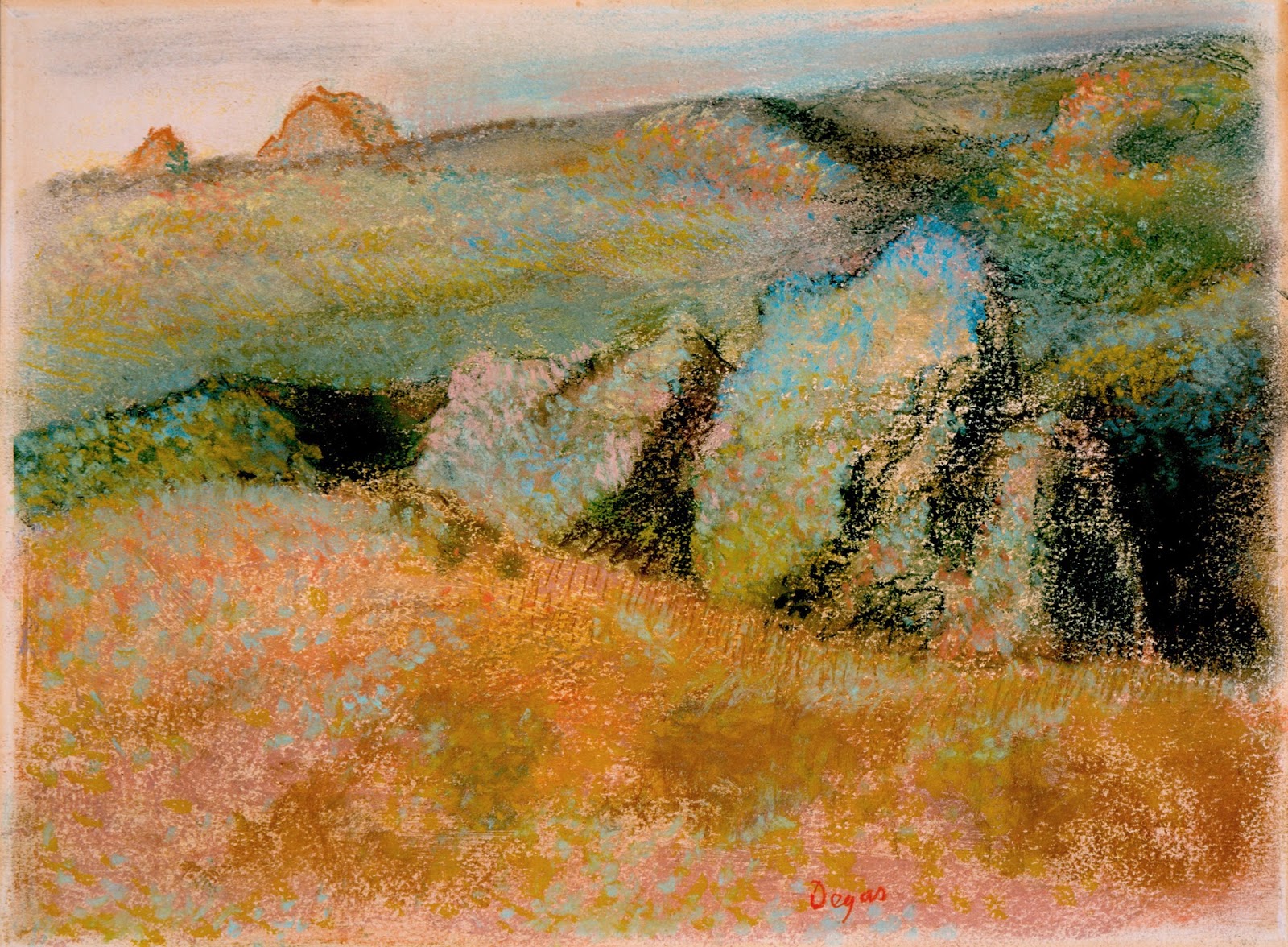
Fortunately, the Degas exhibit has a further surprise in store - a most pleasant one. In 1890, Degas visited Burgundy and was inspired to create landscapes, more ethereal than realistic. This uncharacteristic interest in landscape art revived Degas' utilization of monotype printing which had declined during the late 1880's.


Edgar Degas, Landscape with Rocks, c. 1892

Except in two or three cases, the scenery depicted by Degas in these astonishing monotypes did not correspond to actual geographic localities. Like the "late Turner" landscapes, which are now viewed as a foundation of Modern Art, these sites existed in a distant realm not to be found on any map.

Both Degas and Turner were aging artists, struggling against time and bodily infirmity. As they created their near-abstract landscapes, the "real" world faded around them. This was literally the case for Degas, whose eyesight began to fail in the mid-1870's, just as he took up printing and pastels to create these incredible monotypes. 


Edgar Degas, Forest in the Mountains, c. 1890

The "mind's eye" of  Degas, however, remained unimpaired. The poet, Stéphane Mallarmé, fittingly described the monotypes of Degas as having "a strange new beauty." 

Thanks to this MOMA exhibit we are finally able to appreciate Degas' character and the courage and honesty which he brought to the creation of great art, monotypes in particular. These previously overlooked prints help us to realize that Degas was not a man of contradiction but rather struggled to achieve inner harmony through his art.

Degas declared that he "should like to be famous and unknown." In their first major Degas exhibit, MOMA has insured that his fame will grow, even as his life becomes a little less of an enigma.

 ***
Text: Copyright of Ed Voves, all rights reserved 
Images courtesy of the Museum of Modern Art, New York City                                                                                                                                                                                     Introductory Image: 
Edgar Degas (French, 1834–1917). Heads of a Man and a Woman (Homme et femme, en buste), c. 1877–80. Monotype on paper. Plate: 2 13/16 x 3 3/16 in. (7.2 x 8.1 cm). British Museum, London. Bequeathed by Campbell Dodgson                                                                                                                                                     
Edgar Degas (French, 1834–1917). Dancer Onstage with a Bouquet, c.1876. Pastel over monotype on laid paper. Plate: 10 5/8 × 14 7/8 in. (27 × 37.8 cm). Private collection

Edgar Degas (French, 1834–1917). Factory Smoke (Fumées d’usines), 1877–79. Monotype on paper. Plate: 4 11/16 x 6 5/16 in. (11.9 x 16.1 cm), sheet: 5 13/16 x 6 13/16 in. (14.7 x 17.3 cm). The Metropolitan Museum of Art, New York. The Elisha Whittelsey Collection, The Elisha Whittelsey Fund, 1982.
                                    
Edgar Degas (French, 1834–1917). The Ballet Master (Le Maître de ballet), c. 1876. White chalk or opaque watercolor over monotype on paper. Plate: 22 1/4 x 27 9/16 in. (56.5 x 70 cm), sheet: 24 7/16 x 33 7/16 in. (62 x 85 cm). National Gallery of Art, Washington, D.C. Rosenwald Collection, 1964.

Edgar Degas (French, 1834–1917). Three Ballet Dancers (Trois danseuses), c. 1878-80. Monotype on cream laid paper. Plate: 7 13/16 × 16 3/8″ (19.9 × 41.6 cm). Sterling and Francine Clark Art Institute, Williamstown, Massachusetts.

Edgar Degas (French, 1834–1917). Ballet Scene (Scène de ballet), c. 1879. Pastel over monotype on paper. Plate: 8 x 16 in. (20.3 x 40.6 cm). William I. Koch Collection

Edgar Degas (French, 1834–1917). The Singer (Chanteuse de café-concert), 1875-1880 Pastel over monotype on paper Plate: 6 1/4 x 4 1/2" (15.9 x 11.4 cm) Reading Public Museum, Reading, Pennsylvania. Gift, Miss Martha Elizabeth Dick Estate 

Edgar Degas (French, 1834–1917). Frieze of Dancers (Danseuses attachant leurs sandales), c. 1895. Oil on fabric. 27 9/16 × 78 15/16″ (70 × 200.5 cm). The Cleveland Museum of Art, Gift of the Hanna Fund. © The Cleveland Museum of Art.

Edgar Degas (French, 1834–1917). Landscape with Rocks (Paysage avec rochers), 1892. Pastel over monotype in oil on wove paper. Sheet: 10 1/8 × 13 9/16″ (25.7 × 34.4 cm). High Museum of Art, Atlanta, Purchase with High Museum of Art Enhancement Fund.

Edgar Degas (French, 1834–1917). Forest in the Mountains (Forêt dans la montagne), c. 1890. Monotype in oil on paper. Plate: 11 13/16 x 15 3/4″ (30 x 40 cm). The Museum of Modern Art, New York. Louise Reinhardt Smith Bequest.