Saturday, May 27, 2023

Art Eyewitness Review: Of God and Country: American Art from the Jill & Sheldon Bonovitz Collection, Philadelphia Museum of Art

Of God and Country:

 American Art from the Jill & Sheldon Bonovitz Collection

Philadelphia Museum of Art
May 19, 2023 - January 1, 2024


Reviewed by Ed Voves 
Original Photography by Anne Lloyd 

Some special exhibitions stay in the mind long after the art works are taken down from the gallery walls. It may be the oeuvre of a particular artist, an especially accomplished display of curatorial talent or the unusual subject of the art works in the exhibition which make for an unforgettable show.

“Great and Mighty Things”: Outsider Art from the Jill and Sheldon Bonovitz Collection was definitely an exhibition which met the criteria of “all of the above.” And so does its sequel, Of God and Country: American Art from the Jill and Sheldon Bonovitz Collection.

“Great and Mighty Things” was presented in the spring of 2013. It was my first real exposure to “outsider” art. Self-taught artists like Bill Traylor (1854-1949), Elijah Pierce (1892-1984), William L. Hawkins (1895-1990) and many others in the exhibit were unfamiliar names. Their paintings and sculptures were radical departures from what I normally beheld on museum walls.


Anne Lloyd, Photo (2023)
 William L. Hawkin's Boffo, 20th century

Ten years have gone by and these “Outsiders” are back at the Philadelphia Museum of Art. Like the art works on view in the earlier show, all of the paintings and sculptures in Of God and Country come from the collection of a dynamic duo, Jill and Sheldon Bonovitz. Their perceptive eye for great folk art is matched by their magnanimous generosity. The Bonovitz collection is a promised gift to the Philadelphia Museum of Art.


Anne Lloyd, Photo (2023) 
Sheldon and Jill Bonovitz at the Of God and Country exhibit.

The new exhibition, Of God and Country, takes its name from the deeply-held religious sentiments and personal convictions of these “outsider” artists.

When considered in conjunction with notable events in twentieth century U.S. history, the art works on view in Of God and Country share in the idealism and civic spirit which motivated the Civil Rights movement and efforts to preserve the natural environment of our nation.

Use of the term “outsider art” to describe the work of artists lacking formal training is a matter of some controversy. Outsider Art appeared as the title of a 1972 book by a British scholar, Roger Cardinal, and was embraced by the art community in the English-speaking world.

Personally, I think “inspired art” is far more accurate than “outsider.” Not only were many of these artists devout members of Christian congregations, but several of the leading figures testified that actual religious visions motivated them to create their amazing - and occasionally alarming - art.


Anne Lloyd, Photo (2023)
 Howard Finster’s Angel, #3,236, 1984

Howard Finster (1916-2001) claimed that at age 60, God's message appeared to him on a paint smudge on his finger and commanded him to make “sacred art.” Finster, who had been a preacher at religious revivals since his teens, heeded the divine calling, as we will examine in some detail later in this review.


                                       Anne Lloyd, Photo (2023)                                                             Gallery view of the Of God and Country exhibit,                        showing three of Felipe Archuleta’s carved animals.

Felipe Archuleta (1910-1991) is on record on how he came to sculpt his incredible animal statues, stating that “I asked God for some kind of miracle, some kind of thing to do, to give me something to make my life with. I started carving and they just came out of my mind after that.”

The most succinct statement on “outsider” inspiration – and one of the great quotes in American art history – is Bill Traylor's terse, ironic remark on the origin of his impulse to create art: “It just come to me.”

Of God and Country's inspired art is organized in four thematic sections: U.S. History & Life in America, The American Landscape, Christianity and Spirituality and Death and Mortality. All of the artists brought unique viewpoints to these topics, as might be expected. But many, indeed most, of their works are very subtle, open to different interpretations.


Anne Lloyd, Photo (2023) 
Bill Traylor's House with Two Men, a Turkey, and a Dog, c. 1939-42

One of Bill Traylor's signature, silhouetted drawings is a good example of the challenges posed to quick and easy interpretation. The drawing is entitled House with Two Men, a Turkey, and a Dog, c. 1939-42. We see a top-hatted man climbing-up on a roof top to snatch a large bird, while another fellow, protected by a ferocious guard dog, appears to have passed-out, the victim of one drink too many.


Anne Lloyd, Photo (2023) 
Bill Traylor's House with Two Men, a Turkey, and a Dog (Detail)

That is a conventional explanation for this cryptic scene. However birds frequently figure in Traylor's drawings. These birds are depicted in a generalized, schematic fashion, as with this supposed “turkey.” Art scholars have speculated that Traylor's avian imagery may reflect the folk memory of a sacred bird, the Sankofa from Ghana.

The African-American community preserved much of the heritage of their ancestral cultures during the long years of slavery, so this may well be the case for Traylor's drawing. Whether this intriguing drawing evokes a memory of a specific incident from Traylor's early life or an mythic image from Africa is only one of the many, many fascinating questions posed by works of art in the Bonovitz collection.


Anne Lloyd, Photo (2023) 
Gallery view of the Of God and Country exhibition, showing William L. Hawkin's American Flag with Cone-Shaped Fireworks

Of God and Country opens with an appealing and easy-to-appreciate icon. The carved and painted American Flag with Cone-shaped Fireworks by William L. Hawkins recalls the Rogers and Hammerstein lyrics from South Pacific: High as a flag on the Fourth of July! But most of the works of art which follow are less straightforward. Of God and Country has a lot of gray area, mixed in with the red, white and blue.

Consider Uncle Sam by Leroy Almon (1938-1997). Is Uncle Sam a star-spangled superhero, returning to Capital Hill to rid the halls of Congress of corrupt politicians? Or has he become a demonic figure, his hands choking the American Eagle and crushing the symbolic arrows it normally holds in its talons?


Anne Lloyd, Photo (2023) 
Leroy Almon’s Uncle Sam, late 20th century

Whatever is going on in this brilliant, disturbing work, it was surely based on deep thinking in the mind of its creator. Almon, who trained as a wood carver with Elijah Pierce, often addressed the theme of good and evil in his work. As we see here, the issue was often left very much in doubt.

Another talented African-America artist, Josephus Farmer, created two narrative scenes dealing with the experience of slavery in the American South. Both focus on the role of Eli Whitney, whose 1793 invention of the cotton gin led to the extension of African-American slavery at a time when many thought or hoped it was on the decline. Whitney, a New Englander, was also a central figure in the development of heavy industry which was a key factor in the Union war effort which ultimately triumphed over the Cotton Kingdom of the South.


Anne Lloyd, Photo (2023) 
Josephus Farmer 's Eli Whitney Nemesis of the South, c. 1985

Josephus Farmer describes Whitney as the “Nemesis of the South.” Did this reference allude to Whitney's unintended role in spreading slavery or in laying the foundation for the Northern military machine? Either answer is valid but the decision is ours to make.


Anne Lloyd, Photo (2023) Elijah Pierce's Love (Martin Luther King, Jr.)

We are - seemingly - on much firmer ground in judging works dealing with themes related to Christianity. Many of these are portraits of heroic figures, exemplified by Elijah Pierce's iconic Love (Martin Luther King, Jr. or based on readings from the Holy Bible. 

The gallery devoted to religious art is dominated by works of art by two other artists: the nearly life-sized  Preacher and his Wife, carved by S.L. Jones, and Simon Sparrow's Assemblage with Faces. Both are sensational works and, though sharply different in technique, these two masterpieces work together to anchor the entire exhibition. 

Both S.L. Jones and Simon Sparrow were men of deep religious faith, tempered by lives of poverty and toil. Their contrasting approaches to art embody the two essential aspects of religion: the practice of lives of devotion by members of a faith community and the mystical, contemplative experience of God by individual believers. 


Anne Lloyd, Photo (2023) 
Gallery view of the Of God and Country exhibition,
 showing S.L. Jones’ Preacher and His Wife, date unknown

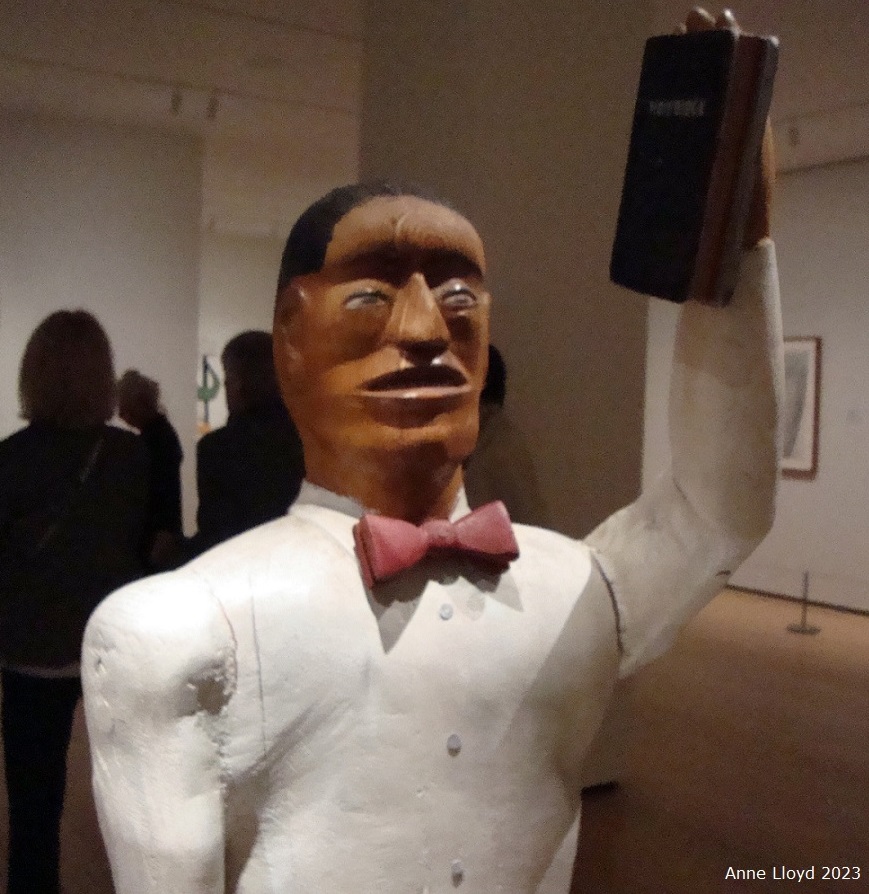
Jones, a sharecropper's son from West Virginia, worked long years for the Chesepeake and Ohio Railroad.  A devoted member of the Primitive Baptist Church, he started carving religious figures to ease the pain in his heart, following the death of his wife. According to the beliefs of the Primitive Baptists, every man and woman can be called to preach the Gospel. There is no need for an ordained clergy as in other denominations.


Anne Lloyd, Photo (2023)
Details of S.L. Jones' Preacher and His Wife


Jones did not aim to carve portraits of specific individuals but rather to evoke the expression of faith on the features of two Christian believers. Their faces radiate the inner light of grace, as they proclaim the word of God. Jones' Preacher and Wife is a brilliant illustration of communal worship, of the famous quote from the Gospel of St. Matthew.

For where there are two or three gathered together in my name, there am I in the midst of them. (Matthew, 18:20)

For Simon Sparrow (1925-2000), the "variety" of religious experience devolved to a personal relationship with God. Sparrow had an amazing life-story. His father was a member of the Yoruba community from West Africa, his mother a Native-American. Details of his childhood are few and conflicting. Sparrow may have been born in Africa, but at some point his family moved to a Cherokee reservation in North Carolina, where he grew-up.


Anne Lloyd, Photo (2023) 
Gallery view of the Of God and Country exhibition,
 showing Simon Sparrow’s Assemblage with Faces.

The spiritual traditions of his ancestors exercised a powerful influence, but Sparrow's approach to art was so unique that it is best to let him speak for himself. Sparrow said that when he began a work of art, he would allow his mind to go blank and let God take over. The process was "sweeter than anything on earth... I feel like I'm climbing."


                                       Anne Lloyd, Photo (2023)                                            Simon Sparrow’s Assemblage with Faces. (Detail), date unknow.

Before letting his mind ascend the "stairway to heaven", Sparrow collected a vast store of found objects, trinkets, shells, small toys and glitter... lot's of glitter. These, Sparrow would place at the service of his God-directed creative power. 

The resulting works are depictions of the numinous, the emergence of the divine presence into the prosaic reality of human life. Sparrow's "assemblages" are as close as an artist can go, I believe, to showing what it would be like to open one's eyes and glimpse heaven. 


                                      Anne Lloyd, Photo (2023)                                       Simon Sparrow’s Assemblage with Faces. (Detail)

Faces and patterns materialize on the mosaic-like surface of Sparrow's art works, seemingly from nowhere. These leave an indelible imprint on the mind of the beholder. But trying to grasp and understand these images is almost impossible, except perhaps by an act of faith. To see, as Simon Sparrow did, one needs to believe.

The final gallery of Of God and Country is, in some ways, the most affecting and perplexing.

To do justice to the treatment of Death and Mortality really requires an additional review. This will appear shortly in Art Eyewitness.


Anne Lloyd, Photo (2023)
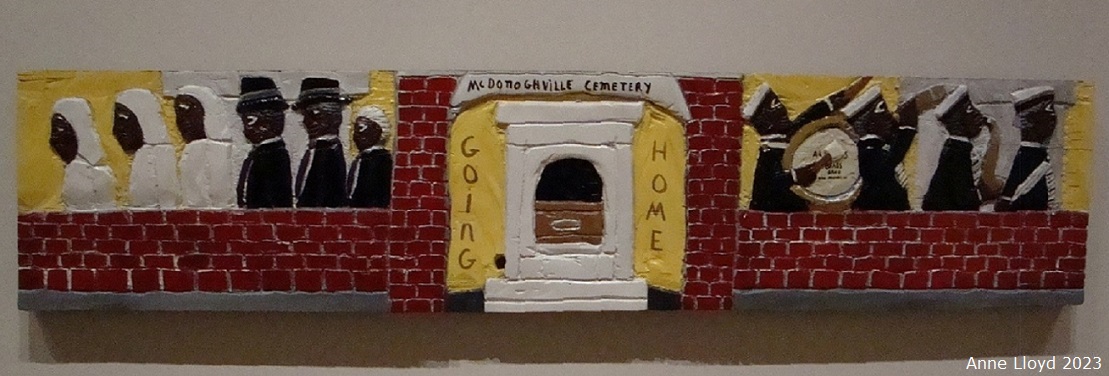
 Herbert Singleton's Going Home: McDonogh Cemetery. Date unknown

No one returns from the "undiscovered country" as Hamlet said so memorably. But judging from the extraordinary works of art in Of God and Country, I would not be surprised if some of the visionary artists in the exhibition had a few sneak previews. 

***

Text, copyright of Ed Voves. Original photography, copyright of Anne Lloyd.

Introductory Image: Anne Lloyd, Photo (2023) William L. Hawkin's American Flag with Cone-Shaped Fireworks ( Detail), 1983. Paint on plywood: 48 x 57 inches (121.9 x 144.8 cm) Collection of Jill and Sheldon Bonovitz, Promised Gift to the Philadelphia Museum of Art.

Anne Lloyd, Photo (2023) William L. Hawkin's Boffo, 20th century. Alkyd house paint on Masonite, fiberboard, alkyd paint mixed with broken starch chunks (possibly dried glue): 44 1/2 x 51 1/2 inches (113 x 130.8 cm) Collection of Jill and Sheldon Bonovitz, Promised Gift to the Philadelphia Museum of Art.

Anne Lloyd, Photo (2023) Sheldon and Jill Bonovitz at the Philadelphia Museum of Art's Of God and Country exhibition.

Anne Lloyd, Photo (2023) Howard Finster’s Angel, #3,236, 1984. Paint on wood cutout: Collection of Jill and Sheldon Bonovitz. 

Anne Lloyd, Photo (2023) Gallery view of the Philadelphia Museum of Art's Of God and Country exhibition, showing three of Felipe Archuleta’s carved animals, Donkey (1981), Spotted Boar (1981) and Mule (1975). Cottonwood, paint, sisal, sawdust, glue. Collection of Jill and Sheldon Bonovitz, Promised Gift to the Philadelphia Museum of Art. 

Anne Lloyd, Photo (2023) Bill Traylor's House with Two Men, a Turkey, and a Dog, c. 1939-42. Graphite on thin cream card; punched for hanging:Sheet: 22 × 14 1/2 inches (55.9 × 36.8 cm). Collection of Jill and Sheldon Bonovitz, Promised Gift to the Philadelphia Museum of Art. 

Anne Lloyd, Photo (2023) Gallery view of the Philadelphia Museum of Art's Of God and Country exhibition, showing William L. Hawkin's American Flag with Cone-Shaped Fireworks. 

Anne Lloyd, Photo (2023) Leroy Almon’s Uncle Sam, late 20th century. Paint on carved wood. Collection of Jill and Sheldon Bonovitz.

Anne Lloyd, Photo (2023) Josephus Farmer 's Eli Whitney Nemesis of the South, c. 1985. Paint and ink on carved wood. The Jill and Sheldon Bonovitz Collection. 

Anne Lloyd, Photo (2023) Elijah Pierce's Love (Martin Luther King, Jr.). Paint, glitter, and local applications of varnish on carved wood; artist-made frame: 19 x 16 inches (48.3 x 40.6 cm) Collection of Jill and Sheldon Bonovitz, Promised Gift to the Philadelphia Museum of Art. 

Anne Lloyd, Photo (2023) Howard Finster's The Big Push, #1,765, 1980. Paint on plywood; artist-made frame of Douglas fir branded with artist-made metal stamps: Framed: 15 1/4 x 15 inches (38.7 x 38.1 cm) The Jill and Sheldon Bonovitz Collection. 

Anne Lloyd, Photo (2023) Gallery view of the Philadelphia Museum of Art's Of God and Country exhibition, showing S.L. Jones’ Preacher and His Wife. 

Anne Lloyd, Photo (2023) S.L. Jones’ Preacher and His Wife (Detail), date unknown. Paint on wood with nails; leather belt: Preacher (a): 62 1/2 x 19 x 14 inches (158.8 x 48.3 x 35.6 cm) Wife (b): 54 x 15 x 18 inches (137.2 x 38.1 x 45.7 cm) The Jill and Sheldon Bonovitz Collection. 

Anne Lloyd, Photo (2023) Gallery view of the Philadelphia Museum of Art's Of God and Country exhibition, showing Simon Sparrow’s Assemblage with Faces. 

Anne Lloyd, Photo (2023) Simon Sparrow’s Assemblage with Faces. (Detail), date unknown. Glitter, paint, and other found objects on wood; artist-made painted wood frame: 56 1/2 inches × 8 feet 11 inches × 3 1/2 inches (143.5 × 271.8 × 8.9 cm. Collection of Jill and Sheldon Bonovitz, Promised Gift to the Philadelphia Museum of Art. 

Anne Lloyd, Photo (2023) Herbert Singleton's Going Home: McDonogh Cemetery. Date unknown. Alkyd industrial paint, including metallic paint, on carved red cedar with yellow pine battens: 12 3/4 x 60 inches (32.4 x 152.4 cm) Collection of Jill and Sheldon Bonovitz.


Saturday, May 13, 2023

Art Eyewitness Review: The Sassoons at the Jewish Museum, New York


The Sassoons

Jewish Museum, New York

March 3- August 13, 2023

Reviewed by Ed Voves

The Jewish Museum of New York has a well-deserved reputation for presenting unusual exhibitions which provide expansive, yet incisive, views of complex subjects. The current exhibit, The Sassoons, certainly deserves such accolades.

From the Ottoman Empire to the British Raj to the splendor of Edwardian Britain and the subsequent horrors of World War I, The Sassoons tells the story of a Jewish dynasty which gained (and lost) huge fortunes and bequeathed a rich legacy in art and philanthropy.

And what a story! Normally, such a saga, spanning several generations, would feature in a multi-episode television series rather than on the gallery walls of a New York City museum. 


Ed Voves, Photo (2023)
Gallery view of The Sassoons exhibit at the Jewish Museum, 
showing a photo montage of members of the Sassoon family

Escapes from danger, breathtaking risks in the world of high finance, battlefield exploits, bitter family feuds and savvy, strong-willed heroines, it's all here in The Sassoons.

The Jewish Museum exhibition highlights this stirring drama with a fascinating display of sacred religious artifacts of Judaism which the Sassoon family commissioned or helped to preserve. Among the many examples of Judaica on view is the Sassoon Haggadah, an exquisite illuminated manuscript containing the service read during the Passover Seder. It dates from the early fourteenth century and was most likely created in Spain or perhaps the south of France. 


JM Nahson, Photo (2022)
The Sassoon Haggadah, Spain or Southern France, c. 1320

Now in the collection of the Israel Museum, the Sassoon Haggadah had special relevance for the Sassoons, who were driven from their home in Baghdad during a campaign of persecution, just as the Sephardic Jews of Spain had earlier suffered in 1492. This splendid hand-written and decorated book is a testament to the enduring faith of devout Jews like the Sassoons across the centuries.

The Sassoons also devoted much effort and discernment to collecting works of Old Master art and rare books, especially after numerous family members relocated to England in the late 1800's. And being “eminent” Victorians and Edwardians, these later Sassoons could not resist having their noble faces preserved for posterity by the finest portrait painter of their age: John Singer Sargent.


Ed Voves, Photo (2023)
Gallery view of The Sassoons exhibit, showing portraits
 of the Sassoon family painted by John Singer Sargent

The Sassoons begins in the Middle East during the rule of the Ottoman Turkish Empire. Skilled in military matters, the Turks delegated much of the administration of their domains to Jewish or Christian subjects. Sheikh Sassoon Ben Saleh Sassoon (1750-1830) was the finance minister for the Turkish Pashas of Baghdad, Iraq, a post he held with honor for many years.

During the 1820’s, a ruthless Pasha, Dawud, began harassing Baghdadi Jews in order to curb their influence – and to enrich himself. Sheikh Sassoon’s eldest son, David, was taken hostage in 1828 and placed under guard until a hefty ransom could be paid to the Pasha. David managed to escape and the family, including the aged Sheikh Sassoon, made a daring bid for freedom. Eluding Dawud’s troops, some of whom had been paid a hefty “bakhshesh” or bribe to look the other way, the Sassoons fled Baghdad. They made their way to Iran, where Sheikh Sassoon died in 1830.

David Sassoon (1792-1864) was now the patriarch of the Sassoon clan. This resourceful, clear-sighted business man carefully studied the international scene and decided to secure his family’s fortune with the British Raj in India. The British were notably indifferent to matters of religion. Loyalty to the British Empire and skill in trade and finance were what mattered to the British “sahibs.” David Sassoon and his sons and heirs were ready to oblige.


Ed Voves, Photo (2023)
Portrait of David Sassoon, attributed to William Melville, mid-1800's

David Sassoon was a skilled linguist, fluent in most of the languages of the Middle East and India (though he never mastered English) and a skilled investor. He established the Sassoon fortune, initially in the lucrative cotton and silk trades. He dispatched his numerous sons to important trading cities in Asia, including China. In a relatively short span of time, the wealth and political influence of the Sassoon family was secured.

In 1857, the time for loyalty to the Raj became a paramount concern. Triggered by fears of modernization to the traditional society of India and by the arrogant and insensitive behavior of their British officers, many of the regiments of the Indian Army rose in revolt. The Sassoons supported the embattled Raj with all the resources at their disposal. 

When the Great Mutiny was defeated and British rule reasserted, the “sahibs” were very grateful to the Sassoons for their timely support. In 1863, David Sassoon was awarded a British coat of arms. The armorial emblem depicts symbols with biblical references and the Hebrew motto, Emet ve-emunah (Truth and Faith).

The early years of the Sassoon saga are brilliantly illustrated in the exhibition by a number of works of art including a portrait of David Sassoon (shown above). The portrait is attributed to William Melville, a British merchant who took up painting while in India. Although not a major figure in British art, Melville certainly captured the intelligence and quiet tenacity of David Sassoon.


Ed Voves, Photo (2023)
Gallery view of The Sassoons exhibit, showing
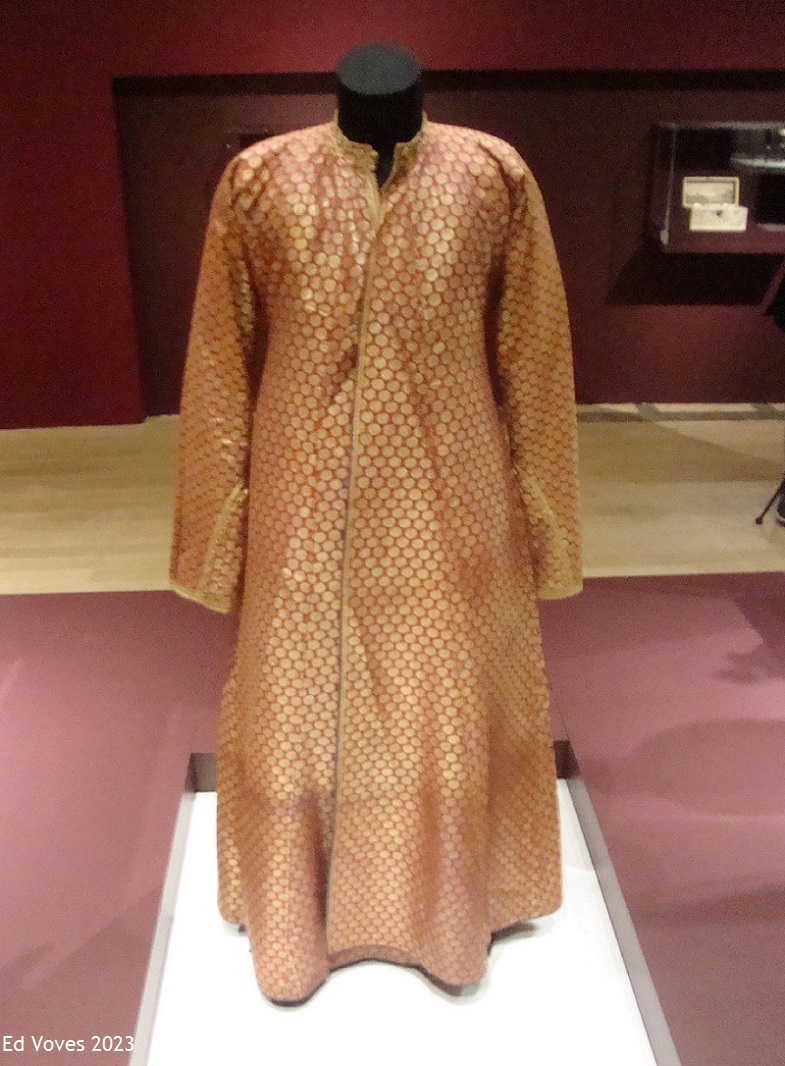
 the Wedding Robe of Ezekial Gubbay, c. 1852

The “star” of this part of the exhibition, however, is the Wedding Robe of Ezekiel Gubbay. Made of silk, gold metallic thread and cotton around 1852, it was worn by Ezekial Gubbay when he married Aziza Sassoon, the granddaughter of David. Like the Sassoons, Gubbay was a refugee from the Ottoman Empire, though his base of commercial operations for many years was China not India.

This magnificent robe is fascinating on many counts. It reminds us of the Asian roots of the Sassoons and of the adaptability of Jews and Judaism to whatever geographic region they find themselves.

The design of the Wedding Robe of Ezekiel Gubbay is Iraqi. While in India and China, the early Sassoons and Gubbay dressed in the fashion of their native land (at least for special occasions) even after they had to flee for their lives. Like many refugees, they still preserved a heart-felt affinity for the place of their birth.


Ed Voves, Photo (2023)
 The Wedding Robe of Ezekial Gubbay, c. 1852

Another interesting point about Ezekial Gubbay and his wedding robe is that he frequently loaned it to grooms who could not afford such splendid attire for their marriage celebrations. Generous and thoughtful, Gubbay was a deeply religious man. His daughter, Flora, as we will see, became a brilliant scholar of Jewish theology and culture.

David Sassoon died in 1864, bequeathing a huge fortune worth over £4 million, an impressive network of charitable institutions throughout Asia - and a complicated family situation. By his first marriage, he had fathered two sons and two daughters; by his second marriage, six sons and three daughters. With trading bases throughout Asia, these eight sons had provided David Sassoon with reliable representatives for his business transactions. But after his death, the House of Sassoon became a house divided. Beginning in 1867, two bitterly hostile companies, David Sassoon and Co. and ED Sassoon and Company, competed with each other for the lion's share of the wealth of Asia.

An important part of the Sassoon's profits came from Indian cotton, especially when the American Civil War interrupted the flow of cotton from the American South to British factories. After 1865, American cotton flooded the market and the Sassoons invested in another lucrative product of Indian agriculture, opium.

The exhibition curators are quite candid about the controversial nature of the opium trade. In a very effective wall-text, they detail the resistance of the Chinese government to the ruthless efforts of European powers, especially the British, to export the addictive drug to China. When China banned opium, the British responded with a military campaign, the First Opium War, in 1842. The British incursion forced the Chinese to open "treaty ports" to merchant trade, including opium.


Ed Voves, Photo (2023)
Ivory Casket from China, with a painting of Bocca Tigris,
 a strait of the Pearl River Delta, early 1800's

The Sassoons entered the opium trade after these strongarm tactics had taken effect. Moreover, it is worth noting, the Sassoons were not operating as an illegal drug cartel similar to the dangerous global narcotic dealers of today. Opium was legal worldwide and indeed could be purchased without a doctor's prescription in the U.S. until 1914 and in Britain until 1916. Still, it is rather disturbing to note that by the 1870's, David Sassoon and Co. controlled 70% of the Indian opium production.

 By now, it should be obvious that the full story of the Sassoon family is way beyond the scope of a online journal like Art Eyewitness. Suffice it to say that when David Sassoon and Co.moved its corporate headquarters from Bombay to London in 1872, the narrative shifts from Asian affairs and empire-building to a more cultural focus. This will allow us to concentrate on the art collecting activities of the "English" Sassoons.

The late Victorian and Edwardian eras were a golden age for amassing art collections. Among wealthy art lovers, the art of the eighteenth century and medieval manuscripts were favored genres. The Sassoons subscribed to these trends and their collections were well-stocked with portraits of Age of Enlightenment celebrities like the sculptor Jean-Jacques Caffieri by Adolf Ulric Wertmuller (1784) and Thomas Gainsborough's Major John Dade of Tannington, Suffolk (c.1755).


Ed Voves, Photo (2023)
Adolf Ulric Wertmuller, Jean-Jacques Caffieri, 1784


Ed Voves, Photo (2023)
Thomas Gainsborough, Maj. John Dade of Tannington, Suffolk, c. 1755

The medieval manuscripts collected by Sassoon family members is one of the most fascinating displays of the exhibition. On view are outstanding examples with a direct relevance to Judaism, like the Sassoon Haggadah (shown above), and illuminated books from the Christian and secular spheres like the Astronomical Anthology from Catalonia, created around the same time as the Haggadah. 


Ed Voves, Photo (2023)
Astronomical Antholgogy, from Catalonia, c. 1361

Given the importance of Asian trade to the Sassoons, it should come as no surprise that Chinese art featured in their collections. Astonishing examples of Qing Dynasty ivory sculpture, carved from single pieces of ivory, are on view in the gallery devoted to Asian art.


Ed Voves, Photo (2023)
China, Qing Dynasty, Ivory Carving
From left, Miniature Mountain, 19th century, & Table Screen, 1775

Pride of place among the Sassoon collectors ought to go to the remarkable Flora Sassoon (1859-1936). Born as Farha Gubbay (daughter of Ezekial), Flora married Solomon David Sassoon (the son of patriarch David, from his second marriage). When her husband died in 1894, Flora Sassoon took over the management of David Sassoon and Co. She was so successful that her jealous male relatives reorganized the company structure to oust her! 


Flora Sassoon, 1900

Instead of founding a third Sassoon company to rival the others, Flora moved to Britain with her invalid daughter, Mozelle, and directed her formidable intellect and generous spirit to theological scholarship, philanthropy and patronage of the arts. She became so famous and beloved that letters were simply addressed to her, "Flora Sassoon, England."

Flora Sassoon was so devoted to the correct observance of Jewish religious law that she traveled with a minyan, a quorum of ten Jewish men needed for a public prayer service, and her own shohet or ritual butcher, so that she could always eat kosher. 


JM Nahson, Photo (2022)
Torah and haftarah scrolls in cases,
 commissioned by Flora Sassoon, 1888-93

The exhibition showcases Torah and haftarah scrolls, protected in gilt silver and enamel cases, which were commissioned by Flora Sassoon. These beautiful examples of Judaica are now in a private collection, making the Jewish Museum exhibit a rare opportunity to admire both the tremendous workmanship of the craftsmen who made these precious works of devotional art and the religious convictions of the remarkable woman who sponsored them.


Ed Voves, Photo (2023)
Gallery view of The Sassoons with Torah and haftarah scrolls
 in cases commissioned by Flora Sassoon

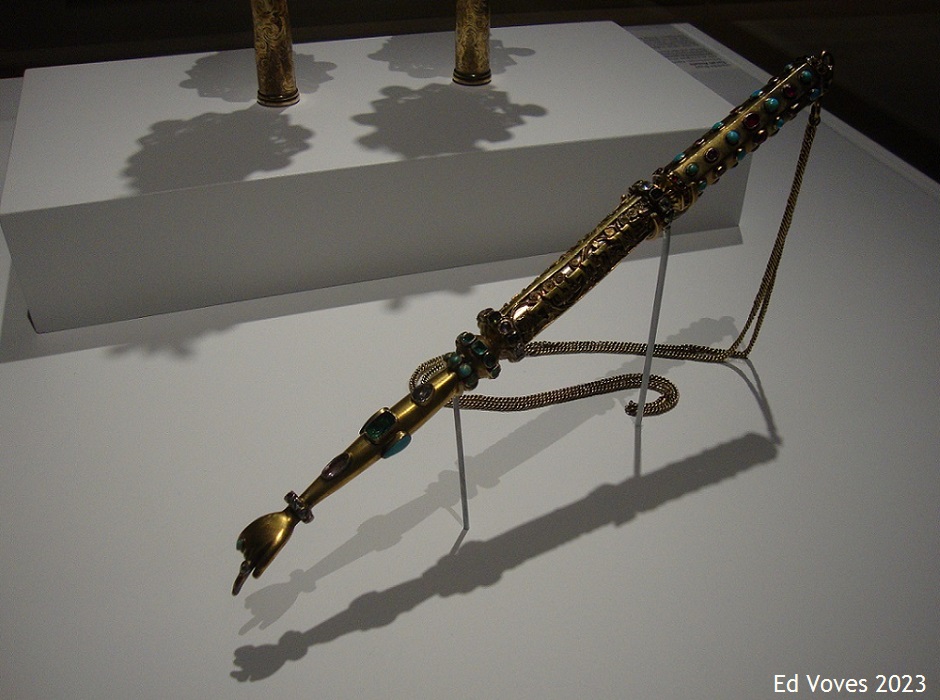
Another sacred artifact owned by Flora Sassoon is a gilt silver Torah pointer, made in the Netherlands during the mid-nineteenth century. It is inscribed with the words "(For) the honor of God and His Torah."  A Torah pointer, also called a "YAD" from the word for hand, is used during readings of the Torah in order to keep track of the text without physically touching the sacred scroll. Of all the wonderful works of art on view in The Sassoons, this was my favorite!


Ed Voves, Photo (2023)
Torah pointer, c. 1840-1853, from Flora Sassoon's collection

The narrative of The Sassoons turns from displays of Old Master paintings, Chinese carvings and precious examples of Judaica to a moving consideration of World War I. On view are a number of oil paintings by John Singer Sargent, created during his 1918 tour of the Western Front which would lead to the monumental painting, Gassed, arguably the most searing depiction of war by a major artist. 

Fourteen members of the Sassoon family served in the British military, 1914-1918. But the exhibit focuses - wisely - on two of these "Lost Generation" soldiers. Sir Philip Sassoon (1888-1939) and Siegfried Sassoon (1886-1967) both served with distinction in the war, but their experiences were markedly different. Their portraits are placed side-by-side in the exhibition, yet they seem like strangers from different realms of experience rather than second-cousins and comrades-in-arms.


Ed Voves, Photo (2023)
World War I portraits, Sir Phillip Sassoon (at left) & Siegfried Sassoon 

Philip Sassoon (1888-1939) served as a staff-officer, private secretary to the British commander-in-chief, Sir Douglas Haig. Charming yet diligent, he was fluent in French, an important skill since the British and French fought side-by-side at the Battle of the Somme, 1916. He was also a close friend of Sargent and helped facilitate his painting expedition to the front.

Siegfried Sassoon, by contrast, was a front-line infantry officer, wounded in action, awarded the Military Cross for valor. He was nicknamed "Mad-Jack" for his almost suicidal gallantry. The very passion which fueled his courage on the Somme and at Arras also triggered his anger at the futile frontal attacks which squandered thousands of lives and the political duplicity on the Home Front.


Ed Voves, Photo (2023)
World War I-era journals of Siegfried Sassoon 
Appearing at left is the April-June 1917 journal containing the draft of Sassoon's "Statement against the Conduct of the War" 

For a sensational display, the Jewish Museum curators were able to secure a trove of Siegfried Sassoon's notebooks and  journals. These include the draft copy of his "Statement against the Conduct of the War" which was quoted in a speech in Parliament. This might have led to a court martial -and possibly a firing squad for Sassoon. Instead, he was sent to a hospital for the "shell shocked" and then released to fight again and be wounded again on the unquiet Western Front.

The Sassoons goes on to look at the family's post-World War I experiences.  Attempts to revive the economic fortunes of the family by major investment in China, especially the booming real estate market in Shanghai in the 1920's and early 1930's, promised success. But the coming of a second "Great War" and the Communist take-over of China devastated the hopes and the finances of the Sassoons.

As the sun set on the British Empire, so too did it fade upon the Sassoon family.


Ed Voves, Photo (2023)
Claudia Nahson (left) and Esther da Costa Meyer, curators of
 The Sassoons exhibit at the Jewish Museum

The Sassoons at the Jewish Museum is a wonder of an exhibition. There are almost too many themes, too many characters, too much geography to cover - and yet it succeeds memorably in bringing this vital story to life. For that triumph, we have the exhibition curators, Claudia Nahson and Esther da Costa Meyer, to thank. The Sassoons is a fascinating, thoughtful investigation of an incredible family, flesh-and-blood human beings who never - or almost never - forgot the God of Israel.

In a final testament to the Sassoons, let us end with the exhibit display which shows the heart-shaped inscription from a Torah ark curtain donated by Rachel Sassoon (1857-1911) in memory of her only child and an embossed silver plaque from another Torah ark curtain, this time dedicated to Hannah Khatun Sassoon, who died in 1895. Let the words of the final invocation on the plaque speak for all the Sassoons - and hopefully for us too!


Ed Voves, Photo (2023)
Torah ark curtain memorials for Sassoon family members, late 1800's

This Torah Curtain is consecrated upon the passing of the noble, modest, elder Lady Hannah Khatun bat No'am, may she abide in Eden, wife of Sir Abdullah David Sassoon, may God protect and keep him, to the Yagel Yaakov Synagogue in the Holy City of Jerusalem, may it be rebuilt and reestablished quickly in our days, amen. She passed away in Bombay on Wednesday, 13 Tevet 5655 (January 9, 1895). May her soul be bound up in the Bond of Life.

***

Text: Copyright of Ed Voves, all rights reserved. Original Photography by Ed Voves, all rights reserved.                                                                          

Exhibition images courtesy of the  Jewish Museum, New York 

Introductory image: Ed Voves, Photo (2023) Gallery view of The Sassoons exhibit, showing a photo montage of members of the Sassoon family.

Ed Voves, Photo (2023) Gallery view of The Sassoons exhibit, showing a photo montage of members of the Sassoon family.

JM Nahson, Photo (2022) The Sassoon Haggadah, Spain or Southern France, c. 1320. Ink, tempera, and gold and silver leaf on parchment 8 5/16 × 6 ½ in. (21 ×16.5 cm) Israel Museum, Jerusalem, purchased by the State of Israel through an anonymous donor, London, L-B75.0583, formerly in the David Solomon Sassoon Collection.

Ed Voves, Photo (2023) Gallery view of The Sassoons exhibit, showing portraits of members of the Sassoon family, painted by John Singer Sargent.

Ed Voves, Photo (2023) Portrait of David Sassoon, attributed to William Melville, mid-1800's. Oil on canvas: 41 ½ × 33 in. (105.4 × 83.8 cm) Private Collection

Ed Voves, Photo (2023) Gallery view of The Sassoons exhibit, showing The Wedding Gown of Ezekial Gubbay, c. 1852.

Ed Voves, Photo (2023) The Wedding Gown of Ezekial Gubbay, c. 1852. Silk, gold metallic thread, and cotton: L 54in (137.2 cm) Private Collection, New York.

Ed Voves, Photo (2023) Ivory Casket from China, with a painting of Bocca Tigris, a strait of the Pearl River Delta, early 1800's. Ivory: 4 9/16 × 9 7/8 × 4 11/16 in. (11.5 × 25 × 11.8 cm) Collection of the British Museum.

Ed Voves, Photo (2023) Adolf Ulric Wertmuller's Jean-Jacques Caffieri, 1784. Oil on canvas: 50 3/4 x 37 3/4 in. (128.9 x 95.9 cm) Collection of the Museum of Fine Arts, Boston.

Ed Voves, Photo (2023) Thomas Gainsborough's Major John Dade of Tannington, Suffolk, c. 1755. Oil on canvas: 30 × 25 1/2 inches (76.2 × 64.8 cm) Collection of the Yale Center for British Art.

Ed Voves, Photo (2023) Astronomical Anthology, from Catalonia, c. 1361. Ink and paint on parchment 11 3/8 × 8 13/16 in. (28.8 × 22.4 cm) Lawrence J. Schoenberg Collection, Kislak Center for Special Collections, Rare Books and Manuscripts, University of Pennsylvania.

Ed Voves, Photo (2023) China, Qing Dynasty, Ivory Carving. Miniature Mountain, 12 1/4 x 4 9/16 in. (31 x 13.5 cm) 19th century (left) and Table Screen, 11 7/16 x 3 15/16 in. (29 x 10 cm), 1775. Both from collection of the British Museum.

JM Nahson, Photo (2022) Copy of a Portrait Photo of Flora Sassoon, 1900.

JM Nahson, Photo (2022) Torah and haftarah scrolls in cases, commissioned by Flora Sassoon, China and Iraq, 1888–93. Cases: gilt silver and enamel; scrolls: ink on parchment Heights 37 3/8 in. (95 cm); 30 in. (76.2 cm) Private collection.

Ed Voves, Photo (2023) Gallery view of The Sassoons exhibit, with Torah and haftarah scrolls in cases, commissioned by Flora Sassoon, 1888-93.

Ed Voves, Photo (2023) Torah pointer, c. 1840-1853, from Flora Sassoon's collection. Made in the Netherlands by Hedde Buys. Gilt silver with precious and semiprecious stones (possibly later additions): L 13 1/2 in. (34.4 cm) Weitzman Family Collection.

Ed Voves, Photo (2023) World War I portraits, from left, Sir Philip Sassoon by Philip Alexius De Laszlo, 1915, collection of Houghton Hall, U.K.,and Siegfried Sassoon by Glyn Warren Philpot, 1917, collection of the Fitzwilliam Museum, Cambridge University.

Ed Voves, Photo (2023) World War I-era journals of Siegfried Sassoon, with (at left) the the April 11 -June 2, 1917 journal containing the draft of Sassoon's "Statement against the Conduct of the War". Ink on paper; leather binding: 5 x 3 in (12.7 x 7.6 cm) Cambridge University Library, United Kingdom.

Ed Voves, Photo (2023) Claudia Nahson (left) and Esther da Costa Meyer, curators of The Sassoons exhibit at the Jewish Museum.

Ed Voves, Photo (2023) Inscription from Torah ark curtain donated by Rachel Sassoon (1857-1911) to Shalom Shabazi Synagogue, Jerusalem. Probably made in Mumbai (Bombay), c. 1886. Velvet embroidered with metallic thread: 15 x 11 in (38.1 x 27.9 cm) and Plaque from a Torah ark curtain in memory of Hannah Khatun Sassoon, dedicated to Yagel Yaakov Synagogue, Jerusalem Probably Mumbai, 1895 Embossed silver Diam. 6 1/8 in. (15.6cm) Both works in the collection of the Jewish Museum, New York.

Monday, May 1, 2023

Art Eyewitness Book Review: Picasso: the Self-Portraits by Pascal Bonafoux

Picasso: the Self-Portraits

By Pascal Bonafoux

Thames & Hudson/$45/223 pages

Reviewed by Ed Voves

Often times, when a great writer, actor or artist of advanced age dies, the  reaction is a bemused exclamation, "I didn't know he (or she) was still alive."

When Pablo Picasso died a half century ago, on April 8, 1973, that was not the response. No one thought of Picasso in the past tense, but rather with shock that he could die.

Yes, Picasso had lived a very long time, 1881-1973. Yes, many of his best works were already on museum walls years before his passing. Picasso, however, was such a legendary figure, an artist of genius caliber, that it was hard to conceive of the art world without him.

Fifty years on, art historians are still grappling with the legacy of Picasso. Museums around the world have announced exhibitions to mark the anniversary of his death - and his continuing importance. While these upcoming exhibits will doubtless provide new insights, museum curators are already facing stiff-competition from an impressive new book, Picasso: the Self-Portraits, written by the French art historian, Pascal Bonafoux.

There are a number of surprising aspects to this outstanding book. Perhaps the most glaring one is the fact that this is the first systematic study of Picasso's self-portraits. Considering the exhaustive treatment of Picasso's oeuvre, it is a bit perplexing that this trove of revelatory art has been little regarded by scholars, at least as a body of work - and an extensive one at that.


Pablo Picasso, Self-Portrait (detail), 1906

Picasso: the Self-Portraits examines 170 paintings, drawings and photos. Beginning with an 1894 drawing of himself, aged thirteen, Picasso continued to record - and in some cases, disguise - his features up until a few months before he died. 

Most of these self-portraits, however, were created before 1918. In November of that year, Picasso heard the shocking news that his great friend, Guillaume Apollinaire, had just died during the Influenza pandemic. According to legend, Picasso was shaving when the message arrived and could not bear looking into a mirror after that terrible moment. Doing so reminded him of the painful passing of Apollinaire - and of his own mortality.

The second surprise factor is the curiously "old-fashion" look to the present volume. The book opens with the text, eighty-plus pages of solid print, en bloc. Then come the pictures, treated with superb fidelity whether color, sepia or black and white, but lacking explanatory captions. Given that the publisher is Thames and Hudson, who practically invented the process of closely integrating pictures with text in art books, this arrangement did come as a bit of shock when I first leafed through the pages.

Any doubts about Picasso: the Self-Portraits vanished by the time I finished reading the first couple of paragraphs. It was a master-stroke to use Bonafoux's brilliant narrative to engage the reader's imagination, followed by the pictures. Bonafoux is an exceptional writer, a French intellectual whose scholarship is tempered with warm human empathy and philosophic insight. 

In many ways, Bonafoux's text is a meditation on life, Picasso's and ours. Quoting a remark by Picasso that "a painting only lives through the person looking at it," Bonafoux invites us to join in this silent dialog. 

Alone. I am alone before Picasso's self-portraits. You are alone before these same self-portraits... And perhaps that is the purpose of a self-portrait, to make us examine our own solitude.

So let the words and the images of Picasso: the Self-Portraits speak for themselves without constant referring back and forth. The best way to use this intriguing book is to savor the text and images as complementary essays. 

Bonafoux begins his narrative by relating how he met Picasso's widow, Jacqueline, at a dinner party. Bonafoux's specialty in art scholarship is the study of self-portraits from the Renaissance to the contemporary world.

Pablo Picasso, Self-Portrait, 1917

During their discussion about art, Jacqueline Picasso asked if Bonafoux had referred to Picasso's self-portraits in his research. Bonafoux replied by mentioning the mirror incident, which the photographer Brassai had related. Jacqueline Picasso contradicted Brassai's account, telling Bonafoux that Picasso had continued to create self-portraits after 1918. This exchange launched Bonafoux on a forty-year exploration of how Picasso came to depict himself in paintings and drawings over the course of his life.

Later, Jacqueline showed Bonafoux a self-portrait by Picasso, (above) dated to 1959. The 1959 date referred to the occasion when Picasso presented it to her. The drawing was actually created in 1917. 

The Self-Portrait is exceptionally crisp and well-delineated, worthy of the classical style of French drawing, especially the portrait sketches of Jean Auguste Ingres (1780-1867). Picasso executed several more in this manner, but almost all before the end of World War I. The self-portraits he created in the years that followed the war were few in number and very varied in composition. Apparently, there was an element of truth in both what Brassai and Jacqueline Picasso had stated.

Bonafoux discounts a shattering event like Apollinaire's death (which was certainly upsetting to the artist) as having any real effect on Picasso's production of self-portraits.

For Picasso, self-portraits were more documents of experimentation than documentation. That is why most of the self-portraits were created when Picasso was very young. He was finding his way in the world, especially when he made the decision to settle in France, despite the vibrant culture of Barcelona and the fellow-artists whose friendship he celebrated in a poster for the fabled cafe, Els Quatre Gats. 


Pablo Picasso, Poster for Els Quatre Gats with self-portrait, 1902
Picasso is shown in the foreground, with Pere Romeu’s dog

The self-portraits of Picasso's early years how him in many guises: dressed as a top-hatted Parisian boulevardier (despite being nearly destitute); sporting a mustache, making him look much older than his age in 1901; even a rather silly pose, wearing the crown of an Egyptian Pharaoh, in a composite drawing.


Pablo Picasso, Picasso with a Woman, 1901

 Pablo Picasso, Profile, 1901

Pablo Picasso, Self-portrait as a Pharaoh, 1903-4

Many of these early self-portraits would be of little interest today except that Picasso had created them. But create them he did, as he investigated the life around him and within, with abundant explorations of sexuality as evidenced by the accompanying nude sketches on Self-portrait as a Pharaoh. 

Bonafoux notes that a constant factor in Picasso's life was his devotion, indeed obsession, to change. From early on, he set himself to oppose the established conventions of art, summed-up under the disparaging term, style. This leads Bonafoux to the "paradoxical conclusion" that "it is the very changeability of Picasso's work that makes it endure."

"Perhaps," Bonafoux muses, "we should therefore view Picasso's self-portraits as symbols of these changes that look like him... When he paints himself, he is not so much seeking to represent Picasso as he is seeking to be a Picasso."

If many of the early self-portraits merely reflect the "changes that look like him," several were major, monumental likenesses. The haunting, 1901 Blue Period Self-Portrait and the 1906 "Iberian" Self-Portrait from the collection of the Philadelphia Museum of Art are works which evoke Picasso's moods and interests at the time he painted himself on these canvases. But both works probe deeply below surface details, into Picasso's soul and psyche. Together these self-portraits forecast the mature Picasso's role as the Magus of Modern Art.


Pablo Picasso, Self-Portrait, 1906 
Philadelphia Museum of Art Collection

None of the self-portraits which Picasso created during the inter-war years, 1918-1939, or the period following the Second World War, approached these early works in skill or interest. Some are technically significant, others little more than sketches.

This takes us back to the "mirror image" question. This time, we can safely say that Picasso now had little need to represent himself. He was now painting and drawing "Picasso" in each and every one of his works. The painter of Guernica had little need to limit himself to autobiography. 

Only very late in life, when Picasso was indeed confronting his mortality, did he return to a serious focus on self-portraits. In 1972, only months before he died, Picasso created several skull-like depictions of himself, looking like apparitions from beyond the grave. These leave little doubt as to where his thoughts were directed.

In one of the most poignant reflections in his compelling narrative, Bonafoux affirms that the real, lasting value of self-portraiture is the way it encourages, indeed insists, that artists remain true to themselves:

The only model who is always available to a painter, the only model who they can be sure will never recoil, offended or disappointed, on seeing the final portrait, is themselves. Their own image is what artists have always measured themselves against, time and again, to establish their visual identity.

Delete the words "painter" or "artist' from these wise words and forget about Pablo Picasso for the moment. Apply Pascal Bonafoux's sage reflection to ourselves. This I think will make for a very telling experience, the next time we look into a mirror. 

***

Text: Copyright of Ed Voves, all rights reserved. Original photography by Anne Lloyd, all rights reserved. 

Images of works by Pablo Picasso, courtesy of Thames and Hudson

Introductory Image: Cover art of Picasso: the Self-Portraits, by Pascal Bonafoux, courtesy of Thames and Hudson, 2023.

Anne Lloyd, Photo (2020) Pablo Picasso's Self-Portrait, 1906. Oil on canvas: 36 3/16 inches x 28 7/8 inches. Philadelphia Museum of Art. (Photo by Anne Lloyd, 2020)

Pablo Picasso, Self-Portrait, 1917, pencil on paper, 34 x 23.5 cm. Private collection. © Succession Picasso 2022

Pablo Picasso, Poster for Els Quatre Gats with self-portrait, 1902, pen and ink on paper, 31 x 34 cm. In the foreground, the artist and Pere Romeu’s dog; background, from left to right, Pere Romeu, Rocarol, Fontbona, Àngel F. de Soto, Sabartés. Private collection. © Succession Picasso 2022

Pablo Picasso, Picasso with a Woman, 1901, ink and watercolor on paper, 17.3 x 13 cm. Private collection. © Succession Picasso 2022

Pablo Picasso, Profile, 1901, ink on paper, 21 x 13 cm. Private collection. © Succession Picasso 2022 

Pablo Picasso, Self-portrait as a Pharaoh, 1903-4, Chinese ink and colored pencils on paper, 26 x 36 cm. Private collection. © Succession Picasso 2022