Wednesday, May 25, 2016

Delacroix and the Rise of Modern Art at the National Gallery, London


Delacroix and the Rise of Modern Art

National Gallery, London

February 17 – May 22, 2016

Reviewed by Ed Voves

There is an intangible element to the character and achievement of  Eugène Delacroix (1798-1863) that makes it easy to describe him as "the last of the Old Masters" or the "last Romantic." 

The provocative exhibit at the National Gallery in London, Delacroix and the Rise of Modern Art, considered him from a different vantage point. Delacroix was the first of the New Masters.

When I recently visited Delacroix and the Rise of Modern Art, I was struck by some basic similarities with an earlier exhibit, Cezanne and Beyond at the Philadelphia Museum of Art in  2009. The exhibits featured major works by Delacroix or Cezanne, and by artists whom they inspired.

This comparative approach enables us to grasp how Delacroix and Cezanne created new paths for painting which subsequent generations of artists were to follow. There was an all-important difference, however, in their respective legacies.

Cezanne and Beyond charted the efforts of Henri Matisse, Alberto Giacometti, Ellsworth Kelly and others to articulate the motifs and techniques of the "Father of Modern Art." Delacroix's paintings,  on the other hand, were used by his successors more as a source of broad artistic themes. 


Eugène Delacroix, Women of Algiers in their Apartment, 1847-9

Delacroix and the Rise of Modern Art displayed sixty paintings, one-third of which were by Delacroix. This relatively small number was unavoidable since much of Delacroix's work cannot leave France. Delacroix was a major mural painter, covering the walls of government institutions and churches in Paris with paintings that rank high in his life work. Likewise, his most famous painting, Liberty Leading the People, is so central to the identity of the French nation that even a short visit to London is out of the question.

Thanks to judicious selection and an excellent short film about Delacroix's murals, the range of Delacroix's oeuvre was surveyed with admirable balance. 

The display of one of Delacroix's early works underscores the effort that went into the design of this exhibition. The Death of Sardanapalus, painted in 1827, is essential to understanding Delacroix's bravura use of color and his anti-authoritarian political views. As Kenneth Clark wrote, "It is the most liberated of all his works, the one in which he most unreservedly gratified all of his appetites."


Eugène Delacroix, The Death of Sardanapalus, 1844

Yet The Death of Sardanapalus was simply too big to transport from the Louvre, measuring 12 ft 10 in x 16 ft 3 in.  Fortunately, Delacroix painted a smaller, personal copy in 1844. This version was displayed in the exhibition, illustrating major themes in Delacroix's art without overwhelming the exhibit as the huge original would have done. 

Delacroix's influence on the rise of Modernism was  thus well established by this fine exhibition.  With works like The Death of Sardanapalus, Delacroix bequeathed a manifesto of artistic freedom to  those who followed him.

"O young artist," Delacroix exclaimed, "you want a subject? Everything is a subject; the subject is yourself; they are your impressions, your emotions before nature. You must look within yourself and not around yourself.” 


Eugène Delacroix, View of Tangier, 1852-53
 
In a bold move, Delacroix went to Morocco in 1833 as the official artist on a diplomatic mission. While in North Africa,  Delacroix sketched "living antiquity" in a setting little touched by European civilization.  When he returned to France, he had source material for a lifetime of painting.

Delacroix never traveled  beyond the borders of France again. But the trip to Morocco was not an isolated act. Repeatedly, Delacroix ventured to realms left unexplored by other artists.

Following an earlier visit to Great Britain in 1824, Delacroix incorporated techniques of English landscape painting in his work. This was an unthinkable act for French painters. At a time when still-life painting was considered fit only for women artists, he revived the genre as a bold exploration of color. And though a skeptic in matters of faith, Delacroix's murals at the Church of Saint-Sulpice in Paris rank among the greatest masterpieces of religious art since the Renaissance.


Eugène Delacroix, A Basket of Fruit in a Flower Garden,1848-49

An excellent vantage point for considering the legacy factor of Delacroix's career is a comparison of his A Basket of Fruit in a Flower Garden (1848-49) with The Trellis, painted by Gustave Courbet in 1862. 

The French term for still-life is nature morte. There is nothing "dead" about Delacroix's painting. The flowers and fruit are bursting with life, thanks to the vibrancy of color and the exceptional skill of the modeling. 

Delacroix's work evokes the fertility of nature, the recurring cycle of life - seeds, flowers, fruit - that propels earthly existence. Courbet's The Trellis takes this a step further by including a young woman in contemporary dress, "blooming" with health and vitality. 


Gustave Courbet, The Trellis, or Young Woman arranging Flowers, 1862

The influence of Delacroix on succeeding generations of painters is particularly notable in landscape painting. Delacroix had been friends with the tragically short-lived Richard Parkes Bonnington (1802-1828), who might well have succeeded J.M.W. Turner as the pillar of British landscape painting. After Bonnington's death, Delacroix carried on with vivid depictions of English Channel seascapes. 

Long before Courbet and Monet immortalized  the rocky coast around Etretat, Delacroix was there painting in water color and oil sketch. Some of Delacroix's seascapes (and landscapes) were imaginative evocations of nature, such as Shipwreck on the Coast. Whether Delacroix witnessed the aftermath of an actual maritime disaster is beside the point. Here he depicted the living sea, the source of life and the taker of life.


Eugène Delacroix, Shipwreck off a Coast,1862

Delacroix was a master technician of painting. He closely studied the new theories about complementary colors which  Michel-Eugène Chevreul began to promulgate in 1828. Delacroix created a new method of painting called flochetage which blended short strokes of complementary colors to brilliant effect.     

Delacroix's experimental use of color led to claims that he was a pioneer of scientific painting. No artist was more determined to lionize Delacroix in that respect than Paul Signac, the great pointillist painter who was born in 1863, the same year that Delacroix died.

Taking on the leadership of pointillism after the early death of Georges Seurat, Signac invoked Delacroix's name and achievements to promote this exacting school of painting. In 1899, Signac published a polemical book, From Eugéne Delacroix to Neo-Impressionism. Intending to establish the credentials of Post-Impressionism, Signac traced the movement's signature "dots" back to Delaroix's flochetage.


Paul Signac, Snow: Boulevard de Clichy, Paris, 1886

Signac was personally generous, for all his doctrinaire theorizing. He supported Matisse emotionally and financially during a very difficult period of his life and after the First World War, he led the effort to preserve Delacroix's Paris studio as a museum. I surmise that Delacroix would have enjoyed Signac's company - Signac was a superb sailor - while brusquely rejecting an honorary role as the apostle of Post-Impressionism. 

Delacroix is likely to have been displeased with the later appreciation of his paintings from Morocco, as well. His vivid depictions of life in North Africa were linked to one of the less praiseworthy genres of nineteenth century art, Orientalism. 

Delacroix's expedition to Morocco enabled him to grasp the humanity and nobility of the people there. Unfortunately, as the "scramble for Africa" commenced, a cultural veneer was applied to the crass, ruthless exploitation of African peoples by the colonial powers of Europe. By stressing exotic, sensual and violent themes, Orientalism was used to justify the conquest of the "Dark Continent."


Eugène Delacroix, Lion Hunt, 1861

Delacroix's scenes of savage lion hunts and sultry Moroccan women were interpreted in ways that he never intended. Orientalism, as in the Arab slave market scenes of Jean-Léon Gérôme, provided jaded Western audiences with erotic images, discretely bordering on pornography. At the same time, paintings of this genre asserted the superiority of European civilization.

As his writings reveal, Delacroix's complex character was not without elements of chauvinism. He did not, however, engage in the hypocrisy of colonialism. His portraits of the common people of North Africa, women in particular, were respectful and conveyed a real sense of their humanity.


Henri Matisse, The Red Carpet (Le Tapis rouge), 1906

Several of Delacroix's heirs, Renoir and Matisse, continued his more benign treatment of North African themes. Matisse, who visited Morocco in 1912, drew upon Delacroix's vision and empathy, painting his famous Moroccan Triptych, now in Moscow's Pushkin Museum. 

The National Gallery exhibit illustrated Matisse's debt to Delacroix with a work dating to 1906. The Red Carpet, shows how a spiritual affinity between two artists can flourish, even when one of them had not (yet) visited the country whose culture both evoked.


Vincent van Gogh, Olive Trees, 1889

Vincent van Gogh was another of Delacroix's heirs. In September 1889, while convalescing at Saint-Rémy, van Gogh wrote his brother Theo about the influence of Delacroix and the way it inspired him to continue with his own art. The letter beautifully sums up the essential message of the National Gallery exhibit. Van Gogh wrote:

Although I am well aware of the worth and originality and superiority of Delacroix or Millet, for example, I can still say, yes, I too am something, I too can achieve something

***
Text: Copyright of Ed Voves, all rights reserved 

Images courtesy of the National Gallery, London                                                
Introductory Image:
Eugène Delacroix (1798-1863) Self Portrait, ca. 1837. Oil on canvas, 65 x 54.5 cm. Musée du Louvre, Paris (RF 25) © RMN-Grand Palais (musée du Louvre) / Jean-Gilles Berizz

Eugène Delacroix (1798-1863) Women of Algiers in their Apartment, 1847-9. Oil on canvas, 85 x 112 cm. Musée Fabre, Montpellier (868.1.38) © Musee Fabre, Montpellier aglomeration

Eugène Delacroix (1798-1863) The Death of Sardanapalus, 1844. Oil on canvas, 73.7 x 82.4 cm. © Philadelphia Museum of Art, Pennsylvania   Henry P. McIlhenny Collection in memory of Frances P. McIlhenny, 1986 (1986-2617)

Eugène Delacroix (1798-1863) View of Tangier, 1852-53. Oil on canvas, 45.09 x 54.61 cm. © The Minneapolis Institute of Art  Gift of Georgiana Slade Reny

Eugène Delacroix (1798-1863) A Basket of Fruit in a Flower Garden, 1848-9. Oil on canvas, 106.7 x 142.2 cm. © Philadelphia Museum of Art, Pennsylvania  John G. Johnson Collection, 1917 (1917,974)

Gustave Courbet (1819-1877) The Trellis, or Young Woman arranging Flowers, 1862. Oil on canvas, 109.2 x 135.3 cm. © The Toledo Museum of Art, Toledo, Ohio Purchased with funds from the Libbey Endowment, Gift of Edward Drummond Libbey, 1950.309

Eugène Delacroix (1798-1863) Shipwreck off a Coast, 1862. Oil on canvas, 38.1 × 45.1 cm. The Museum of Fine Arts, Houston, Texas. Museum purchase funded by the Agnes Cullen Arnold Endowment Fund (2004.1693) © The Museum of Fine Arts, Houston, Texas / Bridgeman Images

Paul Signac (1863-1935) Snow: Boulevard de Clichy, Paris, 1886. Oil on canvas, 66 x 43.2 cm. © The Minneapolis Institute of Art Bequest of Putnam Dana McMillan 61.36.16

Eugène Delacroix (1798-1863) Lion Hunt, 1861. Oil on canvas, 76.3 x 98.2 cm. © The Art Institute of Chicago, Illinois Potter Palmer Collection, 1922.404

Henri Matisse (1869-1954) The Red Carpet (Le Tapis rouge), 1906. Oil on canvas, 89 x 116 cm. Musée de Grenoble Agutte-Sembat Bequest © Succession H. Matisse/ DACS 2015; photo © Musée de Grenoble

Vincent van Gogh (1853-1890) Olive Trees, 1889. Oil on canva, 73.7 x 92.7 cm © The Minneapolis Institute of Art The William Hood Dunwoody Fund 51.7


Sunday, May 8, 2016

Edgar Degas: A Strange New Beauty at the Museum of Modern Art


Edgar Degas: A Strange New Beauty


Museum of Modern Art, New York City

March 26, 2016–July 24, 2016

Reviewed by Ed Voves

Edgar Degas: A Strange New Beauty at the Museum of Modern Art follows in the footsteps of MOMA's 2014 exhibit, Gauguin: Metamorphoses. Both exhibitions treat an aspect of creative expression - printmaking - normally regarded as secondary to the main focus of two artists renowned as painters.  

Gauguin: Metamorphoses charted the familiar, if exotic, venture to the "savage, primitive" world of Tahiti and the Marquesas Islands. MOMA's exhibit of Degas goes even further. It reveals creative endeavors by this enigmatic artist which until now most of us never knew existed.

Amazingly, Edgar Degas: A Strange New Beauty is the first MOMA exhibit to focus exclusively upon Degas. Brilliantly organised by MOMA curator, Jodi Hauptman, this exhibition definitively transforms the appreciation of Degas' already towering achievements.
  
Fittingly, the focus of this solo exhibit is the printing format which preoccupied Degas, known as monotype. This was a "one of a kind' form of printing, as we shall see, created by a very singular artist.   

Degas became interested in printmaking very early in his career when he closely studied the etchings of Rembrandt. The influence of a less famous artist, however, stimulated Degas' embrace of monotype printing. This was Ludovic Napoleon Lepic (1839-1899), a cigar smoking, dog-loving aristocrat who was a close friend of Degas.

There are several etchings by Lepic from the early 1870's in the MOMA show, with "variable inking" done to the print. Such a work strictly speaking is a monoprint, one in a series, with changes made to produce distinctive prints rather than make exact copies.


Edgar Degas, Dancer Onstage with a Bouquet, c.1876

What really intrigued Degas were monotypes. In this process, the artist draws directly with ink on a metal plate, usually copper, which is pressed with a sheet of dampened paper and run through a hand-operated press. The result is a truly unique work of art.

As if the distinction between monoprints and monotypes was not complicated enough, there are two methods of creating monotypes.

The drawing method is known as "light-field." The resultant print resembles a conventional sketch. The plate, however, can be inked with other colors and run though the press with the print again to add a further layer of color. This process can be repeated multiple times to produce almost full-color images. 

A second method, “dark-field manner,” is even more dramatic. The plate is entirely covered with ink and the image is created by removing ink with a pen, brush or rag - or fingers. In a way, creating dark-field monotypes is akin to sculpture. Just as marble is chipped away to reveal the body "concealed" inside the stone, so the ink is wiped clear, allowing the form of a person to take shape or a mountain to emerge.

Degas became quite a master of monotypes. One can surmise that the monotype process, exacting and unpredictable, engaged him on an emotional level usually held in check by his austere demeanor.

Degas also grasped that monotypes could capture the essence of modern life. One of Degas' most notable monotypes, Heads of a Man and a Woman, leaves the faces of this pair unformed and out-of-focus. This brilliantly evokes the sensation of having only a fleeting glimpse of a person's features as they pass us by in the "stream of consciousness" of daily living.


Edgar Degas, Factory Smoke, 1877-79

Another example of the way that Degas depicted modernity is the unprecedented work, Factory Smoke. Except for Turner's Rain, Steam and Speed – The Great Western Railway, there is not a more evocative work of art dealing with the Industrial Revolution than this stunning monotype from the collection of the Metropolitan Museum of Art.

The energy and risk-defying zeal that Degas devoted to these monotypes was prodigious.  A friend and fellow printmaker, Marcellin Desboutin, left an unforgettable description of Degas, totally absorbed in the challenging art of monotypes.

Degas, Desboutin declared “is no longer a friend, a man, an artist! He’s a zinc or copper plate blackened with printer’s ink, and plate and man are flattened together by his printing press whose mechanism has swallowed him completely!”

Degas created his first monotype with Lepic's assistance and both artists signed the finished work. This was The Ballet Master, most likely done in 1876. The theme may be a predictable choice by Degas. What he did with this print had huge implications for his continued exploration of the potential of monotypes. 

When a monotype is successfully rolled through the press, most artists are content to have produced a unique work of art. Not Degas. He saw the possibility of adding detail and depth to his monotypes with the application of chalk or pastel crayon. Occasionally, Degas dampened his pastels to create a watercolor effect. 


Edgar Degas, The Ballet Master, c. 1876

The Ballet Master provides telling insight into this process. Degas applied pearly white color (most likely opaque watercolor) to the dancer's legs and skirt in such a way that they seem to be illuminated by the stage lights. Only an artist of Degas' stature could have contrived to evoke "limelight" in a monotype. 

Degas kept pushing the monotype to new levels of artistic brilliance. He began making second prints with the residue of the inked copper plate - a seeming contradiction for a monotype. This second print, termed a cognate, is better understand by its nickname, "ghost." Using pastels or other media, Degas transformed this barely discernible print into an entirely new work of art. A comparison of the two versions of Three Ballet Dancers testifies to Degas' technical mastery in this respect.


Edgar Degas, Three Ballet Dancers, c. 1878


Edgar Degas, Ballet Scene, c. 1879

Degas exhibited several monotypes at the Third Impressionist Salon in 1877. Afterwards, a number of his colleagues, particularly Camille Pissarro, began to experiment with monotype printing. None of his fellow Impressionists ever matched Degas in skill and diversity of monotype printing.

The sheer variety of subject matter in Degas' monotypes is what struck me with such force and surprise. Degas seemed absolutely determined to overturn his reputation as a talented painter of a restricted range of subjects. Perhaps the one person Degas really needed to convince was an arch-traditionalist who worshiped the memory of Jean Auguste Dominique Ingres and spurned the title of Impressionist - himself. 


Edgar Degas, The Singer, c. 1875-1880

In some of his monotypes, Degas achieved profound levels of individuality and spontaneity, as in The Singer. One can almost feel the electrical charge surge through the chanteuse de café-concert  as she prepares to sing. It is a virtuoso image, a depiction of the act of song, of the incarnation of melody.

With his Frieze of Dancers, on the other hand, Degas created an image of poetry in motion. This monotype approaches the effect of Eadweard Muybridge's human and animal "locomotion" photo series. 


Edgar Degas, Frieze of Dancers, 1895

Instead of a scene of marble gods and satyrs, frozen in time on a temple pediment, Degas' Frieze of Dancers depicts potential energy turning kinetic. His ballerinas, lacing their slippers, are like coiled metal-springs at the moment of release.

There were other aspects of his embrace of monotype printing that confirm and confound what we thought we knew about Degas. There are the expected Degas nudes, views of women sponging themselves, emerging from their baths. But more unsettling are the haggard prostitutes, "waiting for the client." Their sad faces and tired bodies mark them as drudges in the nineteenth century sex industry. 

Degas' brothel scenes are devastating, more so than Picasso's Les Demoiselles d’Avignon. In their frank, matter-of-fact depiction of bodies for hire, they reduce both the artist and the art lover to the status of voyeur. There is no gawking at these unfortunate women for the sake of discussing the influence of African motifs as in Demoiselles. If you look at Degas' nude women, you are implicated. It is that straightforward. Degas does not let us - or himself - off the hook. 

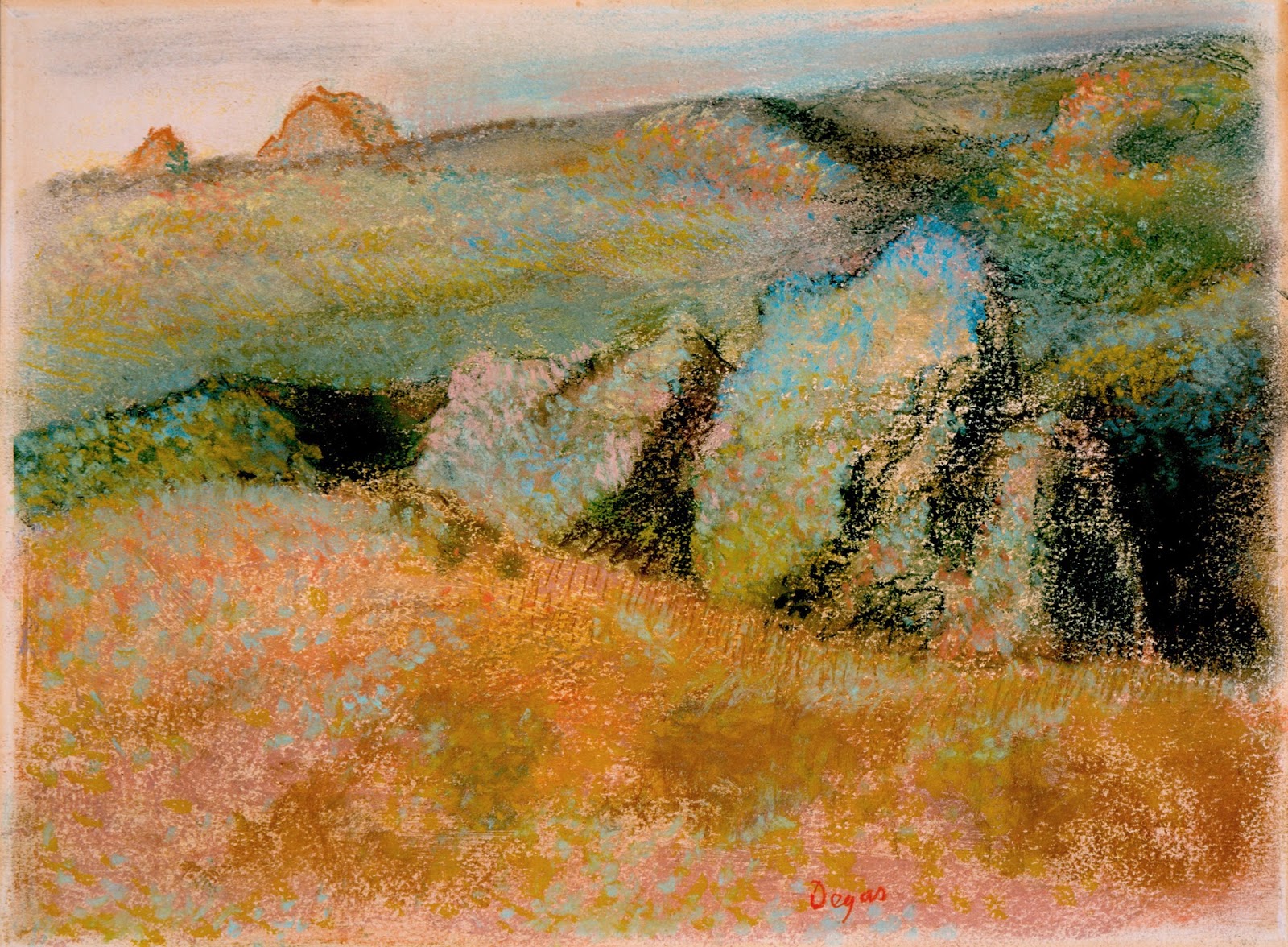
Fortunately, the Degas exhibit has a further surprise in store - a most pleasant one. In 1890, Degas visited Burgundy and was inspired to create landscapes, more ethereal than realistic. This uncharacteristic interest in landscape art revived Degas' utilization of monotype printing which had declined during the late 1880's.


Edgar Degas, Landscape with Rocks, c. 1892

Except in two or three cases, the scenery depicted by Degas in these astonishing monotypes did not correspond to actual geographic localities. Like the "late Turner" landscapes, which are now viewed as a foundation of Modern Art, these sites existed in a distant realm not to be found on any map.

Both Degas and Turner were aging artists, struggling against time and bodily infirmity. As they created their near-abstract landscapes, the "real" world faded around them. This was literally the case for Degas, whose eyesight began to fail in the mid-1870's, just as he took up printing and pastels to create these incredible monotypes. 


Edgar Degas, Forest in the Mountains, c. 1890

The "mind's eye" of  Degas, however, remained unimpaired. The poet, Stéphane Mallarmé, fittingly described the monotypes of Degas as having "a strange new beauty." 

Thanks to this MOMA exhibit we are finally able to appreciate Degas' character and the courage and honesty which he brought to the creation of great art, monotypes in particular. These previously overlooked prints help us to realize that Degas was not a man of contradiction but rather struggled to achieve inner harmony through his art.

Degas declared that he "should like to be famous and unknown." In their first major Degas exhibit, MOMA has insured that his fame will grow, even as his life becomes a little less of an enigma.

 ***
Text: Copyright of Ed Voves, all rights reserved 
Images courtesy of the Museum of Modern Art, New York City                                                                                                                                                                                     Introductory Image: 
Edgar Degas (French, 1834–1917). Heads of a Man and a Woman (Homme et femme, en buste), c. 1877–80. Monotype on paper. Plate: 2 13/16 x 3 3/16 in. (7.2 x 8.1 cm). British Museum, London. Bequeathed by Campbell Dodgson                                                                                                                                                     
Edgar Degas (French, 1834–1917). Dancer Onstage with a Bouquet, c.1876. Pastel over monotype on laid paper. Plate: 10 5/8 × 14 7/8 in. (27 × 37.8 cm). Private collection

Edgar Degas (French, 1834–1917). Factory Smoke (Fumées d’usines), 1877–79. Monotype on paper. Plate: 4 11/16 x 6 5/16 in. (11.9 x 16.1 cm), sheet: 5 13/16 x 6 13/16 in. (14.7 x 17.3 cm). The Metropolitan Museum of Art, New York. The Elisha Whittelsey Collection, The Elisha Whittelsey Fund, 1982.
                                    
Edgar Degas (French, 1834–1917). The Ballet Master (Le Maître de ballet), c. 1876. White chalk or opaque watercolor over monotype on paper. Plate: 22 1/4 x 27 9/16 in. (56.5 x 70 cm), sheet: 24 7/16 x 33 7/16 in. (62 x 85 cm). National Gallery of Art, Washington, D.C. Rosenwald Collection, 1964.

Edgar Degas (French, 1834–1917). Three Ballet Dancers (Trois danseuses), c. 1878-80. Monotype on cream laid paper. Plate: 7 13/16 × 16 3/8″ (19.9 × 41.6 cm). Sterling and Francine Clark Art Institute, Williamstown, Massachusetts.

Edgar Degas (French, 1834–1917). Ballet Scene (Scène de ballet), c. 1879. Pastel over monotype on paper. Plate: 8 x 16 in. (20.3 x 40.6 cm). William I. Koch Collection

Edgar Degas (French, 1834–1917). The Singer (Chanteuse de café-concert), 1875-1880 Pastel over monotype on paper Plate: 6 1/4 x 4 1/2" (15.9 x 11.4 cm) Reading Public Museum, Reading, Pennsylvania. Gift, Miss Martha Elizabeth Dick Estate 

Edgar Degas (French, 1834–1917). Frieze of Dancers (Danseuses attachant leurs sandales), c. 1895. Oil on fabric. 27 9/16 × 78 15/16″ (70 × 200.5 cm). The Cleveland Museum of Art, Gift of the Hanna Fund. © The Cleveland Museum of Art.

Edgar Degas (French, 1834–1917). Landscape with Rocks (Paysage avec rochers), 1892. Pastel over monotype in oil on wove paper. Sheet: 10 1/8 × 13 9/16″ (25.7 × 34.4 cm). High Museum of Art, Atlanta, Purchase with High Museum of Art Enhancement Fund.

Edgar Degas (French, 1834–1917). Forest in the Mountains (Forêt dans la montagne), c. 1890. Monotype in oil on paper. Plate: 11 13/16 x 15 3/4″ (30 x 40 cm). The Museum of Modern Art, New York. Louise Reinhardt Smith Bequest.

Friday, April 29, 2016

Van Dyck: The Anatomy of Portraiture at The Frick Collection


Van Dyck: The Anatomy of Portraiture 


The Frick Collection, New York City

March 2, 2016, through June 5, 2016 

Reviewed by Ed Voves

The list of foreign artists who have found fame and fortune in Great Britain - or refuge, at the very least - is a long one. Hans Holbein, Claude Monet and John Singer Sargent are just a few who achieved success or gained inspiration on British soil.

One artist who "crossed the Channel" made such a mark that it seems incredible that he was not British-born.  Anthony van Dyck (1599-1641) influenced the visual culture of Britain so profoundly that Thomas Gainsborough (1727-1788) invoked his name from his deathbed almost a century and a half later.

"We are all going to heaven," gasped Gainsborough with his dying words, "and van Dyck is of the Company."

Van Dyck: The Anatomy of Portraiture, now on display at the Frick Collection in New York City, demonstrates the exceptional skill and versatility that earned van Dyck this singular acclaim. 

It is highly appropriate that this exhibition is being mounted by the Frick Collection, for it has one of the finest collections of van Dyck's works in the world. 

By a great stroke of fortune - in more ways than one - Henry Frick was able to buy a matched pair of van Dyck portraits, of the painter Frans Snyders and his wife, Margareta de Vos. Unlike so many husband-wife matched portraits from the Old Master era, these two were not separated.  They can be regularly seen together at the Frick and they anchor this special exhibit of van Dyck portraits.

Van Dyck: The Anatomy of Portraiture enables us to see beyond specific masterpieces in order to gain an appreciation of the entire oeuvre of van Dyck's portrait painting. The exhibit cogently integrates van Dyck's preparatory works with his celebrated portraits in oil and less famous etchings. 


Anthony van Dyck, Frans SnydersMargareta de Vos, ca.1620

The portraits of Frans Snyders and Margareta de Vos testify to van Dyck's well-earned place in the grand tradition of Flemish painting.  But the great age of Flanders was nearing its end by the time that van Dyck painted Frans Snyders and Margareta de Vos. It was in the wider arena of Europe that van Dyck made his mark, in Great Britain most of all. 

A youthful Anthony van Dyck first visited Britain for about six months, October 1620 to March 1621. Returning a decade later, he was appointed "principal painter in ordinary to their Majesties" and was knighted by Charles I. 


Anthony van Dyck, Self-Portrait, ca. 1620-21

Accounts of his lifestyle made "Vandyke" - as he anglicized his name - seem more of a nobleman than some of the "milords" he painted. As his numerous self-portraits reveal, van Dyck possessed a highly-developed self-regard.

Van Dyck's rapid rise was founded upon his consummate skill. He masterfully captured the character and individuality of the members of Britain's ruling class and of the Italian nobility during his sojourn there, 1621-1627. 

The salient traits of a van Dyck portrait are not the arrogance or conceit that one might expect of seventeenth century aristocrats. Certainly, there are some portraits proclaiming the inflated dignity of van Dyck's protagonists. But elitism was largely a defense mechanism as royal and aristocratic privilege were threatened on many fronts.

When viewing a van Dyck portrait from his 1630's classic decade, what we see most often is fear, melancholy or blank inscrutability spread across these handsome English and Scottish faces. This was the generation who had been admonished in 1624 by John Donne, "never send to know for whom the bells tolls; it tolls for thee."

Van Dyck, naturally, aspired to a very different tone for his art. He wanted to be the "prince of painters and the painter of princes" as his mentor, Peter Paul Rubens (1577-1640), had been. For a brief few years, during the the 1630's, van Dyck seemingly had achieved his goal at the court of Charles I. 

At first glance, the monumental portrait of Queen Henrietta Maria, the French-born wife of Charles I, overwhelms us with a sense of majesty. Van Dyck lavished a huge amount of time and talent on the preparatory sketch, done with chalk on blue paper.


Anthony van Dyck, chalk sketch for Queen Henrietta Maria with Jeffery Hudson, 1633

The fabrics in the sketch glisten and evoke a tactile feel in the same way, if not to the same degree, of the finished work. This is a masterpiece of draftmanship and it is no wonder that this sketch is a prized work in the collection of the École Nationale Supérieure des Beaux-Arts, Paris.

The most telling element of this sketch, however, is the faint, almost invisible, trace of Henrietta Maria's head. Forsaking preparatory drawings, van Dyck reserved the special magic of his painterly technique to achieve a likeness of the queen.

Van Dyck learned his trade from Rubens but the methods they employed in portraiture were vastly different. Rubens made exquisite preliminary sketches, which the Metropolitan Museum displayed in a memorable exhibit during the winter of 2005. Van Dyck, on the other hand, depicted the features of those he painted by intensive scrutiny during sittings. He methodically creating a "living" image through layer after layer of carefully applied color.

The special achievement of the Henrietta Maria portrait is the way it evokes the queen's outward reserve. This magnificent painting does not portray hauteur or conceit. Rather, it is a masterpiece of not showing any emotion. It is a portrait as a mask of concealment. 


Anthony van Dyck, detail of Queen Henrietta Maria with Jeffery Hudson, 1633

Queen Henrietta Maria, as a French woman and a devout Roman Catholic, was placed in an impossible situation following her marriage to Charles I in 1625. She was never actually crowned Queen of England because of her staunch Catholicism. In militantly Protestant England, Henrietta Maria had to watch her every move and work behind the scenes. This she did, using her influence to aid Catholics in Britain. This only inflamed her Protestant opponents all the more.

Van Dyck was also a devoted Roman Catholic, living and working in what was essentially "enemy" territory. While he was in Italy during the 1620's, however, van Dyck may have felt more secure or perhaps his Italian patrons were less threatened by religious conflict. The portraits that van Dyck painted in Italy are generally less marked by the Hamlet-like introspection that is a notable feature of those he did in Britain.

There is one magnificent exception among van Dyck’s Italian portraits that defies easy categorization.  Shortly after arriving in Italy, van Dyck painted the portrait of the Roman Catholic prelate, Cardinal Guido Bentivoglio. For me, this is the most arresting and unforgettable work in the exhibition. 


Anthony van Dyck, Cardinal Guido Bentivoglio, 1623 

I had never seen van Dyck's Cardinal Guido Bentivoglio before. Yet, there is an ineffable "something" in Bentivoglio's expression. If you examined this masterpiece year-after-year, you would be no closer in getting to the emotional core of Cardinal Bentivoglio than after a fleeting glance.

Bentivoglio was a man of contradiction. He was a brilliant scholar and an able diplomat for the Papacy. However, his face as depicted by van Dyck is that of a mystic, not a man of learning or of worldly affairs. 

Although Bentivoglio was one of the last in a long line of Renaissance humanists, he voted against Galileo at his trial. Bentivoglio was a patron of Claude Lorraine and of Girolamo Frescobaldi, one of the most influential musicians and composers of the seventeenth century. Yet, there is not one visual reference to art or to music in this painting.

For all the intricate detail involved in painting Bentivoglio's white linen surplice, I suspect that van Dyck was not much concerned with the external trappings of the Cardinal's life. Rather, he depicted the enigma at the heart of this "prince of the church" - and of all mortal men and women.

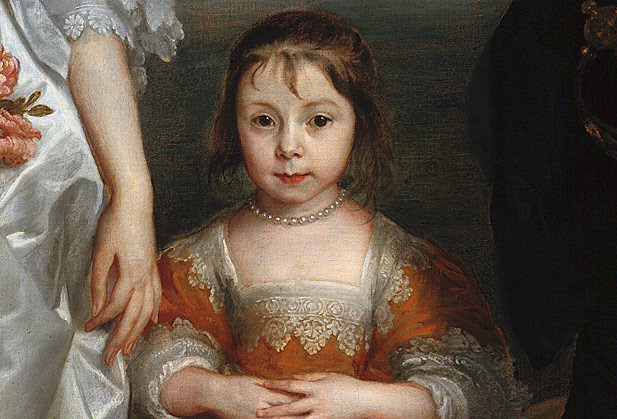
There is  perhaps no more intriguing aspect of human existence than the way that children grow into adulthood. Significantly, portraying children was another point at which van Dyck excelled. As Paul Johnson comments in his great study, Art: a New History, "No one ever painted childhood and youth better than this sensitive and engaging Fleming."


Anthony van Dyck, detail of James Stanley, Lord Strange, Later Seventh Earl of Derby, with His Wife, Charlotte, and Their Daughter, ca. 1636

"Sensitive and engaging" are the words to describe the portrait of the daughter of Lord Strange, Earl of Derby. The young girl was most likely Henrietta Stanley (1630-1685). Posing between her parents, she was painted by van Dyck with an astute grasp of character. Looking at her, we realize that van Dyck was well aware that children are not merely adults in embryo but are unique individuals at every stage of their lives. 

This insight into human nature and development is readily apparent in one of van Dyck's supreme achievements, The Five Eldest Children of Charles I, 1637. 

Van Dyke's group portrait is not among the works at the Frick exhibit but rather exerts a virtual presence. This famous work hung above the breakfast table of Charles I at Whitehall and remains one of the most renowned paintings in the Royal Collection. It is chiefly known by the image of the future Charles II resting his arm on the head of a huge mastiff. To the right of the young Charles are two princesses, Elizabeth and Anne. 

On exhibition at the Frick is an oil study of Princess Elizabeth and Princess Anne used by van Dyck to complete The Five Eldest Children of Charles I. Working with very young children, he elected to follow Rubens' example and do preparatory sketches of the facial features of his subjects.


Anthony van Dyck, The Princesses Elizabeth and Anne, Daughters of Charles I, 1637

This is a tremendously compelling work. Tragically, baby Anne died from tuberculosis in 1640. Elizabeth, at age fifteen, succumbed to the same disease ten years later. Queen Henrietta Maria maintained that she died from a broken heart after hearing of the execution of her father on orders of Parliament. 

By the time Charles I was executed in 1649, van Dyck had been dead for almost a decade. Worn out by his staggering work load, the "sensitive and engaging" painter from Flanders died on December 9, 1640. His "grand manner" world was crashing down around him, with the Thirty Years War devastating Europe and civil war erupting in Britain.

Among the unfinished works in van Dyck's studio was an oil painting of a woman whose identity has not come down to us. 


Anthony van Dyck, Portrait of a Woman, c 1640

Once a great beauty, she appears just past her "prime" in this magnificent portrait. Everything about her is starting to diminish or decline. Her hand claws at her heart. The look of wry self-knowledge in her eyes speaks volumes for her, for van Dyck and to us.

In probing the ultimate mystery and majesty of life, van Dyck had no peers and few equals. All the kings and queens, dukes and duchesses, whose portraits grace the galleries of the Frick are long since passed away. But the human soul is immortal. This is what Anthony van Dyck painted to perfection - or as close to it as any artist can go.

***

Text: copyright of Ed Voves, all rights reserved

Images Courtesy of the Frick Collection, New York City

Introductory image:
Anthony van Dyck (1599–1641) Queen Henrietta Maria with Jeffery Hudson, 1633. Oil on canvas, 219.1 x 134.8 cm (86 1/4 x 53 1/16 in.). National Gallery of Art, Washington; Samuel H. Kress Collection, 1952.5.39. 

Anthony van Dyck (1599–1641), Frans Snyders, ca. 1620. Oil on canvas, 56 1/8 x 41 1/2 in. (142.6 x 105.4 cm) Henry Clay Frick Bequest  Accession #: 1909.1.39 Frick Collection.

Anthony van Dyck (1599–1641), Margareta de Vos, ca.1620. Oil on canvas 51 1/2 x 39 1/8 in. (130.8 x 99.4 cm) Henry Clay Frick Bequest  Accession #: 1909.1.42 Frick Collection.

Anthony van Dyck (1599–1641) Self-Portrait, ca. 1620–21. Oil on canvas, 47 1/8 x 34 5/8 in. (119.7 x 87.9 cm) The Metropolitan Museum of Art, New York; The Jules Bache Collection, 1949 49.7.25

Anthony van Dyck (1599–1641) Queen Henrietta Maria with Jeffery Hudson, 1633. Black chalk, red and yellow (fabricated?) chalks, heightened with white chalk, on blue paper,
16 1/2 × 10 1/8 in. (41.9 × 25.5 cm) École Nationale Supérieure des Beaux-Arts, Paris

Anthony van Dyck (1599–1641)  Detail of Queen Henrietta Maria with Jeffery Hudson, 1633. Oil on Canvas. National Gallery of Art, Washington (see above).

Anthony van Dyck (1599–1641), Cardinal Guido Bentivoglio, 1623. Oil on canvas, 76 3/4 × 57 7/8 in. (195 × 147 cm) Galleria Palatina, Palazzo Pitti, Florence 

Anthony van Dyck (1599–1641) Detail of James Stanley, Lord Strange, Later Seventh Earl of Derby, with His Wife, Charlotte, and Their Daughter, ca. 1636. Oil on canvas,
97 x 84 1/8 in. (246.4 x 213.7 cm) Henry Clay Frick Bequest Accession #: 1913.1.40 Frick Collection.

Anthony van Dyck (1599–1641) The Princesses Elizabeth and Anne, Daughters of Charles IOil on canvas, 11 3/4 × 16 1/2 in. (29.8 × 41.8 cm) Scottish National Portrait Gallery, Edinburgh; purchased with the aid of the Heritage Lottery Fund, the Scottish Office and the Art Fund 1996

Anthony van Dyck (1599–1641) Portrait of a Woman, c 1640. Oil on canvas, 29 7/8 × 23 1/4 in. (75.9 × 59.1 cm) Speed Art Museum, Louisville; Museum Purchase, Preston Pope Satterwhite Fund 


Sunday, April 17, 2016

Pergamon and the Hellenistic Kingdoms of the Ancient World at the Metropolitan Museum of Art


Pergamon and the Hellenistic Kingdoms of the Ancient World 


The Metropolitan Museum of Art


April 18–July 17, 2016


Reviewed by Ed Voves

There is an element of mystery to the huge, sadly mutilated marble head which is a highlight of the new exhibition, Pergamon and the Hellenistic Kingdoms of
the Ancient World at the Metropolitan Museum of Art. 

What could have been the purpose of such a colossal portrait head? Measuring over twice the size of a human skull, its purpose is unclear. It was intended to be fixed in another setting - but where? And whose likeness did the portrait head represent?                             

There is no mystery about what this battered survivor of the ancient Greek world means for the twenty-first century. As we watch the cultural heritage of the world being vandalized and plundered, this work of art stands for what has been lost and also for what has been saved.

Civilization has survived, as Kenneth Clark memorably declared, by "the skin of our teeth."

Clark's 1969 Civilization television series documented the rise of art and culture in the West "after the fall."  What fell was not just the Roman Empire in 476 A.D. The cultural matrix of ancient Rome and its dominions was essentially Greek, a legacy of the Hellenistic kingdoms which flourished before the rise of Rome. Along with the pomp and power of the Pax Romana, the heritage of the Hellenistic era was largely lost during the centuries following the collapse of the Roman Empire.

What was lost is now found - or nearly so. The spectacular exhibit at the Metropolitan Museum, Pergamon and the Hellenistic Kingdoms of the Ancient World, provides a detailed overview of the Hellenistic age for the first in the United States. Both the achievements of the Hellenistic Greeks and the cultural transition to upstart Rome are brilliantly treated in the Met's exhibit.

Pergamon, located in present-day Turkey, was one of the Hellenistic kingdoms which rose to power after the death of Alexander the Great in 323 B.C. Founded in 282 B.C., Pergamon was ruled by the Attalid dynasty. Most of the rulers of Pergamon were named Attalus, adding to the difficulties of dating inscriptions by modern-day archaeologists.

Pergamon is one of the most exhaustively studied sites from ancient times. Its recovery is literally a "triumph of German engineering."

During the 1860's, Carl Humann, a German railroad engineer working in Turkey, noticed people in the town of Bergama digging up pieces of ancient statues. These fragments were burned to produce lime. Humann successfully petitioned Turkish leaders to stop the destruction.

On his own initiative, Humann undertook preliminary excavations and passed the reports to German museum authorities. Humann, though not a trained archaeologist, became so accomplished and maintained such a vital network of contacts in Turkey that he was nicknamed the "Viceroy of Asia Minor." 

In 1878, a prolonged archaeological expedition under the leadership of Alexander Conze at Bergama recovered the lost grandeur of Hellenistic Pergamon.


Female Figure in the Archaic Style (The Dancer), 150-125 B.C.

One of the early discoveries was this intriguing statue of dancer. Although dating to late in the Hellenistic era, the figure with its intricate skirt folds was deliberately created in the artistic style of the early city states of mainland Greece. This elegant dancer was intended to evoke the Hellenic spirit, a sense of Greek tradition that was the foundation of the Attalid dynasty and the imposing temples and palaces of Pergamon.

Much of what was excavated was taken back to Berlin, by special agreement with Turkey. This included the west side of the Great Altar of Pergamon which was reconstructed in the Pergamon Museum in Berlin. This great institution is currently being renovated, providing the opportunity to bring many of its treasures to the Metropolitan Museum of Art.


Friedrich von Thiersch, The Akropolis of Pergamon, 1882

Of the many works of art brought from Berlin surely the most remarkable are the fragmentary marble head, discussed at the beginning of this review, and a towering statue of Athena, modeled after the cult figure of the Parthenon.  Both tell us much about the Hellenistic kingdom of Pergamon.

The shattered head is thought to have decorated the wall of the gymnasium of Pergamon. It is a type of art variously described as a tondo or imago clipeata meaning "portrait on a round shield." The colossal head jutting forward, with parted lips as if to speak, may be Apollo but is more likely to be an idealized portrait of Alexander.

Alexander's presence dominates the exhibit galleries of Pergamon and the Hellenistic Kingdoms of the Ancient World.


Small Statue of Alexander the Great,1st century B.C. copy of original, 320-300 B.C.

There are numerous portraits of Alexander, ranging from a lean-featured warrior to a sensitive, god-like figure. The Hellenistic rulers of Egypt kept a careful guard over the embalmed body of Alexander, so the monstrously large portrait head excavated in Pergamon is likely to have been created as chess move in the cultural "Cold War" waged between the Attalids of Pergamon and their rivals in Egypt.

The statue of Athena, smaller than the one in the Parthenon but still imposing, stood in the Library of Pergamon. The Attalids built a book collection second in size and importance to that of Alexandria in Egypt.

At some point, the flow of Egyptian papyrus for new volumes was halted, reputedly by order of Ptolemy V. The librarians at Pergamon began using cured sheep skins for their books. They were so successful that this form of paper became known as pergamēnē which eventually was translated into English as parchemin or parchment.


Statue of Athena Parthenos, ca. 170 B.C.; copy of original, mid-5th century B.C.

Worship of Athena took on additional meaning in Pergamon as one of its early rulers, Attalus I, assumed the role of the Athenians as the defender of Greece against the "barbarians." But instead of fighting Persian or other Asian enemies as the Athenians had done, Attalus I won a resounding victory in 241 B.C. over invading Celts. These raiders had crossed from Europe over the Hellespont into Asia Minor to attack Pergamon and other Greek states.

The Great Altar at Pergamon was built to celebrate this victory of Attalus I. However, there is very little that is straightforward about the Hellenistic period. In battling against the Celts, Attalus was really fighting against the Hellenistic Greek dynasty in Syria, the Seleucids. These "civilized" rivals paid the "savage" Celts to attack Pergamon several times following the initial victory of Attalus in 241 B.C. 

Just as the one-time allies, Athens and Sparta, had torn each other to pieces in the fifth century B.C., so later did the Hellenistic kingdoms.The Greeks had a cyclical view of history and no wonder! For all their brilliance, they kept fighting and slaughtering each other - over and over again.

Much of the art on display in the Metropolitan exhibit had a propaganda value intended to enhance the status of Hellenistic rulers like Attalus I. Other works testify to the efforts of the Hellenistic monarchies to provide their citizens with recreation and luxuries in order to distract their minds from the endless wars. 


Hair Ornament with Bust of Athena, 2nd century B.C.

The "good life" in Hellenistic Greece included items of magnificent adornment like this golden hairnet, graced with a tondo image of Athena.

Theater flourished during the Hellenistic age, chiefly through the "New Comedy" of Menander (342/41 – c. 290 B.C.). The exhibition includes a sensitive marble portrait of Menander from the Dumbarton Oaks Museum collection, as well as this outstanding mosaic of a scene from one of Menander's comedies, likely Theophoroumene (The Possessed Girl).


Emblèma with Itinerant Musicians, 2nd-1st century B.C. 

Menander wrote over one hundred plays, many of them bawdy comedies. He was so famous in antiquity that many lines in his plays became popular proverbs. Even St. Paul in 1 Corinthians 15:33 quoted Menander, "Bad company corrupts good character." 

Menander, however, is one of the most notable examples of civilization surviving by the "skin of our teeth." Only a few scattered lines from his plays survived until twentieth century discoveries. Papyrus texts, used to line Egyptian mummy cases during the era of the Roman Empire, were found, containing substantial quotations from Menander's plays. Even with these fortunate finds, however, only one (nearly) complete comedy by Menander has been discovered.

The Metropolitan Museum exhibit also displays numerous examples of the Hellenistic taste for sensuality, a theme that was usually expressed with reference to mythology. By the end of the Hellenistic era, many people had begun to question the nature of the gods. But the traditional pantheon of Olympus continued to yield images for popular art.  


Calyx-Krater (The Borghese Krater), 40-30 B.C.

The Borghese Krater, an imposing work in the Louvre collection, beautifully expresses the desire for Arcadian ease and sexual gratification. Sentiments like this are often found in societies sick of war and rumors of war. Here Dionysian figures delight in each other's company on a marble vase made around the time that Octavian Caesar's battle fleet crushed the forces of Antony and Cleopatra at the Battle of Actium, 31 B.C.

The ill-stared alliance and immortal love-match of Antony and Cleopatra brought the Hellenistic era to an unforgettable close. There are several works of art in the Metropolitan exhibit relating to this well-known episode. One of these is a multi-panel bas relief of the Battle of Actium from a private collection in Spain that I had never seen before.

It is a very familiar piece of art, however, which seems to me to be the best evocation of the Hellenistic Age and the passing of its torch to Rome - and to us in modern times.

This is the beautiful Vienna Cameo. Unlike the plays of Menander, this carved-jewel from Ptolemaic Egypt was never lost. It was stolen in 1574, from the cover of a reliquary containing the "bones" of the Three Kings. Some years later, the cameo was purchased by the ruler of Mantua and then found its way to the art collection of the Hapsburg Empire in Vienna.


The Vienna Cameo, 278-270/69 B.C.

The cameo dates from around 278 B.C., early in the Hellenistic era. The elegant couple are King Ptolemy II Philadelphos and Queen Arsinoe II, his sister and his wife! But with the Roman-style helmet worn by Ptolemy and the forceful gaze of Arsinoe, I cannot help but see these two as a fitting stand-in for Antony and Cleopatra.

More to the point, the Vienna Cameo testifies to the resilience of great art and the spirit that motivates its creation. It says a lot that people in the Middle Ages prized the cameo enough to place it on a relic container and that a Renaissance collector would pay a healthy sum to add it to his "cabinet of curiosities."

Now, the Vienna Cameo graces an outstanding art exhibition filled with works that have survived centuries of war, looting and destruction. On view at the Met, these treasures tell of a lost civilization whose remnant has survived by "the skin of our teeth."

Among its many accomplishments, Pergamon and the Hellenistic Kingdoms of
the Ancient World inspires the hope that our civilization, heir to the Hellenistic world, will endure too. 

***
Text: Copyright of Ed Voves, all rights reserved 

Introductory Image:                                                                                                         Fragmentary colossal marble head of a youth, Greek, Hellenistic period, 2nd century B.C. Discovered at Pergamon, on upper terrace of gymnasium, 1879 Antikensammlung, Staatliche Museen zu Berlin (AvP VII 283) Cat. 58

Archaistic female figure, Greek (Pergamene), Hellenistic period, 150-125 B.C.
Marble H. 47 1⁄4 in. (120 cm) Antikensammlung, Staatliche Museen zu Berlin (AvP VII 43) Image: © SMB/Antikensammlung (photographs by Johannes Laurentius)

The Akropolis of Pergamon. By Friedrich (von) Thiersch, 1882 Pen and ink with watercolor on canvas H. 78 in. (198 cm), W. 11 ft. 53/4 in. (350 cm)
Antikensammlung, Staatliche Museen zu Berlin (Graph 91) Image: © SMB / Antikensammlung

Small Statue of Alexander the Great astride Bucephalos, Roman, Late Republican or Early Imperial period, second half of the 1st century B.C.; copy of a Greek original of ca. 320-300 B.C. Bronze H. 19 1/8 (48.6 cm), L. 18 1⁄2 in. (47 cm) Museo Archeologico Nazionale, Naples (1996)

Statue of Athena Parthenos, Greek, Hellenistic period, ca. 170 B.C.; copy of a mid-5th century B.C.chryselephantine cult statue of Athena Parthenos by Pheidias
Marble H. without base 10 ft. 2 1/4 in. (310.5 cm), W. 46 5/8 in. (118.5 cm), D.
27 1/8 in. (69 cm), H. of base 16 in. (40.5 cm). Antikensammlung, Staatliche Museen zu Berlin (AvP VII 24). Image: © SMB/Antikensammlung

Hair Ornament with Bust of AthenaGreek, Hellenistic period, 2nd century B.C. Gold, red garnets, blue enamel D.11.1 cm.Athens, Benaki Museum (inv. no. 1556)

Emblèma with Itinerant Musicians, Roman, Late Republican period, 2nd-1st century B.C. H. 18 7/8 in. (48 cm), W. 18 1/8 in. (46 cm)Museo Archeologico Nazionale, Naples (inv. no. 9985)

Calyx-Krater (The Borghese Krater) Greek, Late Hellenistic period, 40-30 B.C.
Marble H. 67 3⁄4 in. (172 cm) Musée du Louvre, Paris(Ma 86). Image: © RMN-Grand Palais/Art Resource, NY

The Vienna Cameo, Greek (Ptolemaic), Early Hellenistic period, 278-270/69 B.C.
Ten–layered onyx (Indian sardonyx) H. 41/2 in. (11.5 cm), W. 4 in. (10.2 cm)
Antikensammlung, Kunsthistorisches Museum, Vienna (IXa 81)