Monday, May 1, 2023

Art Eyewitness Book Review: Picasso: the Self-Portraits by Pascal Bonafoux

Picasso: the Self-Portraits

By Pascal Bonafoux

Thames & Hudson/$45/223 pages

Reviewed by Ed Voves

Often times, when a great writer, actor or artist of advanced age dies, the  reaction is a bemused exclamation, "I didn't know he (or she) was still alive."

When Pablo Picasso died a half century ago, on April 8, 1973, that was not the response. No one thought of Picasso in the past tense, but rather with shock that he could die.

Yes, Picasso had lived a very long time, 1881-1973. Yes, many of his best works were already on museum walls years before his passing. Picasso, however, was such a legendary figure, an artist of genius caliber, that it was hard to conceive of the art world without him.

Fifty years on, art historians are still grappling with the legacy of Picasso. Museums around the world have announced exhibitions to mark the anniversary of his death - and his continuing importance. While these upcoming exhibits will doubtless provide new insights, museum curators are already facing stiff-competition from an impressive new book, Picasso: the Self-Portraits, written by the French art historian, Pascal Bonafoux.

There are a number of surprising aspects to this outstanding book. Perhaps the most glaring one is the fact that this is the first systematic study of Picasso's self-portraits. Considering the exhaustive treatment of Picasso's oeuvre, it is a bit perplexing that this trove of revelatory art has been little regarded by scholars, at least as a body of work - and an extensive one at that.


Pablo Picasso, Self-Portrait (detail), 1906

Picasso: the Self-Portraits examines 170 paintings, drawings and photos. Beginning with an 1894 drawing of himself, aged thirteen, Picasso continued to record - and in some cases, disguise - his features up until a few months before he died. 

Most of these self-portraits, however, were created before 1918. In November of that year, Picasso heard the shocking news that his great friend, Guillaume Apollinaire, had just died during the Influenza pandemic. According to legend, Picasso was shaving when the message arrived and could not bear looking into a mirror after that terrible moment. Doing so reminded him of the painful passing of Apollinaire - and of his own mortality.

The second surprise factor is the curiously "old-fashion" look to the present volume. The book opens with the text, eighty-plus pages of solid print, en bloc. Then come the pictures, treated with superb fidelity whether color, sepia or black and white, but lacking explanatory captions. Given that the publisher is Thames and Hudson, who practically invented the process of closely integrating pictures with text in art books, this arrangement did come as a bit of shock when I first leafed through the pages.

Any doubts about Picasso: the Self-Portraits vanished by the time I finished reading the first couple of paragraphs. It was a master-stroke to use Bonafoux's brilliant narrative to engage the reader's imagination, followed by the pictures. Bonafoux is an exceptional writer, a French intellectual whose scholarship is tempered with warm human empathy and philosophic insight. 

In many ways, Bonafoux's text is a meditation on life, Picasso's and ours. Quoting a remark by Picasso that "a painting only lives through the person looking at it," Bonafoux invites us to join in this silent dialog. 

Alone. I am alone before Picasso's self-portraits. You are alone before these same self-portraits... And perhaps that is the purpose of a self-portrait, to make us examine our own solitude.

So let the words and the images of Picasso: the Self-Portraits speak for themselves without constant referring back and forth. The best way to use this intriguing book is to savor the text and images as complementary essays. 

Bonafoux begins his narrative by relating how he met Picasso's widow, Jacqueline, at a dinner party. Bonafoux's specialty in art scholarship is the study of self-portraits from the Renaissance to the contemporary world.

Pablo Picasso, Self-Portrait, 1917

During their discussion about art, Jacqueline Picasso asked if Bonafoux had referred to Picasso's self-portraits in his research. Bonafoux replied by mentioning the mirror incident, which the photographer Brassai had related. Jacqueline Picasso contradicted Brassai's account, telling Bonafoux that Picasso had continued to create self-portraits after 1918. This exchange launched Bonafoux on a forty-year exploration of how Picasso came to depict himself in paintings and drawings over the course of his life.

Later, Jacqueline showed Bonafoux a self-portrait by Picasso, (above) dated to 1959. The 1959 date referred to the occasion when Picasso presented it to her. The drawing was actually created in 1917. 

The Self-Portrait is exceptionally crisp and well-delineated, worthy of the classical style of French drawing, especially the portrait sketches of Jean Auguste Ingres (1780-1867). Picasso executed several more in this manner, but almost all before the end of World War I. The self-portraits he created in the years that followed the war were few in number and very varied in composition. Apparently, there was an element of truth in both what Brassai and Jacqueline Picasso had stated.

Bonafoux discounts a shattering event like Apollinaire's death (which was certainly upsetting to the artist) as having any real effect on Picasso's production of self-portraits.

For Picasso, self-portraits were more documents of experimentation than documentation. That is why most of the self-portraits were created when Picasso was very young. He was finding his way in the world, especially when he made the decision to settle in France, despite the vibrant culture of Barcelona and the fellow-artists whose friendship he celebrated in a poster for the fabled cafe, Els Quatre Gats. 


Pablo Picasso, Poster for Els Quatre Gats with self-portrait, 1902
Picasso is shown in the foreground, with Pere Romeu’s dog

The self-portraits of Picasso's early years how him in many guises: dressed as a top-hatted Parisian boulevardier (despite being nearly destitute); sporting a mustache, making him look much older than his age in 1901; even a rather silly pose, wearing the crown of an Egyptian Pharaoh, in a composite drawing.


Pablo Picasso, Picasso with a Woman, 1901

 Pablo Picasso, Profile, 1901

Pablo Picasso, Self-portrait as a Pharaoh, 1903-4

Many of these early self-portraits would be of little interest today except that Picasso had created them. But create them he did, as he investigated the life around him and within, with abundant explorations of sexuality as evidenced by the accompanying nude sketches on Self-portrait as a Pharaoh. 

Bonafoux notes that a constant factor in Picasso's life was his devotion, indeed obsession, to change. From early on, he set himself to oppose the established conventions of art, summed-up under the disparaging term, style. This leads Bonafoux to the "paradoxical conclusion" that "it is the very changeability of Picasso's work that makes it endure."

"Perhaps," Bonafoux muses, "we should therefore view Picasso's self-portraits as symbols of these changes that look like him... When he paints himself, he is not so much seeking to represent Picasso as he is seeking to be a Picasso."

If many of the early self-portraits merely reflect the "changes that look like him," several were major, monumental likenesses. The haunting, 1901 Blue Period Self-Portrait and the 1906 "Iberian" Self-Portrait from the collection of the Philadelphia Museum of Art are works which evoke Picasso's moods and interests at the time he painted himself on these canvases. But both works probe deeply below surface details, into Picasso's soul and psyche. Together these self-portraits forecast the mature Picasso's role as the Magus of Modern Art.


Pablo Picasso, Self-Portrait, 1906 
Philadelphia Museum of Art Collection

None of the self-portraits which Picasso created during the inter-war years, 1918-1939, or the period following the Second World War, approached these early works in skill or interest. Some are technically significant, others little more than sketches.

This takes us back to the "mirror image" question. This time, we can safely say that Picasso now had little need to represent himself. He was now painting and drawing "Picasso" in each and every one of his works. The painter of Guernica had little need to limit himself to autobiography. 

Only very late in life, when Picasso was indeed confronting his mortality, did he return to a serious focus on self-portraits. In 1972, only months before he died, Picasso created several skull-like depictions of himself, looking like apparitions from beyond the grave. These leave little doubt as to where his thoughts were directed.

In one of the most poignant reflections in his compelling narrative, Bonafoux affirms that the real, lasting value of self-portraiture is the way it encourages, indeed insists, that artists remain true to themselves:

The only model who is always available to a painter, the only model who they can be sure will never recoil, offended or disappointed, on seeing the final portrait, is themselves. Their own image is what artists have always measured themselves against, time and again, to establish their visual identity.

Delete the words "painter" or "artist' from these wise words and forget about Pablo Picasso for the moment. Apply Pascal Bonafoux's sage reflection to ourselves. This I think will make for a very telling experience, the next time we look into a mirror. 

***

Text: Copyright of Ed Voves, all rights reserved. Original photography by Anne Lloyd, all rights reserved. 

Images of works by Pablo Picasso, courtesy of Thames and Hudson

Introductory Image: Cover art of Picasso: the Self-Portraits, by Pascal Bonafoux, courtesy of Thames and Hudson, 2023.

Anne Lloyd, Photo (2020) Pablo Picasso's Self-Portrait, 1906. Oil on canvas: 36 3/16 inches x 28 7/8 inches. Philadelphia Museum of Art. (Photo by Anne Lloyd, 2020)

Pablo Picasso, Self-Portrait, 1917, pencil on paper, 34 x 23.5 cm. Private collection. © Succession Picasso 2022

Pablo Picasso, Poster for Els Quatre Gats with self-portrait, 1902, pen and ink on paper, 31 x 34 cm. In the foreground, the artist and Pere Romeu’s dog; background, from left to right, Pere Romeu, Rocarol, Fontbona, Àngel F. de Soto, Sabartés. Private collection. © Succession Picasso 2022

Pablo Picasso, Picasso with a Woman, 1901, ink and watercolor on paper, 17.3 x 13 cm. Private collection. © Succession Picasso 2022

Pablo Picasso, Profile, 1901, ink on paper, 21 x 13 cm. Private collection. © Succession Picasso 2022 

Pablo Picasso, Self-portrait as a Pharaoh, 1903-4, Chinese ink and colored pencils on paper, 26 x 36 cm. Private collection. © Succession Picasso 2022

Tuesday, April 25, 2023

Art Eyewitness Review: Innocence and Experience at the Metropolitan Museum of Art


Innocence & Experience: 
Selections from the Dept. of Drawings & Prints   

Metropolitan Museum of Art

February 09, 2023 – May 16, 2023   

Reviewed by Ed Voves                                                                  

Original photos by Anne Lloyd  

The Metropolitan Museum of Art has 5,000 years worth of art works to display. It goes without saying that even the Met, vast as it is, needs every square foot of space to present its encyclopedic collection.

Make that every square inch. 

What other museums might treat as a transit corridor, the Met curators see as prime exhibition real estate. Gallery 690 is a case in point. 

Essentially, Gallery 690  is a passage way on the second floor of the Met, located just to the left of the grand staircase. It is the path most people take as they hasten toward the Impressionist galleries and special exhibition venues like the Tisch Galleries, the site of blockbuster exhibits like last autumn's The Tudors: Art and Majesty.


Anne Lloyd, Photo (2023) 
Gallery 690 at the Met, showing Innocence and Experience: Selections from the Department of Drawings & Prints 

Gallery 690 (also known as the Robert Wood Johnson Jr. gallery after a generous benefactor) gets a lot of pedestrian traffic. Many people who traverse it just keep going without stopping to look at the works of art displayed on its walls. I'm nobody to criticize such behavior. I've done exactly that, countless times, including my recent "audience" with the Tudors. I did not want to keep Henry VIII or Elizabeth R waiting! 


Anne Lloyd, Photo (2023) 
Gallery view of Innocence and Experience, showing  
William Blake's Angel of the Revelation, 1803-05

I have had reason to rethink my hasty behavior. Gallery 690 is the primary site for the display of the riches of the Met's Drawings and Prints Department. Four times each year, the Met's curators mount rotations of prints and pictures, in themed presentations which certainly deserve prolonged study and appreciation.

Founded in 1916, the Drawings and Prints Department at the Met now totals well-over one million works on paper, including 21,000 drawings and 12,000 illustrated books. Along with Gallery 690, the Met has a special study room where art lovers can schedule appointments to study prints and drawings at close hand.

The current display in Gallery 690 made it impossible for me to simply breeze through on my way to the Tisch Galleries. In fact, Anne and I made a special point to visit the Met so that we could immerse ourselves in the winter/spring 2023 rotation of treasures from the Drawings and Prints Department. Entitled Innocence & Experience, this superb display is highlighted by the Met's sensational holdings of works by William Blake, notably his Songs of Innocence and Songs of Experience. 


William Blake (1757-1827), 
Title page of Songs of Innocence and Songs of Experience, 1794 

William Blake (1757-1827) is, of course, one of the greatest names in British art and literature. Given the importance of Songs of Innocence and Songs of Experience, you might expect that these masterful "illuminated" pages to be one of the highlights of the Met, constantly on view. 

In fact, like all light sensitive prints and pictures, Songs of Innocence and Songs of Experience must spend long years in darkened solitude. This is done to help mitigate damage done by exposure. The last time Songs of Innocence and Songs of Experience were displayed en bloc was the Met's "once in a lifetime" William Blake exhibit in 2001. 

William Blake, ignored and disparaged during his lifetime, spent a lot of time himself in seclusion. Moreover, it took long decades after his death in 1827 for his skill as an artist and printmaker to be fully recognized. But, by 1917, Blake's works were being sought by museums and collectors in Britain and the U.S. When a copy of Songs of Innocence and Songs of Experience was placed on the art market, the Met purchased this rare illustrated book for its new collection of drawings and prints. 

It was a bold decision. If William Blake's visual imagery was gaining recognition by the early years of the twentieth century, his poems remained unsettling and controversial.

 Blake's verse mixed prophetic visions, his own and from the Holy Bible, with interpretations of classical mythology and "contrarian" social theories. Blake's writings are among the richest and most challenging works in all of English literature.


Anne Lloyd, Photo (2023) 
Subtitle of Blake's Songs of Innocence and Songs of Experience

Blake published Songs of Innocence in 1789. Songs of Experience followed in a combined volume, Songs of Innocence and Songs of Experience, issued in 1794. Blake continued to print separate copies of Songs of Innocence, as well, turning the proper sequence of publication of the two editions into a chronic headache for literary scholars.

The twenty-seven printing plates for Songs of Innocence in 1789 were created by a process called relief etching, which Blake had invented several years before. In this technique, the words of the poem were etched directly onto the plate along with the illustration. This entailed inscribing the words backward, so that they would be readable in the finished print. 


William Blake (1757-1827), 
 Songs of Innocence: The Divine Image, 1789 (printed 1825) 

The heightened level of mental acuity and technical skill involved in this process reveal Blake to have been one of the most accomplished artists of his era. 

The astonishing degree of Blake's accomplishment is made all the more incredible when one sees the actual printed pages of Songs of Innocence and Songs of Experience displayed on the walls of Gallery 690. Each is a masterpiece in its own right, a "pocket-sized" miracle of integrated word and image.


Anne Lloyd, Photo (2023) 
Gallery view of the Innocence and Experience exhibit, showing
pages from Songs of Innocence and Songs of Experience 

Blake continued to print copies of Songs of Innocence and Songs of Experience upon request over the succeeding years. The Met exhibition displays the set of prints commissioned by Edward Calvert in 1825, only a short time before Blake died. Calvert (1799-1883) was a talented artist (several of his otherworldly prints are displayed in the exhibit) and a member of The Ancients. This small band of young idealistic artists led by Samuel Palmer embraced Blake as their mentor.

Calvert's copy of Songs of Innocence and Songs of Experience is known as Copy Y to distinguish it from earlier copies. Because each copy was hand-colored, there are often great variations in the different finished books. The Met's Copy Y has a congenial, "child-friendly" look which is very different from that of Copy F in the collection of the Yale Center for British Art. This variation can be seen in the following comparison of the prints of Blake's immortal poem, The Tyger, from these two respective copies.


William Blake's The Tyger, 1794 (Copy Y, Metropolitan Museum)


William Blake's The Tyger, 1794 (Copy F, Yale Center for British Art)

Blake had great hopes for Songs of Innocence when he first published it in 1789. He envisioned childhood years as a time of creative exploration which would lead to lives of freedom and self-fulfillment. His view shared in the ideals of Jean Jacques Rousseau, embraced and celebrated by the French Revolution launched that very year. 


William Blake (1757-1827), 
 Songs of Innocence: The Ecchoing Green, 1789 (printed 1825) 

By 1794, when the combined volume appeared, the mood in Britain had dramatically turned. The initial hopes for peaceful reform in France had been dashed, war between the two nations was declared and idealists like Blake were increasingly viewed with suspicion. In 1803, Blake was accused of sedition after an argument with a drunken soldier. Although the jury returned an innocent verdict, Blake's artistic career never recovered.

Blake expressed his visions in a personal vocabulary and a cast of unique protagonists much as J.R.R. Tolkein would later do. And just as initial incredulity about Tolkien's Hobbits gave way to world-wide acclaim, so Blake's prophecies would over-time be vindicated.

"Over-time" however took a very long time. Blake's The Chimney Sweeper from Songs of Experience testifies to just how prolonged the process of social reform in Great Britain could be.


William Blake (1757-1827), 
 Songs of Experience: The Chimney Sweeper, 1794 (printed 1825) 

In this passionate protest, Blake denounced the appalling practice of forcing pre-teen boys to clean filthy, begrimed chimneys. This dangerous task was done often with fires still lit or smoldering while the boys brushed away the noxious coal dust and soot. Despite Blake's passionate protest, the horrifying practice was not outlawed until 1873.

When The Chimney Sweeper is contrasted with Little Boy Lost or Infant Joy, the sentimental words and images of these pages from Songs of Innocence seem as if they come from a lost pre-Industrial Revolution paradise. Blake  knew that such a realm had not existed, at least in recent times, in Britain. Instead, the nation, despite its wealth and power, was gripped by the "cold and usurous hand" which figures so memorably in Holy Thursday from Songs of Experience.

Yet, Blake, despite the derisive criticism and threadbare poverty which blighted his life, never lost faith that rays of God's light would bring the "mercy, pity, peace and love," which serve as the refrain of The Divine Image, to our all-too human hearts.


Anne Lloyd, Photo (2023) 
Detail of Infant Joy from Songs of Innocence, 1789 

"Mercy, pity, peace and love" feature in many of the works of art which accompany those of Blake in the Innocence & Experience exhibition in Gallery 690. Jean-Auguste-Dominique Ingres, Edgar Degas, Mary Cassatt, Berthe Morisot, Edgar Degas and Kathe Kollwitz are all represented (or depicted) by images which stress the common - and quietly extraordinary - aspirations which bond all of humanity.


Anne Lloyd, Photo (2023) 
 Kathe Kollwitz, Municipal Shelter, 1926

The works of art chosen for the quarterly rotations in Gallery 690 are linked by subject themes or technical elements which provide an underlying unity to these wonderful displays of prints and drawings. Often the emotional impact is quite moving, as I have commented upon at some length in this review.

But there is always room for humor in most artistic endeavors. Even Hamlet is enlivened by a moment or two of comic relief. I was glad to see that the Met curators had wittily chosen a rather jaunty, non-threatening lion by George Stubbs to join Blake's fearsome Tyger on the walls of Gallery 690. 


George Stubbs, A Lion (A Lion Resting on a Rock), 1788

One look at Stubbs' noble lion and you know that he won't be gobbling up Blake's woolly lamb or the infant who embraces it on the nearby print of Spring (second plate) from Songs of Innocence

Did the "immortal hand" which "made the lamb make thee", lion? 


Anne Lloyd, Photo (2023)
 Detail of Blake's Spring (second plate) from Songs of Innocence

I, for one, have no doubt that the answer to Blake's existential question in The Tyger is yes! God made the tiger, the lion and the lamb. And me and you.

Here at last, in Gallery 690 at the Met, is a "Peaceable Kingdom" of sorts. Stubbs' lion and Blake's lamb can rest together in the spirit of "mercy, pity, peace and love." 

And so can we.

***
Text: Copyright of Ed Voves, all rights reserved. Original photography by Anne Lloyd,                                                                                           
Images courtesy of the Metropolitan Museum of Art. 

Introductory Image: Detail of the Frontispiece of William Blake's Songs of Experiencecreated 1794, printed ca. 1825. Relief etching printed in orange-brown ink and hand-colored with watercolor and shell gold: sheet: 6 3/16 x 5 9/16 in. (15.7 x 14.1 cm) Metropolitan Museum of Art. #17.10.28

Anne Lloyd, Photo (2023) Gallery 690 at the Metropolitan Museum of Art, showing the exhibition Innocence and Experience: Selections from the Department of Drawings & Prints

Anne Lloyd, Photo (2023) Gallery view of the Innocence and Experience exhibition, showing William Blake's Angel of the Revelation, ca. 1803–5,  Watercolor, pen and black ink, brush and wash, over traces of graphite. Collection of the Metropolitan Museum of Art.

William Blake (British,1757–1827) Title page of Songs of Innocence and Songs of Experience, 1794. Relief etching printed in orange-brown ink and hand-colored with watercolor and shell gold: sheet: 6 3/16 x 5 9/16 in. (15.7 x 14.1 cm) Metropolitan Museum of Art collection

Anne Lloyd, Photo (2023) Subtitle of Blake's Songs of Innocence and Songs of Experience.

William Blake (British,1757–1827) Songs of Innocence: The Divine Image, created 1789, printed 1825. Relief etching printed in orange-brown ink and hand-colored with watercolor and shell gold sheet: 6 3/16 x 5 9/16 in. (15.7 x 14.1 cm) Metropolitan Museum of Art collection

Anne Lloyd, Photo (2023) Gallery view of the Innocence and Experience exhibition, showing showing pages from William Blake's Songs of Innocence and Songs of Experience.

William Blake (British,1757–1827) Songs of Experience: The Tyger, 1794 (Copy Y, Metropolitan Museum) Relief etching printed in orange-brown ink and hand-colored with watercolor and shell gold: sheet: 7 1/4 x 4 3/4 in. (18.4 x 12.1 cm) Yale Center for British Art collection.

William Blake (British,1757–1827) The Tyger, 1794 (Copy F, Yale Center for British Art) Relief etching with watercolor on textured, cream wove paper:    6 3/16 x 5 9/16 in. (15.7 x 14.1 cm) Metropolitan Museum of Art collection

William Blake (British,1757–1827) Songs of Innocence: The Ecchoing Green, 1789, printed 1825. Relief etching printed in orange-brown ink and hand-colored with watercolor and shell gold: sheet: 6 3/16 x 5 9/16 in. (15.7 x 14.1 cm) Metropolitan Museum of Art collection

William Blake (British,1757–1827) Songs of Experience: The Chimney Sweeper, 1794, printed 1825. Relief etching printed in orange-brown ink and hand-colored with watercolor and shell gold: sheet: 6 3/16 x 5 9/16 in. (15.7 x 14.1 cm) Metropolitan Museum of Art collection

Anne Lloyd, Photo (2023) Detail of William Blake's Infant Joy from Songs of Innocencecreated 1789, printed 1825. Relief etching printed in orange-brown ink and hand-colored with watercolor and shell gold:  sheet: 6 3/16 x 5 9/16 in. (15.7 x 14.1 cm) Metropolitan Museum of Art collection

Anne Lloyd, Photo (2023) Kathe Kollwitz' Municipal Shelter, 1926. Lithograph: image: 17 1/4 x 21 1/4 in. (43.8 x 54 cm): sheet: 21 x 29 7/8 in. (53.3 x 75.9 cm Metropolitan Museum of Art collection

George Stubbs (British,1724–1806)A Lion (A Lion Resting on a Rock), 1788. Etching with roulette work; only state: 13 1/4 x 10 1/4 in. (33.7 x 26.0 cm) Metropolitan Museum of Art collection

Anne Lloyd, Photo (2023) Detail of William Blake's Spring (second plate) from Songs of Innocence. Relief etching printed in orange-brown ink and hand-colored with watercolor and shell gold: sheet: 6 3/16 x 5 9/16 in. (15.7 x 14.1 cm) Metropolitan Museum of Art collection


Saturday, March 25, 2023

Art Eyewitness Review: Lives of the Gods: Divinity in Maya Art


Lives of the Gods: Divinity in Maya Art

Metropolitan Museum of Art, Nov. 2022 - April 2, 2023

Kimbell Art Museum, Fort Worth TX, May 7 - Sept. 3, 2023

Reviewed by Ed Voves

Original photography by Anne Lloyd

To compare ancient peoples, separated by thousands of miles and hundreds of years, is always problematical. The danger of emphasizing superficial resemblances between two cultures can easily lead to dubious or untenable conclusions.

Despite this risk, I think that the astonishing Mayan kingdoms of southern Mexico and Central America rank with the ancient Greeks as the most dynamic cultures of their respective regions. What the Greeks were to the lands bordering the Mediterranean Sea, the Maya equaled in their influence on the Mesoamerican world.

After visiting the Lives of the Gods: Divinity in Maya Art exhibition, now in its final weeks at the Metropolitan Museum, one is struck by the singular nature of Mayan civilization. The parallels with Greece, however, are certainly interesting. The small Mayan kingdoms, like the Greek city-states, never formed a united coalition or empire. But that can be said of other native peoples of the Americas as well, like the Moche of Peru.


Anne Lloyd, Photo (2022)
 Gallery view of the Lives of the Gods Art exhibit,
 showing Column, from Campeche, Mexico, c. 800-900

The fundamental influence of religion on both the Maya and the Greeks is what really counts in comparing the two cultures. As the subtitle of the Met's exhibition, Divinity in Maya Art, affirms, religion was fundamental to the Mayan peoples.

Lives of the Gods: Divinity in Maya Art is a superb exhibition, very much in the grand tradition of the Met. Inevitably, it will be compared with the 2018 Golden Kingdoms exhibit which presented 200 treasures, notably exquisite gold jewelry, of the Aztecs, Incas and Mayas. There is little glitter in the 100 works of art on view in Lives of the Gods, but visitors should not be disappointed. The Maya regarded jade as far more valuable than gold and they honored their gods with a another precious substance which cannot be put on view in a modern art museum: blood.


Anne Lloyd, Photo (2022)
 Maya jade pendants, 7th-9th century

Mayan gods were powerful, capricious beings, willful and cruel like Zeus and company. But they were different, too. Mayan gods, especially the youthful and much-loved Maize God, could perish and be reborn. 


Anne Lloyd, Photo (2022 )
 Gallery view of Lives of the Gods, showing Maize God, from Copan, 715

The gallery devoted to images of the Maize God is centered on a sensational limestone carving from Copan in Honduras. The exhibition text, expressed in almost poetical terms, deserves quotation here because it demonstrates the emotional appeal of certain aspects of Mayan religion:

The Maize God is an eternally youthful being who endures trials and overcomes the forces of death. Maya artists portrayed him as a graceful young man with glossy skin and a sloping forehead, his elongated head resembling a maize cob crowned with silky, long locks of hair... Formally appealing and conceptually rich, the Maize God’s transit through death and his subsequent rebirth were metaphors for regeneration and resilience.

Not all of Mayan cosmology touched the hearts of the people with the reassuring symbolism of the Maize God. Religion for the Maya was an awe-inspiring, often terrifying system of belief.


Anne Lloyd, Photo (2022)
 Censer Stand, from Palenque, Mexico, c. 690–720
 
Among the first images to greet visitors to Lives of the Gods are fearsome-looking censer stands, on the top of which were placed vessels of smoldering incense. Often these censers bore the image of jaguar gods, incarnations of nocturnal menace. Jaguars, stealthy predators lurking in the jungles surrounding the Mayan cities, were an obvious choice to symbolize divine wrath.


Anne Lloyd, Photo (2022)
 Jaguar God Censer Stand, from Palenque, 7th–8th century

The terrifying aspect of statues and paintings of the Mayan gods was emulated by the kings or ajaws of Mayan states like Palenque or Tikal. This wasn't just "dress-up" on the part of Mayan rulers like the formidable King Jaguar Bird Tapir of Tonina in southern Mexico. The rulers of Mayan kingdoms assumed the personality of gods for important ceremonial and religious functions.


Anne Lloyd, Photo (2022)
 King Jaguar Bird Tapir, from Tonina, Mexico, early 7th century
 
For all of the "divine-right" authority with which Jaguar Bird Tapir and his peers were invested, being a Mayan monarch was no easy task. And of all the royal burdens of state, none was more significant than keeping the gods "happy."

Due to the challenging natural environment of the Mayan world, which the Met exhibition evokes with brilliant video and sound clips, the gods of the Maya needed to be constantly placated.


Anne Lloyd, Photo (2022)
 Gallery view of the Lives of the Gods exhibit,
 showing video of Tikal and El Mirador, filmed by Ricky Lopez Bruni

The Mayas - like their northern rivals in the great city of Teotihuacan in central Mexico, lived in danger of frequent droughts, the annual hurricane season, periodic earthquakes and the occasional volcanic eruption. These disasters involved the anger of deities like Chahk, the god of rain and storms, or K’awiil, the celestial lord of lightning. These heavenly overlords lashed out when provoked by human failure to pay them due homage.

To keep the gods pleased required rich gifts, chiefly of human blood. This sacrificial bloodletting is not pleasant to consider but it is necessary given the role it played in Mayan religion.

Blood sacrifice among the Maya came in two forms. The first involved the ritual execution of captives, an almost universal practice by the peoples of Mesoamerica. We will address this briefly later in the essay.

The other form involved shedding one's own blood, an act largely reserved for the Mayan kings, queens and nobility at moments of high importance, such as transition points on the calendar cycle or the opening of a military campaign. This act of personal mutilation was known as ch'ahb' meaning "penance" and was often inflicted by stabbing with a stingray spine.


Anne Lloyd, Photo (2022) 
Lady K'abal Xook Conjuring a Supernatural Warrior, Yaxchilan, Mexico, 725

One of the key works of art in the exhibition is a carved limestone lintel which depicts such an act of blood sacrifice. It is entitled Lady K'abal Xook Conjuring the Spirit of a Warrior. Lady K’abal Xook, was the wife of Shield Jaguar III, king of Yaxchilan, located on the border of Chiapas, southern Mexico, and Guatemala.


In this work from the British Museum collection, Lady K'abal Xook has pieced her tongue and is bleeding into a bowl containing pieces of cloth. These, most likely made of cotton fabric, will absorb the blood and then be burned as an offering. Weakened by bleeding and related rituals such as fasting, Lady K’abal Xook will be enabled to enter into a trance state and commune with the other world.


This is exactly what is depicted in the detail above. A spirit warrior, armed with shield and spear, emerges from a giant serpent's mouth, in order to converse with Lady K'abal Xook. The scene most likely refers to preparations for war, as her husband's kingdom, Yaxchilan, was one of the most aggressive Mayan states.

The impressive carving of Lady K'abal Xook and the spirit warrior bears a few faint traces of the vivid colors with which it was painted when created around the year 725. Whatever guidance she received in her vision ultimately failed to help Lady K'abal Xook's homeland. The population of Yaxchilan, worn-down by constant warfare and drought, abandoned the city a century later, during the widespread collapse of the Classical Mayan kingdoms.


Anne Lloyd, Photo (2022) 
Gallery view of the Lives of the Gods exhibit,
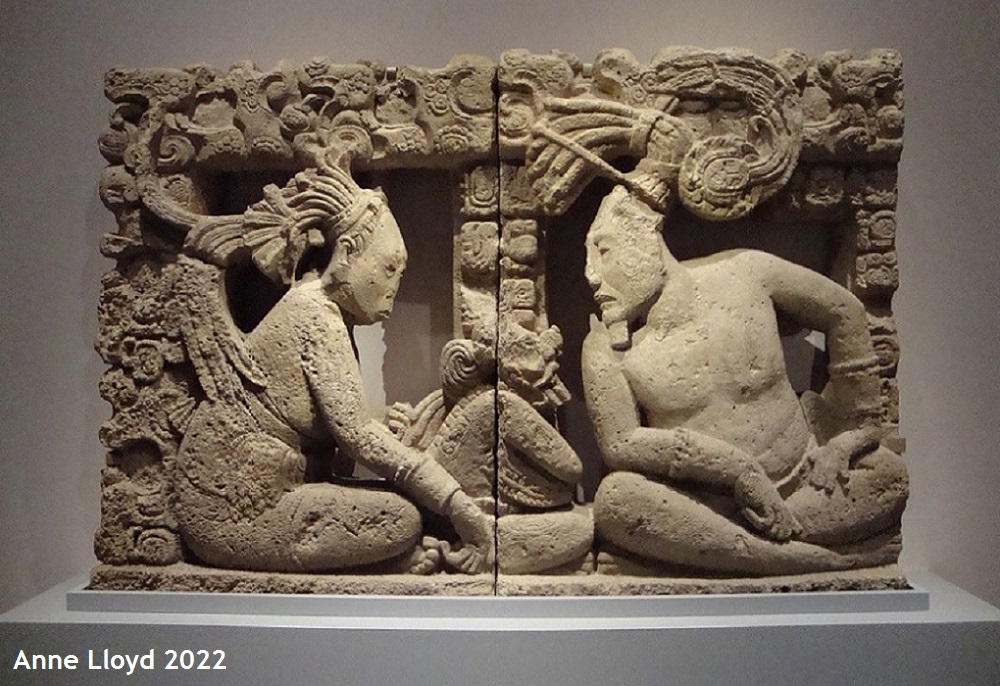
 showing Throne Back, from Mexico or Guatemala, 7th-9th century

A very different visit by a celestial being was carved into the upright back panel of a throne  (above). It was discovered in Guatemala, at a site on the Usumacinta River not far from Yaxchilan. The date of its creation is unknown, but is projected as occurring between the seventh and ninth centuries. I don't profess to being an expert in Mayan art, but I suspect that this wondrous work of art (my favorite in the exhibition) was created in the earlier range of these dates.

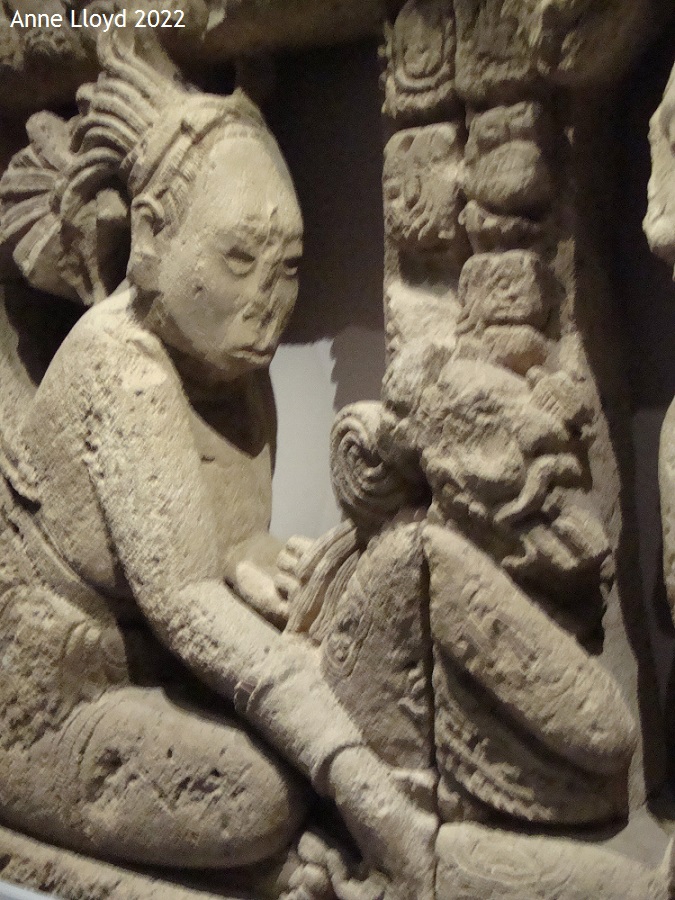
This carved backrest to a throne shows a Mayan king (at right) conversing with a small, supernatural visitor (center). This unearthly creature has the face of a jaguar deity and wings. His upward gaze meets that of the Mayan ajaw. It is truly a meeting of two worlds.


Details of Throne Back, 7th-9th century

Oddly enough, the face of the jaguar deity resembles that of a shipwrecked Spanish sailor, though centuries before Columbus. Behind him, a royal attendant takes in the interview, perhaps mystified, as we are, at what is going on.

What message does the jaguar deity impart to the intently-listening king? Of course, we cannot know. But experts in Mayan art and religion locate the scene to a cave, sacred places to the Maya. Whatever communication is being given, it is certainly of importance. 

What impresses me with this magnificent carving is the tone of a style and presentation. It is free of the frightful imagery which we see on carvings from the eighth and ninth centuries when the Mayan kingdoms were in their death spiral. That is why I surmise that it should be dated earlier, before the fatal steps to the dissolution of the Classical Mayan age had been taken.

Indeed, Mayan art of the earlier periods, (proto-Classical and early Classical, third-fifth centuries) often demonstrates humane values and a sense of humor. There are quite a few examples of early Mayan art on view in Lives of the Gods, making this part of the exhibition a very enjoyable and compelling trip back in time.


Anne Lloyd, Photo (2022) Whistling Vessel, 5th century

Displayed close to the Throne Back carving is a whistling device showing another mythical scene. Activated by being filled with water, the ceramic vessel mounts a vignette showing  a trickster tale. A fearsome bird deity confronts a kneeling human being, unaware of a cat climbing-up the side of the vessel, ready to pounce.

Other ceramic masterworks on view comprise a group of lidded vessels for feast days, topped with animal knobs or handles. Howler monkeys, a peccary and a turtle with a grinning man's head emerging from its mouth attest to the Maya kinship with the animal realm and a generous helping of fun. It's hard to resist a smile when looking at these wonderful examples of Mayan pottery.


Anne Lloyd, Photo (2022) Lidded vessel with Peccary Handle, 4th century


Anne Lloyd, Photo (2022)
 Lidded Vessel with Mythological Turtle, 4th century

As the timeline of Lives of the Gods reaches the eighth and ninth centuries, the  Mayan success story began to turn to ashes. The complex turn of event, drought, soaring population, hardening class distinctions are still being studied by historians. One thing can be certain, during the 700's, the time of Lady K’abal Xook's vision quest, warfare in the Mayan world escalated from low-intensity raids to secure a few captives for sacrifice to rampaging campaigns of wholesale destruction.


Anne Lloyd, Photo (2022)
 Gallery view of Lives of the Gods, showing statues of captive warriors

The terrible eclipse of Classical Mayan civilization is evoked in the carved images of bound prisoners awaiting execution. As part of his humiliation, a captive warrior named Yak Ahk' has been dressed as a jaguar deity, who had been tortured and killed in a tale from Mayan myth. 


Anne Lloyd, Photo (2023)  
Yak Ahk' as Captive, Impersonating a Jaguar Deity, c. 700

The precise chronology of the Maya wars is still incomplete and likely to remain so. Looking at this one carving is quite sufficient, however, to illustrate the suicide of the Classical Maya kingdoms. The image of Yak Ahk's suffering recalls the haunting 1971 photo of a young Vietnamese girl, Phan Thi Kim Phuc, set aflame by napalm. One picture tells us all we need to know.

The Mayan people proved able to survive the apocalypse of the Classical kingdoms. After the great cities were abandoned, by the year 900, Mayan life reconfigured on a localized, village basis. This decentralized community structure produced less in the way of great art, but enabled the Maya to survive the Spanish invasions of the 1500's and the epidemic diseases which followed in the footsteps of the Conquistadors.

The Met exhibit pays tribute to contemporary Maya life with a colorful video clip of a modern day festival. Dance of the Macaws in the Santa Cruz Verapaz, Guatemala, was filmed by Ricky Lopez Bruni. Dance of the Macaws exudes the life and spirit of the Maya, filling the exhibition gallery with incandescent light - and a palpable feeling of life!


Anne Lloyd, Photo (2022) 
Gallery View of the Lives of the Gods exhibit, showing
 Dance of the Macaws, filmed by Ricky Lopez Bruni

The survival of the Maya over the ages and their still-flourishing folk-culture is as remarkable a phenomenon as the pyramids, statues and paintings their ancestors created over twelve hundred years ago.

Happily, Lives of the Gods: Divinity in Mayan Art will be traveling to the Kimbell Art Museum, Fort Worth, Texas,  after it closes at The Met. This year marks the 50th anniversary of the Kimbell Museum and I can't conceive of better company for this celebration than the Maya, ancient and modern.

 ***

Text: Copyright of Ed Voves, all rights reserved                                                      

Original photography, copyright of Anne Lloyd

Introductory Image: Anne Lloyd, Photo (2022) Maize God, 715, from the British Museum. Details below.

Anne Lloyd, Photo (2022) Gallery view of the Lives of the Gods: Divinity in Maya Art exhibit, showing Column, from Campeche, Mexico, c. 800-900. Limestone: H. 68 3/4 x 29 in. Metropolitan Museum of Art. 

Anne Lloyd, Photo (2022) Gallery view of the Lives of the Gods exhibit, showing Maya jade pendants, 7th-9th century. Collection of the Metropolitan Museum of Art. 

Anne Lloyd, Photo (2022 ) Gallery view of the Lives of the Gods exhibit, showing Maize God, from Copan, Honduras, 715. Limestone: H. 35 1/16 x W. 22 1/4 in. x D. 11 13/16 in. 264.6  lbs. British Museum.

Anne Lloyd, Photo (2022 ) Censer Stand, from Palenque, Mexico, c. 690–720. Ceramic, traces of pigments: H. 44 × W. 22 × D. 12 1/4 in.,103 lb. (111.8 × 55.9 × 31.1 cm, 46.7 kg) Kimbell Art Museum, Fort Worth, TX

Anne Lloyd, Photo (2022 ) Jaguar God Censer Stand, from Palenque, Mexico, 7th–8th century. Ceramic: H. 26 × W. 14 9/16 × D. 6 5/16 in., 132.3 lb. (66 × 37 × 16 cm, 60 kg) Museo de Sitio de Palenque Alberto Ruz

Anne Lloyd, Photo (2022 ) King Jaguar Bird Tapir, from Tonina in Chiapas, Mexico, early 7th century. Limestone: 8 ft 5 9/16 in. x 28 3/4 in. x 20 1/16 in. 881.8 lb. Museo de Sitio de Tonina, Mexico.

Anne Lloyd, Photo (2022 ) Gallery view of the Lives of the Gods exhibit, showing video of Tikal and El Mirador, Guatemala, filmed by Ricky Lopez Bruni.

Anne Lloyd, Photo (2022) Lady K'abal Xook Conjuring a Supernatural Warrior, Yaxchilan, Mexico, 725. Limestone: H. 47 5/8 × W. 33 11/16 × D. 5 5/16 in., 509.3 lb. (121 × 85.5 × 13.5 cm, 231 kg) British Museum.

Anne Lloyd, Photo (2022) Detail views of Lady K'abal Xook Conjuring a Supernatural Warrior.

Anne Lloyd, Photo (2022) Gallery view of the Lives of the Gods exhibit, showing Throne Back, from Mexico or Guatemala, 7th-9th century. Limestone: H. 43 11/16 x W. 65 3/8 x D. 9 1/4 in. 937 lb. Museo Amparo Collection, Puebla, Mexico

Anne Lloyd, Photo (2022) Detail views of Throne Back (See above). 

Anne Lloyd, Photo (2022) Whistling Vessel, from Guatemala or Mexico, 5th century. Ceramic: H. 11 7/8 x W.  7 3/4 x D. 5 1/4 in. Metropolitan Museum of Art

Anne Lloyd, Photo (2022) Lidded vessel with Peccary Handle, from Guatemala, 4th century. Ceramic: H. 10 5/8 x Diam. 12 5/8 inches. Museo de Nacional Arqueologia & Ethologia, Guatemala.

Anne Lloyd, Photo (2022) Lidded Vessel with Mythological Turtle, 4th century. Ceramic: H. 9 5/8 x Diam. 10 7/16 inches. Museo de Nacional Arqueologia & Ethnologia, Guatemala.                                                                                                                                                                                                             Anne Lloyd, Photo (2022) Gallery view of the Lives of the Gods exhibit, showing statues of captive warriors, Yak Ahk' (left) and Muwaan Bahlam,     

Anne Lloyd, Photo (2023)  Yak Ahk' as Captive, Impersonating a Jaguar Deity, c. 700. Sandstone: H. 22 7/16 x W. 18 1/8 x D. 4 5/16 in. 176.4 lb. Museo de Sitio de Tonina, Mexico.

Anne Lloyd, Photo (2022) Gallery view of the Lives of the Gods exhibit, showing video clip of Dance of the Macaws. Filmed by Ricky Lopez Bruni.