Showing posts with label Art History. Show all posts

Thursday, April 12, 2018

A Chronology of Art, A Timeline of Western Culture from Prehistory to the Present


A Chronology of Art

A Timeline of Western Culture from Prehistory to the Present


Edited by Iain Zaczek

Thames & Hudson/288 pages/$29.95

Reviewed by Ed Voves

A Chronology of Art, recently published by Thames & Hudson, explores how events shape art - and vice versa. The book skillfully juxtaposes an extended timeline of key dates in history with discussion of the great works of art which were created while these events unfolded. 

1533 is a case in point. It was a  year filled with momentous events. The Spanish conquest of Peru reached a bloody climax with the judicial murder of the ruler of the Incas, Atahualpa. A world away, the  "King's Great Matter" shattered England as Henry VIII broke with the Papacy over his marriage to Catherine of Aragon. Henry then married Anne Boleyn and was excommunicated by Pope Clement VII.

That same year, two French diplomats in England, Jean de Dinteville and Georges de Selve, decided to have their portraits painted. They commissioned Henry's court painter, the Swiss-born Hans Holbein, to portray them together. De Dinteville and de Selve posed with symbolic artifacts such as a celestial globe and a terrestrial globe, a lute with a broken string, a hidden crucifix and a huge skull, tilted at a baffling angle.


Hans Holbein the Younger, The Ambassadors (detail), 1533

The resulting work, now in the collection of the National Gallery in London, is the enigmatic painting entitled The Ambassadors. For all of their political skill and elegance, Holbein's diplomats confront a political reality characterized by the broken string of the lute and a globe of the earth, turned upside down. These testify to the shattered unity of Christendom.
Art and politics seldom connect so neatly as happened with The Ambassadors. Yet, there is almost always some shared idea or influential factor linking the world of art and affairs of state. 

A Chronology of Art is likely to become an essential reference work for art students. The book cogently documents the development of art in the West, while highlighting the progression of political and religious events. Although the civilizations of antiquity and the Middle Ages are surveyed, the art and events of recent times are given the fullest coverage.

A disturbing pattern emerges as you proceed with A Chronology of Art. The "best" art often emerges from the "worst" of times. 

The years, 1480 to 1500, are a good example. The Spanish Inquisition was launched during these two decades. The English "Princes in the Tower" were murdered during the Wars of the Roses. Columbus made his epic voyages of discovery, increasingly viewed in some circles as acts of genocide.


The Unicorn in Captivity tapestry (c.1495)

By contrast, the art of the period includes many works of singular beauty, including Botticelli's The Birth of Venus (c.1485) and The Unicorn in Captivity tapestry (c.1495). 
I was especially moved by The Glorification of the Virgin (c.1490) by the little known Flemish painter, Geertgen tot Sint Jans. 

In theological terms, Geertgen shows the victory of good over evil proclaimed by the Book of Revelations. Yet we scarcely notice this cosmic interpretation. This is partly due to the fact that The Glorification of the Virgin was one half of a diptych. The other panel, now separated, shows the crucifixion of Jesus. The real reason, at least for a modern art lover, is that this incredible work appeals to our heart rather than our beliefs.


Geertgen tot Sint Jans, The Glorification of the Virgin, c.1490

What we focus upon in The Glorification of the Virgin is a full symphony of the heavenly choirs. Angels play every conceivable musical instrument: lutes, trumpets, violins, a pipe organ powered by a bellows. They are making "a joyful noise unto the Lord" and the Christ Child joins in, tinkling away with a little bell.


The "march of time" chronology pauses every few pages for a thematic essay focusing on a subject of note -  Celtic metalwork, the discovery in 1939 of the incredible Sutton Hoo ship burial with its trove of early Anglo Saxon treasures, the invention of oil painting during the early Renaissance and many more topics - brilliantly complementing the unfolding timeline.

One of the most enjoyable of these essays traces the imagery of power in one of its most potent forms, the Equestrian Portrait. We follow the trend of depicting the "man on horseback" across art history. Anthony van Dyck's 1633 portrait of Charles I, mounted on a magnificent war horse, is paired with Jacques-Louis David's Napoleon Crossing the Alps (1801). (Napoleon actually rode a mule over the Alps as shown in an 1850 painting by Paul Delaroche). As both rulers were short of stature, their noble steeds gave them the advantage of height.


Carolus-Duran, Mademoiselle Croizette on Horseback, 1873
By contrast, Mademoiselle Croizette looks far more commanding - and certainly more dashing - in Carolus-Duran's 1873 portrait of her riding on the beach of Trouville. What a fabulous work of art, horse and horsewoman at ease in the enjoyment of life and vitality! Napoleon Bonaparte, the "Man of Destiny," never looked half so imposing on his steed as Sophie Croizette, riding sidesaddle on a summer's day.
Napoleon also figures significantly in the pages devoted to the years, 1800-1810. Two works of art display the French emperor in all his vanity and arrogance. In an intriguing comparison, William Blake's The Great Red Dragon and the Woman Clothed in the Sun also is highlighted. 
The "heroic" nude stature of Napoleon as Mars the Peacemaker took flattery to an absurd level. Antonio Canova commenced work on the statue in 1802, during the brief Peace of Amiens with Great Britain. 


Antonio Canova, Napoleon as Mars the Peacemaker, 1802-1806

Mars, of course, was no peacemaker and neither was Napoleon. In less than a year, Napoleon was back on his career of conquest. He was addicted to war, but after a few moments of reckless glory as a young commander, he seldom exposed himself to danger on the battlefield. 
A "god of war" Napoleon may have been, but he tried to convince his subjects that he was a noble, humane ruler as well. The second work depicting him in the 1800 to 1810 section is Napoléon on the Battlefield of Eylau. Painted by Antoine-Jean Gros, shortly after the battle, this is one of the rare works in the history of art to show accurate depictions of battlefield casualties.


Antoine-Jean Gros, Napoléon on the Battlefield of Eylau, 1807

This surprising willingness to acknowledge the horrors of war was actually a sophisticated propaganda venture on Napoleon's part. The Battle of Eylau, fought during a blinding snowstorm in February 1807, was not a French victory. Everyone knew that Napoleon had come close to defeat, saved only by a massed cavalry charge which broke through the Russian lines, enabling Napoleon to hold out until reinforcements arrived. So many French troops fell in the battle (perhaps 25,000), that the exact number was never computed, or at least not published in the reports sent back to France. 
Antoine-Jean Gros, acting on Napoleon's directive, turned the frozen hell of Eylau into a moral victory. Napoleon is shown, haggard and distraught, directing care for French and Russian wounded alike. It was a clever ploy and convinced many that Napoleon was a wise and compassionate leader. More to the point, it did not stop Napoleon from going to war against Russia in 1812 where this dreadful scene was repeated on a vaster scale.
At the same time as Napoleon was pursuing his "destiny," William Blake was attempting to "see a world in a grain of sand and heaven in a wild flower, hold infinity in the palm of your hand and eternity in an hour."


William Blake, The Great Red Dragon and the Woman Clothed with the Sun, c. 1805
Apart from a small band of admirers, many people thought the visionary Blake to be utterly insane. Others considered him a prophet. Blake's wife was perhaps closest to the truth when she noted that "I have very little of Mr. Blake's company. He is always in paradise."

Blake may have inhabited his own spiritual realm. But that did not mean that he was cut-off from the world around him or oblivious of the human cost of Napoleon's bid for glory. When you reflect on the scene of carnage at Eylau, you realize that Blake's attempt to visualize the struggle of good versus evil in biblical terms reflected the dark era that he shared with Napoleon.


Pierre-Auguste Renoir, La Grenouillère, 1869
These reflections should not cast a shadow on the human genius for transcending history through art. That is certainly true for Blake. It was true, as well, for Pierre-Auguste Renoir and Claude Monet, when they painted decent, ordinary people relaxing at the "frog's pond," La Grenouillère, as war clouds gathered over France in 1869.

Today, only historians can explain the reasons for the Franco-Prussian War of 1870-71. But the "dueling" paintings of Monet and Renoir at La Grenouillère, the founding works of Impressionism, are cherished all over the world. 
You don't have to study the historical background of great works of art like the La Grenouillère paintings in order to appreciate them. However, by establishing the context for the art works we love so much, A Chronology of Art reminds us that human beings, beset by "wars and rumors or wars," can rise to the challenges of life and create enduring masterpieces. 
This is a lesson of great relevance to the troubled times we live in and, if we are lucky, this lesson will apply to the timeline of the future. 

***
Text: Copyright of Ed Voves, all rights reserved                                                                Photos courtesy of the Metropolitan Museum of Art; the National Gallery, London; the National Gallery of Art, Washington D.C.; Wikimedia Commons


Introductory Image
Hans Holbein the Younger (Swiss, 1497-1543) Jean de Dinteville and Georges de Selve, The Ambassadors, 1533. Oil on oak panel: 207 x 209.5 cm. National Gallery, London. Purchased 1890, NG 1314

Artist unknown (Flemish) The Unicorn in Captivity (from the Unicorn Tapestries), 1495–1505. Wool warp with wool, silk, silver, and gilt wefts: 144 7/8 x 99 in. (368 x 251.5 cm). Metropolitan Museum of Art. Gift of John D. Rockefeller Jr., 1937 # 37.80.6

Geertgen tot Sint Jans (Flemish, c.1465-c.1495) The Glorification of the Virgin, c. 1490–1495,originally part of a diptych. Oil on panel: height: 24.5 cm (9.6 in) x Width: 20.5 cm (8 in) Museum Boijmans Van Beuningen  2450 (OK) Google Art Project.jpg  Wikimedia Commons

Carolus-Duran (French, 1837-1917) Equestrian Portrait of Mademoiselle Croizette, 1837. Oil on canvas.  Le MUba Eugène Leroy/Tourcoing. From Wikimedia Commons

Antonio Canova (Venetian, 1757-1822) Napoleon as Mars the Peacemaker, 1802-1806. Marble: 345 cm. Apsley House, London. Wikimedia Commons

Antoine-Jean Gros (French, 1771-1835) Napoleon on the Battlefield of Eylau, 1807. Oil on Canvas, 104.9 × 145.1 cm (41.2 × 57.1 in) Toledo Museum of Art 1988.54. Purchased with funds from the Libbey Endowment, Gift of Edward Drummond Libbey. Google Art Project.jpg  Wikimedia Commons

William Blake (British, 1757-1827) The Great Red Dragon and the Woman Clothed with the Sun. c. 1805. Pen and gray ink with watercolor over graphite, Rosenwald Collection, 1943.3.8999 National Gallery of Art, Washington, D.C.

Pierre-Auguste Renoir (French 1841-1919), La Grenouillère, 1869. Oil on canvas: 81 x 66.5 cm. Nationalmuseum, Sweden. #2425 From Wikimedia Commons

Saturday, November 30, 2013

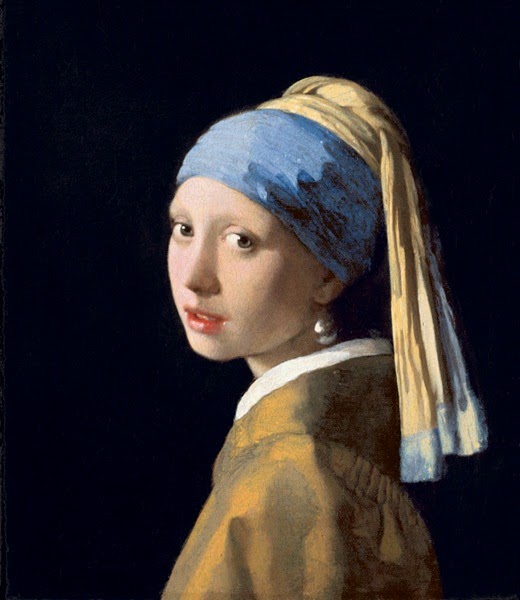
Girl with a Pearl Earring at the Frick Collection


Vermeer, Rembrandt, and Hals: Masterpieces of Dutch Painting from the Mauritshuis

Frick Collection, New York City

October 22, 2013, through January 19, 2014


Reviewed by Ed Voves


When I recently visited the Frick Collection in New York City, there was a line of visitors "queuing-up" as the English say, at the entrance. The line stretched nearly a block long and was continually reinforced with new art lovers anxious to get in.
The exhibition at the Frick, Vermeer, Rembrandt, and Hals: Masterpieces of Dutch Painting from the Mauritshuis, is certainly worth the wait. But I suspect that very few people in the daily throng at the door to the Frick come to see Nicolaes Maes' genre masterpiece, The Old Lacemaker, or even the clutch of major works by Rembrandt.

The majority of the art lovers in the line at the Frick come to pay homage to one of the true "beauties" of Holland. They are there to see Johannes Vermeer's Girl with a Pearl Earring.

This celebrated character study or tronie is given the honor of its own separate gallery. It is a sensible curatorial decision because many visitors approach Girl with a Pearl Earring with a sense of visible anticipation, even with awe, and most want to linger. Some come back for a second or even a third look. Girl with a Pearl Earring exerts a magnetic force, drawing people to her, making it difficult for them to break free.

There are a number of reasons for the magnitude of the attraction of Girl with a Pearl Earring. We know absolutely nothing about this beautiful, enigmatic woman. For that matter, we know very little about Vermeer himself. The painter from Delft kept to himself, holding the world - and his creditors - at bay, while painting one masterpiece after another.

There is also the legend of Girl with a Pearl Earring. The painting lingered for decades, unremarked and unrecognized as a work by Vermeer until the mid-1800's. It was purchased for the princely sum of two guilders and change by Arnoldus des Tombe in 1881. Des Tombe was encouraged by the art historian Victor de Stuers, a passionate advocate of the work of Vermeer, whose reputation had earlier been eclipsed by Rembrandt and Hals.

Girl with a Pearl Earring was donated to the Royal Collection of the Netherlands. It is housed in the museum known as the Mauritshuis, currently being renovated. Girl with a Pearl's visit to museums in the U.S., of which the Frick is the last venue, is a result of this museum rehab. We probably will not be seeing her again in the U.S. any time soon.

Who is this young woman in the improvised turban, this "Mona Lisa of the North" as some now call her? Was she a serving girl in Vermeer's household? His daughter? A professional model? We are unlikely to ever know.

I think it fair to say that Girl with a Pearl Earring is the perfect symbol of the Dutch Golden Age. During this burst of creative energy spanning the seventeenth century, the people of the Netherlands beat back the armies of the Spanish Empire and Louis XIV of France, while creating the first recognizably modern, free market society in the Western world. These political and economic deeds were complemented by a remarkable degree of religious tolerance, major scientific innovations and soaring achievements in the visual arts.

Examples of the rich artistic heritage of the Dutch Golden Age are on view in the second gallery of the Vermeer, Rembrandt, and Hals exhibit - provided you can tear your gaze away from Girl with a Pearl Earring.

The selection of works from the Mauritshuis testifies to the diversity of Dutch art during the seventeenth century. The incredible range of genres and of technical virtuosity produced in such a small nation is sometimes hard to fathom.

Consider the paired portraits by Frans Hals of husband and wife, Jacob Olycan and Aletta Hanemans. With her plump, flushed cheeks offset by the neck ruff and headpiece which were the height of fashion in 1625. Aletta Hanemans conforms to the stereotype of female beauty of the Dutch Golden Age.

 
Frans Hals, Portrait of Jacob Olycan

Hals' portrait of Jacob Olycan, presents an altogether different image. Olycan's dark piercing eyes and sallow skin are the features that we associate with the Spanish enemies of the Dutch during this period. Yet Olycan was a brewer from Haarlem and an officer in the St. George Militia Company. Hals painted Olycan in a group portrait of the St. George Militia officers at a banquet in 1627. A more Dutch scene could hardly be imagined.

Vincent van Gogh praised Hals, commenting that he painted with twenty-seven different shades of black. Where did this Spanish-style obsession with black originate? Frans Hals (1582-1666) was born in Flanders, present-day Belgium, which remained under Spanish control after the Dutch revolted, led by the indomitable William of Orange in 1568. But Hals' parents fled from Antwerp to escape the Spanish in 1585 when he was a young child. Any Spanish influence upon his painting, therefore, could only have been indirect and marginal.

Hals was one of the greatest portrait painters in the history of art. He needs no chain of influences to explain his grasp of color and form, his "rough style" or his insight into human character.

Artists of the Netherlands during seventeenth century, however, did possess unrivaled access to the material culture of the entire globe. Thanks to the intrepid - and aggressive - outreach of Dutch maritime trade, all manner of things - Chinese porcelain, lacquerware from Japan, art prints from Italy - were easily attainable to Dutch artists. So vast was the Dutch control of world trade that the English, who had fought as allies against Spain, were infuriated at being locked-out of colonial trade zones and European markets. Warfare broke out between England and the Dutch Republic, with a heavy loss of ships and lives. Samuel Pepys, in his famous diary, records the exasperated comment of a fellow advisor to King Charles II, "By God, says he, I think the Devil shits Dutchmen."

The Dutch themselves were apprehensive about the effect of the unprecedented wealth flowing into their nation during the 1600's. This was particularly true during the first half of the seventeenth century when the strict commandments of Calvinist religious doctrine still dominated Dutch society.


Pieter Claesz, Vanitas Still Life.
 
Pieter Claesz was a German-born artist who settled in the city of Haarlem. Claesz specialized in still-life paintings. His Vanitas Still Life from 1630 reinforced the Sunday preaching of Calvinist ministers that life is short and worldly pursuits are ultimately in vain. The toppled wine glass, the dying flame of the oil lamp and the cracked, pitted skull are obvious reminders of such sermons.

Perhaps the most notable feature of this superbly crafted work is the way that Claesz treated the pages of the large folio. These are so jagged and brittle that they would crumble at the merest touch. With this master stroke, Claesz affirms that even knowledge and scholarship, major concerns for the scientific Dutch, will pass away.

Rembrandt's "Tronie" of a Man with a Feathered Beret was painted in 1635, during a decade of bravura portraits and major biblical scenes. The term "tronie" is derived from the Dutch word for "face." Tronies were smaller works, character studies or depictions of people in exotic garb. Rembrandt, flush with funds from his portraits, invested in all manner of hats, clothing and gear which he could use as props in his paintings. The fantastical hat and gleaming armor in this tronie were no doubt part of his collection, later auctioned-off after his bankruptcy in 1656.

 
Rembrandt, "Tronie" of a Man with a Feathered Beret

A close look at Rembrandt's "Tronie" reveals that it is a cautionary work like Vanitas Still Life by Claesz. The dashing beret, worthy of one of Hals' cavaliers, strikes a hollow note when we examine the puffy features and creased brow of Rembrandt's protagonist. Is he the recipient of bad news? Has he caught a glimpse of himself in the mirror and realized his own mortality? Whatever the case, there is real fear in the eyes that flash at us from the picture. Here we can begin to see the origins of the introspection and self-knowing that were to transform Rembrandt's later portraits and self-portraits into the most insightful evocations of human character ever painted.

The fleeting nature of life is further attested to by another astonishing painting on view at the Frick, The Goldfinch by Carel Fabritius. This wondrous painting is a trompe l’oeil masterpiece. Fabritius delicately balances brilliant handling of the feathery plumage of the goldfinch against an equally expert depiction of the wall plaster. Is that a real bird posed on a sunlit wall or is it a "trick of the eye" that we are looking at?


Carel Fabritius, The Goldfinch

Tragically, Fabritius, Rembrandt's most brilliant pupil, was killed the same year as this amazing work of art was created. On October 12, 1654, a gunpowder factory in the city of Delft, where both Fabritius and Vermeer lived, exploded. Hundreds of people perished, including Fabritius. His studio was burned and much of his work was consumed in the flames.

A year later, another talented pupil of Rembrandt, Nicolaes Maes, painted The Old Lacemaker. It is a sentimental genre work, but also one liberated from allegorical or didactic content.


Nicolaes Maes The Old Lacemaker

In the last decades of the seventeenth century, Dutch taste favored comforting images of hearth and home. The long years of constant warfare led to a reaction against grand visions of life or preachy moralizing. It was, perhaps, the beginning of the end of the Dutch Golden Age. But Maes' The Old Lacemaker also testifies to the patient, industrious and quietly courageous character of the Dutch people who had made the Golden Age possible in the first place.

Of course, we want to see Vermeer's Girl with a Pearl Earring more than a picture of an old lady making lace. But if there is one lesson to be learned from these masterpieces from the Mauritshuis, it is that beauty can be found almost everywhere we look. Living as they do, in a small corner of Europe hemmed in by the North Sea, the Dutch have nurtured this faculty for appreciating the world around them to a remarkable degree.

And so, when the Girl with a Pearl Earring turns her gaze upon us at the Frick Collection, we are transfixed by that gleam in her eyes. It conveys a visible, lively sense of humor and humanity, pouring out from the soul of Girl with a Pearl. It beams from her eyes, turning the space beyond the picture plain into a place of wonder.

It is the look that defined the Dutch Golden Age - and perhaps ours as well.

***

Text: Copyright of Ed Voves, all rights reserved

Images Courtesy of the Frick Collection, New York City
 
Introductory Image: Johannes Vermeer (1632–1675). Girl with a Pearl Earring, c. 1665. Oil on canvas: 44.5 x 39 cm. Royal Picture Gallery Mauritshuis, The Hague.

Frans Hals (1581/1585–1666). Portrait of Jacob Olycan (1596–1638), 1625. Oil on canvas: 124.8 x 97.5 cm. Royal Picture Gallery Mauritshuis, The Hague.

Pieter Claesz Vanitas Still Life, 1630. Oil on panel: 39.5 x 56 cm. Royal Picture Gallery Mauritshuis, The Hague.

Rembrandt van Rijn (1606–1669). "Tronie" of a Man with a Feathered Beret, c. 1635. Oil on panel: 62.5 x 47 cm. Royal Picture Gallery Mauritshuis, The Hague.

Carel Fabritius (1622–1654). The Goldfinch, 1654. Oil on panel: 33.5 x 22.8 cm. Royal Picture Gallery Mauritshuis, The Hague.

Nicolaes Maes The Old Lacemaker, c. 1655. Oil on panel: 37.5 x 35 cm. Royal Picture Gallery Mauritshuis, The Hague.


Tuesday, November 12, 2013

Art Eyewitness Review: Art and Architecture in Mexico

Book Review: Art and Architecture in Mexico


                                                                                                                                       Art and Architecture in Mexico 
By James Oles Thames & Hudson/432 pages/$26.95


Reviewed by Ed Voves

If the art of Mexico may be defined with a single word, the best choice would be grandeur. Given the central role of the visual arts in defining the Mexican national character, no other individual term really suffices. Mexican art is very grand, indeed.

James Oles' brilliant work of scholarship, Art and Architecture in Mexico, emphasizes the visionary nature and the self-conscious importance of Mexican art. The sense of its own greatness certainly came early in the development of Mexican art. Oles quotes a poem from 1604, La grandeza mexicana, extolling Mexico as "center of perfection" and "hinge of the world."

This is a trick reference, however. Mexican "grandeur" as praised by the poet, Bernardo de Balbuena, was the grandeur of Mexico City. The country of Mexico did not yet exist, being at that point the jewel of the Spanish colonial realm known as New Spain - which also included the West Indies, most of Central America, Florida, California and the faraway Philippines. Even after Mexico declared its independence from Spain in 1821, the identity crisis was protracted between the Mexican core of the new nation and its diverse, disparate provinces.

Art was often the deciding factor, as Oles shows, in determining the outcome of that struggle. The result of such cultural conflict usually resulted in favor of "official" Mexico. This was a trend dating to the Spanish conquest in 1521 of the powerful state known today at the Aztec Empire. The "Aztecs" called themselves Mexica. In a strange turn of events, the Spanish conquistadors renamed the charred ruins of the great city of the Mexica, Tenochtitlan, after their vanquished adversaries: Mexico City.

From Mexico City, the Spaniards launched what Oles rightly calls "one of the most terrible iconoclastic campaigns in history." After destroying virtually all the art works, religious buildings and manuscripts of the native peoples, the Spanish initiated a vast campaign of church building, the creation of religious paintings and sculptures and, curiously enough, the compilation of manuscripts such as the Codex Mendoza, which preserved the few traces of the native cultures that had survived the bonfires of the conquistadors. It was a huge enterprise and a tremendous success.

This marked the birth of "Mexican Grandeur."

To build their great churches, the Spaniards utilized craftsman from the native peoples, many of whom had fought alongside them against the Aztecs/Mexica. Elements of the suppressed pre-Conquest culture emerged during the process of creating the new social order of the Spanish empire. This can clearly be seen in the facade of the massive, fortress-like church of San Augstín built between 1555 to 1560 in Acolman, an important town a few miles north of Mexico City.


Church of San Augstín, Acolman

St. Augstín was built with stones from a demolished Aztec temple. Around the entry to the church, an intricate facade was carefully constructed with statues of Christian saints positioned among symbols of food carved in the tradition of the native peoples. Oles calls the facade of St. Augstín "an assertion of up-to-date Renaissance sophistication in a truly reborn world."

Oles also raises the question of how the newly baptized native peoples interpreted these details of the church facade. They may have viewed the garlands of sculpted flowers and food - a roasted pig is on display - as symbols of the bounty of Christianity or as recollections of "ritual offerings from the pre-Conquest period."

The Christian clergy who masterminded the "spiritual conquest of Mexico" were astute manipulators of human psychology. The interior decoration of the new churches contained carefully integrated assemblages of statues, paintings and tapestries. Called retablos, these multimedia art works related the themes of Christian theology in a way that the native peoples could appreciate - and ultimately come to understand.


Retablo, Church of Santo Domingo

Retablos, positioned around church altars, often attained staggering dimensions. A particularly imposing example of these retablos was created in 1688-90 by the Mexican artist, Pedro Maldonado, for the church of Santo Domingo in the city of Puebla.

The church architecture and religious art that arose in the valley of Mexico spread throughout the provinces of New Spain as far as California and New Mexico. Local adaptations to suit the culture and climate of these regions were skillfully created.


Church of San José de la Laguna, Laguna Pueblo, New Mexico

The mission church of San José in Laguna, New Mexico, demonstrates the skill and determination to bring the rule of the Spanish crown - boastfully known as the "Planet Kings" - and the Christian religion to remote locations around the world. The stark, austere presence of the church of San José also drives home the survival ability of human spirituality in contrast to the swiftly disintegrating earthly power of "planet kings," whatever their nationality or power base.

The religious paintings that formed part of the retablos of the 1500s to the 1700s gave rise to an influential school of Latin American art. Long dismissed merely as "folk art," paintings with devotional or grandiose historical themes were created on a large scale throughout New Spain. In Mexico, such works were often painted on screens called biombos, an art form that had been imported from Japan on board the celebrated Manila Galleon, which sailed each year across the Pacific Ocean to Acapulco. These colonial era paintings, which Oles analyzes with great insight, fused European art techniques with elements of Native American and local Spanish (or Criollo) cultures to create an emotionally powerful art.

After Mexican independence, the reality of Mexico's vulnerable position in relation to the rest of the western world soon intruded on the proud tradition of la grandeza mexicana. The newly independent nation was rich in land, natural resources and population. But Mexico lacked internal unity and was short of ready cash. It was woefully ill-equipped to begin modern industrialization and - worst of all - was nearly bankrupt in the supply of capable, clear-sighted leaders.

Mexican art during the 1800's is an almost unknown subject in the English-speaking world. Oles' chapters covering this period of Mexican cultural history are therefore of particular interest.

The career of the great landscape painter, José Maria Velasco (1840-1912) is very instructive. Velasco was a gifted student of medicine and science, particularly geology. He was a noteworthy example of the nineteenth century Mexican progressives known as "cientificos."

As an artist, Velasco could match the contemporary American "Sublime" painters like Frederic Edwin Church. Velasco captured the inspiring beauty, diversity and vast scale of the Mexican natural environment, winning wide-spread acclaim and gold medals at international exhibitions such as the one held in Philadelphia in 1876.

 
 Curved Bridge of the Mexican Railway on the Metlac Ravine, 1881. José Maria Velasco

Several of Velasco's landscapes, like Curved Bridge of the Mexican Railway in the Metlac Ravine, painted in 1881, were assertions of Mexico's ongoing campaign of modernization. Once again, there is a problematical element to the use of "Mexico" or "Mexican." The steam engine that Velasco depicts here belonged to the British firm that built and owned this railroad line. Velasco's landscape proclaimed that Mexico had indeed found a place in the modern, industrial world - but also conceded that it did so as an economic colony of Europe and the United States.

Mexico has long prided itself on the racial blending of its main demographic groups. Mestizaje certainly is a hallmark of Mexican society, in contrast to the extreme racism of the United States during much of its history. However, the modernization symbolized by the puffing locomotive in Velasco's painting exacted a crushing human toll of the lowest social classes of Mexico and in 1910, the steam engine exploded.

Printmaker José Guadalupe Posada (1852-1913) and photographer Agustin Victor Casasola (1874-1938) were the primary artists who documented the Mexican Revolution. Their highly influential work also set the tone for the great cultural renaissance that followed.

More immediately, the prints and photos of Posada and Casasola represent early examples of the misuse of art as propaganda.


Calaveras of the Masses, Number 2, 1910. José Posada

Posada was a political conservative, though he sympathized with the suffering of the Mexican poor. The skeletal "Day of the Dead" figure shown above is in fact a satirical representation of Francisco Madero, who first raised the banner of revolt. Posada died in 1913 before the worst of the fighting. The Vanegas Arroya print shop, where Posada had worked, then reissued this image in support of the Revolution. In time, Posada's image would find a more appropriate theme - as a symbol for the estimated one million Mexicans who were killed or died from starvation or disease during the ten years of bloodshed.

According to Oles, Agustin Casasola took over 2,000 photos and the other photographers who worked for the news agency he founded produced 400,000 negatives. This made the Mexican Revolution the most visually documented conflict of the early twentieth century except for World War I. These images could be easily manipulated, however, making them "as subject to speculation as the most fictive paintings."

Women in the Buenavista Train Station shows a group of bare foot women in 1912, arriving with food parcels. By most accounts they are bringing food to the fighting troops, though which of the contending forces they are supplying is hard to establish.


Women in the Buenavista Train Station, 1912. Archivo Casasola (Gerónimo Hernández)

Eventually, the issue was decided by cropping the women on the right out of the photo, leaving only the dramatically-posed figure on the left who is gripping the handrails. With her intense gaze, this woman became the woman of the Mexican Revolution.

The use and misuse of the works of Posada and Casasola reveal the deep political roots of the next - and most familiar - stage of Mexican art. This was the age of the Mexican muralists, los tres grandes - José Clemente Orozco, Diego Rivera and David Siqueiros, the photography of Tina Modotti and, of course, the autobiographical paintings of Frida Kahlo. It is the special merit of Oles' treatment of these famous figures that he manages to assert their importance within the actual history of the era, rather than the subsequent mythologizing of it.

Nor does Oles neglect other major artists from these crowded decades of Mexican cultural achievement. Architect Juan O'Gorman, artists like Rufino Tamiyo and Manuel Álvarez Bravo and the enlightened political leader, José Vasconcelos, who guided and supported the great mural projects, all get their due in this exceptionally well balanced narrative.

It was during Mexico's great period of the 1920's and 1930's that the national, "official" Mexico and the Mexico of diverse regional cultures achieved the greatest degree of balance in the nearly five hundred years since the arrival of Cortes and his conquistadors in 1519. Mexico's cultural success during these decades, however, attracted a new European invasion. Political exiles, most notably Leon Trotsky, cultural theorists like André Breton and refugee artists such as Mathias Goeritz chose Mexico as a safe haven and a place for new beginnings.


Bamboo Palace, after 1962. Edward James

The results of this Surrealist "discovery" of Mexico were decidedly mixed. The strange sculpture garden created by the eccentric English artist, Edward James, looks like - and is - an alien structure set down in the lush landscape of Mexico.

The infusion of fresh blood, new ideas and unforeseen challenges to the established identity of Mexico is ultimately for the good of this great nation. Mexico is no longer an intellectual colony of Europe or an appendage of the United States. It is a dynamic, independent cultural force on the global stage and James Oles' book is a masterful summation of how this transformation took place.

 
Orange Lush I, 1995. Melanie Smith

One of the images in the last chapter of Oles' book is Orange Lush I by Melanie Smith, a British-born artist who represented Mexico at the 2011 Venice Biennale. This, as Oles notes, was "something that would have been unimaginable in the 1950's."

Melanie Smith and other foreign born artists of today, like Francis Alys and Thomas Glassford, have chosen to live and work in Mexico because it is a country no longer entrapped by its past. Their embrace of Mexico is a huge step toward the realization that the Mexican people will become a "cosmic race," as envisioned long-ago by José Vasconcelos.

Mexico the nation - not merely Mexico City - has finally achieved at least part of what was envisioned in the 1604 poem, La grandeza mexicana. If not a "center of perfection," twenty first century Mexico certainly is a "hinge of the world."

***
Text: Copyright of Ed Voves, all rights reserved

Images Courtesy of Thames & Hudson

Introductory Image: Art and Architecture in Mexico, 2013 (cover) Image credit: Thames & Hudson

Church of San Augstín, Acolman (Mexico), façade completed 1560. (page 33) Photo Dr. Charlotte Ekland/www.mexicanarchitecture.org.

Pedro Maldonado and others, main retablo, church of Santo Domingo, Puebla, 1688-90. (page 74) Photo Angelo Hornak/ Alamy

Church of San José de la Laguna, Laguna Pueblo, New Mexico, c. 1699. (page 105) Photo LatitudeStock/Alamy

José Maria Velasco, Curved Bridge of the Mexican Railway on the Metlac Ravine, 1881. (page 188) Oil on canvas, 47 5/8 in x 5 ft ¼ in. (121 x 153 cm). Private collection. Photo Arturo Piera.

José Guadalupe Posada, Calaveras of the Masses, Number 2, 1910. (page 225) Etching and letterpress on paper, 16 x 11 5/8 in. (40.5 x 29.5 cm). Library of Congress, Prints and Photographs Division, Washington, D.C

Archivo Casasola (Gerónimo Hernández), Women in the Buenavista Train Station, 1912. (page 228) Photograph, from gelatin dry-plate negative, 4 x 5 in. (10 x 12.7 cm). SINAFO-Fototeca Nacional-INAH, Pachuca.

Edward James, Bamboo Palace, after 1962. (p. 311) Xilitla (San Luis Potosí). Reinforced concrete with paint. Photo Amanda Holmes.

Melanie Smith, Orange Lush I, 1995. (p. 389) Plastic objects on wood support, 96 x 48 x 10 in. (244 x 124 x 25.5 cm). Courtesy of the artist and Galerie Peter Kilchmann, Zurich.


Sunday, October 6, 2013

Medieval Masterpieces from Germany at the Metropolitan Museum of Art


Medieval Treasures from Hildesheim at the Metropolitan Museum of Art, New York City September 17, 2013-January 5, 2014

Reviewed by Ed Voves

The exhibition of German art works from the Middle Ages now on view at the Metropolitan Museum of Art in New York City both inspires and confounds the expectations of viewers. Are these precious objects relics of the great Age of Christian Faith? Or are these strange and wonderful artifacts survivors from a remote pagan past, barbaric in spirit beneath a thin veneer of Christian piety?

Medieval Treasures from Hildesheim presents 50 masterpieces from the cathedral and monastery of Hildesheim, an ecclesiastical site of major importance. Here, in this city in Lower Saxony, Bishop Bernward of Hildesheim (960–1022) launched bold programs of church building and the creation of Christian art that rank among the most influential of the Middle Ages. Bernward deserves to be remembered along with Abbot Suger (1081-1151) as one of the pioneering patrons of the arts in what was truly a renaissance before The Renaissance.

The great age of church and cathedral building began after the year 1000 A.D., which many had dreaded as the onset of the Apocalypse. The lavish spending on ecclesiastical buildings during the Middle Ages was not without its critics. Where forward-thinking prelates like Bernward saw the impressive new churches and monasteries as reflections of the Heavenly City, others held different opinions.

In a foreshadowing of the Reformation of the 1500's, Bernard of Clairvaux (1090-1153) condemned the kind of gilded reliquaries and ornate candlesticks that are on display in the Hildesheim exhibit at the Metropolitan Museum:

"Oh vanity of vanities, but no more vain than insane! The church is radiant in its walls and destitute in its poor. It dresses its stones in gold and abandons its children naked. It serves the eyes of the rich at the expense of the poor."

Both Bernard of Clairvaux and Bernward of Hildesheim are recognized as saints in the Roman Catholic Church. Though separated by nearly a century, the two churchmen, one French, the other German, had much in common. Both served as advisers and confidantes of kings. Bernard's puritanical zeal and Bernward's progressive vision reflect a duality in Christendom that stretches back to antiquity.

In Bernward's case, he was chaplain and tutor to the short-lived Emperor Otto III, 980-1002. The Ottonian Dynasty, Saxons by birth, revived the Holy Roman Empire of Charlemagne that had largely disintegrated after his death in 814. The Ottonian rulers looked to expand Christian (and German) power eastward and to exert political power in Italy.

Capable religious leaders like Bernward were essential to the dynastic agenda of the Ottonian rulers. The influential role of bishops and the heads of orders of monks and priests was symbolized by the ceremonial shepherd's staff that they carried. An example on display is the remarkable Crosier of Abbot Erkanbald, a striking statement of ecclesiastical authority. Church leaders during the eleventh century, of whom Bishop Bernward was a noteworthy example, were men to be reckoned with.

The world view and social position of Bernward served as the foundation for his church building. It infused his enthusiastic patronage of art as a means of conveying the truths of religion, as well. This is immediately apparent in the two extraordinary objects that greet visitors to the Hildesheim exhibit at the Metropolitan Museum.

The first is the monumental Baptismal Font, cast in copper alloy in the early thirteenth century. The Baptismal Font displays biblical scenes in bold relief and remarkable narrative power. Each has a water theme - the baptism of Jesus, Moses' crossing of the Red Sea, the transport of the Ark of the Covenant across the River Jordan and the dedication of the font itself. The massive vessel is supported by four figures which represent rivers mentioned in the Bible, the Tigris, the Euphrates, the Pishon and the Gihon.


Baptismal Font from Hildesheim, Germany

A stunning masterpiece in its own right, the Baptismal Font evokes the great bronze doors which Bernward originally commissioned for St. Michael's, the church of the Benedictine Order in Hildesheim. The massive doors, measuring 16 feet, 6 inches high, solid cast, are adorned by eight scenes from the Old Testament on one door, eight New Testament scenes on the other.

After seeing the ancient Roman war monument, Trajan's Column, Bernward also ordered a similar column to be cast around 1000 A.D. Instead of battle scenes in bas relief, Bernward's column depicts twenty-eight episodes from the life of Jesus swirling upward with cinematic dynamism.

There are some disturbing nuances in Bernward's Column, given the aggressive efforts of the Ottonian dynasty to invest itself with the trappings of Roman imperialism. Bernward's Column is too closely modeled after Trajan's to escape suspicion that it too is a monument to power politics. But no such charge could be leveled against the Ringelheim Crucifix.

It is commonly believed that Bernward commissioned the carving of this magnificent crucifix for the convent where his sister, Judith, was abbess. In a brilliant design decision, the Metropolitan curators have displayed the Ringelheim Crucifix on a cross-shaped partition immediately visible as one approaches the exhibition. The Ringelheim Crucifix looms over the shimmering display cases with their gilded reliquaries and gem-studded manuscript covers. The effect is profound.

 
Ringelheim Crucifix
 
The Ringelheim Crucifix was carved from linden wood, the favored medium of great German carvers down to Tilman Riemenschneider, during the 1500's. The arms, though, are a later addition, replacements made of oak. During restoration in the years 1949-52, a cavity was discovered in the head where several relics had been stored. A note on parchment signed by Bernward himself identified two stones as coming from the Holy Sepulcher in Jerusalem, along with bone fragments from two saints. But amazing as this discovery is, nothing can match the sense of spiritual power of the Ringelheim Crucifix, one of the earliest surviving three-dimensional works of art from the Christian Middle Ages.

The Ringelheim Crucifix manifests the raw, powerful convictions of the Christian populations of Western Europe, still only a few generations from the time of their conversion. If the Ringelheim Crucifix exudes the "faith of the convert," the exquisite Bernward Cross, which dates to Bernward's era, points to the growing sophistication of that faith. Likewise, the gilded Hezilo Cross, used in processions, is evidence of the growing wealth and worldliness of the Christian clergy.

Before we endorse Bernard of Clairvaux's zealotry at the expense of Bernward's pragmatic approach to religion, one should take a closer look at the silver Bernward Cross. The figure of the crucified Jesus depicts him as a tortured martyr, head slumped and skeletal rib-cage clearly visible even on such a small scale. Here we see the dying, Good Friday Jesus.


Bernward Cross

This image of the death of Jesus on the cross so shocked early Christians that for the first five hundred years or more of their religion, few depictions of the crucifixion were created. But people of Bernward's generation embraced images of both the suffering Jesus and the transcendent Christ of the Ringelheim Crucifix. And human nature being what it is, it should not surprise us that Christians of Medieval Europe, whose "barbarian" ancestors exulted in objects "rich in gold," should also have paraded around with the glittering Hezilo Cross, encrusted with semi-precious gems and rock crystals. Later "reformers" like Bernard of Clairvaux and Martin Luther would condemn such objects. To most Christian believers during the Middle Ages, however, the Hezilo Cross was a symbol of devotion.

The discovery of the relics inside the head of the Ringelheim Crucifix, mundane chips of stone and bone though they seem to modern eyes, points to the Christian cult of relics. Impressive for engendering piety and belief among the faithful, the cult of relics was also the keystone of vast financial transactions to the Church. The monarchs and nobles of Europe donated lands and revenue to build pilgrimage shrines to safeguard these - often dubious - body fragments and personal objects reputed to have belonged to Jesus, the Virgin Mary and Christian martyrs.


Arm Reliquary of St. Bernward

The Metropolitan exhibit displays several containers or reliquaries for relics. In the case of the silver, arm-shaped reliquary, skillfully cast to show the hem of a bishop's robe, we can be reasonably certain that it contained body parts of Bernward, raised to the rank of sainthood in 1193. But the identity of the skull in the reliquary of St. Oswald is open to question.


Reliquary of St. Oswald
 
 
There were at least four skulls of St. Oswald lovingly preserved in reliquaries throughout Europe. The most likely candidate was the one in Durham Cathedral in northern England. Oswald had been one of the earliest Anglo-Saxon rulers to embrace Christianity. But Oswald had converted for the same reason that the Emperor Constantine had in the fourth century. Oswald felt that the Christian god would aid him in his military campaigns. For a time, his plan seemed to be working - until he fought one battle too many and was killed fighting the pagan Mercians in 642.

The exultant Mercians displayed Oswald's severed head on a wooden stake as a battle trophy. Later retrieved, it was placed for safe-keeping in a church in Durham. By the time this bizarre reliquary was created, around 1185, Oswald was venerated as a Christian martyr. This was also the era of King Richard the Lionhearted and the Crusades. Oswald had become a model saint for Church leaders, like Bernard of Clairvaux, preaching "Holy War" against Islam.

The ominous implications of events and Church policies in Bernward's time in the early eleventh century should not detract from his achievements. We should not judge the piety of medieval religious books - or that of the clergymen who commissioned them - by the lavish decoration of their covers.

 
Small Bernward Gospel
 
The Reichenau Lectionary, created during the last years of Bernward's life and the so-called Small Bernward Gospel, which dates from a century after his death, are both testaments to a deep and abiding faith. The Reichenau Lectionary, used in church services, presents a charming and heart-moving depiction of the death of the Virgin Mary, with angels swooping down to escort her to heaven. And the gems and rock crystal on the cover of the Small Bernward Gospel should not distract our attention from the carved ivory plaque on the cover depicting the Crucifixion. This was an especially precious object, a gift very likely from the Byzantine court in Constantinople.


Reichenau Lectionary
 
Yet this wonderful exhibit at the Metropolitan Museum produces an unsettling effect, difficult to define. Is it due to the sheer amount of gleaming gold and silver artifacts in the small space of the single gallery displaying Medieval Treasures from Hildesheim? Or is this vague uncertainty caused by the evidence of so much religious piety in a society vastly different from our own?

Whatever the answer, it is hard not to be impressed with the life and the legacy of the clergyman who was responsible for the creation of so many of these medieval treasures. As Bernward's biographer said of him, "There was nothing in the fields of the arts that Bernward did not try, even when he was not able to bring it to completion."
***

Text: Copyright of Ed Voves, all rights reserved.

Images courtesy of the Metropolitan Museum of Art
 

Crozier of Abbot Erkanbald German (Hildesheim), before 1011 Silver with gilding H : 4-1/2 x 3 in. (11.3 x7.5 cm) without stem Dom-Museum Hildesheim (DS 7) Photograph by Frank Tomio

Baptismal Font German (Hildesheim), ca. 1226 Copper alloy, cast in eight pieces Overall H. ca. 72–7/8 in. (185 cm); font: H. 26–3/8 in. (67 cm); Diam. 37–3/4 in. (95.9cm.); cover: H. 16–1/8 in. (41 cm); finial: H. 12–5/8 in. (32 cm); supporting figures: H. 18–1/2 in. to 19–3/4 in. (47 cm to 50 cm) Hohe Domkirche Hildesheim Photograph by Manfred Zimmermann

Ringelheim Crucifix German (Hildesheim), ca. 1000 / before 1022 Linden wood (corpus) and oak (arms) Overall 63–7/8 × 63–3/8 × 9–7/8 in. (162 × 161 × 25 cm) Dom-Museum Hildesheim, on loan from the church of Sts. Abdon and Sennen, SalzgitterRingelheim (L 1993-8)

Bernward Cross German (Hildesheim), after 1007 / before 1022; base: 14th century Silver, gilding Overall (H. with base) 12–3/8 × 5–7/8 × 1–1/4 in. (31.2 × 14.9 × 3.2 cm); H. of cross 8–1/4 in. (20.9 cm.) Dom-Museum Hildesheim (DS 6) Photograph by Frank Tomio

Arm Reliquary of Saint Bernward German (Hildesheim), ca. 1194 Silver, gilded silver, rock crystal, and semiprecious stones; wood core Overall 21–1/2 × 6–1/8 × 4–5/8 in. (54.5 × 15.5 × 11.6 cm) Dom-Museum Hildesheim, on loan from the church of St. Magdalen, Hildesheim (L1978-2) Photograph by Jürgen Liepe

Reliquary of Saint Oswald German (Hildesheim) or possibly English, ca. 1185–89; partly restored 1779 Gold, silver, gilded silver, niello, cloisonné enamel (a few replaced), gems, pearls, antique cameos and intaglios; wood core H. with crown 18–3/4 in. (47.5 cm); Diam. (base) 10–5/8 in. (27 cm) Dom-Museum Hildesheim (DS 23) Photograph by Lutz Engelhardt

Gospel Book (so-called Small Bernward Gospel) Front cover: German (Hildesheim), second half of 12th century. Gilded copper, rock crystal, paint on parchment under horn on oak; Byzantine ivory plaque 8-7/8 x 6-3/4 in. (22.5 x17 cm) Dom-Museum Hildesheim (DS 13) Photograph by Erika Dufour, courtesy of the Art Institute of Chicago

Gospel Lectionary and Collectar German (Reichenau), ca. 1010–30 Tempera and gold on vellum Overall 8–3/4 × 6–1/2 in. (22 × 16.5 cm); 96 leaves Dombibliothek Hildesheim (Hs. 688) Photograph by Lutz Engelhardt