
Imperial Splendor: The Art of the Book
in the Holy Roman Empire, 800-1500
By Jeffrey Hamburger and Joshua O'Driscoll
Morgan Library & Museum-Giles Ltd./216 pages/$45
Morgan exhibition: Oct. 15, 2021- Jan. 23, 2022
Reviewed by Ed Voves
December 25, 800 AD is one of the great dates of European history. On that long-ago Christmas Day, the Frankish king, Charlemagne, was crowned as the first Holy Roman Emperor. The ceremony took place in St. Peter's Basilica in Rome. Charlemagne's huge, unwieldy realm, which Voltaire derided as neither holy nor Roman nor even an empire, lasted until 1806.
One factor, perhaps the most important, for the longevity of the Holy Roman Empire was the realization by the empire's rulers that knowledge is power.
From Charlemagne to the Hapsburg Dynasty during the Renaissance, the authority of the Holy Roman emperors was founded upon patronage of learning, as well as military might. Books, copied by hand and bound in glittering, jewel-studded covers, were commissioned and bestowed as signs of power and benevolence. Books were the most potent symbols of the Holy Roman Empire, far more so than the heraldic eagle badges decorating knightly shields and fluttering banners.
The Morgan Library and Museum in New York City is currently presenting an exhibition of some of the most important books created under the auspices of the Holy Roman Empire. The exhibition catalog, published by the Morgan, in association with D. Giles Ltd., expertly combines cogent, insightful text with superlative illustrations.


Voltaire's jibe about the "holy" in the title of the Holy Roman Empire was actually quite inaccurate. Religion really was an important unifying factor for this vast political state. Often, it was a matter of actual piety that motivated the creation of the illuminated manuscripts now on display at the Morgan. In other cases, worldly ambition played an important role.
The course of events covered by the Morgan exhibition and the superb catalog published in conjunction with it follows a three-part chronology.
The patronage of hand-copying and illustrating devotional books under Charlemagne and his successors was initially directed from the Imperial court. This was established by Charlemagne at Aachen. Then, as new dynasties gained the throne, the locus of power shifted to strongholds further east, including Prague and Vienna.
The other powerful source of patronage was the Church. As their wealth and influence grew, monastic orders, such as the Benedictines, began commissioning new editions of sacred books on their own initiative.
Bibles, liturgical volumes such as missals - used to proclaim the Christian Mass - and choir books were created in the copying chambers or scriptoria of the monasteries. These pious works, graced with astonishing illustrations, proclaimed God's majesty - and the divinely sanctioned rule of the Holy Roman Empire.

Portrait of an Artist, likely from Augsburg, late 15th century
Often, the identity of the manuscript makers remains unknown, even as late at the 1300-1400's. Details, however, can be gleaned from unique aspects of artistic style, discernible in important manuscripts. From meticulous study of their work come "names" for these otherwise anonymous scribes and artists. Such is the case of the artist known as the "Gregory Master" (active 972-1000) because of the distinctive illustrations for a book of letters written by Pope Gregory the Great.
Toward the end of the Middle Ages, secular artists began to make their mark along with the scribes of the religious orders. At first, they were itinerant craftsman, traveling to monasteries to assist in creating illuminated books.
With the rise of urban centers during the thirteenth century, these laymen began to establish their own workshops in cities like Augsburg. Important innovations followed in due course, widespread use of paper rather than expensive parchment, wood block printing of illustrations, the invention of movable type and savvy publishing practices, many introduced by Albrecht Dürer.
This neat, well-defined timeline overlooks the compelling human interest stories of how these almost miraculous books were made and used. Each illuminated manuscript has its own unique biography. Testaments of "holy writ," these deluxe volumes were also cherished as talismans of local pride and other earthly concerns - power, social status and wealth.
The "backstory" of the Stammheim Missal exemplifies the underlying cultural attitude to books during the Middle Ages.
The Stammheim Missal was created around 1170 at the Benedictine monastery at Hildesheim in Saxony. Hildesheim was one of the most influential monastic centers in Germany. It had been founded by Bishop Bernward, who directed its operations from 993 to 1022. The monks at Hildesheim revered Bernward and wanted him to be declared an official saint of the Christian Church, an honor normally accorded only after a long, scrupulous investigation. To "encourage" the process, this spectacular liturgical book was created.
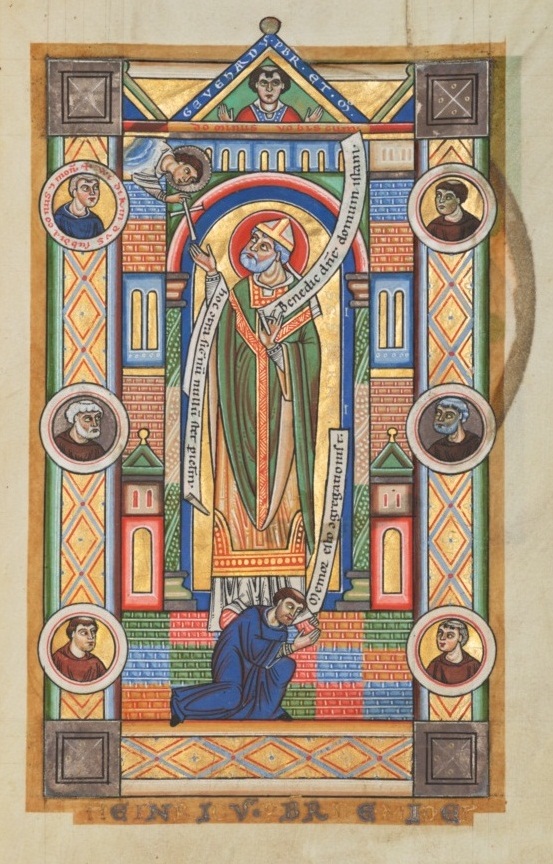
As might be expected, the venerable Bernward (who eventually was decreed a saint in 1192) appears in one of the illustrations of the Stammheim Missal. He is shown receiving a communique from heaven, delivered by an angel.

The most fascinating illumination in the Stammheim Missal, however, envisions the cosmological order of the world. Like Michelangelo's fresco on the ceiling of the Sistine Chapel, the stages of the creation of the world are presented, in conjunction with episodes of human sinfulness and its consequences from the Book of Genesis. Jesus, depicted as a Byzantine-style Pantocrator or Ruler of the Cosmos, reasserts divine order from on- high, with the assistance of a pair of extraordinary angels.
This was the world-view of the Christian Middle Ages, re-imagined, again and again, in the sacred, hand-created volumes on view In the Imperial Splendor exhibit. Heaven and earth, God and gold leaf were bound together by the covers of a book.
And what book covers! The "star" of Imperial Splendor is the Lindau Gospels, one of the treasures of the Morgan Library.
The manuscript of the Lindau Gospels was written in Latin at the monastery of St. Gall, in Switzerland, around 880-890. It is not opened in the exhibit showcase to display the pages of its sacred text. Rather, all attention is directed at the gleaming, bejeweled book covers.

These spectacular "treasure covers" of the Lindau Gospels actually predate the text transcribed by the monks at St. Gall. The front cover was made about a decade before, apparently in France. The back cover, from Salzburg, Austria, dates from a century earlier, 780 to 800, having been previously used for another, now lost, gospel book. Both covers are likely to have been gifts to monastic community at St. Gall from the reigning Holy Roman emperor.

According to Joshua O'Driscoll and Jeffrey Hamburger, curators of the exhibition, the metal-working skill and artistry devoted to the back cover utilizes "eight distinct techniques, including two types of champleve enamel, cloisonne enamel, garnets and inlaid glass, precious stone settings, the chip-carved plaques between the arms of the cross, and the two pierced-relief medallions on either end of the cross's vertical arm."
From the standpoint of early Christianity or later "puritan" reformists, the glittering Lindau Gospel book covers might be condemned as contradicting the letter and spirit of Christ's teaching. Yet, the place and timing of the creation of the Lindau Gospels explains the rationale of this imposing book as an expression of God's majesty and the earthly power of the Holy Roman Empire
The monastery of St. Gall, in present-day Switzerland was founded by a wandering Irish monk as part of the effort to convert Germanic tribes to Christianity. Elements of the Celtic traditions which are so noteworthy in the Book of Kells and the Lindisfarne Gospels were preserved in the manuscripts and works of art created at St. Gall.
 look
lookTitle Page, Epistle Lectionary, St. Gall, ca. 880
The probable date for the creation of the Lindau Gospels, c. 880, coincided with the invasion of Europe by another "barbarian" people little interested in any treasures in heaven. The Magyars burst into central Europe from the steppes of Russia, via the Carpathian Mountains. For over a half-century, the Magyars spread havoc throughout Europe, ravaging as far as the Atlantic coast of France and over the Pyrenees into northern Spain. One group of raiders reached St. Gall in 926, forcing the monks to gather their books and writing materials and flee to Reichenau, a better-protected monastery,
The eventual victory of Emperor Otto I over the Magyars at the Battle of Lechfield in 955 saved Europe. But it had been a close call on a number of occasions. The Lindau Gospels were preserved, testifying to the providential aid of God and the military prowess of Otto I and his knights.
As a work of art symbolizing the power of Christian civilization, the Lindau Gospels has few peers. The Book-Shaped Reliquary, on loan to the Morgan exhibition from the Cleveland Museum of Art, is certainly worthy of similar respect. Indeed, it is displayed next to the Lindau Gospels in the exhibit display cases.

The reliquary was created to appear to be a book, though the only pages were separate sheets believed to have come from the first gospels. These were concealed in an inner compartment. The Book-shaped Reliquary was commissioned by a devout nobleman, Duke Otto the Mild of Saxony, during the fourteenth century.
Like the Lindau Gospels covers, the Book-shaped Reliquary reused precious objects, in this case a magnificent ivory carving, showing the first miracle of Jesus at the wedding feast of Cana. This ivory plaque was created around the year 1000, by an artist working in the style of the Gregory Master, perhaps with his guidance.
Following the repulse of the Magyars, and of the Norse Vikings who raided from the sea during the same period, Europe achieved a measure of stability during the eleventh century. Yet, the Holy Roman Empire suffered a political disaster in 1077 from which it never fully recovered. When Emperor Henry IV insisted that he had the right to appoint bishops within the empire, Pope Gregory VII excommunicated him. This crushing rebuke led to an upsurge of local independence movements by the German nobility.
Although Imperial prestige was later restored to some degree, the internal unity of the Holy Roman Empire never fully revived. Centralized authority wielded by a powerful monarch and his court failed to take hold, as it did in England and France. The Holy Roman Empire evolved into a "decentralized" state where the leading feudal lords elected the emperor.
With their political hegemony thwarted, the emperors of the Holy Roman Empire had to contend with diminished financial resources. As a result, they were often unable to continue subsidizing the arts, especially illuminated manuscripts with treasure bindings like the Lindau Gospels. Instead, patronage flowed from powerful nobles and later the Free Imperial Cities.

An excellent example of this shift in cultural clout is the Weltchronik. This lavish world chronicle was begun by Rudolf von Ems, a German knight and poet, to honor Emperor Conrad IV, around 1200, and completed by Jansen Enikel after his death. Whatever the intentions of von Ems were when he commenced his mighty literary endeavor, there is precious little of the Holy Roman Empire's grandeur in the opening illustration of the version of the book, created during the 1400's.

Instead, the place of the emperor and his consort had been usurped by Duke Albrecht IV of Bavaria and his wife, Kunigunde of Austria. The heraldic coats of arms of Bavaria and Austria figure as prominently as the duke and duchess and rival in size and splendor the angels who hover around the Virgin Mary and the child Jesus.
The visual magnificence of this edition of the Weltchronik also testifies to the reaction of manuscript creators to the invention of printing by Johan Gutenberg and Johan Fust in 1455.

Prologue to the Psalms in the Gutenberg Bible, 1455
The Gutenberg Bible was intended for daily use, not for display on church altars or religious processions. Manuscript scribes and illuminators could never compete with such a utilitarian, cost-effective process. So, like Hollywood movie producers reacting to television during the 1950's with "Cinemascope," they enhanced the scale of their production values.In a brilliant passage of the catalog of Imperial Splendor, Joshua O'Driscoll and Jeffrey Hamburger write:
What illuminated manuscripts could not offer in quantity, however, they could make up for in quality. Numerous manuscripts of the later fifteenth century are marked by a kind of gigantism, with large, often enormous pictures rivaling panel paintings. An ambitious program of illustration could separate a particular commission from run-of -the-mill production.
For over a half century, this curious, hybrid publishing culture continued. Then, in 1517, Martin Luther used the printing press to protest the sale of Papal Indulgences. Luther's revolution brought the medieval era's "art of the book" to a close with resounding finality.
The Protestant Reformation further undermined the power of the Holy Roman Empire which staggered under the calamities of the Wars of Religion until Napoleon administered the coup d'grace in 1806.

Today, nothing remains of the "imperial splendor" of the Holy Roman Empire except for the illuminated manuscripts on view at the Morgan Library and Museum. Despite the passage of centuries, these astonishing works of mind, body and spirit endure and inspire. These masterworks remain potent symbols of the state of intellectual inquiry and moral integrity which we call Civilization.
***
Text: Copyright of Ed Voves, all rights reserved. Gallery photos of the Imperial Splendor exhibition, courtesy of the Morgan Library and Museum, all rights reserved.
Introductory image: Matthew portrait. Heiningen Gospels. Hammersleben, c. 1170-1200. Morgan Library & Museum, MS M.565, fol.13v
Cover art of Imperial Splendor:The Art of the Book in the Holy Roman Empire, 800-1500, courtesy the Morgan Library and Museum and Giles Ltd.
Luke portrait & initial page, Helmarshausen Gospels, c. 1120-1140. J. Paul Getty Museum, MS Ludwig II 3, fols. 83v-84r.
Artist Unknown. Portrait of an Artist, likely from Augsburg, late 15th century. Chicago Art Institute, 1947.77
Miniature showing St. Bernward, Stammheim Missal, c. 1170. J. Paul Getty Museum, MS 64, fol. 156r.
Creation of the World, Stammheim Missal, c. 1170. J. Paul Getty Museum, MS 64, fol. 10v.
Lindau Gospels, in Latin, manuscript from Switzerland, St. Gall, ca. 880; front cover from Eastern France, ca. 870; back cover from Austria, Salzburg region, ca. 780–800. The Morgan Library & Museum, MS M.1. Purchased by J. Pierpont Morgan, 1901.
Epistle Lectionary, in Latin, from Switzerland, St. Gall, ca. 880. The Morgan Library & Museum, MS M.91, fols. 1v–2r. Purchased by J. Pierpont Morgan, 1905.
Book-Shaped Reliquary, c. 1000. Circle of The Master of the Registrum Gregorii (German, active c. 972-1000). Ivory, silver: gilded, pearls, rubies, emeralds, crystals, onyx, carnelian, oak; overall: 31.6 x 24.4 x 7.5 cm (12 7/16 x 9 5/8 x 2 15/16 in.); part 1: 17.8 x 14 cm (7 x 5 1/2 in.). The Cleveland Museum of Art, Gift of the John Huntington Art and Polytechnic Trust 1930.741
Workshop of Berthold Furtmeyr, introductory pages to the Weltchronik of Rudolf von Ems, created 1400-1487. J. Paul Getty Museum, MS 33, fols. 2v-3r.
Albrecht IV of Bavaria & Kunigunde of Austria, adoring the Virgin Mary and Jesus, detail from Weltchronik (above), 1400-1487.
Prologue to the Psalms in the Biblia Latina, (Gutenberg Bible), Old Testament volume, Mainz: Johann Gutenberg and Johann Fust, c. 1455. Morgan Library and Museum. PML 12. 1, 292v-293r.
Gallery view of the Imperial Splendor exhibition at the Morgan Library and Museum. Shown in the illustration is a homilary, created for nuns of the Cistercian Order, Westphalia, c. 1330. From the collection of the Walters Art Museum, Baltimore. Photo courtesy of the Morgan Library and Museum.


