Showing posts with label Mosaic. Show all posts

Saturday, September 24, 2022

Art Eyewitness Essay: The Dream Garden of Maxfield Parrish & Louis Comfort Tiffany


Art Eyewitness Essay:
The Dream Garden of Maxfield Parrish & Louis Tiffany

Essay Text by Ed Voves
Original Photos by Anne Lloyd

It was a perfect September day. Golden sunshine, bright blue sky, temperature in the high 70's, low humidity. "Camelot" weather, where "it never rains until after sundown." More to the point, since I live in Philadelphia, it was a "Dream Garden" kind of day. 

On this delightful day, my wife, Anne, and I visited The Dream Garden, a magnificent mosaic located in the historic "Old City" section of Philly. Created over a century ago by Maxfield Parrish and Louis Comfort Tiffany, it is one of the greatest mosaics in the world and it is right here, in Philadelphia.


Anne Lloyd, Photo (2022) 
The Curtis Center lobby, showing The Dream Garden.

It is always a sunny day in Philadelphia's Dream Garden. But the dramatic story of the creation of this vision of earthly paradise has plenty of stormy weather.

Cyrus Curtis, who founded the Curtis Publishing Company in 1891, desired a grand work of art for the lobby of his new office building, opened in 1910. The Curtis Building, now Curtis Center, is located at 601-645 Walnut Street, Philadelphia, across the street from the park behind Independence Hall.


Anne Lloyd, Photo (2022) 
Exterior view of the Curtis Center, Philadelphia PA

The Curtis Building served as the headquarters of one of America's great media empires. Cyrus Curtis and his talented son-in-law, Edward W. Bok, guided their flagship magazines, The Saturday Evening Post and Ladies Home Journal, to readership in the millions and immense profits.

Curtis and Bok wanted a work of art to match the influence and vision of their publications and they got what they wanted - eventually. 

Edwin Austin Abbey (1852-1911) was commissioned to create an appealing, accessible work of art, suited to the taste of the readers of the Curtis publications. A Philadelphia-born painter with an international reputation, Abbey was a member of the Royal Academy in London, a rare honor for an American. He had played an important role in the American watercolor renaissance following the Civil War and was an accomplished mural painter. 

For the Curtis Building, Abbey planned a painting in the spirit of Raphael's School of Athens. The mural would depict Plato and his disciples engaged in discussion in the Grove of Academe.

Abbey set to work on the preparatory sketches. And then, suddenly, in August 1911, he died.

Abbey's death was a heavy blow but this moment of adversity also brought Edward W. Bok, Vice President of Curtis, to the center stage of the saga of The Dream Garden. Three dynamic men of genius would play leading roles in the creation of this masterpiece, with Bok as a Lorenzo the Magnificent-style patron. 


Edward W. Bok

Edward Bok (1863-1930) was a leading proponent of the Art and Crafts movement as well as a brilliant editor. Born in Holland, Bok was ambitious and hard-working, courteous and community-conscious. In short, he was well-positioned to find the right artist to create a mural for the lobby of the Curtis Building. 

Following Abbey's death, Bok offered the mural commission to John Singer Sargent, who declined. Howard W. Pyle, America's most renowned illustrator, based in nearby Wilmington, Delaware, was next on Bok's list. Pyle, however, died suddenly in November 1911. 

Over the next two years, a succession of artists were considered and rejected for the mural, including Louis Comfort Tiffany (1848-1933), the leading decorative artist in the U.S.


Louis Comfort Tiffany

Bok esteemed Tiffany's luminous mosaic technique, known as favrile glass, but rejected the designs he submitted. Finally, a French artist, Louis Boutet de Monvel, was selected. Then, on March 16, 1913, Boutet de Monvel died.

The entire project to transform the lobby of the Curtis Building into a showcase of truth and beauty seemed jinxed.

"The hoodoo that is following me in regard to the panels is simply amazing," Bok wrote, "... the moment  I have mural relations with a man he seems to run off the earth."

After Boutet de Monvel's death, Bok turned to the hugely popular artist/illustrator, Maxfield Parrish, for a design which Tiffany and his artisans would translate into mosaic. Parrish, the "master of make-believe" had local Philadelphia roots like Abbey and Pyle. But he was in remarkably good health and would, in fact, live until 1966.


Maxfield Parrish

It is odd that Bok waited so long to approach Parrish. He and the artist had worked together on a number of successful projects. Parrish was completing a series of murals for the Ladies' Dining Room at the Curtis Building while Bok searched in vain for an artist for the lobby mural. Moreover, Parrish was a member of Bok's design selection team. 

There is no easy answer to this riddle. But it is revealing that the design Parrish submitted, a three by nine foot panel painting, was not a "grove of Academe" scene. Instead, it portrayed a "dream garden."

Based in part on Parrish's own garden at his home in New Hampshire, the design is radically different from a reworking of Raphael's School of Athens. Except for two small sculptures featuring Commedia dell'Arte masks at the bottom of the design, there is no sign of the hand of man. No Greek-style architecture, no pensive philosophers.


Anne Lloyd, Photo (2022) 
Detail of The Dream Garden, showing a Commedia dell'Arte mask

What Parrish's design depicted was an idyllic refuge from the hard-edged industrial world on the streets of modern American cities. 


Anne Lloyd, Photo (2022) 
Gallery view of The Dream Garden at the Curtis Center

Parish offered a beguiling scene to viewers, who could imagine themselves stepping over the lobby threshold into the sylvan setting of The Dream Garden. Bathed in golden light, meditating among the clumps of fragrant flowers and majestic trees, visitors to the Curtis Building would be "at one with nature." 


Anne Lloyd, Photo (2022) 
Detail of The Dream Garden, center-foreground of the mosaic

Bok accepted the design, paying Parrish $2,000 for the picture. Tiffany would receive $40,000 to create the mosaic. Work began in 1914. 

The key to success was matching Tiffany's favrile glass technique to Parrish's radiant color scheme. The favrile glass firing technique, patented by Tiffany in 1894, treats molten glass with metallic oxides which ingrain color throughout the glass, not just on the surface. The signature iridescent quality of Tiffany Glass is the result.


Anne Lloyd, Photo (2022) 
Detail of The Dream Garden, showing Tiffany mosaic tiles

Rather than continuing with a detailed recapitulation of the production process of The Dream Garden, I will quote from the brilliant - and succinct - summation on the descriptive plaque in the lobby of the Curtis Center.

The mosaic's images are rendered in "favrile" glass, following a complex hand I firing process developed by Tiffany to produce over 100,000 pieces of glass in 260 colors. Most of the glass was set in 24 panels in Tiffany's New York studios. Thirty artisans worked for a year on the mosaic, and the installation of the panels in this location took six months. The finished work was hailed by art critics as "a veritable wonder-piece" at the official unveiling in 1916. The amazing variety of opaque, translucent, and transparent glass, entirely lighted from the lobby achieves perspective effects that have never been duplicated.

The unveiling of The Dream Garden, first in Tiffany's studio in New York and then in Philadelphia, created a sensation. Bok was mightily pleased, as were the throngs of art lovers who visited the previews. 


Anne Lloyd, Photo (2022) 
Detail of The Dream Garden, showing Louis Comfort Tiffany's careful
 translation of Maxfield Parrish's original design into mosaic 

Even art critics approved of The Dream Garden, one going so far as to say, "Mere words are only aggravating in describing this amazing picture."

Maxfield Parrish, however, was not pleased. He flatly refused to attend the opening reception in Philadelphia or to send a conciliatory message.

Parrish's dislike of The Dream Garden mosaic is hard to fathom. He only visited Tiffany's studios on two occasions, at the beginning of the project and once more, as work neared completion. He raised no major criticism at that time. 

Bok lavished praise on Parrish, printing and distributing a handsome color print of the the original painting which Tiffany and his team labored so diligently to translate into mosaic. Except for a remark that the mosaic lacked the "painterliness" of his original design, Parrish retreated into an aggrieved silence.

Unless a stash of recriminatory letters comes to light, it is unlikely that a definitive reason for Parrish's disapproval of The Dream Garden mosaic will be discovered. 

Anne was able to take some superb close-up photos of The Dream Garden mosaic tiles. These enabled me to study images of these bits of favrile glass on the computer screen in a way that I could not by direct examination in the Curtis Center Lobby. Over and over again, I was astonished by the artistry, as well as the technical skill, of Tiffany and his team. 

This mastery is particularly evident in the way that Tiffany and his artisans were able to recreate the orange glow of early morning light bathing the exposed mountain face. Shades of light purple evoke the shadowy recesses, still untouched by the dawn. 

All of this visual magic was achieved with thousands of small pieces of colored glass covering a vast space measuring fifteen by forty-nine feet.  


Anne Lloyd, Photo (2022) 
Details of The Dream Garden mosaic
showing skillful use of contrasting colors in Tiffany's favrile tiles

As if this was not impressive enough, the very moment of sunrise is articulated by a golden line of light, outlining the summit of a mountain, above and to the left of the scene just described. Dawn awakens the world, not in one blazing moment, but in a gradual process, a sublime transformation which the Tiffany team captured with astonishing skill.


Anne Lloyd, Photo (2022) 
Mountain sunrise in The Dream Garden mosaic

As stated in the descriptive lobby plaque (provided by the Pennsylvania Academy of Art) the Tiffany Studio used 260 colors of glass to translate The Dream Garden into mosaic. But this wide array of colors was not sufficient for Tiffany who tasked his artisans to hand-paint some of the glass pieces to better replicate the details of Parrish's design. 


Anne Lloyd, Photo (2022) 
Detail of The Dream Garden mosaic. Painted embellishments by 
Tiffany artisans are visible in the rose petals.

Many of the glass pieces of the mosaic were also backed by gold leaf to enhance a shimmering effect.


Anne Lloyd, Photo (2022) 
Many of The Dream Garden mosaic tiles were set in place 
over a gold leaf backing by Tiffany artisans.

Given this exacting effort to to insure fidelity with Parrish's original, the  comment that the mosaic was not "painterly" does seem to be a bit unfair. 

It is important to remember that the original design was Parrish's conception, his "dream." It is intriguing to speculate about the human drama behind The Dream Garden. But a more important point needs to be considered, as well. 


Anne Lloyd, Photo (2022) 
The Curtis Center lobby, showing the installation of The Dream Garden

During the long six-year campaign to mount a major work of art in the lobby of the Curtis Building, a series of seismic shifts, cultural and political, transformed the familiar world of Bok, Tiffany and Parrish.

In 1911, when Abbey died and Bok's quest began in earnest, the social structures of the Edwardian age, with its unquestioning belief in progress and profit, were still in place. Then, in 1913, the Armory Show hit the American art scene like a tornado. The next year, World War I shattered Europe. "Too proud to fight" in 1915 when 128 U.S. citizens drowned in the sinking of the passenger ship Lusitania by a German submarine, many Americans were ready and willing to join in the global bloodbath in 1917.


Anne Lloyd, Photo (2022) 

Seen in retrospect, 1916 was the last year of America's Gilded Age. The Dream Garden, intended to embody precepts of truth and beauty, serves as a poignant memorial to a vanished America where "wars and rumors of wars" were almost always "Over There" or in the past.


Anne Lloyd, Photo (2022) 

Melancholy thoughts like this don't last long, when you stand before The Dream Garden. Meditate for a moment or two. Behold the reflection of the glimmering mosaic in the wishing pool, below. Savor the essence of this remarkable work of art, ingrained in thousands of favrile glass tiles, and then that spirit will enter into our hearts, too! 

After we left the Curtis Building, Anne and I walked down Walnut Street past the 18th-style gardens cultivated  for by the Pennsylvania Horticultural Society. 


Anne Lloyd, Photo (2022)
Colonial-style gardens at the Independence National Historical Park 

It was a familiar scene for me. Many years ago, I used to work as a volunteer tour guide at the Independence National Historic Park. I have walked past these gardens countless times

On this sunny day in September, however, the neatly-trimmed hedges and shrubs, sited with geometric precision, affected me much differently than they usually do. 


Anne Lloyd, Photo (2022) 
A Philadelphia "Dream Garden", 2022

Perhaps it was the weather or just my impression, but everywhere I looked I seemed to see a Dream Garden.

***

Maxfield Parrish (American, 1870-1966), designer. The Dream Garden, 1914-15. Constructed by Tiffany Studios, Cortona, New York; installed in the Curtis Center Building, Philadelphia, 1916. Favrile Glass Mosaic:15 x 49 feet (180 x 588 Inches.) Weight: four tons. 

The Dream Garden is part of the Collection of the Pennsylvania Academy of the Fine Arts. Partial Bequest of John W. Merriam; partial purchase with funds provided by a grant from the Pew Charitable Trusts; partial gift from Bryn Mawr College, The University of  the Arts, and the Trustees of the University of Pennsylvania. 2001-15.#2001.15

The photo of Maxfield Parrish is from the archives of the National Portrait Gallery, Washington D.C.; the photos of Edward W. Bok and Louis Comfort Tiffany are from the Library of Congress.

Wednesday, December 9, 2020

Art Eyewitness Book Review: Ravenna by Judith Herrin


                                  Ravenna: Capital of Empire, Crucible of Europe

By Judith Herrin    

Princeton University Press/$29.95/537 pages

Reviewed by Ed Voves 

In most books on Western art, the mosaics of Ravenna, the last capital of the Western Roman Empire, are accorded a few paragraphs of commentary. Then, the narrative bids farewell to the glories of ancient art and the journey to the Middle Ages begins.

A recently published book about Ravenna presses the pause button of the march of art history. The author, Judith Herrin, demonstrates that the impact of Ravenna was much broader and more influential, in politics and in art, than is generally realized.

In this major reassessment, Herrin combines an overarching view of events and historical trends. She also focuses on the social, religious and artistic history of Ravenna. There are so many points of cultural transition, shared with the embryonic nations of the West, that Ravenna certainly merits the title of "crucible of Europe."

Ravenna's "center stage" role in history began as Germanic tribes crossed the frontiers of the Roman Empire, beginning with the Goths in 376. 

In 402, the Emperor Honorius evacuated his court from Milan (Rome itself was no longer the capital of the Western half of the Empire) and took refuge in the more defensible city of Ravenna. Until that point, Ravenna had been a navy base where a branch of the Po River flows into the Adriatic Sea. Ravenna and its neighboring port facility, Classis, were surrounded by dense marshes which the cavalry of the Gothic tribes could not easily cross. 

Of necessity, Herrin presents a considerable amount of political history which took place beyond Ravenna's protective marshes. Inside the city limits, many of the norms of urban life under the Roman Empire continued - chariot races, public baths, regular supplies of grain from Sicily or North Africa. When Rome was sacked in 410 by Gothic troops who had not been paid, the shock was "seismic" but life went on. Those who could, fled to Ravenna.

Two of the political "survivors" who flourished in Ravenna serve as major protagonists in Herrin's often gripping narrative. These larger-than-life figures are Empress Galla Placidia (ca.388-450) and the savy Gothic leader, King Theodoric (454–526). Their lives, fraught with peril and adventure, cannot be more than summarized here. They did share one significant life experience. Galla Placidia and Theodoric both spent a considerable part of their youth as hostages.


Gold Solidus of Galla Placidia, minted at Ravenna, 426-430

Galla Placidia was half-sister to the feckless Emperor Honorious. She was living in Rome rather than Ravenna, when the Gothic mercenaries stormed the city in 410. Galla Placidia was carted-off with other prisoners when these Visigoths departed. She was very well-treated and eventually married the Gothic king, Athaulf. This union might have led to a Roman-Goth alliance but Athaulf was murdered by one of his own men. Galla Placidia was eventually released, married again and for a decade was the regent of the Western Empire for her young son, Valentinian III. 

Theodoric, born in 454, spent his younger years as a hostage in Constantinople, capital of the Eastern roman Empire. He spent his time wisely, learning about the ways of the Romans. 


Gold Triple Solidus of Theodoric, 493-526

By a series of complex maneuvers, diplomatic and military, Theodoric seized power in Italy, with his capital in Ravenna. He ruled, nominally on behalf of the Eastern Empire. The real power was his and Theodoric understood that raw military strength was most effective when tempered by patronage of the Christian Church and its art. 

In cultivating the Church, Theodoric followed in the footsteps of Galla Placidia.

When Galla Placida took up residence in Ravenna, following her release by the Visigoths, she had few political "cards" to play. But constructing  impressive churches was one way of asserting power. This she did, building the great church in Ravenna dedicated to St. John the Evangelist and, even more famously, the edifice known as the Mausoleum of Galla Placidia. As Herrin astutely notes, Galla Placida's Mausoleum was never intended as a burial chamber but was part of another church which no longer survives.


The Dome of the Mausoleum of Galla Placidia, 425-450
Photo: © Kieran Dodds

Galla Placidia's "Mausoleum" is an manifestation of political and religious, indeed universal, order. The astonishing mosaics of its interior show a starry sky, an image of Jesus - one of the earliest surviving depictions of Christ, a scene showing the martyrdom of St. Lawrence and decorative motifs of flora and fauna recalling the Garden of Eden. These mosaics are accompanied by verses, based on quotes from the Bible, carved on the arches of the building. 

Galla Placidia brought heaven to earth with this incredible imagery. She also reasserted the claim of the rulers of Rome to a definitive religious role. Beginning with Constantine, the first Christian emperor, Rome's supreme leader was declared to be isapóstolos - "equal of the Apostles." Galla Placidia's magnificent buildings in Ravenna proclaimed that an empress could be isapóstolos, too.

There is no record of King Theodoric desiring to be recognized as "equal to the Apostles." He did aim at political parity with the Eastern Roman emperor and very nearly achieved this goal. 


Detail of mosaics on the north wall of the nave of St. Apollinare Nuovo, showing the presentation of gifts by the Three Magi. 
(This image does not appear in the book.)

A capable general and skillful diplomat, Theodoric rivaled Galla Placdia as a builder of churches in Ravenna. His palace church, St. Apollinare Nuovo, with towering marble pillars and three tiers of mosaics, ranks as one of the great architectural achievements of the period, equal in merit to contemporary structures in Constantinople sponsored by the Eastern emperors.

Theodoric faced a problem which Galla Placidia never had to deal with. Although Theodoric was a Christian, he was a member of a group branded as heretics by the Christian religious establishment. He wasn't alone. Almost all of the German tribes had embraced Arianism, a form of Christianity which emphasized the cosmic power of God the Father, with the divinity of Jesus - the Son of God - being of a much lesser degree. The established Christian view, Orthodoxy, held that Jesus was equally human and equally divine. 

The difference in theology was profound and affected the composition of the art works on the walls of Ravenna's churches. Herrin's perceptive analysis, ably complemented by the superb photos of Kieran Dodds, helps the reader grasp the contending views of Jesus, God and Man.

Ravenna's baptisteries are a case in point. These buildings, still standing, were constructed for new Christians to profess their faith. Recalling the baptism of Jesus in the River Jordan, one shows a mosaic of Jesus as a mature adult, the other as a beardless youth. The first is the Orthodox Baptistery, the second - built by Theodoric - is the Arian Baptistery.

These rival interpretations of how Jesus' physical attributes reflected his divine status is a fascinating subject. Early Christian art emphasized the image of Jesus the Good Shepherd, rather than Jesus on the Cross. The crucified Christ was still a source of grief and mortification despite the passing of centuries. 


Detail of the young Christ from the apse of San Vitale, 526-540
Photo: © Kieran Dodds

When we look at the magnificent depiction of a young, fresh-faced Jesus on a spectacular mosaic in the Church of San Vitale in Ravenna, we are seeing the deep roots of the emphasis on his humanity. Yet, San Vitale is an Orthodox Church, built after Theodoric. Not far from this image in San Vitale, is another depiction of Jesus, older and more venerable - and bearded. Even the Christian Church establishment felt the need to try and satisfy both parties.

So too did Theodoric. He was a notably tolerant ruler, accommodating both the Orthodox population of Italy and his own Arian followers. .

Theodoric's amazing political fortune never turned as long as he lived. But all his hopes for a Gothic dynasty of a united Italy, ruled from Ravenna, swiftly withered after he died in 526. The powerful and ambitious Emperor Justinian made his move to reconquer Italy, ultimately achieved after a bitterly fought campaign. Italy was left in ruins and the Byzantine treasury drained of funds needed to pay Justinian's troops. 

No sooner were the Goths defeated than a new wave of German invaders, the Lombards, overran the north of Italy. Ravenna was menaced by an unceasing round of raids and sieges, though its marshland defenses generally held. 

Within the city walls, a similar scenario occurred. Arianism was refuted, to be succeeded by endless, hair-splitting interpretations of Jesus' human/divine nature. 

The latter chapters of Ravenna, Capital of Empire, Crucible of Europe make for some fairly discouraging reading. But Herrin redeems the political and religious folly of that era by her insightful examination of Ravenna's social history. While "things fell apart" and "the center did not hold," considerable achievements in medicine, scientific education and linguistics occurred in the beleaguered city.

Ravenna endured. Charlemagne eventually crushed the Lombards and was crowned as Holy Roman Emperor on Christmas Day, 800. As he laid the foundations of his expansive realm, he had only to look to Ravenna as a treasure house of art and architecture and a ready source of political ideology and scientific ideas.


The Domkirche (Palace Chapel) of Charlemagne at Aachen, 794-813

Charlemagne visited Ravenna three times. He directly modeled the Domkirche,  or palace chapel, which he built in his capital city of Aachen on the plan of the Church of San Vitale in Ravenna. 

Herrin also speculates - with abundant evidence - that Charlemagne felt a special affinity for King Theodoric: 

Visiting the king's mausoleum ... Charles perhaps considered how to be buried in a comparably impressive fashion. Theodoric's combination of Germanic aggression and Byzantine statecraft created a startlingly relevant model for the Frankish king so recently raised to imperial status.

Ravenna's legacy came at a high price - for Ravenna. In one of the most provocative conclusions of her very fine book, Herrin judges that the efforts to safeguard the knowledge of the ancient world ultimately sapped the strength and independence of Ravenna's people. 

So much effort was expended in protecting the city from invaders beyond the marshes that little energy and resources remained to drain the harbor at Classis. Year-after-year, erosion filled the port with silt, cutting Ravenna's access to the sea. Likewise, the emphasis on preserving traditional knowledge prevented the growth of a sense of trial-by-error initiative - and innovation. 

By the time of Charlemagne's visits, Ravenna was fading in economic power. Venice, founded in 697 by refugees from Lombard raids, was already sending merchant vessels and protecting warships down the Adriatic Sea, en route to the Mediterranean sea lanes. The ships of Venice, proudly flying the lion banner of St. Mark, sailed past land-locked Ravenna, without bothering to stop. 

***

Text: Copyright of Ed Voves, all rights reserved                                                                                           

Introductory Image: Book cover image of Ravenna, Capital of Empire, Crucible of Europe, Courtesy of Princeton University Press

Gold Solidus of Galla Placidia, minted at Ravenna, 426-430. Gold: 4.47g, 21mm. Dumbarton Oaks Museum. # BZC.1948.17.932

Gold Triple Solidus of Theodoric, 493-526.   https://commons.wikimedia.org/wiki/File:Teodorico_re_dei_Goti_(493-526).png

The Dome of the Mausoleum of Galla Placidia, 425-450. Courtesy of Princeton University Press. Photo: © Kieran Dodds

Detail of mosaics on the north wall of the nave of St. Apollinare Nuovo, showing the presentation of gifts by the Three Magi. Courtesy of the University of Michigans' Art Images for College Teaching. 

Detail of the young Christ from apse of San Vitale, 526-540. Courtesy of Princeton University Press Photo: © Kieran Dodds 

The Domkirche (High Cathedral) of Charlemagne at Aachen, 794-813. Photo courtesy of J. Heribert Pohl. https://commons.wikimedia.org/wiki/File:Hohe_Domkirche_zu_Aachen,_Impressionen_aus_dem_karolingischem_Oktogon_---_High_Cathedral_of_Aachen,_Impressions_from_the_Carolingian_octagon_(14328301875).jpg


Wednesday, March 29, 2017

Time and Cosmos in Greco-Roman Antiquity at the Institute for the Study of the Ancient World, New York City


Time and Cosmos in Greco-Roman Antiquity


Institute for the Study of the Ancient World, New York City 

October 19, 2016 - April 23, 2017

Reviewed by Ed Voves

The exhibit space of the Institute for the Study of the Ancient World (ISAW) in New York City  consists of two moderately-sized galleries. The ISAW is located a couple blocks from the Metropolitan Museum of  Art at 15 East 84th Street. What ought to be a classic illustration of a sapling wilting under the shadow of a mighty oak tree is not true at all. 

The ISAW is a research and graduate education institute of New York University. It mounts two important exhibitions each year and somehow manages to encompass whole civilizations or historical epochs in the confines of these two galleries.

In its latest exhibit, Time and the Cosmos in Greco-Roman Antiquity, ISAW has brought together an astonishing range of art works from museums throughout Europe and the United States. ISAW has no permanent collection of its own, but knows how to pick the best of the best.

I was especially impressed that a silver figurine from the treasure of Mâcon was loaned to ISAW from the British Museum. This is the Statuette of Tutela with Planetary Divinities, the introductory image of this review.

In 1764, a vast hoard of ancient silver and gold, mostly coins, was discovered in Mâcon in France. All but eight figurines and one silver plate were melted down for the face value of the bullion. The British Museum was able to purchase the exquisite Statuette of Tutela and seven others before they were consigned to the smelting furnace. 

As the name of the ISAW exhibit proclaims, the over-arching theme of the present exhibition is the biggest one imaginable: time.

Time is the absolute component of life: of our daily lives, of the march of history and ultimately of the nature of the universe. Everyone and everything exists in time. 

Time's importance should occasion no surprise. But people throughout history have not been able to agree about time anymore than tribal or national boundaries. 


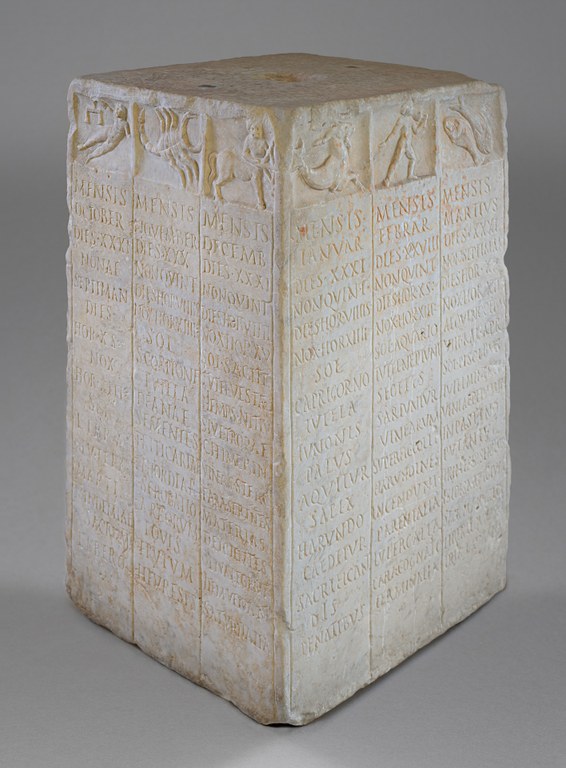
Roman Calendar Inscription with Zodiac, 1st century A.D.

Most city states in ancient times had  civic and religious calendars and dating systems unique to themselves. For ancient Romans, time and history began with the founding of the city by Romulus (738 B.C. to us). The first Roman calendar was composed of only ten months and was a thorough mess. February was later added as the last month of the year, but was then squeezed to fit between January and March. 

It took Julius Caesar to straighten things out in 46 B.C. Caesar introduced a proper twelve month calendar, which unfortunately for him included the Ides of March. 

With just two galleries at their disposal, the ISAW curators wisely limited the exhibition to Greek and Roman civilization. But they do acknowledge the influence of ancient Egypt and the Babylonians, especially the latter on the rise of astrology which retained a powerful influence throughout ancient times. The ISAW exhibit brilliantly reveals a Classical world that was considerably less "classic" than we have been led to believe.


Roman Frieze showing Putti with Sundial, 140–160 A.D

The Greeks and Romans measured the course of the day using sundials, as is well known. However, one of the wonderfully strange objects on view in the ISAW exhibit is a small portable sun dial shaped like a ham! Historians surmise that the shape (like a Prosciutto ham) had an "eat, drink and be merry" connotation. It actually functioned, though the Greeks and Romans also used portable sundials that look like official time pieces by our standards.


Portable Universal Sundial, 1st–4th century A.D.

Many of the other works of art and artifacts displayed in Time and Cosmos seem alien to the image we have long held of the Greeks and Romans as founders of Western Civilization. And even some of the exhibit pieces that do conform to the conventional view of the Classical Age raise questions.

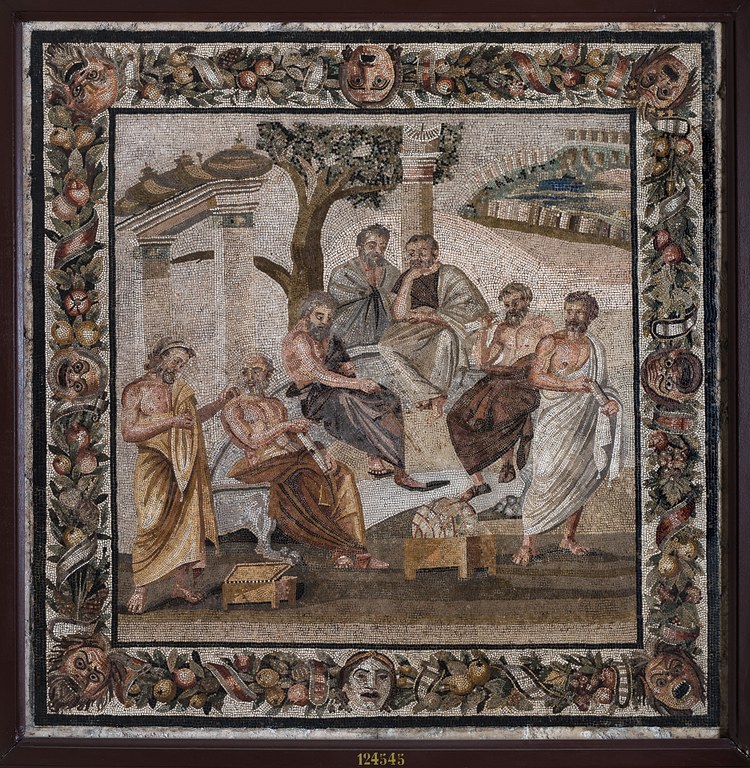
The superb mosaic from the Villa of Titus Siminius Stephanus in Pompeii likely depicts Plato's Academy with the sitting figure directly under the tree being Plato himself. Or it might depict the "seven sages." These pioneering thinkers included Thales of Miletus, the first "scientist" whose many accomplishments included predicting the solar eclipse of 585 B.C.Thales believed in the unity of nature whose phenomena could be explained without reliance on mythology.


Roman Mosaic Depicting the Seven Sages ("Plato's Academy"), from Pompeii

The ancient Greeks and Romans generally ignored the writings of Thales with his emphasis on scientific method. Astrology retained a strong grip on the minds of ancient people until the triumph of Christianity in the fourth century A.D. (and behind closed doors after that). The surviving art and artifacts from antiquity testify to the ceaseless efforts by people, great and small, to comprehend what was in store them, to prepare for and - if possible - to deflect "the slings and arrows of outrageous fortune."

The ISAW has an intriguing stone object on display, a fragment of what is called a "parapegma." The museum text calls it a "precursor to the modern day almanac." On it were inscribed market days in a nine-day cycle and a peg could be inserted in notch holes to keep track. This prosaic use in turn was related to astronomical, meteorological and astrological lore attached to each of these days. 


Roman Parapegma, after 8 B.C.

It is easy enough to understand the day-to-day use of the parapegma, but what purpose was served by the beautifully carved "Altar" with Zodiacal Frieze and Heads of the Twelve Gods is hard to ascertain. It was mounted on a pedestal and may have been purely decorative. But we have no idea what - if anything - was placed in its center space. Perhaps a mirror for individuals to reflect on fate or some device for divination, but this remains a mystery.


"Altar" with Zodiacal Frieze and Heads of the Twelve Gods, 117–138 A.D.

The ISAW exhibit also presents a short visual "reconstruction" of the extraordinary Antikythera Mechanism. In 1900, a Greek sponge diver found fragments of what is now considered the first mechanical computer at an ancient shipwreck site. Named for the nearby island where it was found, the Antikythera Mechanism was a box containing bronze gears permitting complex calculations. Three external dials controlled the settings.

A century later, historians of science are still trying to figure out the workings of this amazing machine. The main purpose, as outlined by the ISAW, is clear. The Antikythera Mechanism can be "understood to be dedicated to astronomical phenomena and operates as a complex mechanical 'computer' which tracks the cycles of the Solar System."

The Antikythera Mechanism dates to 70 B.C., the final flourishing of ancient Greek scientific endeavor. Many of the works of art in the ISAW exhibit date from the "high noon" of the Roman Empire, during the second century A.D.

This brings to mind Edward Gibbon's famous remark about this period in his Decline and Fall of the Roman Empire, the first volume of which was published in 1776:

If a man were called to fix the period in the history of the world during which the condition of the human race was most happy and prosperous, he would, without hesitation, name that which elapsed from the death of Domitian to the accession of Commodus.

Gibbon, a leading thinker of the Age of Reason, wrote his magisterial book entirely based on the surviving literature from ancient times. Gibbon knew about the religious cults of antiquity but very little archaeological evidence about them had surfaced by the time of his writing. As a result, Gibbon could find a kinship between the 1700's Enlightenment and the age of the Good Emperors.

One of the most beautiful, but troubling, works on display in Time and Cosmos dates to Gibbon's "most happy and prosperous" era. Statuette of Nemesis with Portrait Resembling the Empress Faustina I, eighteen inches in height, comes from the Getty Museum collection. It was one of the first exhibit objects to "catch" my eye in the ISAW exhibit, but the more I read and thought about it, the more questions it raised.


Statuette of Nemesis with Portrait Resembling the Empress Faustina I, 150 A.D.

Nemesis, the goddess of divine or "moral" retribution, is usually thought of in terms of delivering "just desserts" to arrogant or law-breaking individuals. This Nemesis, however, has the facial features of Faustina, the wife of the Roman emperor, Antoninus Pius, who ruled 138 to 161 A.D. 

Despite the placid countenance of Faustina/Nemesis, this statuette is one of menacing portent.The wings of Faustina/Nemesis exemplify swift justice, the wheel of destiny in her hand signifies control of present and future. The prostrate figure under the foot of the goddess is an enemy of Rome. 

Antoninus Pius ruled Rome during a comparatively peaceful period of the often violent Pax Romana. His predecessor, Hadrian, however, had attempted to impose the values of Greco-Roman civilization on the Jews of Palestine by building a temple to Jupiter in Jerusalem. Bitter memories of the Roman destruction of the Temple of Jerusalem in 70 A.D. were still very much alive. In 132, the revolt of Simon bar Kokhba challenged Hadrian's heedless policy, as well as the value system we see on display in the ISAW exhibit.

Nemesis, in the form of six Roman legions, eventually crushed Simon bar Kokhba and his rebels. Is there a connection between this statuette, discovered in Egypt, and the Jewish resistance to Greco-Roman civilization? Might the prostrate man under the heel of Faustina/Nemesis symbolize Simon bar Kokhba or someone else in Rome's eastern dominions who dared to think in different terms from the ruling elite?

We are unlikely to know the answer to this question. Indeed, it is a bit unfair to reach beyond the basic framework of Time and Cosmos to raise such an issue. There is so much here to think upon and ponder. Yet, it is the mark of a great museum exhibition that it sparks provocative thoughts such as these.

Time and Cosmos is ultimately concerned with "world view" - in ancient times and for all time. Just one more month remains to see this superb exhibit but the issues it addresses so brilliantly are truly "for the ages."

***
Text: Copyright of Ed Voves, all rights reserved 

Images courtesy of Institute for the Study of the Ancient World (ISAW) and the British Museum

Introductory Image:                                                                                                         Statuette of Tutela with Planetary Divinities, from Mâcon, France, 150–220 AD. Silver with Gilding Dimensions: H. 13.9 cm; W. 6 cm; D. 4.2 cm. The British Museum. GR 1824,0424.1 © Trustees of the British Museum. Digital image courtesy of the  British Museum's Open Access Policy.

Roman Calendar Inscription (Menologium Rusticum Colotianum) with Zodiac, Festivals, and Agricultural Activities, found near the Palatine, Rome. 1st century A.D. Marble.H. 66.4 cm; W. 41.3 cm; D. 38.7 cm. Museo Archeologico Nazionale di Napoli. Inventory Number:2632 © Institute for the Study of the Ancient World / Guido Petruccioli, photographer

Frieze from a Roman Sarcophagus Representing Putti with Sundial. 140–160 A.D. H. 34.5 cm; W. 23 cm; D. 7.4 cm. Musée du Louvre, Paris. Inventory Number:MA1341. Musée du Louvre, Paris, Département des Antiquités grecques, étrusques et romaines  © RMN-Grand Palais / Hervé Lewandowski / Art Resource, NY

Portable Universal Sundial. Believed to have been discovered near Bratislava, 1st–4th century A.D.  Bronze. H. 6.4 cm; W. 6.1 cm; D. 2.5 cm Museum of the History of Science, Oxford. Inventory Number:51358 © Museum of the History of Science, University of Oxford

Roman Mosaic Depicting the Seven Sages ("Plato's Academy"), from the Villa of Titus Siminius Stephanus, Pompeii. 1st century BC–1st century A.D. Stone Tesserae. H. 96 cm; W. 94 cm. Museo Archeologico Nazionale di Napoli. Inventory Number:124545 © Institute for the Study of the Ancient World / Guido Petruccioli, photographer

Roman Parapegma with Lunar Days, Market Days, and Planetary Weekdays, believed to be from Latium, Italy. After 8 B.C. Marble. H. 53.5 cm; W. 33 cm; D. 3 cm. Museo Archeologico Nazionale di Napoli. Inventory Number:2635 © Institute for the Study of the Ancient World / Guido Petruccioli, photographer

"Altar" with Zodiacal Frieze and Heads of the Twelve Gods, from Gabii, Latium, 117–138 AD. Marble. Diameter. 83.5 cm; D. 26.5 cm. Musée du Louvre, Paris. Inventory Number: MA666 Musée du Louvre, Paris, Département des Antiquités grecques, étrusques et romaines © RMN-Grand Palais / Hervé Lewandowski / Art Resource, NY

Statuette of Nemesis with Portrait Resembling the Empress Faustina I,  discovered in Egypt, 150 AD. Dolomitic Marble. H. 46.4 cm; W. 20.3 cm; D. 12.7 cm. The J. Paul Getty Museum, Villa Collection, Malibu, California. Inventory Number: 96.AA.43  Digital image courtesy of the Getty's Open Content Program. 

Thursday, June 30, 2016

Sicily: Culture and Conquest at the British Museum


Sicily: Culture and Conquest


British Museum, London 

April 21 – Aug 14, 2016 


Reviewed by Ed Voves

The island of Sicily is the subject of a fascinating exhibition currently at the British Museum, Sicily: Culture and Conquest. Like Sicily itself, the exhibit dazzles the imagination. And like this ancient land, there is much about the exhibit that does not "meet the eye." 

Strategically set in the middle of the Mediterranean Sea, Sicily is a land of opposites. Bursting with fertility and abundance, the island is haunted by violence and death. It is the birthplace of some of the most creative masters of European culture: Archimedes of Syracuse (d.212 BC), Antonello da Messina (1430-1479) and Luigi Pirandello (1867-1936). It is also the homeland of the Cosa Nostra. 

In antiquity, Sicily was the setting for one of the most significant Greco-Roman myths, the story of Demeter and Persephone. When her daughter, Persephone, is abducted by Hades,  god of the underworld, Demeter wins her release for part of the year. In spring and summer, Persephone is free. Nature blooms, crops ripen - and then comes winter. This, to the ancient Greeks, explained the regenerative cycle of nature. 

But how evocative is the myth of Demeter and Persephone of the fate of Sicily! Joy mixed with an equal portion of sorrow, salvation and damnation forever linked. 

There are two hundred works of art in the British Museum exhibition, covering Sicily's history from antiquity to the Renaissance. Two periods, the rise of the Ancient Greek city-states and the Norman French rule during the Middle Ages, are extensively covered. Other eras, notably the long period of Roman rule, are illustrated with only few works of art. Given the thousands of years covered by the exhibit, this imbalance was perhaps necessary. But it does have some unfortunate consequences.

An excellent place to start grappling with Sicily: Culture and Conquest is the Terracotta Altar with Three Women. 

The altar comes from the Greek colony of Gela on the south coast of Sicily. It dates from around 500 BC, well after the first Greeks beached their galleys on the coast at Naxos in 735 BC.  In terms of style, this terracotta statue is early in the Greek artistic tradition and it represents religious and social themes even earlier - much earlier.


Terracotta Altar with Three Woman and a Lioness Mauling a Bull, 500 BC

Here we see Demeter and Persephone, along with another goddess, Hecate, who cared for Persephone in Hades during her months of wintry exile. Hecate was a goddess of very ancient origin. The three goddesses represent the Mother Goddess cult which preceded Zeus and the Olympian gods. 

Above the three goddesses on the Gela altarpiece is a depiction of a female lion or panther savagely killing a bull. Is this violent scene a reference to the female-male conflict implicit in Persephone's abduction by Hades? Does this  bloody encounter recall a myth from the pre-Greek people of Sicily, the Sicels? We are unlikely to know with certainty.

Gela was a major site of terracotta production in ancient times.The British Museum exhibit also displays a  terracotta roof ornament with head of a gorgon from a temple in Gela. Gorgons were fearsome female deities in Greek myth whose very look could turn a person to stone. This one was likely placed to protect the Gela temple in time of war. 


Antefix in the form of a Gorgoneion, c. 500 BC

Sadly, Sicily was to figure as a battleground from antiquity to the 1943 invasion by Allied forces in World War II. The principal combat in ancient times was between the Greeks in Sicily against the Phoenician maritime power, Carthage. 

The Phoenicians, originally from Lebanon, had established the major city-state of Carthage in North Africa and settlements in Sicily during the 9th century BC. These Semitic peoples were intrepid seaman, creators of the alphabet we still use and tough fighters. But they were merchants first of all. The Phoenicians preferred the art of the deal to the art of war.

There is but one work of Phoenician art in Sicily: Culture and Conquest, a mask designed to protect graves at Carthage from evil spirits. This does a disservice to Phoenician culture. Compared with the Greek art on view, it is easy to look at this grimacing image and conceive of the Phoenicians as an alien civilization.


Grave Mask from Carthage, 5th Century BC

The Greeks had early developed a jealous dislike of the Phoenicians. Sicily represented  the promised land to the Greeks and they were not prepared to share it with Carthage. Syracuse, with one of the most superb harbors in the Mediterranean, became the superpower among the Greek city-states on the island. The rulers or tyrannoi of Syracuse were determined to expand their territorial holdings over Sicily.

The British Museum exhibit displays several outstanding works of "the art of war" recalling ancient bloodshed in Sicily.  A marble statue of a warrior from the city-state of Akragas (modern-day Agrigento) was created around 470 BC. It was certainly part of a monument celebrating the resounding victory over Carthage ten years before by the Greek forces commanded by Gelon of Syracuse and Theron, the ruler of Akragas. 


Statue of a Warrior, c. 480 BC

This great battle in 480 BC, Himera, was won at the same time as the victories of Athens and Sparta against the Persian invaders, 480-479 BC. The Akragas war monument was clearly intended by the Greeks of Sicily to remind their boastful cousins in the ancestral homeland that they had triumphed over the "Barbarians" as well.

After the battle of Himera, the Greeks in Sicily followed the example of Athens, Sparta and Corinth by fighting endlessly among themselves. Carthage regained much of its strength and began to reassert its power in Sicily. After a deadly chess match lasting over two centuries both the Greeks and Carthaginians were checkmated by a new player, the Romans.

Amazingly, Carthage had been an early trade partner and ally of the fledgling Roman Republic, founded in 509 BC. It took many years for the Romans to bring the Italian peninula under their rule. All the while, they watched Carthage and the Greeks wage costly wars without either side gaining hegemony  over Sicily.

In 264 BC, the Romans made their move, clashing with Carthage in the first of the three Punic Wars. The British Museum exhibit displays a truly remarkable piece documenting the "art of war"  during those terrible conflicts. 


Bronze Rostrum or Roman naval ram, 243-241 BC

Normally,  I would hardly consider the rostrum or battering ram mounted on the prow of Roman warship as a work of art. But this menacing weapon illustrates perfectly the relentless warfare that turned Sicily into the gate of Hades for thousands and thousands of war victims, not merely for Persephone in the myth. 

The rostrum was excavated from the seabed in 2008 near Levanzo, on the western tip of Sicily. Here on March 10, 241 BC, the Roman fleet smashed the naval squadrons of Carthage in the climatic battle of the war. The rostrum came from one of the 30 Roman ships lost in the battle. 


Detail of Bronze Rostrum, showing figure of Victory, 243-241 BC

It is a measure of Roman determination and confidence that the bronze ram had been cast with a winged-figure of Victory. 

Rome was to sustain further losses in the Second Punic War, when Hannibal invaded Italy in 218 BC. But Rome won in the end, destroying Carthage in 146 BC. Sicily was reduced to vassal status. Its rich lands were turned into vast, grain-producing estates called latifundia

Apart from this bronze naval ram, Sicily: Culture and Conquest presents few works of art or artifacts from the Roman era. Since this period lasted for an entire millennium, up to the brief Arab conquest in 965 AD, this is a debatable curatorial decision. Indeed, it may well be a serious omission preventing a proper understanding of Sicily's history.

Sicily is the site of the greatest surviving mosaic installation of the Roman era in Europe. This is the great series of mosaic pavements at the Villa del Casale near Piazza Armerina in central Sicily. Created early in the  fourth century AD, it shows wild animal hunts and bikini-clad (or at least the Roman equivalent) female athletes. 

What the mosaics of Villa del Casale really depict is the staggering difference between the privileged lifestyle of the elite of Roman society, the honestiores, and those who served them. The grinding existence of the humiliores is notably absent from these mosaics.

It is missing too from Sicily: Culture and Conquest.                                                                                                                                                                                              . Yet, without some acknowledgement of this centuries-long impoverishment, the rise of the Cosa Nostra cannot be understood. Indeed ,the first Mafia were the Gabellotti. These were the managers whom absentee landlords during the 1800's - descendants of the honestiores - relied upon to run their estates.  The Gabellotti, with no Roman legions to fear, seized power themselves. Sicily and much of the Western world, is still dealing  with the deadly legacy of the Gabellotti.

If the British Museum exhibits skims lightly over the Roman domination of Sicily, compensation is abundantly made in the galleries devoted to the Norman Kingdom and the the reign of Frederick II. These incredible episodes from the Middle Ages are brilliantly explored, presenting art and literary treasures of a unique realm, tolerant, multilingual and open to new ideas. 


Bronze Falcon from Norman-era Sicily or Southern Italy, c. 1200-1220

The Normans arrived in Italy as mercenary knights in 1016 AD, fighting for and against just about everybody including the Pope. The Normans, descendants of the Norsemen who had raided the north of France, were mighty warriors. Christian baptism had changed them barely at all. They were Vikings on horseback. 

In  1061, the Normans launched a thirty-year campaign to "liberate" Sicily from the Arabs. The details of their campaigns and their later rule has been memorably chronicled by the great historian, John Julius Norwich in his books, The Normans in the South 1016-1130, and The Kingdom in the Sun, 1130-1194. We will concentrate on the amazing  - and unexpected - flourishing of culture under the Normans.

Like the Carthaginians, the Normans in Sicily had limited manpower. Instead of hiring mercenaries to wage war, they used others, Greeks and Arabs, to build churches, create works of art and manage the economy. 


The Virgin as Advocate for the Human Race, c. 1130 AD

The exquisite mosaic, the Virgin as Advocate for the Human Race, was made by Byzantine Greeks around 1130 AD. This was the era of King Roger II, the greatest Norman ruler. Originally from the Cathedral in Palermo, the Virgin as Advocate for the Human Race beautifully evokes the toleration that was the foundation of Roger's tremendous achievements.

The compassion and empathy in the Virgin as Advocate is reinforced by a work which symbolizes the spirit of "coexistence"  that marked the era of Roger II. It is easy to miss this funerary piece, insignificant in size, but it is key to the medieval galleries of the exhibit.


Tombstone with Eulogy to Anna, Written in Four Languages, 1149 AD

In 1149 AD, a clergyman named  Grisandus set-up this memorial plaque for his mother Anna. The eulogy was  written in the four languages used in Norman Sicily: Judaeo-Arabic (Arabic written in Hebrew script) on top, Latin on the left, Greek on the right, and Arabic below.

If only this touching, multi-language work of art could have characterized the whole course of Sicily's development from the Norman era to ours!

Unhappily, this is an "exceptional" work of art because it is an exception. Sicily's golden age came to an end when Frederick II died in 1250. The "wonder of the world" to some, Antichrist to others, Frederick was a rare example of a brilliant, tolerant and effective ruler during the Middle Ages - and today. 

Sicily: Culture and Conquest concludes with a painting believed to be a work by Antonello da Messina. One of the earliest Renaissance artists in Italy to use oil paint, Antonello was a master of psychological depth as well. His Madonna, from the collection of the National Gallery of Art in London, is vastly different from the Virgin as Advocate for the Human Race.


Antonello da Messina, Virgin and Child, c. 1460-9

The eyes of Antonello's Madonna are firmly closed. She does not look at Jesus, who is not a child but rather a weird, doll-like man. As the angels lower a glittering crown on the Madonna's head, we become aware of the dread anticipation she feels. The pain on her face reminds us of Antonello's depictions of Christ being crowned by thorns before his crucifixion. 

This jewel-covered crown may not have skin-piercing thorns. But Mary's sorrowing countenance conveys the pain it will bring. This disturbing work is entitled  - most inaccurately - The Virgin and Child

A much more appropriate name for this strange, haunted painting springs readily to mind:    

The Madonna of Sicily's History.

***
Text: Copyright of Ed Voves, all rights reserved. 
Images Courtesy of the British Museum, London, UK

Introductory Image:  
Fragment of a Metope from Temple C, Sicilian Greek, Limestone, c. 540 – 500 BC, H: 460 mm, W: 470 mm Lent by: Palermo Museo Archeologico Regionale, Antonio Salinas, Via Bara All'Olivella, 24, 90133 Palermo, Italy, museum # NI 3899                                                                                                                                                                                                                   
Terracotta Altar with Three Woman and a Lioness Mauling a Bull, Sicilian Greek, 500 BC, Terracotta H: 1140 mm, L: 750 mm, D: 350 mm Lent by: Museo Archeologico Regionale Di Gela, Corso Vittorio Emanuele, 1, 93012 Gela 

Antefix in the form of a Gorgoneion, Sicilian Greek, about 500 BC, Terracotta, H: 385 mm, L: 380 mm, D: 880 mm Lent by: Museo Archeologico Regionale Di Gela, Corso Vittorio Emanuele, 1, 93012 Gela

Grave Mask, Carthage, North Africa, 5th Century BC, Baked Clay, H: 17.7 cm © The Trustees of the British Museum, British Museum # 133128

Statue of a Warrior, Sicilian Greek, c. 480 BC, Marble, H: 861 mm Lent by: Lent by: Museo Archeologico Regionale di Agrigento, Contrada San Nicola, 12, Agrigento, 92100, Italy, Ag 217

Bronze Rostra from Levanzo, Roman-era Italy, 243-241 BC, Bronze, H: 700 mm, W: 500 mm Lent by: Soprintendenza per i Beni culturali e ambientali del Mare Palazzetto Mirto - Via Lungarini, 9, Lungomare Cristoforo Colombo, 4521 (Istituto Roosevelt) Palermo 90100, Italy  # Egadi 4

Bronze Falcon, Norman-era Sicily / Southern Italy, 1200-1220, Gilded Bronze, H: 279 mm, W: 165 mm, L: 79 mm Lent by: The Metropolitan Museum of Art, New York  Metropolitan Museum # 47.101                                                                                                                                                                                                                                             
Mosaic of the Virgin Haghiosoritissa, Norman-era Sicily,  12th Century, H: 750mm, W: 620mm Lent by: Museo Diocesano di Palermo, Via M. Bonello, 2, 90133 Palermo, Italy, museum # 6

Tombstone with Eulogy to Anna, Mother of Grisandus, Written in Four Languages, Church of  St. Michael the Archangel, Palermo, Sicily, 1149, Inlaid Marble, W:  410 mm, L: 320 mm, D: 45 mm max Lent by: SoprIntendeza di Palermo, Soprintendenza BB.CC.AA. Via Calvi, 13, 90139 – Palermo, museum # 19304

Antonello da Messina (Sicilian, 1456-1479) Virgin and Child, c. 1460-9, Oil on wood, 43.2 x 34.3 cm National Gallery, London, UK, Salting Bequest, 1910, NG2618