Showing posts with label Dox Thrash. Show all posts

Friday, June 30, 2023

Art Eyewitness Review: Whistler's Mother at the Philadelphia Museum of Art


The Artist's Mother: Whistler and Philadelphia

Philadelphia Museum of Art
June 10 - October 29, 2023

Reviewed by Ed Voves

Original Photography by Anne Lloyd

It's been a long interlude between visits. The last time Anna Matilda McNeil Whistler - or rather her famous portrait - came to Philadelphia was 142 years ago. The occasion was an exhibition at the Pennsylvania Academy of the Fine Arts of the painting by her son, now universally called Whistler's Mother. 

A.K.A. Arrangement in Grey and Black: Portrait of the Artist's Mother, the celebrated painting by James McNeil Whistler is back in the City of Brotherly Love. A true icon of American art, Whistler's Mother highlights a special exhibition at the Philadelphia Museum of Art, organized by Jennifer Thompson, the museum's curator of European Art. The exhibit will be on view until October 29, 2023. 

It is important to note that the official designation of Whistler's Mother, noted above, is actually the anglicized translation of its French title, Arrangement en gris et noir n° 1. That is an important distinction since the French government bought the painting in 1891, ten years after its first sojourn in Philadelphia. 


Anne Lloyd, Photo (2023)
James Whistler's Arrangement in Grey and Black:
 Portrait of the Artist's Mother (1871)

Arrangement en gris et noir was the first acquisition of a painting by an American painter for the Louvre's collection. Initially, it was put on display in the Luxembourg Museum, until Whistler died twelve years later. The galleries of the Louvre were reserved for deceased artists, who were deemed worthy to share the museum walls with Leonardo, Watteau and Gericault.

Thanks to a far-sighted French art critic, Gustave Geffroy (one of the first to appreciate Cezanne, as well), James Abbott McNeil Whistler (1834-1903) joined the company of the "immortals" of art in the Louvre. And, as we will see, the help of Anna Whistler was of crucial importance for securing the fame and fortune of her son!


Anne Lloyd, Photo (2023)
Gallery view of Whistler's Mother at the Philadelphia Museum of Art

Whistler's Mother is now the center of attraction at the Philadelphia Museum of Art. But it shares the stage with eight other works of art focusing on the theme of motherhood. Each of the eclectic cast of major artists, Cecilia Beaux, Henry Ossawa Tanner, John Sloan, Dox Thrash, Alice Neel and Sidney Goodman, follows Whistler's lead, but in their own unique way. 

All the artists have Philadelphia backgrounds, with the exception of a Venetian engraver, Francesco Novelli (1764-1836) who skillfully copied an etching by Rembrandt of his mother. Novelli's etching is believed to have influenced Whistler when he painted his mother's portrait in 1871.


Francesco Novelli (1792), after Rembrandt's 
The Artist's Mother Seated, in an Oriental Headress, 1631

Arrangement in Grey and Black received indifferent reviews during its exhibition at the Pennsylvania Academy of Art (PAFA) in 1881. The museum directors refused to purchase the painting, which, surprisingly, was for sale. Whistler was deeply in debt, following his disastrous libel suit against John Ruskin. Another effort to find a buyer likewise failed, this time in New York.

It is ironical for a painting which has come to symbolize Motherhood, that Whistler was "shopping" his mother's portrait around the U.S., looking for a sale. 

Anna Whistler had died on January 3, 1881, only a short time before Whistler returned to the U.S. from England. One would have suspected that Whistler would try and keep this painting, of all his oeuvre, as a testimonial to his beloved mother. Not so! Whistler exhibited a baffling, mercurial mix of emotions, making it difficult to probe his true feelings. 

In fact, Whistler had posed his mother only when the young woman he was scheduled to paint that day failed to appear.  Rather than discard a prepared canvas, Whistler decided to use it for a portrait of his mother.


Anne Lloyd, Photo(2023)
James Whistler's Arrangement in Grey and Black (detail)

It's a sobering thought that Whistler's Mother began its storied career as an "also ran."

Anna Whistler was accustomed to her son's mood swings and changing priorities. She had supported her dear "Jemmie" with long-suffering patience, including his dismissal from the United States Military Academy. But even her forbearance had limits. 

After several days of standing for her portrait, the exhausted Anna insisted on sitting down. Whistler changed the orientation of the painting, with results which, thanks to the Philadelphia Museum of Art, we can now study close at hand.


Anne Lloyd, Photo(2023)
 Jennifer Thompson discussing the kimono wall hanging depicted in James Whistler's Arrangement in Grey and Black

As the artistic skill devoted to his portrait of his mother began to stir popular interest, Whistler professed himself bemused:

Take the picture of my mother, exhibited at the Royal Academy as "an Arrangement in Grey and Black." Now that is what it is. To me it is interesting as a picture of my mother; but what can or ought the public to care about the identity of the portrait?

The "public" in America responded to Whistler's portrait of his mother with ever -increasing regard. In part this was due to the fact that the French had anointed the painting as worthy of the Louvre. But nostalgia played a major role, too. The U.S. in the 1890's was undergoing massive social changes, many very unsettling. Frontier America was passing, the big industrial cities taking its place. A symbol of bedrock national values was needed. What better image, representing the moral absolutes of the U.S.A., could there be than a painting of an American mother?

Anna McNeil Whistler provided the human face, even if painted in profile, to the movement to create a national holiday in honor of American mothers. The first Mothers Day was celebrated in 1908 and, in 1934, the U.S. Postal Service issued a stamp, graced by a rather sanitized reworking of Whistler's Mother. 

Neither the artist or his mother were acknowledged by name on the stamp. To make matters worse, a vase of flowers was added to the image of the unidentified matriarch. Then, along with a sentimental inscription, appeared the incredibly crass notification: three cents.

Whatever value the U.S. Postal Service placed on motherhood, Philadelphia artists responded very quickly and favorably to Whistler's Mother, following its display at PAFA in 1881. The current exhibition at the Philadelphia Museum of Art brilliantly underscores the influence of Whistler on succeeding generations of American artists. But the crucial point of this legacy is that none of these later works of art is a direct "quotation" of Arrangement in Grey and Black. 


Anne Lloyd, Photo(2023)
Henry Ossawa Tanner's Portrait of the Artist's Mother (detail)

The work which most closely follows Whistler, is Henry Ossawa Tanner's Portrait of the Artist's Mother, but there are major differences.

Tanner saw Arrangement in Grey and Black in 1881. He was a student at PAFA at the time. Tanner then went to France for further study, eventually settling there. He would have seen Whistler's increasingly famous painting at the Luxemborg, as well.

In 1897, during a trip home to Philadelphia, Tanner posed his own mother for a portrait. The warm tones of brown, amber and the golden fabric of the shawl evoke feelings of life and well-being, in contrast to the somber, almost funereal, hues of Whistler's painting. Likewise, the relaxed, meditative gaze of Tanner's mother creates a mood vastly different from the frozen profile of Anna Whistler.


Anne Lloyd, Photo(2023)
 Jennifer Thompson discussing Cecilia Beaux's early masterpiece,
The Last Days of Childhood, 1883-1885

Sharing the gallery wall with Tanner's Portrait of the Artist's Mother is Cecilia Beaux's The Last Days of Childhood. Painted over the course of two years, 1883-85, this deeply moving work of art established Beaux's reputation as one of America's premier artists.

The Last Days of Childhood shares enough elements of setting and composition with Arrangement in Grey and Black that we can be fairly certain that Beaux saw and studied the Whistler painting during its display at PAFA, where she was taking classes. Beaux, a strong-willed and immensely talented young woman, later asserted that she had not been influenced by Whistler. But the evidence points to the contrary.

At the press preview, Jennifer Thompson discussed the "backstory" of The Last Days of Childhood. The protagonists of Beaux's painting were her elder sister, Etta, and Etta's son, Henry. That would seem to technically disqualify Beaux's painting from inclusion in an exhibition dedicated to artists and their mothers, but Thompson detects a strong affinity with Whistler's masterpiece.

Indirectly, Beaux's mother is very much present in the The Last Days of Childhood. The French title of the painting uses the word "enfance" and the translation might more appropriately be The Last Days of Infancy. That is certainly in keeping with Henry's age and Beaux's own life story.

Beaux's mother had died when her infant daughter, Cecilia, was only twelve days old. Beaux directed her sister to wear a black dress for the painting sessions. According to social conventions in America at the time, such attire was a sign of mourning. However, Etta, unlike Anna Whistler, was not a widow. The black dress may therefore be interpreted as a memorial of their long-dead mother.


Anne Lloyd, Photo(2023)
Cecilia Beaux's The Last Days of Childhood (detail)

What really impressed me about The Last Days of Childhood is Beaux's ability to reprise the narrative of the entire work in "a painting within the painting." This is her astonishing treatment of the hands of the child, resting on those of his mother, which are folded over his body in an embrace of enduring love. Childhood may be passing but the bond of mother and son will never break. 


Following the progression of magisterial paintings from Whistler to Beaux and Tanner, the exhibition shifts gears to three smaller works, Sunday Morning by Dox Thrash (c. 1939), Aritist's Mother I by Sidney Goodman (1994) and Mother by John Sloan (1906). The works by Thrash and Sloan are etchings, Goodman's is a charcoal and pastel drawing on cream paper.


Dox Thrash, Sunday Morning, c. 1939


 Sidney Goodman, Aritist's Mother I, 1994


John Sloan, Mother, 1906

This trio may appear to be quite a "comedown" from the preceding oil paintings, but careful study validates their inclusion in the exhibition. All three are "arrangements in gray and black" worthy of Whistler's color scheme. Yet, the emotion-based sentiments underpinning each of these works of art is what merits them a place in the exhibition.

Dox Thrash created this loving image of his mother, Ophelia, on her way to church, shortly after she died in 1936. Thrash's mother, like Whistler's, is shown in profile, but there is an incredible degree of mobility in this etching, a sense of serene progress through life which the many obstacles placed across his mother's path could never impede.

The works by Sloan and Goodman present the two faces of motherhood which  linger in the memories of their children. Sloan shows lively, animated interest in the expression of his mother, no doubt listening to the latest news about his life and career. Goodman's drawing, showing his mother arise from her sick bed, depicts the heroic efforts of ill, elderly mothers to keep living, keep striving on behalf of their loved ones.

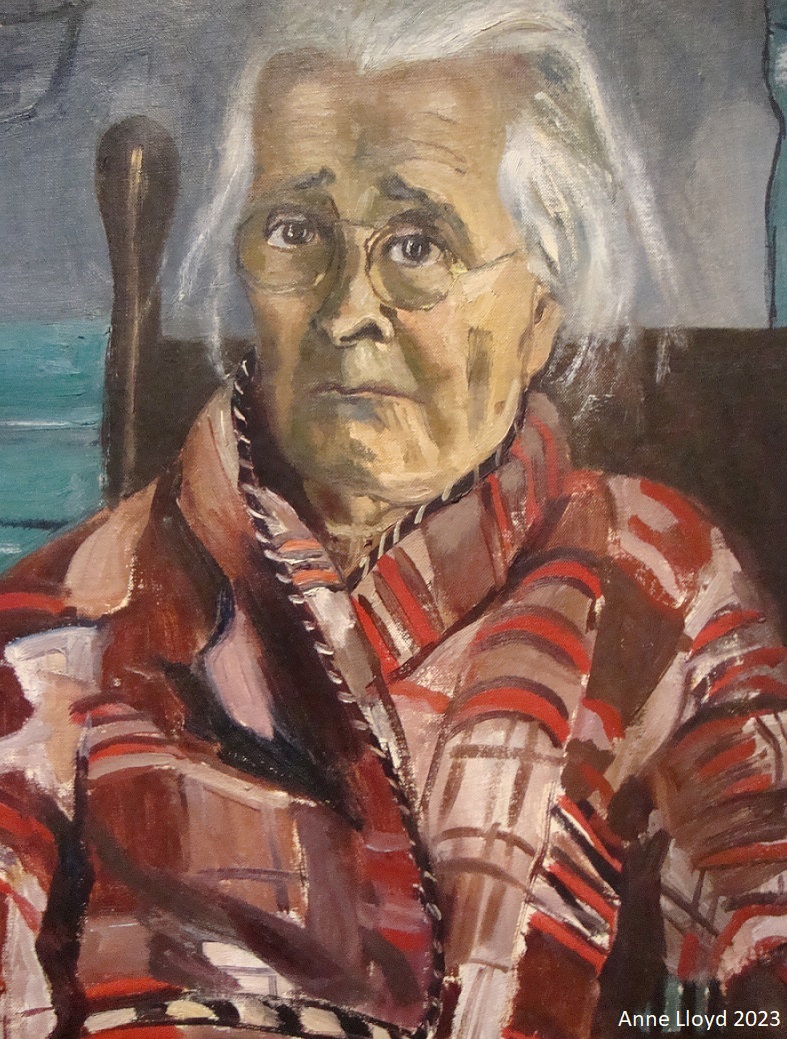
Goodman's Artist's Mother I sets the stage for the final work of art in the exhibition, Alice Neel's Last Sickness (1953). The painting is a loving, yet unsparing examination of the effect of age and illness on an "alert, tart woman" as Neel described her mother, who died the following year.

Those fortunate to visit the Metropolitan Museum of Art's sensational 2021 exhibition of Alice Neel's paintings will recall numerous examples of Neel's clear-eyed empathy for people of all ages and races, but especially those sick in body and in spirit. For those who were unable to visit the Met's Alice Neel: People Come First, the magnificent portrait on view at the Philadelphia Museum of Art provides the opportunity to see a life of artistic genius distilled into one superlative work of art.


 Anne Lloyd, Photo (2023)
 Alice Neel's Last Sickness, 1953 


The look of recognition of life's short span which we see on the face of Alice Neel's mother brings The Artist's Mother exhibition full circle. Anna Whistler's face, seen in profile, betrayed no such emotion. But no one knows what she was thinking, as her son fumed and muttered about the difficulties he faced to get the look he wanted on the canvas.


Anne Lloyd, Photo (2023)
 Gallery view of The Artist's Mother: Whistler and Philadelphia

Some commentators say that Anna Whistler was praying during the painting sessions that "Jemmie" would succeed with his portrait. If so, her prayers were answered.

So too, are the prayers of those - like me - who never had an opportunity to view Arrangement in Grey and Black: Portrait of the Artist's Mother in person. Seeing this magnificent painting is like being accorded an audience with a queen or a beloved author or actress.

My wife, Annie, said it best, during a pause in her picture-taking.

"When you enter the gallery where Whistler's Mother is displayed, you just don't go to see it," Anne said. "You are admitted into her presence."

***

Text: Copyright of Ed Voves. Original Photos: Copyright of Anne Lloyd.

Introductory Image: Anne Lloyd, Photo (2023) James Whistler's Arrangement in Grey and Black: Portrait of the Artist's Mother (detail), 1871.

Anne Lloyd, Photo (2023) James Whistler's Arrangement in Grey and Black: Portrait of the Artist's Mother. Oil on canvas: 144.3 x 162.5 cm (56 3/4 x 64"). Musée d'Orsay, Paris, RF 699.

Anne Lloyd, Photo (2023) Gallery view of The Artist's Mother: Whistler and Philadelphia exhibition at the Philadelphia Museum of Art.

Francesco Novelli (Italian, 1764-1836) After Rembrandt van Rijn's The Artist's Mother Seated, in an Oriental Headdress: Half Length, 1792. Etching: 5 1/4 x 5 1/16 inches ( 13.4 x 12.9 cm.) Philadelphia Museum of Art, 1928-42-4413

Anne Lloyd, Photo (2023) Jennifer Thompson of the Philadelphia Museum of Art discussing the kimono wall hanging depicted Whistler's Arrangement in Grey and Black: Portrait of the Artist's Mother. 

Anne Lloyd, Photo (2023) Henry Ossawa Tanner's Portrait of the Artist's Mother (detail), 1897. Oil on canvas: 29 1/4 x 39 1/2 inches ( 74.3 x 100.3 cm.) Philadelphia Museum of Art  EW1993-61-1

Anne Lloyd, Photo (2023) Jennifer Thompson of the Philadelphia Museum of Art discussing Cecilia Beaux's early masterpiece, The Last Days of Childhood, 1993-85.

Anne Lloyd, Photo (2023) Cecilia Beaux's The Last Days of Childhood, 1883-85. Oil on canvas: 116.2 x 137.16 cm (45 3/4 x 54 inches). Pennsylvania Academy of the Fine Arts. 1989.21

Dox Thrash (American, 1893–1965) Sunday Morning, around 1939. Etching: 8 7/8 x 8 inches (22.5 x 20.3 cm.) Philadelphia Museum of Art, 1941-53-378

Sidney Goodman (American, 1936-2013) Artist's Mother I, 1994. Charcoal and pastel on cream wove paper: 52 3/4 x 41 3/16 inches (134 x 104.6 cm.) Philadelphia Museum of Art, 2009-216-1

Anne Lloyd, Photo (2023) John Sloan's Mother, 1906. Etching:  9 x 7 1/2 inches (22.9 x 19.1 cm.) Philadelphia Museum of Art, 1956-35-73f

Anne Lloyd, Photo (2023) Alice Neel's Last Sickness, 1953. Oil on canvas: 30 x 22 inches (76.2 x 55.9 cm.) Philadelphia Museum of Art, 2003-148-1

Anne Lloyd, Photo (2023) Gallery view of The Artist's Mother: Whistler and Philadelphia exhibition at the Philadelphia Museum of Art..


Saturday, February 29, 2020

"Awakened in You" African American Art at the Pennsylvania Academy of the Fine Arts


"Awakened in You": the Collection of Dr. Constance E. Clayton


Pennsylvania Academy of the Fine Arts
February 21, 2020–July 12, 2020

Reviewed by Ed Voves
Original photography by Anne Lloyd

There are so many reasons to celebrate the latest exhibition at the Pennsylvania Academy of the Fine Arts (PAFA) that it is hard to know where to start.

"Awakened in You" does not merely represent the opening of another landmark exhibition at the historic art school and museum. The 75 works on view are part of a major collection of paintings and sculptures by African American artists. The works of art selected for the exhibit will join the permanent collection of PAFA's museum once "Awakened in You" closes in July 2020.


Anne Lloyd, Photo (2020)
Laura Wheeler Waring's The Study of a Student, ca. 1940s 


Anne Lloyd, Photo (2020)
Gallery view of the "Awakened in You" exhibition at PAFA

Any time a museum receives a major bequest like this, it is a truly significant event. 

The magnitude of the "Awakened in You" collection is enhanced by the fact that it represents an African American success story demonstrating the importance of inspired community leadership in the arts. The exhibition also testifies links to PAFA's commendable role in aiding and encouraging African American artists.

The "Awakened in You" paintings and sculptures were collected by Dr. Constance Clayton, who was the Superintendent of the School District of Philadelphia from 1982 to 1993. Born and raised in Philadelphia, Dr. Clayton was the first African American and the first woman to take on the challenge of directing the city’s schools. 

With the aid of her mother, Mrs. Williabell Clayton, Dr. Clayton set about building a collection which would document the great achievements of African Americans in the visual arts.  From the post-Civil War landscapes of Edward Bannister (1828-1901) to Romare Bearden's bold reworking of Classical mythology in the light of the African American experience, virtually every significant African American artist is represented in "Awakened in You."


Anne Lloyd, Photo (2020)
 Edward Bannister's Untitled (Landscape with Water and Sail Boat), 1885 


              Anne Lloyd, Photo (2020) Romare Bearden 's Odyssey Series, ca. 1970s            

As a measure indicative of just how important the donation of the "Awakened in You" collection is to PAFA, Dr. David Brigham, President and CEO of PAFA, and Brooke Davis Anderson, Director of the PAFA Museum, served as the curators of this exhibition.
Perhaps even more significantly, the exhibition team included Ms. Sarah Spencer, a charismatic and knowledgeable assistant curator.


  Dr. David Brigham & Ms. Brooke Davis Anderson introduce Ms. Sarah Spencer (center)  at the "Awakened in You" exhibition at PAFA

In their introductory remarks, Brigham and Anderson stressed the importance of “mentoring” in the past practice and contemporary mission of PAFA. Mentoring is more than just teaching or passing the secrets of the “trade” to apprentice workers. Rather it is a process by which future leaders are accorded the opportunity to demonstrate their knowledge and skill. Judging from her dynamic participation in the press preview, Sarah Spencer has amply fulfilled her role in the “mentoring” process at PAFA and in the African American art community.


Anne Lloyd, Photo (2020)  
Ms. Sarah Spencer, Assistant Curator of the "Awakened in You" exhibition 

The display of magnificent paintings and sculptures collected by Dr. Clayton begins with a series of nature studies by a long time teacher at PAFA, Louis B. Sloan (1932-2008). These are displayed at the foot of the grand staircase of the PAFA Museum and at first glance appear to be conventional, “weekend” paintings. Indeed, some of them were painted on weekend art excursions when Sloan took student groups to the nearby Wissahickon Park, some of which is quite rugged terrain, and farther afield to more distant countryside around Philadelphia.


                                       Anne Lloyd, Photo (2020)                               
Louis B. Sloan's Landscape with White and Yellow Wild Flowers

Sloan was a beloved teacher and a brilliant painter. His finished works ranged from highly accomplished realism in Backyards (1955) to the almost abstract landscape of Frost Valley in the Catskills (1995). Both of these works are part of PAFA's collection. I was astonished when I realized that this John Constable-like nature study had been painted by the artist who did the dazzling Frost Valley!

There a subtle message to the placement of Sloan’s small landscape series. Many of the artists included in the second floor exhibition galleries of “Awakened in You” were graduates of PAFA or had worked in the WPA art programs of the Depression-era Philadelphia. They had to establish their “creds” with works like these nature studies. No artist can claim a spot on the gallery walls of PAFA without climbing the “steps” of practice, experimentation, of inspiration-dripping with perspiration.

Upon entering the “Awakened in You” galleries, you quickly realize just how hard these African American artists worked and how brilliantly they integrated their life experience into the powerful works on view.

Among the first works on art on view in the exhibition galleries are portraits of family members and friends, testifying to bonds of love and relationship which enabled African Americans to endure privation and prejudice for so many years, indeed centuries.

Laura Wheeler Waring's engaging group portrait, Four Friends, painted around 1940, and Barkley Hendrick's Head of a Boy, which introduces this review, evoke childhood as close to an ideal state, yet tinged with a degree of melancholy.
                                                                                                                                        
                            
Anne Lloyd, Photo (2020) Laura Wheeler Waring's Four Friends, ca. 1940s 

In the wall text which accompanies Four Friends, Sarah Spencer comments on the serious underlying message to what otherwise might be accounted an exercise in "mere" portrait painting. Spencer notes:

Four Friends celebrates Black youth and the innocence of childhood in a world that often sees Black children as a threat. Waring captures joy in its purest form, emphasizing its necessity for Black children’s survival and the ability to fully claim their humanity.

Beyond their evident charm, of these two works of art, assert the human dignity of the young people who posed for their portraits. These works - and many others collected by Dr. Clayton - challenge our preconceptions of the artists. 

Barkley Hendricks later created his "brand" of art, bold, full-length portraits of cool, savvy men and women. They posed, at ease with themselves and proud of their flamboyant "70's" clothing. Hendrick's later portraits strike such a chord that the sensitive drawing of the pensive, young boy takes us off-guard.


Anne Lloyd, Photo (2020) Barkley Hendricks' Head of a Boy (detail)

The skillful handling of a limited range of colors, highlighted by deft touches of light blue on the boy's forehead, the mastery of drawing - all these proclaim an "old master" status for the artist. If it comes as a surprise that Barkley Hendricks created this portrait, and not John Singer Sargent, it should not do so.

Hendricks graduated from PAFA - he studied with Sloan - and so did Waring. There is a strong, Philadelphia regional element to the "Awakened in You" collection. Philadelphia-based Dox Thrash, one of the greatest print makers of mid-century America, is well-represented in the exhibition, though in a unconventional way. The selection of his works on view includes a nude, a controversial African American genre given its connotations with slavery. Thrash was on more sure ground with his arresting portrait of a man wearing red suspenders.


Anne Lloyd, Photo (2020)  
Dox Thrash's Portrait of Male with Red Suspenders (detail)

Dr. Clayton, however, looked beyond Philadelphia in her collecting efforts.

There are two drawings in "Awakened in You" by the great Chicago artist, Charles White, on view and a strong showing showing of works by Harlem Renaissance artists. I was particularly impressed by the woodcuts of James Lesesne Wells (1902-1997). The ironically entitled, Primitive Girl, is actually an amazingly sophisticated work, skillfully incorporating American folk art themes with the dignity of the bronze portrait sculptures of Benin.


Anne Lloyd, Photo (2020)  
James Lesesne Wells's Primitive Girl, 1927

In terms of the artists of the Harlem Renaissance, Augusta Savage was surely the most influential, in terms of her leadership and teaching. Her own work as a sculptor was of the highest quality but Savage often lacked the funds to have her clay originals cast in bronze. 


   Anne Lloyd, Photo (2020)  
Augusta Savage's Gamin

The version of this iconic work, which Clayton was able to purchase for her collection, is one of three sculptures which anchor the "Awakened in You" exhibition. The other sculptures, both bronze casts, are Richmond Barthé's Head of a Dancer, created around 1940, and May Howard Jackson's Slave Boy, 1899. 

Another cause for celebration is the high quality of the wall texts which accompany many of the art works on display. Exhibition visitors, myself included, often skim through the comments from unseen, unheralded curators. That is perhaps unavoidable given the need to focus on the art works. But PAFA has gone the extra-mile to commission especially cogent mini-essays to help art lovers grasp the historical setting and aesthetic value of these works of art. 

Some of these wall texts were written by the PAFA curators, as we saw with Sarah Spencer's reflections on Four Friends. For the superlative etching  by Henry Ossawa Tanner, extremely perceptive brilliant insights were provided by Mr. Teddy R. Reeves,  Assistant Curator of Religion, Smithsonian National Museum of African American History and Culture.


Anne Lloyd, Photo (2020) Henry O. Tanner's Mosque,Tangier, ca.1910 

Tanner's subject is a mosque in Tangier, Morocco. Reeves, however, affirms that it is the "Judeo-Christian influence on Tanner" that is on full display. Also implicit in this exceptional work is Tanner's awareness of his status in a racially-divided America. Reeves notes:

Within the biblical text, the positionality of one’s physical body inside or outside of a gate was essential in understanding an individual’s position and stature—from the prophets of the Old Testament calling for justice and transparency at the city gates to Jesus’ interaction with the blind beggar Bartimaeus at the city gate in the Gospel of Mark. Tanner’s capturing of the woman and horse outside of the city’s gates is indicative of the marginality African Americans, including Tanner himself, experienced at the gates of many American cities... Lift up your heads, you gates; be lifted up, you ancient doors, that the King of glory may come in… (Psalm 24:7)

American art has come a long way since Henry Ossawa Tanner felt compelled to express himself in such coded messages. But it is precisely because Tanner "lifted-up" his head and created great and meaningful art that the gates have finally opened wide for African-American artists, writers, philosophers to express themselves fully and freely.

The same can be said of Augusta Savage, Dox Thrash, Charles White, James Lesesne Wells and the other African-American artists whose works Dr. Constance Clayton preserved in the collection which she has so generously shared with the Pennsylvania Academy of the Fine Arts.

***
Text: Copyright of Ed Voves, all rights reserved  
Images copyright of Anne Lloyd


Introductory Image:
Barkley L. Hendricks, (American, 1945-2017) [Head of a boy], n.d. Charcoal and pastel on paper: 17 x 13 in. Pennsylvania Academy of the Fine Arts (PAFA) # 2019.3.24. Gift of Dr. Constance E. Clayton in loving memory of her mother Mrs. Williabell Clayton

Anne Lloyd, Photo (2020) Laura Wheeler Waring's The Study of a Student, ca. 1940s. 
Oil on canvas: 20 x 16 in. PAFA, # 2019.3.69  Gift of Dr. Constance E. Clayton in loving memory of her mother Mrs. Williabell Clayton 

Anne Lloyd, Photo (2020) Gallery view of the "Awakened in You" exhibition at PAFA.

Anne Lloyd, Photo (2020) Edward Bannister's Untitled (landscape with water and sail boat), 1885. Oil on canvas: 14 3/4 x 23 in. PAFA, # 2019.3.2. Gift of Dr. Constance E. Clayton in loving memory of her mother Mrs. Williabell Clayton 

Anne Lloyd, Photo (2020)  Romare Bearden's Odyssey Series, ca. 1970s. 
Silkscreen: 25 1/2 x 21 1/4 in. PAFA, # 2019.3.4. Gift of Dr. Constance E. Clayton in loving memory of her mother Mrs. Williabell Clayton 

Anne Lloyd, Photo (2020)  Dr. David Brigham & Ms. Brooke Davis Anderson introduce Ms. Sarah Spencer (center)  at the "Awakened in You" exhibition at PAFA

Anne Lloyd, Photo (2020)  Ms. Sarah Spencer, Assistant Curator of the "Awakened in You" exhibition

Anne Lloyd, Photo (2020) Louis B. Sloan's  [Landscape with White and Yellow Wild Flowers], n.d. Oil on board: 15 x 21 in. PAFA # 2019.3.44 Gift of Dr. Constance E. Clayton in loving memory of her mother Mrs. Williabell Clayton 

Anne Lloyd, Photo (2020) Laura Wheeler Waring's Four Friends, ca. 1940s. Oil on canvas: 25 x 30 in.  PAFA, # 2019.3.68. Gift of Dr. Constance E. Clayton in loving memory of her mother Mrs. Williabell Clayton

Anne Lloyd, Photo (2020) Barkley L. Hendricks' [Head of a boy], n.d. (detail).


Anne Lloyd, Photo (2020)  Dox Thrash's Portrait of Male with Red Suspenders (detail), date unknown. Watercolor on paper: 11 3/4 x 8 7/8 in. (29.845 x 22.5425 cm.) Pennsylvania Academy of the Fine Arts.  # 2019.3.57  Gift of Dr. Constance E. Clayton in loving memory of her mother Mrs. Williabell Clayton.

Anne Lloyd, Photo (2020) James Lesesne Wells' Primitive Girl, 1927. Woodcut, ed. 2/50: 7 1/4 x 8 1/2 in. PAFA, 2019.3.74.  Gift of Dr. Constance E. Clayton in loving memory of her mother Mrs. Williabell Clayton 

Anne Lloyd, Photo (2020) Augusta Savage's Gamin, n.d. Plaster : 9 1/2 x 4 x 5 1/2 in.  PAFA, #  2019.3.38. Gift of Dr. Constance E. Clayton in loving memory of her mother Mrs. Williabell Clayton 

Anne Lloyd, Photo (2020) Henry O. Tanner's Mosque, Tangier, ca. 1910. Etching on paper: 10 7/8 x 13 1/4 in.  PAFA, #  2019.3.54. Gift of Dr. Constance E. Clayton in loving memory of her mother Mrs. Williabell Clayton 

Tuesday, May 1, 2018

Modern Times: American Art 1910-1950 at the Philadelphia Museum of Art


Modern Times: American Art 1910-1950


Philadelphia Museum of Art
April 18—September 3, 2018

Reviewed by Ed Voves

Modern art in the United States came of age between 1913 and 1951. These two years were highlighted by art exhibitions of seminal importance, both held in New York City.  The controversial Armory Show of February 1913 shocked an America still clinging to the moral certitudes of the Victorian Age. Nearly four decades later, the Ninth Street Show, held between May 21-June 10, 1951, marked the triumph of the Abstract Expressionism of the New York School.

A great deal of American art was created in between these two red-letter dates. The range and variety of art produced during those crowded decades is truly impressive, as can be seen in the  recently-opened exhibition at the Philadelphia Museum of Art, Modern Times: American Art 1910–1950.


Anne Lloyd, Photo (2018) Gallery view of Modern Times: American Art 1910–1950 

The works of art on view in Modern Times are almost entirely drawn from the collection of the  Philadelphia Museum of Art (PMA). A few come from a private collection which has been promised to the PMA, but there can be little doubt about the exceptional caliber of the museum's holdings of American art. 

Many of these works came to the PMA during the cash-strapped 1930's and 1940's. The head of the PMA at that time, Fiske Kimball (1888-1955), used his limited resources to buy or to encourage donations of then contemporary art. The payoff for Kimball's astute collection strategy can be seen in this excellent exhibit.

Modern Times is a comprehensive and thoroughly enjoyable examination of how American art reflected, rejected  and retooled the accepted ideals of society in "these United States." It is brilliantly curated by Jessica Todd Smith. As an added touch, period clothing and artifacts, such as flapper dresses and Prohibition-era cocktail shakers, are used to complement the art on display.  


Anne Lloyd, Photo (2018) Jessica Todd Smith, Curator of the Modern Times exhibit

A key work of the exhibit is Georgia O’Keeffe's Red and Orange Streak. Painted in 1919, shortly O’Keeffe moved to New York City, it is both an abstract and a realist work of art. O'Keeffe painted it as an homage to the Texas plains where she had lived prior to moving to the East Coast. O'Keeffe took nocturnal walks, observing the dazzling displays of lighting above the darkened expanse of the prairie. 

Such "special effects" in nature are impossible to depict in terms of absolute realism. In fact, no such state exists is nature because the real impact is felt, indeed co-created, in the imagination of the viewer. 


Georgia O'Keeffe, Red and Orange Streak, 1919

O’Keeffe acknowledged this in letter to a friend, noting that “the whole thing—lit up—first in one place—then in another with flashes of lightning—sometimes just sheet lightning—and sometimes sheet lightning with a sharp bright zigzag flashing across—I . . . sat on the fence for a long time—just looking at the lightning.”

Here we can see the process at work that informed O'Keeffe's often-quoted belief that, "nothing is less real than realism. Details are confusing. It is only by selection, by elimination, by emphasis, that we get at the real meaning of things."

O’Keeffe's Red and Orange Streak came to the PMA in 1949, part of her generous endowment of art works by herself and by her husband, Alfred Stieglitz, who had died in 1946. The PMA is rich in works by both artists and this no doubt helped the museum recently secure a vast archive of photos by Paul Strand, Stieglitz' versatile colleague.


Anne Lloyd, Photo (2018) Gallery view of the Modern Times exhibit, showing works by Georgia O'Keeffe, Red Hills and Bones (1943) and From the Lake, No. 3 (1924)

With several of her works on view, we are able to appreciate O'Keeffe's trajectory as an artist and that of twentieth century American art as a whole. More famous for her landscapes of New Mexico, such as Red Hills and Bones (1943), O'Keeffe also painted works evoking the backwoods feel of Stieglitz' summer home at Lake George, New York. What makes this 1924 painting, From the Lake, No. 3, so significant is that O'Keeffe pointed in the direction that American mainstream art would take, leading to the Ab-Ex paintings at the Ninth Street Show of 1951.

The transition from realism to abstraction was but one of the seismic shifts which occurred in the United States during the first half of the twentieth century. The Armory Show certainly led to the efforts of Stuart Davis during the 1930's to "strip a subject down to the real physical source of its stimulus" and then to the 1950's abstraction of Barnett Newman and Jackson Pollock.


Stuart Davis, Something on the Eight Ball, 1953-1954

Realism, however, never entirely lost out to Abstraction. Edward Hopper, Andrew Wyeth and O'Keeffe herself maintained figurative art as a force to be reckoned with. The truth about America's search for an answer to the challenges of the twentieth century, in art and in society, is that there was no one solution, no defining creed of Modernism. Rather, there were many.

During this period of bewildering change, American society crossed the divide from regionalism to a nationalistic identity, from a solidly White Protestant moral code to an acceptance of diversified ethnic ideals. For the first time, the creative talents of African Americans and women secured a beachhead on the New York-East Coast art scene.


Horace Pippin, The Getaway, 1939

Major African American artists like Beauford Delaney, Dox Thrash and Horace Pippin figure prominently in Modern Times. These pioneering artists were literally heroic figures. Pippin, crippled in his right arm by a wound suffered in World War I, taught himself to paint in a vigorous folk style. His works, evoking the rural atmosphere of West Chester in the Philadelphia suburbs, offer an interesting counterpoint to a very different painter from that area, Andrew Wyeth, who is represented in the exhibit by farm scene as well.

Dox Thrash, likewise wounded in World War I, was a gifted painter and a superlative print maker. His powerful images, especially in this latter medium, celebrated African American life at a time when it was all but marginalized by the dominant White culture .


Anne Lloyd, Photo (2018) Beauford Delaney's Portrait of James Baldwin, 1945

Beauford Delaney (1901-1979) was possibly the most talented of the African American artists on view in the PMA exhibit, as his striking portrait of the writer James Baldwin testifies. Delaney however had the bad luck to begin his career just as the glory days of the Harlem Renaissance were cut short by the Wall Street Crash. After years of struggle and hardship, he eventually emigrated to France in the 1950's.        

The role of women in the visual arts is also surveyed in Modern Times. However, the numerous works by Georgia O'Keeffe dominate this aspect of the exhibit and the absence of talented female photographers such as Dorothea Lange and Berenice Abbott is a further weak point. 

A more questionable feature of Modern Times is the lack of art related to the World Wars and the economic collapse of the 1930's. In terms of the impact on the lives of America's people between 1910 to 1950, the global conflicts had powerful and enduring effects. So too did the Great Depression. Yet, there are few direct references to these events.


Man Ray, A.D. 1914, 1914

World War I does figure in two major paintings in the exhibit. Both, however, require considerable effort to interpret before their allusions to the horrors of 1914-1918 can be appreciated. In A.D. 1914, Man Ray posed the combatants, men and horses, in a cubist style which directly acknowledges works from the 1913 Armory Show, especially Marcel Duchamp's Nude Descending a Staircase.

More indirectly - and ultimately more emotionally affecting - is Painting No. 4 (A Black Horse), created by Marsden Hartley in 1915.


Marsden Hartley, Painting No. 4 (A Black Horse), 1915

Hartley lived in Berlin at the outbreak of 1914-1918 war. Berlin was both the capital of the militaristic German Empire and the leading city of Gay culture in Europe. Hartley's lover, Lieutenant Karl von Freyburg, was killed in the opening campaign of World War I. In homage to his fallen companion, Hartley created a series of brightly-hued works, masterpieces of human sentiment and of skillful layering of meaning. 

These paintings are essentially painted colleges, grouping examples of German military insignia, patriotic memorabilia, cult-like symbols and cryptic allusions to von Freyberg's identity. The toy horse for instance refers to von Freyberg's branch of the army, the cavalry. 


Anne Lloyd, Photo (2018) Detail of Marsden Hartley's Painting No. 4 (A Black Horse)


Von Freyberg was killed on October 7, 1914 at a small French town called Gommecourt, not far from the English Channel. The German and Allied forces were engaged in an attempt to outflank each other called the "Race to the Sea." Neither won and both armies, upon reaching the Channel, began digging trenches. The horror of the Western Front had begun.

This excursion into military history is significant because it reminds us how all of the trappings of military glory, which were held to be important before 1914, were now utterly useless. The medals and insignia, which Hartley painted with such vibrant energy, served no purpose except as talismans to cherish the memory of the dead.  

Hartley's Painting No. 4 did exactly that, offering a testament to the Lost Generation of World War I - and II. The lack of similar examples of art from World War II is not such a great omission after all. In fact, World War II produced few great works of visual art, just as the poetry of the 1939-1945 conflict never equaled the verse of 1914-1918.

The theme of Modern Times: American Art 1910–1950 transcends the specific events of the twentieth century, even such an important one as World War II. How the people of the United States conceptualized the industrialized, urban culture which increasingly pervaded every aspect of their lives is the theme of this provocative exhibit.


Wharton H. Esherick, Of a Great City, 1923

The Philadelphia artist Wharton Esherick created a memorable expression of the challenges posed by the sensory overload of modern life. In the wood engraving, Of a Great City, Esherick shows the novelist Theodore Dreiser almost buried by an avalanche of cultural objects, books, music, works of modern art. Below in the concrete canyon is an ant-like stream of humanity. How can we preserve our individuality under such circumstances?

In political terms, the answer was provided by the title of President Franklin D. Roosevelt's Depression-fighting program, the New Deal. Bold legislative and economic initiatives were tried, but never a fundamental realignment of political power. 

Art in the United States emphasized similar concepts, ideals that espoused the "new", the "efficient," the "visionary."  When you look at the PSFS Building in Philadelphia, the first International-style "skyscraper" built in the U.S., you see all these Modernist attributes in place.


Lloyd Ullberg, PSFS Building, Philadelphia, c.1932 - 1933

Yet, when you reflect upon the clean, austere lines and the soaring reach of the PSFS building, you realize that this treasure of American architecture has more in common with the wide-open prairie sky that Georgia O'Keeffe saw than with the European ideals of the Bauhaus.

This is the great lesson of the Philadelphia Museum of Art's superb exhibit. No matter how "thoroughly modern" America became during the first decades of the twentieth century, it remained America First.

***
Text: Copyright of Ed Voves, all rights reserved                                                                Photos courtesy of the Philadelphia Museum of Art and Anne Lloyd

Introductory Image
Charles Sheeler (American, 1883 - 1965) Pertaining to Yachts and Yachting, 1922. Oil on canvas, 20 x 24 1/16 inches. Philadelphia Museum of Art: Bequest of Margaretta S. Hinchman, 1955-96-9.

Anne Lloyd, Photo (2018) Gallery view of Modern Times: American Art 1910–1950 exhibit at the Philadelphia Museum of Art.

Georgia O'Keeffe (American, 1887 - 1986) Red and Orange Streak, 1919. Oil on canvas, 27 x 23 inches. Philadelphia Museum of Art: Bequest of Georgia O'Keeffe for the Alfred Stieglitz Collection, 1987-70-3. 

Anne Lloyd, Photo (2018) Gallery view of Modern Times exhibit at the Philadelphia Museum of Arts, showing works by Georgia O'Keeffe, Red Hills and Bones (1943) and From the Lake, No. 3 (1924)

Stuart Davis (American, 1892 - 1964) Something on the Eight Ball, 1953-1954. Oil on canvas, 56 × 45 inches. Philadelphia Museum of Art: Purchased with the Adele Haas Turner and Beatrice Pastorius Turner Memorial Fund, 1954-30-1. © Estate of Stuart Davis / Licensed by VAGA, New York

Horace Pippin (American, 1888 - 1946) The Getaway, 1939. Oil on canvas, 24 5/8 x 36 inches. Philadelphia Museum of Art: Bequest of Daniel W. Dietrich II, 2016-3-3.

Anne Lloyd, Photo (2018) Beauford Delaney's Portrait of James Baldwin, 1945. Oil on canvas, 22 x 18 inches. Philadelphia Museum of Art: 125th Anniversary Acquisition. Purchased with funds contributed by The Daniel W. Dietrich Foundation in memory of Joseph C. Bailey and with a grant from The Judith Rothschild Foundation, 1998-3-1

Man Ray (American, 1890 - 1976) A.D. 1914, 1914. Oil on linen: 36 7/8 × 69 3/4 inches (93.7 × 177.2 cm) © Man Ray Trust / Artists Rights Society (ARS), New York / ADAGP, Paris Philadelephia Museum of Art # 1944-90-1 A. E. Gallatin Collection, 1944

Marsden Hartley (American, 1877 -1943) Painting No. 4 (A Black Horse), 1915. Oil on canvas, 39 1/4 x 31 5/8 inches. Philadelphia Museum of Art: The Alfred Stieglitz Collection, 1949-18-8

Anne Lloyd, Photo (2018) Detail of Marsden Hartley's Painting No. 4 (A Black Horse), 1915.

Wharton H. Esherick (American, 1887 - 1970), Of a Great City, 1923. Wood engraving, image: 9 15/16 x 6 5/16 inches, sheet: 11 7/16 x 7 1/2 inches. Philadelphia Museum of Art: Purchased with the Lola Downin Peck Fund from the Carl and Laura Zigrosser Collection, 1979-12-11.

Lloyd Ullberg (American, 1904-1996) PSFS Building, Philadelphia, c.1932 - 1933. Gelatin silver print, image and sheet:10 x 7 3/8 inches. Philadelphia Museum of Art: Purchased with the Lola Downin Peck Fund, 1999-121-3.