Sunday, April 7, 2019

The Self-Portrait, from Schiele to Beckmann at the Neue Galerie, New York City


The Self-Portrait, from Schiele to Beckmann


The Neue Galerie, New York City

February 28 - June  24, 2019

Reviewed by Ed Voves

Shell Shock. The Blast of War. The Thousand Yard Stare.

Today we have new, scientific names for the dreadful psychological and physiological consequences of the horrifying slaughter of World War I.

Shell shock is recognized as posttraumatic stress disorder (PTSD)  while "blast" wounds, which later appear after physical recovery has seemingly occurred, are called Heterotopic Ossification, or HO.

Hundreds of thousands of men suffered from the effects of PTSD during the First World War. So many were emotionally shattered that whole nations could be said to have been "shell shocked." And no nation experienced shell shock to such as debilitating degree as defeated Germany. You can see the effects of war in the many portraits painted by German artists following the Armistice of 1918 or in the photos taken of survivors, soldiers and civilians alike.

You can see the scars of  "Weltkreig" on the faces of the artists themselves.

The Neue Galerie, located on New York City's "museum mile", is currently presenting The Self-Portrait, from Schiele to Beckmann. This brilliant, unsettling exhibition displays self-portraits by most of the the leading German and Austrian painters of the first half of the twentieth century. Although direct references to the First World War are few, the facial expressions and eye contact depicted in these works all testify to what the great British historian, John Keegan, called "the face of battle."

The searing experience of war - and its disturbing, violent aftermath - found artistic expression in a school of new painting. This was known as Neue Sachlichkeit or the New Objectivity. It was a "warts and and all" style of visual representation which made no concessions to beauty. Indeed, the self-portraits painted under the auspices of Neue Sachlichkeit often accentuated the negative.


Lyonel Feininger, Self-Portrait, 1915

Lyonel Feininger (1871-1956) was born in New York City but spent much of his adult life in Germany. He was an accomplished woodcut artist, a pioneer of comic strip art and painted mystical landscapes and seascapes. Yet in this unsparing 1915 self-portrait, Feininger turns a withering glance upon himself and the viewer. The Great War, which experts had predicted would end in victory by Christmas 1914, was still raging. The world where Feininger's abundant artistic gifts had flourished was bleeding from a million wounds.

Was the anger so manifest in Feininger's self-portrait entirely the result of the ravages of war? Or were there deeper, unseen wounds as well?

The seventy-plus paintings on view at the Neue Gallerie testify to the emotional struggle which has characterized the art of the Germanic societies throughout most of modern history. To call Germany a "nation" before 1871 would be a misnomer. After 1871, the German "nation" marched to the orders of the militaristic Prussian elite. Austria during this period should more correctly be referred to as the Austro-Hungarian Empire. Thus, the dynamic cultural forces in Germany and Austria, bursting with achievements in art and science, were imprisoned by the straight-jacket of autocratic rule. 

As a result of making the talents of modern Germanic artists conform to the authoritarianism of the Hapsburgs and Hohenzollerns, a state of psychological warfare was already under way even before 1914.

The Neue Gallerie exhibition begins with the self-portraits of Egon Schiele. This precocious and controversial artist was one of the indirect casualties of World War I. He spent the war guarding Russian POW's, only to succumb to the Influenza pandemic of 1918-1919 which killed over fifty million people worldwide.


Egon Schiele, Self-Portrait in Brown Coat, 1910

Schiele painted this sepia-toned self-portrait in 1910. Here we see a brilliant evocation of the agitated state of mind which was disturbing the European (especially the German) psyche in the run-up to the war. 

Schiele's furrowed brow, unfocused eyes, gaunt face and the drab, uniform-like coat convey the image of a POW, such as he guarded during the war. But what really makes this self-portrait stand-out is the flaring nimbus of harsh, almost blinding, white light which surrounds his head. It is the halo of a martyr, or at least a premonition of martyrdom such as befell so many of Schiele's generation.

For many young Germans, this martyrdom came at the First Battle of Ypres in October 1914. Entire regiments of German students, who had volunteered only a few months before, were hurled at the British trenches and mowed down by rifle and machine gun fire. The slaughter was dubbed the "Kindermord" or "Slaughter of the Innocents." 

One of those who fell in the "Kindermord" was Peter Kollwitz. His mother, Käthe Kollwitz  (1867-1945) was one of the most talented artists of her generation. When Germany's leading painter, Adolf Menzil, recommended her for a medal, Kaiser Wilhelm promptly denied the request.


Käthe Kollwitz, Frontal Self-Portrait, ca. 1910

Kollwitz came from a family with Socialist leanings, so the Kaiser's slight probably had little effect on her. But the death of Peter haunted Kollwitz for the rest of her life.

Amazingly, this self-portrait, shadowed by a wave of black, was created in 1910. As we saw with Schiele's self-portrait of the same year, there is a palpable sense of foreboding, of dread of the unthinkable. Sadly, for Kollwitz, the unthinkable was to happen again in 1942 when her grandson, also named Peter, was killed on the Russian Front.


Unlike Peter Kollwitz, Otto Dix served on the Western Front and survived. He took part in one of the worst slaughters of the war, the Battle of the Somme in 1916. The experience transformed him from a loyal German and a good soldier into a brutally, almost sadistically, honest critic of the folly of war - and of "peace" too. 

"Peacetime" Germany was governed by the Weimar Republic. Weimar leaders like President Friedrich Ebert made an honest, if uninspired, attempt to deal with post-war Germany's many problems. The worst was the rampant inflation (at one point in 1923 a single US dollar was worth 4.6 million German marks). Dix, outraged at the catastrophic influence of Prussian militarism on German politics and society, might have been expected to extend the Weimar Republic a measure of  sympathy.


Otto Dix, Self-Portrait with Easel, 1926

Dix, however, excoriated Weimar's politics and society. He was ruthless in exposing the financial profiteers, the disregard of the vast numbers of crippled and shell-shocked veterans and the lurid sexual atmosphere of Berlin. He also depicted himself with Neue Sachlichkeit candor. 

Following the war, Dix studied Old Master techniques such as the use of tempera paint and layering techniques pioneered by Jan van Eyck in the 1400's. Fellow artist, George Grosz (1893-1959), nicknamed him "Otto Hans Baldung Dix" after the Reformation-era painter, Hans Baldung (1484-1545). Baldung's Death and the Maiden, the most notable version of which was painted in 1517, was emblematic of the collapse of Christendom. Martin Luther set forth his Ninety-five Theses, attacking Church corruption, the same year.

With that demonic look in his eye, Dix may well be painting a twentieth century version of Death and the Maiden. Or he might be peering into the soul of the person whose portrait he is painting. Or is he, the decorated machine-gunner of the Somme (Iron Cross, second-class), looking blankly on the world with a "thousand-yard" stare?"

A century later, we don't know the answers to such questions, either about Dix or Weimar-era culture. Dix's art and that of many other Weimar artists held postwar Germany up for scrutiny. What they discovered was a society adrift, without an anchor and troubled waters looming ahead. That, however, was the only answer to their many questions. In truth, Neue Sachlichkeit could just as well have been termed the New Ambiguity. 


George Scholz, Self-Portrait in Front of an Advertising Column, 1926

George Scholz (1890-1945) was another harsh critic of Weimar. In his self-portrait, he presents himself dressed as a proper business executive. in the background is an advertising column covered with samples of the inventive sales posters which were a trademark of Weimar. Scholz was a staunch Communist, later targeted as a "degenerate" artist by the Nazis. But in posing in a banker's suit and bowler hat, Scholz castigated himself as surely as the Nazis were to do.

Max Beckmann, arguably the greatest German artist of the twentieth century, portrayed himself with similar ambiguity. He often depicted himself as an urban sophisticate, in "tux and tails." Beckmann so often dipped his paint brush in "acid" in his depictions of life in Weimar Germany, that it is hard to know what his inner thoughts and motivations were - especially concerning himself. 


Max Beckmann, Self-Portrait with a Cigarette, 1923

Beckmann had served as a medic in the war, but after only a short spell at the front, he suffered a nervous collapse. Beckmann's work, equally brilliant in painting, sculpture and printmaking, showed a society which had experienced a comparable nervous breakdown.  Sometimes, Beckmann portrayed himself like a clinical psychologist observing his patient. On other occasions, as in the introductory image to this essay, Beckmann presents himself as a clownish figure or a sleazy "cad."

In 1933, the Nazis took power. The failed-artist who commanded them resolved all of the ambiguities of the Weimar Republic by abolishing it. Germany entered into a time of nightmarish certainty.

In 1919, William Butler Yeats had written in "The Second Coming" words that applied to the Weimar Republic, to the Nazi new-order and to its victims:

The blood-dimmed tide is loosed, and everywhere
The ceremony of innocence is drowned;
The best lack all conviction, while the worst
Are full of passionate intensity.

The passionate intensity of the Nazis victimized all of the artists whose self-portraits we see on the walls at the Neue Galerie. All were banished from teaching jobs or driven into exile. But only one paid the ultimate price of Hitler's Final Solution. This was Felix Nussbaum (1904-1944). Originally a Surrealist painter, Nussbaum fled from Germany after Hitler and the Nazis gained power. But he did not go far enough to escape them. In 1944, Nussbaum was murdered in Auschwitz.


Felix Nussbaum, Self-Portrait with Jewish Identity Card, ca. 1943

What can one say, looking upon the self-portraits of Nussbaum on display in this staggering Neue Galerie exhibition? 

The first thing to admit is that the "ceremony of innocence" was drowned in the Communist Soviet Union at the very same time as the moral center collapsed in Nazi Germany. Totalitarianism during the 1930's and 40's flourished on both sides of the battle lines. It can take root anywhere.

The second, most important, admission must be that the "ceremony of innocence" could easily be drowned today. All it would take is for you and I to stop honestly looking 
for answers to the human dilemma. This was something which, despite their inner uncertainties, Otto Dix, Käthe Kollwitz and Max Beckmann never ceased searching for.

***
Images: Courtesy of the Neue Galerie, New York City

Introductory image:
Max Beckmann (German, 1884–1950) Self-Portrait in Front of Red Curtain, 1923.
Oil on canvas: 122.9 x 59.2 cm (48 3/8 x 23 1/4 in.) Private Collection © 2019 Artists Rights Society (ARS), New York/VG Bild-Kunst, Bonn

Lyonel Feininger (German, American, 1871–1956) Self-Portrait, 1915. Oil on canvas:
100.3 x 80 cm (39 1/2 x 31 1/2 in.) The Museum of Fine Arts, Houston, Museum purchase funded by the Caroline Wiess Law Accessions Endowment Fund © 2019 Artists Rights Society (ARS), New York/VG Bild-Kunst, Bonn

Egon Schiele (Austrian,1890–1918) Self-Portrait in Brown Coat, 1910. Watercolor, gouache, and black crayon on paper: 45.6 x 32.2 cm (18 x 12 5/8 in.) Private Collection

Käthe Kollwitz (German,1867–1945) Frontal Self-Portrait, ca. 1910. Charcoal on gray-blue Ingres paper: 28.5 x 26 cm (11 1/4 x 10 1/4 in.). Käthe Kollwitz Museum Cologne. Photo: Käthe Kollwitz Museum Cologne © 2019 Artists Rights Society (ARS), New York/ VG Bild-Kunst, Bonn

Otto Dix (German, 1891–1969) Self-Portrait with Easel, 1926. Tempera on panel
80.5 x 55.5 cm (31 3/4 x 21 7/8 in.) Leopold-Hoesch-Museum, Düren Photo: Peter Hinschläger © 2019 Artists Rights Society (ARS), New York/VG Bild-Kunst, Bonn

George Scholz (1890-1945) Self-Portrait in front of an Advertising Column, 1926.
Oil on canvas: 60 x 77.8 cm (23 5/8 x 30 5/8 in.) Staatliche Kunsthalle Karlsruhe
Photo: bpk Bildagentur / Staatliche Kunsthalle Karlsruhe/Art Resource, NY
© 2019 Artists Rights Society (ARS), New York

Max Beckmann (1884–1950) Self-Portrait with a Cigarette, 1923. Oil on canvas:
60.2 x 40.3 cm (23 3/4 x 15 7/8 in.) The Museum of Modern Art, Gift of Dr. and Mrs. F. H. Hirschland Photo: © The Museum of Modern Art/Licensed by SCALA / Art Resource, NY © 2019 Artists Rights Society (ARS), New York/VG Bild-Kunst, Bonn

Felix Nussbaum (German,1904–1944) Self-Portrait with Jewish Identity Card, ca. 1943. Oil on canvas: 56 x 49 cm (22 x 19 1/4 in.) Felix-Nussbaum-Haus Osnabrück, loan from the Niedersächsische Sparkassenstiftung. Photo: Museumsquartier Osnabrück, Felix-Nussbaum-Haus Osnabrück © 2019 Artists Rights Society (ARS), New York

Saturday, March 30, 2019

Hymn to Apollo: The Ancient World and the Ballets Russes at the Institute for the Study of the Ancient World


Hymn to Apollo: the Ancient World and the Ballets Russes

Institute for the Study of the Ancient World (ISAW)
March 6 – June 2, 2019

Reviewed by Ed Voves

Great Art  is timeless. When an artist steps in front of an easel to paint, begins to sculpt a lump of clay or focuses a camera, time vanishes. There is no yesterday, no tomorrow. Art is the eternal now.

What is true for the artist is true for the art lover. To enter into the spirit of a work of art is to create a special communion with reality. The title of a great masterpiece by Nicholas Poussin perfectly expresses this heightened state of being.

A dance with the music of time.

Hymn to Apollo: the Ancient World and the Ballets Russes is a case in point. This recently-opened exhibition at the Institute for the Study of the Ancient World (ISAW) brilliantly surveys the world of dance in ancient Egypt, Greece and Rome. This in turn leads to an exploration of how the culture of antiquity informed and inspired the Ballets Russes during the early twentieth century.

Millennia and centuries do not seem to matter a great deal in this astonishing exhibition. What is on display in the ISAW galleries is the spirit of the dance. During the time you spend there, you are almost certain to feel the rhythm, sense the time-collapsing exhilaration of human bodies, hearts and souls in motion.


Plaque Depicting a Satyr and a Maenad,
 from the Julio-Claudian era, 27 BC-68 AD

The curators at ISAW, Clare Fitzgerald and Rachel Herschman, have evoked this pas de deux of ancient and modern dance through dedicated scholarship of the highest order. 

ISAW, a research facility of New York University, is located at 18 East 84th St. in New York City. It has no art collection of its own. Yet, this is not an obstacle to mounting outstanding exhibitions and several of the ones that I have seen at ISAW rank with the best exhibits I have reviewed in Art Eyewitness.


Anne Lloyd, Photo (2019) View of the entrance of ISAW, New York 

To mount Hymn to Apollo, the ISAW curators called upon their colleagues at museums like the University of Pennsylvania Museum of Archaeology and Anthropology, the Museum of Fine  Arts Boston, the Wadsworth Athenaeum in Hartford, CT. and ISAW's New York City neighbor, the Metropolitan Museum of Art. Special thanks is owed to the Harvard University Theater Collection and to the New York Public Library for Ballets Russes-related works from their respective holdings. 

These borrowed works of art, ancient and modern, have been juxtaposed in such a way to inform and enlighten viewers about dance in ancient times and during the era of the Ballets Russes, 1909 to 1929. The correlation of depictions of dance on Greek and Etruscan vases with costumes for the Ballets Russes dancers is so expertly handled that the influence of ancient artifact on modern stage prop is readily apparent.


Skyphos with a Dancing Maenad, attributed to the Frignano Painter, 375–350 BC


Léon BakstCostume for a Nymph, from Narcisse, 1911

The mastermind of the Ballets Russes was Sergei Diaghilev (1872-1929). Diaghilev was no stranger to history and art. In 1898, he co-founded an art association in Russia, The World of Art (Mir iskusstva). The group sponsored art exhibitions and published an influential journal bearing its distinctive name. Though short-lived, the group and journal established Diaghilev as a major player in the "world" of art.

Diaghilev was both a visionary and a realist. In 1905, as he traveled around Russia collecting works of art for an exhibition, Diaghilev was shocked at the imminent sense of revolt against the government of Tsar Nicholas II. Military defeat at the hands of Japan and the ruthless repression of striking workers on January 22, 1905, "Bloody Sunday," brought Russia to the brink of destruction.

Diaghilev conceived the brilliant idea that touring companies of Russia's supremely-gifted musicians, singers and dancers could help restore his nation's battered reputation. Beginning in 1908, with a modest degree of support from the Imperial Russian government, Diaghilev achieved wonders. A year later, the Ballets Russes was officially born. 

Diaghilev was determined that the theme and content of his ballets be Russian, not just showcasing Russian dancers performing in French ballets. He got his wish with immortal Russian-themed ballets like Firebird and Petrushka.


Adolf de Meyer, Lubov Tchernicheva as a Nymph with Vaslav Nijinsky as the Faun from L’Après-midi d’un Faune, 1912

How then did the culture of the ancient world, the world of Apollo, Bacchus, Cleopatra, secure an important, if not commanding, position in the repertoire of the Ballets Russes? Today, we associate roles from antiquity with Vaslav Nijinsky, the godlike superstar of the Ballets Russes. But things might have turned out very differently.


A brief survey of the history of the Ballets Russes reveals that antiquity-themed ballet constituted only a small share of the performances by that fabled company. The first year of Ballets Russes, 1909, featured Cléopâtre. The 1911 season marked the debut of Narcisse, followed the next year by L'Apres-midi d'un Faune and Daphnis et Chloé.


Léon Bakst, Costume Design for a Woman from the Village, Daphnis et Chloé

All four of these ballets featured costumes and sets by the incomparable Leon Bakst (1866-1924). But only one, L'Apres-midi d'un Faune, was choreographed by Nijinsky. Michel Fokine, who was deeply interested in ancient history, was the choreographer of Narcisse and Daphnis et Chloé

Diaghilev's success earned him enemies at the Tsar's court and he was dismissed from the Imperial Ballet in 1911. It was an incredible blunder by an autocratic regime heedless of the gathering forces of revolution. Diaghilev, however, was determined to continue Ballets Russes programs, even without patronage.To do that, he had to expand his search for viable stories for his ballets. Necessity was the mother of his invention. 

Diaghilev selected themes for his ballets from a wide-ranging body of sources to appeal to his international clientele. Thus, the staging of Narcisse, L'Apres-midi d'un Faune  and  Daphnis et Chloe represent a crucial stage in the globalization of the Diaghilev ballet revolution. Classical antiquity was summoned to life, as we see displayed in the ISAW galleries, to help give birth to modern music and dance.


Female “Psi Idol” Figure, from the Mycenaean, pre-Hellenic era,  ca. 1250 BC

The vision of antiquity which Diaghilev, Bakst, Fokine and Nijinsky embraced was based upon recent discoveries in archaeology, such as Sir Arthur Evans' discovery of the Minoan palaces on Crete and Heinrich Schliemann's excavations at Mycenae in Greece. Europe's outstanding network of museums provided easy access to study material which Diaghilev insisted that his team examine in detail.

All the same, the ample store of knowledge about ancient dance was "circumstantial" evidence. Texts from antiquity with musical and dance notation have not survived. As a result, people in the modern age have no clue how the ancients actually danced. 

The importance of dance as an integral component in religious rituals and civic ceremonies in Greece, especially, was appreciated by the beginning of the twentieth century. Diaghilev and company aimed to free modern dance from outmoded social conventions by using ancient example to liberate the modern spirit.


The Painter of London, Libation Bowl Depicting Dancing Girls
 and a Girl Playing the Double Pipe, ca. 450 BC

A detailed study on ancient dance is provided in the Hymn to Apollo exhibition catalog. Space does not permit even the briefest of summary of this text. But it is vital to quote  this chapter on the significance of dance in antiquity. The author, Frederick G. Naerebout, writes:

Whatever way we seek to understand the function and meaning of dance in ancient Greece, it should be clear that for the ancient Greeks themselves dance was above all an important way to make sense of the world...

Dance in antiquity was often enjoyed as a form of entertainment, but above all it was "an indispensable part of paideia, the formation of a responsible citizen."

Normally, an exhibition review like this praises the curatorial team for what is included in their displays. Hymn to Apollo presents the rare occasion when it is proper to comment favorably on the exclusion of material. In this case, it should be noted that paintings, costumes, etc. from Rite of Spring did not "make the cut" for presentation.

Rite of Spring (1913), the most famous and notorious of the Ballets Russes productions, was based on an ancient theme, though not from Greece or Rome. ISAW has certainly presented excellent exhibitions dealing with Europe during "deep" antiquity, like The Lost World of Old Europe (2010). But limiting the exhibition to the inspiration which the Ballets Russes drew from Egypt, Greece and Rome was a wise decision.

By focusing on classical antiquity, the ISAW curators insured that this important topic in the Ballets Russes story would not be marginalized. If my memory serves, Diaghilev and the Ballets Russes, the great 2013 exhibition at the National Gallery in Washington D.C., did not examine the influence of ancient dance on the Ballets Russes. 

Hymn to Apollo does include an antiquity-themed ballet which was not commissioned by Diaghilev. Apollon-Musagète (Apollo, Leader of the Muses) was composed in 1927-28 by Igor Stravinsky for the American music patron, Mrs. Elisabeth Sprague Coolidge. Choreography was handled by George Balanchine, then 24 years old. It was first performed in the U.S. and then in Paris by the Ballets Russes company. 

Diaghilev was greatly impressed when Stravinsky played the first half of the ballet for him. He described the score as "music not of this world but from somewhere above." 


Léon Bakst, Costume Design for Tamara Karsavina as Chloé,  for Daphnis et Chloé 

Diaghilev died less than a year later, on August 19,1929. The original Ballets Russes did not survive him, though two successor companies mounted performances during the 1930's to the 1960's. By the time of his death, Diaghilev, along with Bakst, Nijinsky and Fokine, had raised ballet to become one of the most dynamic art forms of the twentieth century.

Diaghilev and company did have a little help, as this outstanding ISAW exhibition shows. They had abundant inspiration from dance and music "not of this world but from somewhere above," namely from the gods and goddesses, heroes and heroines of Egypt, Greece and Rome. 

***
Text: Copyright of Ed Voves, all rights reserved                                                                Images courtesy of the Institute for the Study of the Ancient World (ISAW)

Introductory Image:
Artist Unknown. Statue of a Young Satyr Turning to Look at His Tail, Roman, Imperial, ca. 1–200 AD. Marble: H. 34.9 cm; W. 17.8 cm; D. 12.1 cm. The Metropolitan Museum of Art, New York, Rogers Fund, 1919: 19.192.82  CC0 1.0 Image courtesy of The Metropolitan Museum of Art

Artist Unknown. Roman, Augustan or Julio-Claudian. Plaque Depicting a Satyr and a Maenad27 BC–68 AD. Terracotta: H. 45.1 cm; W. 49.4 cm; D. 4.4 cm. The Metropolitan Museum of Art, New York, Rogers Fund, 1912: 12.232.8b. CC0 1.0 Image courtesy of The Metropolitan Museum of Art

Anne Lloyd, Photo (2019) View of the entrance of the Institute for the Study of the Ancient World, with exhibition banner for Hymn to Apollo: the Ancient World and the Ballets Russes.

Attributed to the Frignano Painter, Campania, Italy. Skyphos with a Dancing Maenad, Late Classical, 375–350 BC. Terracotta: H. 16.5 cm; W. 15 cm. Harvard Art Museums/Arthur M. Sackler Museum, Gift of Dr. Harris Kennedy, Class of 1894: 1932.56.39.  Imaging Department © President and Fellows of Harvard College

Léon Bakst (Russian, 1866-1924) Costume for a Nymph, from Narcisse, 1911. Dress: Silk and paint with repp detail at waist. Center-back L. 92 cm; Underarm chest ca. 78 cm (unfitted); Waistline 74 cm. Dansmuseet—Museum Rolf de Maré Stockholm: DM 1969/47 
Image (c) Dansmuseet – Musée Rolf de Maré Stockholm

Adolf de Meyer (French, 1868-1946) Lubov Tchernicheva as a Nymph with Vaslav Nijinsky as the Faun from L’Après-midi d’un Faune, 1912. Platinum print: H. 16.2 cm; W. 14 cm
New York Public Library, Jerome Robbins Dance Division, Roger Pryor Dodge Collection: (S) *MGZEC 84-819, No. 2007 Image courtesy of the New York Public Library

Léon Bakst (Russian, 1866-1924) Costume Design for a Woman from the Village, for Daphnis et Chloé, ca. 1912. Watercolor and graphite: H. 26 cm; W. 21.6 cm. The Metropolitan Museum of Art, New York, Bequest of Sallie Blumenthal, 2015: 2015.787.5. Image source: Art Resource, NY

Artist Unknown, Mycenaean, pre-Hellenic. Female “Psi Idol” Figure, ca. 1250 BC.
Terracotta and pigment: H. 11.1 cm; W. 6.3 cm; D. 3 cm.  Brooklyn Museum, Charles Edwin Wilbour Fund: 35.744           

The Painter of London, D12, Athens, Greece.  Libation Bowl Depicting Dancing Girls and a Girl Playing the Double Pipe, Classical, ca. 450 BC. Terracotta: white ground: Diam. 22.5 cm; D. 3.2 cm. Museum of Fine Arts, Boston, Edwin E. Jack Fund: 65.908. Photograph © 2019 Museum of Fine Arts, Boston

Léon Bakst (Russian, 1866-1924) Costume Design for Tamara Karsavina as Chloé, for Daphnis et Chloé, ca. 1912. Graphite and tempera and/or watercolor on paper: H. 28.2 cm; W. 44.7 cm Wadsworth Atheneum Museum of Art, Hartford, CT, The Ella Gallup Sumner and Mary Catlin Sumner Collection Fund: 1933.392 Image: Allen Phillips/Wadsworth Atheneum

Sunday, March 24, 2019

The Tale of Genji, A Japanese Classic Illuminated at the Metropolitan Museum of Art


The Tale of Genji, A Japanese Classic Illuminated


Metropolitan Museum of Art, New York City

March 5 - June 16, 2019


Reviewed by Ed Voves

In Western literary circles, The Tale of Genji has gained renown as the world's first novel. There is a degree of truth to bestowing this honor on the author, Lady Murasaki Shikibu. The prize, however, could just as legitimately be given to The Golden Ass by Apuleius, written almost a thousand years before.

First or not, The Tale of Genji is one of the world's great books. Written some years after 1000 AD, during the Heian period of Japanese history (794-1185 AD), The Tale of Genji or Genji Monogatari is worthy of many superlatives. It can be viewed as a magnificent novel, an anthology of inspired poetry, a guide to religious reflection and the foundation of Japan's indigenous literature and art.

The Tale of the Genji is the kind of cultural phenomenon that really needs to be studied in such a manner that all the various facets of its genius can be analyzed together. Not an easy task to be sure but one which is best approached by mounting an exhibition where word and image may be viewed together. In the case of Genji Monogatari, word and image need to be considered together.


Ed Voves, Photo (2019) Gallery view of The Tale of Genji exhibit, showing Tosa Mitsuoki's Portrait-Icon of Murasaki Shikibu, 17th century

Surprisingly, no Western museum has ever presented a major exhibition to achieve both a wide-angle and a detailed focus on this Japanese classic. Until now. Unsurprisingly, it is the Metropolitan Museum of Art in New York City which has boldly taken up the task.

Legend has it that 
Lady Murasaki traveled to the Buddhist temple of Ishiyamadera, about a day's journey from Kyoto, the capital of Japan. This temple, which still exists, overlooks Lake Biwa. There on the night of the full moon of August 1004, Lady Murasaki was moved to write about Hikaru Genji. Her novel recounted the loves and adventures of the "Shining Prince", deprived of his royal inheritance despite a Korean soothsayer's prediction of his coming greatness. 


Ed Voves, Photo (2019) Statue of the Dainichi Nyorai, Supreme Buddha of the Cosmos, on display in the Metropolitan Museum of Art's The Tale of Genji exhibition

The Metropolitan Museum curators have recreated the altar of the Ishiyamadera Temple with devotional works from this sacred site. The center piece of the altar is a  sculpture from the Met's own collection, dating to the twelfth century, not long after Lady Murasaki's lifetime. This is the Dainichi Nyorai or Supreme Buddha of the Cosmos.


Ed Voves, Photo (2019) Washio Ryūge of the Ishiyamadera Temple

The Met's curators also invited Washio Ryūge, daughter of the head priest of Ishiyamadera Temple and his designated successor, to come to New York. In a profoundly moving (though difficult to photograph) consecration ceremony, she and a group of monks from Ishiyamadera Temple opened the Met's exhibition, The Tale of Genji, A Japanese Classic Illuminated. 

Over the years, I have been privileged to witness several blessing ceremonies at Metropolitan Museum of Art exhibitions. The consecration for The Tale of Genji exhibition brought to mind the heartfelt prayers addressed to Wankan Tanka, the Great Spirit, at the opening of The Plains Indians, Artists of Earth and Sky exhibit, back in 2015. However different the theological precepts may be, the degree of devotion and the centrality of faith in a supreme being which is manifested at these ceremonies is truly inspiring.


Ed Voves, Photo (2019) Washio Ryūge leading the consecration ceremony
 at the Metropolitan Museum of Art's The Tale of Genji exhibition

The plot of Genji Monogatari is almost certainly based on a real event in Japanese history. Two centuries before Lady Murasaki picked up brush and ink to write the story of the "shining" prince, the Emperor Saga (786-842) demoted a number of his many children to the rank of commoner. Court expenditure was reduced and the line of succession simplified. 

Emperor Saga's son Minamoto no Toru (822-895) likely served as the inspiration for Murasaki's protagonist. Genji , as we noted, was also excluded from the Imperial succession. And thereby hangs a tale - in fiction and in fact!

A poet and statesman, Minamoto no Toru was awarded a high position in government but was later surpassed in rank by another aristocrat, Fujiwara no Motosune. Genji's estate, Rokujō, was modeled on Minamoto no Toru's lavish mansion and gardens. 

From the ranks of the descendants of Minamoto no Toru, a clan arose using his surname. The Minamoto were also known by their family symbol - similar in certain respects to the heraldic badges of the knights of medieval Europe. That clan symbol/name was Genji.


Circle of Tosa Mitsuyoshi, A Lovely Garland (Tamakazura), 17th century

The plot "thickens" because one of the leading characters in the story is named Murasaki, Genji's dearest lover. Murasaki was not the author's real surname. Scholars have identified a lady-in-waiting at the Imperial court, Fujiwara no Kaoruko, as her real identity. If true, this makes the author a member of the Fujiwara clan who had pushed Minamoto no Toru, the "real life" Genji, into early retirement.  

Was "Lady Murasaki" an honorary name bestowed on the author after the book was written?  Did readers recognize in her portrayal of the fictional Genji a sympathy for the Minamoto who had been excluded from power? Might it have been a recognition of the writer's political instincts? By the time "Lady Murasaki" wrote The Tale of Genji, the Minamoto (Genji) clan was again a power to be reckoned with. 

It is worth asking these questions - which really cannot be conclusively answered - because they underline the fact that the author of Genji Monogatari was an astute observer of the political scene in Japan. 

Lady Murasaki  was not merely a "women's writer." But a feminine sensibility definitely - and fortunately - is a prominent feature of the book. This is especially true of the nearly 800 waka poems that are an integral part of the story.

The Tale of Genji, as a literary masterpiece, helped to create the Japanese national identity. In the visual arts, the book’s impact was equally profound. The Metropolitan’s exhibition is devoted to tracing how the various incidents of Genji Monogatari inspired Japanese artists from the Heian period right up to today.

If I had to pick one of the art works on view in the Met’s exhibition to illustrate how The Tale of the Genji  shaped Japan’s sense of self it would be the six-panel screen painting, Kochō or Butterflies.


Tosa Mitsuyoshi, Kochō or Butterflies, late 16th-early 17th century

Tosa Mitsuyoshi (1539–1613) painted this during the last years of the 1500's or the early 1600’s. This was a very violent era in Japanese history, marked by the disastrous invasion of Korea by the Samurai armies of Toyotomi Hideyoshi in 1592. The aim was to conquer China by marching through Korea, an ironical objective considering the debts that Japanese culture owed  to both countries. Following Japan’s retreat from Korea and Hideyoshi’s death, Japan was convulsed by civil war. 

So whether this enchanting, ethereal work of art was painted during the futile Korean campaigns or later during the years of civil war, its dreamlike incidents contrasted starkly with the harsh reality of Japan’s political situation.

Not for the first time - or the last - a work of art extolling the sheer delight of living appeared in a time of strife. Tosa Mitsuyoshi's heaven-like setting was something few Japanese people of his era could experience, except through reading Genji Monogatari.


Tosa Mitsuyoshi, Kochō or Butterflies (detail), showing waterbird boat

Tosa Mitsuyoshi placed two related incidents from The Tale of Genji on the same "picture plain" to borrow a Western art concept. At the top portion of the painting, ladies-in-waiting from the Imperial court travel to visit Genji's Rokujō estate - the Empress being much-too exalted to come herself. These court ladies make the journey in a fantastical boat graced with the figurehead of waterbird. To return the favor, dancing girls are sent via a dragon boat to dance before the Empress who watches discretely from her pavilion.

The panel showing the page girls, dressed as butterflies and kalavinka birds and dancing beneath the cherry blossoms, is stunningly beautiful to behold. 


Tosa Mitsuyoshi, Kochō or Butterflies (detail), showing dancing girls, 
dressed as butterflies and kalavinka birds

Much more than earthly beauty is involved here. The singing of the kalavinka bird was so melodic that it was held to represent the voice of the Buddha. The event in Lady Murasaki's novel which these exquisite rituals celebrated was the official ceremony of reading Buddhist sutras, sponsored by the Empress.                                                                                         
Tosa Mitsuyoshi's painting is thus a multi-layered representation of Japan's past, present and future. Here we see the bygone Heian golden-era, the contemporary yearning for peace and beauty in time of war, and the vision of harmony-to-come.

Screens painted with episodes from The Tale of Genji were a prominent features of the long period of relative peace which followed the civil wars of the early 1600's. Actually, the Edo era (1603-1868) can more accurately be described as a time of the absence of war than a period of real peace. The regime founded by the first Shogun, Tokugawa Ieyasu (1542–1616), enforced law and order with the swords of loyal Samurai. The Shogunate also encouraged traditional Japanese art as a form of social control.

The Tale of Genji was the perfect vehicle to supply the approved themes for art of all types and genres. As visitors to The Tale of Genji, A Japanese Classic Illuminated exhibit will discover, the Genji Monogatari "brand" could be found on everything from embroidered Noh theater robes to clam shells used in a popular matching game!

The Tale of Genji, A Japanese Classic Illuminated is a brilliant exhibition in every respect. John Carpenter, the Met's chief curator of Japanese art, Melissa McCormick, a professor from Harvard who is a leading expert on Genji, and the other scholars involved on this project have worked a special kind of museum magic. 

The Met curators have assembled 135 artworks and artifacts to recreate the lost world of Lady Murasaki and to trace her influence on Japanese culture over the centuries that followed. Several of the most precious exhibit objects have been declared Japanese national treasures and have never been displayed outside of Japan. 


Ed Voves, Photo (2019) Gallery view of The Tale of Genji, A Japanese Classic Illuminated exhibit at the Metropolitan Museum of Art

In an especially effective display, the Metropolitan curators recreated a room in an aristocratic dwelling, complete with bamboo blinds to protect the women of the household from the gaze of passers-by. The objects from this ensemble date to much more recent times - the traditional silk robes of the nobleman were made between 1895 to 1900 - but this brilliant tableau creates a setting where Lady Murasaki would have felt right at home.

The majority of the art objects in The Tale of Genji, A Japanese Classic Illuminated are multi-panel screen paintings and scrolls of highly-esteemed calligraphy. Other artists, over the centuries, explored different media to produced exquisite works with Genji themes.


Ed Voves, Photo (2019) Robe with characters reading Wakamurasaki, 17th century

I was particularly impressed by the way that the art on costumes evoked major elements of the Genji story. This was especially true of a white satin robe, embroidered with silk, made in the late 1600's. It is directly related to a pivotal incident in Chapter 5, when Genji first meets the young girl who will be the true love of his life. Murasaki means purple in Japanese and thus we see two characters, one in light purple, which read wakamurasaki. Waka means young. The autumnal maple tree may refer to the season of the year when Genji first brings Murasaki to his estate.


Ed Voves, Photo (2019) Ogata Kenzan's Teabowl with Moonflower,18th century.

Another outstanding piece is a stoneware tea bowl made in the early eighteenth century by Ogata Kenzan, who excelled as a potter as well as a calligrapher. This striking cup refers to  Chapter 4 in which Genji meets Yugao, "the Lady of the Evening Faces." The words painted onto the cup are from a love poem written around 1500 but are very much in the romantic spirit of Murasaki's novel.

The Tale of Genji is a "woman's" novel in the emphasis it places on sexual attraction, seduction and ultimately love as plot devices. Genji is denied his heritage as a prince but he never responds with violence. He uses his intellect, charisma and male potency to restore his political fortune. 

It should be noted that Minamoto/Genji clan eventually did take up arms in a civil war, in 1185, well over a century after Lady Murasaki died. Genji Monogatari, a "battle of hearts and minds," continued to exercise a positive human sensitivity on Japanese society despite such lapses into bloodshed.


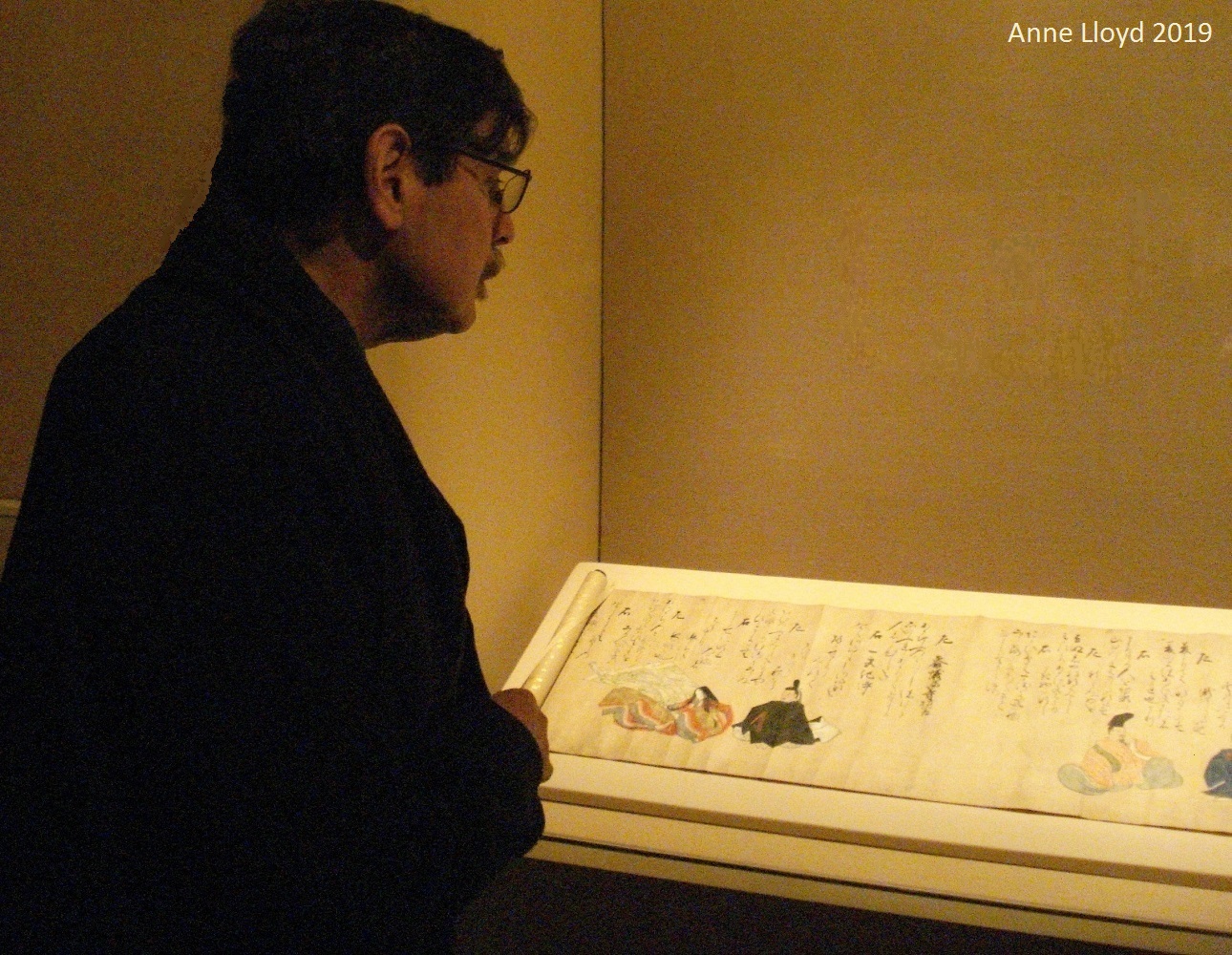
Anne Lloyd, Photo (2019)
 Gallery view of The Tale of Genji exhibit, showing a handscroll, c.1400, depicting an imaginary competition between Lady Murasaki and poet Ōshikōchi no Mitsune

The contrast between a male-female perspective on life and art was treated in a Japanese literary work from the fifteenth century. On display in the Met's exhibition is a stunning handscroll, created with ink, color pigments, gold and silver on paper. It surveys the competition between great Japanese poets and writers over the ages, much as Jonathan Swift satirized the "battle of ancients and moderns" in The Tale of a Tub,1704.

In this remarkable work of art, which dates to around 1400, Lady Murasaki "duels" with a challenger who had died long before she was born.This is the poet, Ōshikōchi no Mitsune (859–925). 

Mitsune had been one of the scholars who had compiled an earlier poetry anthology commissioned by the Japanese government, Collection of Poems Ancient and Modern, around 905. I was especially impressed with the inclusion of the Murasaki-Mitsune "point-counterpoint" because this work had enabled Lady Murasaki's poems to be included in a compendium of poetry. In most literary books, poems written for a novel, like those in Genji Monogatari, were excluded.

This luminous handscroll and its friendly rivalry of ancient and modern, male and female, was created in a time of relative peace for Japan. Later, during the 1500's and early 1600's, Japan was beset with strife and bloody civil wars. The code of the Samurai, exemplified by the revenge-theme saga of The Forty-seven Rōnindominated the cultural, as well as the political scene.

The Tale of Genji, however, is a classic example of the "pen" being mightier than the sword. It is a refreshing alternative to the cult of violence that has crowded out expressions of sensitive feeling and subtle reflection from so much of popular culture throughout the world of today. 

The M
et's Genji exhibition is helping to restore the balance. I felt a real charge of positive human energy, and a heightened  awareness of life's possibilities, upon leaving The Tale of Genji, A Japanese Classic Illuminated. 


Yamato Waki, The Death of Genji, from the manga series
 Tale of Genji: Dreams at Dawn, 1989

The Met's exhibit concludes with an appraisal of The Tale of Genji in the modern world. Genji was featured in ukiyo-e prints during the 1800's and now in manga. 

There was once a time when I would have shuddered at the thought of "comic" books being featured in art exhibitions. No longer. The artistry of Yamato Waki (born 1948) in her 1980's manga series, The Tale of Genji: Dreams at Dawn, created a superb fusion of ancient and modern. Examples of her work are on view in the Met's exhibition - where they belong.

A final point in understanding how Genji has been "illuminated" over a thousand years is that it was originally written in a language which Japanese male writers during the Heian period did not deign to use: their own.

While the noble (male) scholars continued to write in Chinese, women wrote in an early form of their native language called hiragana or "ordinary writing." It was also referred to as onna-de ("woman's hand"). Lady Murasaki was not the first to use "woman's hand" for important literary work. Yet,The Tale of Genji was such a major accomplishment, cherished throughout Japan, that hiragana was embraced for serious writing instead of Chinese.

At the risk of giving away the ending, Genji dies without ever gaining the throne of Japan. But he and Lady Murasaki achieved far more - cultural independence for Japan and immortality for themselves.

***
Text: Copyright of Ed Voves, all rights reserved
Images courtesy of the Metropolitan Museum of Art, New York City.

Introductory image:                                                                                                          Tosa Mitsuoki (Japanese, 1617–1691) Portrait-Icon of Murasaki Shikibu (Detail), 17th century.  Medium: Hanging scroll; ink and color on silk. Lent by Ishiyamadera Temple

Ed Voves, Photo (2019) Gallery view of The Tale of Genji exhibit, showing Tosa Mitsuoki's Portrait-Icon of Murasaki Shikibu, 17th century. Medium: Hanging scroll; ink and color on silk. Image: 35 5/8 × 20 3/4 in. (90.5 × 52.7 cm) Overall with mounting: 66 9/16 × 26 7/16 in. (169 × 67.1 cm). Lent by Ishiyamadera Temple

Ed Voves, Photo (2019) Photo of the Statue of Dainichi Nyorai, Supreme Buddha of the Cosmos, 12th century. Wood with gold leaf and lacquer decoration from the collection of Metropoltan Museum of Art. Accession Number: 26.118 

Ed Voves, Photo (2019) Washio Ryūge of the Ishiyamadera Temple at the Metropolitan Museum of Art, March 4, 2019.

Ed Voves, Photo (2019) Washio Ryūge leading the consecration ceremony at the Metropolitan Museum of Art's The Tale of Genji exhibition, March 4, 2019.

Circle of Tosa Mitsuyoshi (Japanese, 1539–1613) A Lovely Garland (Tamakazura), 17th century. Medium: Album leaves mounted as a pair of hanging scrolls; ink, gold, silver, and color on pape. Metropolitan Museum of Art. Accession Number: 2015.300.33a, b

Tosa Mitsuyoshi (Japanese, 1539–1613 ) Kochō or Butterflies, late 16th-early 17th century. Six-panel folding screen. Ink, color, gold, and gold leaf on paper: 65 in. × 12 ft. 3/4 in. (165.1 × 367.7 cm). Metropolitan Museum of Art. Mary Griggs Burke Collection, Gift of the Mary and Jackson Burke Foundation, 2015 Accession Number:2015.300.32

Ed Voves, Photo (2019) Gallery view of The Tale of Genji, A Japanese Classic Illuminated exhibit at the Metropolitan Museum of Art. Photo shows an ensemble of artifacts, evoking traditional Japanese culture created after 1895. Metropolitan Museum of Art collection.

Ed Voves, Photo (2019) Robe (Furisode) with Maple Tree, Bamboo Fence, and Characters from “Little Purple Gromwell” (Wakamurasaki), late 17th century. White silk satin with silk-thread embroidery and gold-thread couching. Lent by the Tokyo National Museum. 

Ed Voves, Photo (2019) Ogata Kenzan's Teabowl with Moonflower (Yūgao) and Poem, 18th century.  Stoneware with polychrome overglaze enamelsLent by Museum Yamato Bunkakan, Japan

Anne Lloyd, Photo (2019) Gallery view of The Tale of Genji exhibit, showing a 15th handscroll depicting the imaginary competition between Lafy Murasaki Shikibu and the poet Ōshikōchi no Mitsune. This handscroll is one of a pair, created with ink, color, gold, and silver on paper. It is on loan to the Metropolitan Museum of Art from the John C. Weber Collection. 

Yamato Waki, (Japanese, born 1948) The Death of Genji, the Empty Chapter in Murasaki’s Tale, from the manga series The Tale of Genji: Dreams at Dawn,1989. Matted painting; ink and color on paper: Overrall: 14 11/16 × 10 3/4 in. (37.3 × 27.3 cm) (Current mat window): 13 3/4 × 10 3/16 in. (34.9 × 25.9 cm). Credit Line:Lent by the Artist. Rights and Reproduction: Asaki Yumemishi © Yamato Waki