Monday, November 19, 2018

The Berthouville Treasure at the Institute for the Study of the Ancient World


Devotion and Decadence

The Berthouville Treasure and Roman Luxury


Institute for the Study of the Ancient World, New York City 
October 17, 2018 - January 6, 2019

Reviewed by Ed Voves                                                                                                    Original photos by Anne Lloyd

"All roads lead to Rome" was a proverb based on the extensive communication network which bound the provinces of Europe, North Africa and the Middle East to the capital city of the Caesars. At the very heart of this infrastructure, the veins and arteries of the Roman Empire, was a milestone to mark the central spot, a marble column covered in gilded bronze called the Milliarium Aureum.

Nine hundred miles from this fabled marker was a crossroads in the region of France we call Normandy. In Roman times, the place was called Canetonum and was the site of a temple to the god Mercury. Today, the village of Berthouville marks the spot. Then and now, the location was not of strategic importance. But what was under the soil was a different matter.

For nearly fifteen hundred years, a fabulous treasure lay buried, a hoard of silver statuettes, ceremonial cups, vases, utensils and plate. The greatest trove of silver art objects to survive from ancient times, these artifacts date to the height of Rome's grandeur. Now, for a limited time, the Berthouville Treasure is on view at the Institute for the Study of the Ancient World (ISAW) in New York City.


Anne Lloyd, Photo (2018) 
 Gallery view of  the Berthouville Treasure exhibition at the ISAW

The ISAW is located two blocks from the Metropolitan Museum of Art, 15 E 84th St. ISAW is a graduate school of New York University. It does not have an art collection of its own, but mounts outstanding exhibitions of works from other museums. You won't have to search your pockets for a spare sesterce or drachma to pay the admission price of ISAW. The exhibitions there are free of charge.

The Berthouville Treasure normally resides in the Bibliothèque nationale de France (BnF), in Paris. When the BnF closed its galleries for renovation in 2010, the Getty Museum in Los Angeles undertook a massive conservation effort of these ancient art works. After four years of careful study and treatment, the restored Berthouville artifacts went on display at the Getty and several other U.S. museums. The ISAW exhibition is the final display of these treasures before they return to France.

The wonder of the Berthouville Treasure is that it survived all. There were many dangers to this array of precious objects from the Temple of Mercury Canetonensis. But the most perilous moment came with its rediscovery in March 1830. A French farmer, Prosper Taurin, was plowing his field when he unearthed a Roman-era tile. Beneath were ninety-odd silver objects.


Bowl with a Medallion Depicting Omphale, 1–100 CE

Taurin, like most French peasants was not flush with cash. After digging-up the treasures (with his pick-ax!), Taurin decided to travel to a nearby town which had a goldsmith. He planned to employ the goldsmith to melt the artifacts down for the weight value of the silver. Fortunately, Taurin stopped to show his discovery to his cousin. At his cousin's  urging, Taurin took the treasures to the local antiquarian society instead of the goldsmith. These worthies convinced Taurin to sell the wondrous silver objects to a museum, thus preserving them for posterity.

The authorities at the Louvre and the Bibliothèque nationale de France took note. When the Berthouville Treasure was placed on auction, a bidding war ensued. The BnF won. Taurin walked away from the sale, a much wealthier man than had he ignored his cousin's advice.

Following their lucky escape, the Berthouville Treasures were studied by French scholars. The most intriguing question concerned the prominence  given to the god Mercury. Two statuettes, four phialae or libation bowls and a ladle all bear Mercury's image.  Clearly, Mercury was an important deity to the Celtic peoples who inhabited the area around Berthouville in ancient times.

We know a great deal about the Celts of what is today France - but through the testimony of their Roman conqueror, Julius Caesar.


Statuette of Mercury from the Berthouville Treasure , 175–225 CE

Of the Celts, Caesar wrote in The Gallic War, "The god they reverence most is Mercury. They have very many images of him."

Mercury, the messenger god, was the divinity who protected merchants and traders and helped them gain financial success. There was a similar god in the Celtic pantheon, Lugus, whom the Romans equated with Mercury. So there was indeed some justification for Caesar's claim.

To the Celts, however, Mercury had a much more important role. He acted as guide for the souls of newly deceased humans on their journey to the afterlife.

The Celts had a highly developed belief in the immortality of soul and body. This conception of the "hereafter" animated their prowess as warriors and extreme individualists. The amazing - and formidable -  Celtic race lacked a written language but had a complex and sophisticated culture which Caesar's conquest, 58-51 BC, and the later Roman invasion of Celtic Britain did not destroy.

During the years following Prosper Taurin's discovery, archaeological surveys revealed the existence of a temple complex close to where the Berthouville Treasure had been unearthed. Given the numerous examples of Mercury-inspired art works in Taurin's haul and the role of Mercury as guardian of souls, it is surely correct to identify the temple at Canetonum/Berthouville as a shrine to Mercury.

Nine of the silver objects were donated to the Temple of Mercury Canetonensis by an individual named Quintus Domitius Tutus. His identity has not been established, so we do not know if he was a Roman living in Gaul or a Romanized-Celt. 

Nor are we sure of when Tutus lived. I suspect that he lived during the mid-second century, the era of the "Good Emperors" when a Roman citizen's words and deeds still retained their value. 

Of this rare moment, Edward Gibbon declared, "If a man were called to fix the period in the history of the world, during which the condition of the human race was most happy and prosperous, he would, without hesitation, name that which elapsed from the death of Domitian to the accession of Commodus."

If Quintus Domitius Tutus lived during this period, then he did indeed have something to thank the gods for.

The introductory image for this review, Cup with Centaurs and Cupids, is one of his donations. It is a superbly crafted work, made during the first century after Christ. This and the other pieces donated by Tutus were "high-end" works of art, either extremely valuable personal possessions or purchased specifically to be given to the Temple of Mercury.

Cup with Centaurs and Cupids seems excessively ornate and hedonistic to be a presentation object to a temple, even by Roman standards. Yet, on the bottom is inscribed: MERCVRIO AVGVSTO Q DOMITIVS TVTVS EX VOTO ” (To Augustan Mercury, Quintus Domitius Tutus in fulfillment of a vow).


Pitcher with Scenes from the Trojan War of Achilles and Eight Greek Warriors Weeping over the Body of Patroclus, 1–100 CE

I thought the same about the pair of pitchers decorated with gruesome scenes from the Trojan War. Of course, it is a huge error to read contemporary standards of belief into the art and culture of the past. Yet, Quintus Domitius Tutus, whether he was a citizen of the second century or later, lived in an era when people were searching for a deeper spirituality. Why would he donate these objects, reeking of war and slaughter, to the Temple of Mercury?


Anne Lloyd , Photo (2018) 
 Silver Pitcher from Berthouville with Scenes from the Trojan War,  
showing Priam’s Embassy to Ransom Hector’s Body

When I focused on the back of one of the pitchers, my opinion swiftly changed. I was deeply moved by the scene of the body of the slain Trojan hero, Hector, being weighed in order to fix the amount of ransom so that it could be properly buried. Here was the price of human cruelty memorably depicted!


Anne Lloyd , Photo (2018) 
Detail of Scenes from the Trojan War,  
showing Priam’s Embassy to Ransom Hector’s Body

Given the deep-seated Celtic belief in the immortality of the soul, I think it likely that Quintus Domitius Tutus chose art works of great spiritual value to donate to the Temple of Mercury. The sensitive depiction of the corpse of the heroic Hector establishes this silver pitcher as a remarkable visualization of human fate. It certainly would have affected a Celt or Romanized-Celt during the later Roman Empire far differently than a Greek or Roman of earlier centuries.

The works of art donated by Tutus were not destined to be on view for long. The third century A.D. was marked by a calamitous downturn in Rome's fortunes from the time of the "Good Emperors." Endless civil wars sapped the strength of the Roman legions and in the year 276 a huge incursion of Germanic barbarians broke through the defenses along the Rhine River. Ironically, the tribe of Franks, who ultimately gave their name to France, were in the vanguard of the assault.

The Temple of Mercury Canetonensis was burned at some point during the third century, though whether it was a casualty of Roman civil war or barbarian invasion is unresolved. The Berthouville Treasure was buried in order to save it from being carried off as spoils of war.

It is no mystery why the Berthouville Treasure remained below ground until the plowshare of Prosper Taurin broke through the sleep of centuries. The Roman Empire nearly collapsed around the time of the destruction of the Temple of Mercury Canetonensis. Rome's control of what is now northern France and the Rhineland in Germany remained tenuous until the Western Roman Empire finally expired in 476.

This was the age of "hoards," stashes of precious objects or gold and silver coins, hurriedly buried as barbarians or mutinous legions rampaged across the landscape. Many of the owners did not live to reclaim their buried treasures

The ISAW exhibition includes a number of surviving artifacts which have come to light over the years, along with the Berthouville Treasure. These include the "Patera of Rennes," a spectacular golden plate decorated with mythological characters and coins of Roman emperors. This was found in Brittany where many British Celts fled to escape the invading Saxons during the fifth and sixth centuries.


Offering Bowl with Bacchus, Hercules, and Coins, "Patera of Rennes." ca. 210 CE

Fished from the Rhone River, a similar plate, made of silver, shows a scene from the Iliad much like the ones on the silver pitchers dedicated by Quintus Domitius Tutus
. 

Plate with the Embassy to Achilles (The Shield of Scipio), 375–400 CE

Amazingly, this impressive silver plate dates to the years 375–400. This was almost four centuries after the works bequeathed by Tutus were created. Even as vast geopolitical forces reshaped their world, the people of the Roman Empire clung to the old "favorites," motifs from the classical past, when commissioning new works of art. 

This Plate with the Embassy to Achilles and the treasures from Berthouville would seem to confirm the French saying that "the more things change, the more they stay the same."

Actually, the true significance of the Berthouville Treasure is the very opposite of this oft-quoted remark. The Berthouville Treasure points to monumental change. These precious objects testify to the fusing together of Celtic culture with the Classical civilization of the Mediterranean world to form the foundation of a new, dynamic political state. 

If all the roads of Imperial Rome terminated at the Milliarium Aureum, the Berthouville Treasure marks the spot where the nation of France began.

***
Text: Copyright of Ed Voves, all rights reserved
Images courtesy of the Institute for the Study of the Ancient World, New York University and Anne Lloyd.

Introductory image:                                                                                                          Cup with Centaurs and Cupids. Roman, 1–100 CE. Findspot: Berthouville, France. Silver and gold: H. 11.7 cm; W. 26.8 cm; D. 17.4 cm. Bibliothèque nationale de France, Paris: Inv. 56.7.  Photo: Tahnee Cracchiola © Getty-BnF. Inscribed: “MERCVRIO AVGVSTO Q DOMITIVS TVTVS EX VOTO ” (To Augustan Mercury, Quintus Domitius Tutus in fulfillment of a vow)     

Anne Lloyd , Photo (2018) Gallery view of the exhibition at the Institute for the Study  of the Ancient World, NYC, showing the Statuette of Mercury from the Berthouville Treasure. Photo taken with the special permission of the ISAW.

Bowl with a Medallion Depicting Omphale. Roman, 1–100 CE. Findspot: Berthouville, France. Silver and gold: H. 8.2 cm; Diam. 28.9 cm. Bibliothèque nationale de France, Paris: Inv. 56.11. Photo: Tahnee Cracchiola © Getty-BnF. Inscribed: “MERCVRIO AVGVSTO Q DOMITIVS TVTVS EX VOTO ” (To Augustan Mercury, Quintus Domitius Tutus in fulfillment of a vow)

Statuette of Mercury. Roman, 175–225 CE.Findspot: Berthouville, France. Silver and gold:  H. 56.3 cm; Diam. 16 cm. Bibliothèque nationale de France, Paris: Inv. 56.1. Photo: Tahnee Cracchiola © Getty-BnF.

Pitcher with Scenes from the Trojan War of Achilles and Eight Greek Warriors Weeping over the Body of Patroclus, Priam’s Embassy to Ransom Hector’s Body, and Episodes from the Life of Achilles.  Roman, 1–100 CE. Findspot: Berthouville, France.  Silver and gold: H. 29.9 cm; W. 14.5; Circumference. 42 cm. Bibliothèque nationale de France, Paris: Inv. 56.4. Photo: Tahnee Cracchiola © Getty-BnF. Inscribed: “MERCVRIO AVGVSTO Q DOMITIVS TVTVS EX VOTO”. (To Augustan Mercury, Quintus Domitius Tutus in fulfillment of a vow)

Anne Lloyd , Photo (2018) Pitcher with Scenes from the Trojan War with Achilles and Eight Greek Warriors Weeping over the Body of Patroclus, Priam’s Embassy to Ransom Hector’s Body, and Episodes from the Life of Achilles. Photo taken with the special persmission of the ISAW.

Anne Lloyd , Photo (2018) Pitcher with Scenes from the Trojan War, showing  Priam’s Embassy to Ransom Hector’s Body (Detail). Photo taken with the special permission of the ISAW.

Offering Bowl with Bacchus, Hercules, and Coins, "Patera of Rennes." Roman, ca. 210 CE. Findspot: Rennes-le-Château, France. Gold: H. 4 cm; Diam. 25 cm. Bibliothèque nationale de France, Département des Monnaies, médailles et antiques, Paris: Inv. 56.94.

Plate with the Embassy to Achilles (The Shield of Scipio). Roman, 375–400 CE. Findspot: In the Rhône, near Avignon, France.  Silver and gold: Diameter. 71 cm. Bibliothèque nationale de France, Paris: Inv. 56.344. Photo: © BnF 


Tuesday, November 6, 2018

Berthe Morisot exhibition at the Barnes Foundation. Philadelphia


Berthe Morisot, Woman Impressionist


The Barnes Foundation, Philadelphia 
October 21, 2018 - January 14, 2019

Reviewed by Ed Voves
Original photos by Anne Lloyd

Art criticism is a notably risky business. Albert Wolff, one of the leading critics of nineteenth century France, permanently damaged his reputation by one infamous review. On the pages of Le Figaro in 1876, Wolff denounced the art exhibition of "five or six lunatics, one of whom is a woman."

The "lunatics" were the Impressionist painters and the woman was Berthe Morisot. A splendid exhibition of Morisot's paintings is now on view at the Barnes Foundation in Philadelphia. Berthe Morisot, Woman Impressionist is a joint project of several museums: Musée national des beaux-arts du Québec, the Dallas Museum of Art, and the Musée d'Orsay in Paris - and the Barnes Foundation.


Anne Lloyd, Photo (2018)  Curators of the Berthe Morisot, Woman Impressionist exhibition. From left: Nicole R. Myers, Dallas Museum of Art, Sylvie Patry, Musée d'Orsay, Paris, and Cindy Kang of the Barnes Foundation.

This long-overdue retrospective is brilliantly organized to present Morisot in all aspects of her creative genius: Impressionist, woman artist and pioneer of Modernism.

Albert Wolff, by comparison, is all but forgotten except for his notorious comments. Yet, it is worth "giving the devil his due" and revisit Wolff's article. He was clearly impressed with Morisot and caught something of the emotional forces which impelled her quest for artistic  success.

"There is also a woman in the group, as is the case with all famous gangs," Wolff wrote. "Her name is Berthe Morisot, and she is interesting to behold. In her, feminine grace is preserved amidst the frenzy of a mind in delirium."


"Frenzy" and "delirium" were wide of the mark as descriptors for Berthe Morisot. Yet Wolff intuitively grasped Morisot's artistic zeal. She boldly - if quietly - explored  the limits of objective, observable reality. Berthe Morisot, Woman Impressionist might just as well have been entitled Berthe Morisot, Modern Artist.


Anne Lloyd, Photo (2018) Gallery view of Berthe Morisot, Woman Impressionist

The array of art works on display at the Barnes reveals Morisot to have been one of the most daring and experimental of the Impressionists. Over seventy of Morisot's paintings have been placed on display in this, the first major U.S. exhibition of her work since 1987 and the first in France since 1941!

Berthe Morisot, Woman Impressionist follows the basic chronology of Morisot's life, but is also structured to enable visitors to grasp the themes which preoccupied her as an artist. 

The exhibition has much to show about Morisot as a woman and as a woman artist. Many of her paintings take place in "threshold" places, windows, balconies, doorways and verandas. The women and girls are poised to go beyond the home boundaries in these paintings, just as women in the the late 1800's began the campaign for female suffrage and a role in the male-dominated professions. 


Anne Lloyd, Photo (2018), Berthe Morisot's Interior, 1872

Many of Morisot's female protagonists seem pensive and melancholy, as if aware of the emotional price to be paid for reaching beyond the age-old confines of a "woman's" role. The aptly-named Interior, painted in 1872, is a notable example of the theme of Morisot and the modern woman on the threshold.

Some of Morisot's concerns, such as the need to document women as members of the work force or engaged in domestic chores, need to be interpreted in the light the nascent feminism of the nineteenth century.

Morisot, especially early in her career, "appears" to remain focused on the traditional social duties of women, motherhood and "keeping up appearances." Yet appearances were deceiving. There was so much more to Morisot's artistic vision, in contradiction to what was expected of a woman artist.


Anne Lloyd, Photo (2018), Berthe Morisot's Serving Girl,1886

By the time Morisot died, aged 54, in 1895, she had erased almost all details of the fashionable world from her paintings. Clothing styles, ornamentation, the surrounding milieu vanished, with only the human essence of her sitters remaining on the canvas.

This is not a posthumous twenty-first century assessment, no revisionist recalibration of her Impressionist achievement. Morisot's fellow Impressionists - Renoir particularly - were in awe of her talent. And so were critics not blinded by prejudice or male vanity.

 "No one represents impressionism with a more refined talent and more authority than Mme Morisot," Gustave Geoffroy wrote in 1881. 

Berthe Morisot began her career in the company of her elder sister, Edma (1839-1921). Both young women were extremely talented and were supported by their parents in their artistic ambitions. This consideration, exceptional for a family of the haute bourgeoisie, was predicated on eventual marriage for their daughters.

That is exactly what destiny had in store for Edma. She and Berthe studied with a private art tutor and briefly with Corot. Edma's 1865 portrait of Berthe demonstrated both her skill and traditionalist oeuvre. Had she continued with her art, Edma would likely have to follow Corot's lead. In 1869, however, Edma married a naval officer in 1869 and abandoned plans for an artistic career.


Anne Lloyd, Photo (2018) Edma Pontillon's Berthe Morisot, c.1865

For Berthe, Edma's portrait represented the road not taken. From the start, as Corot realized, Berthe was a more restless spirit. But why did she join the fledgling Impressionist movement?


Thanks to family connections, Berthe Morisot was introduced to a wide circle of rising artists. Her meeting with Édouard Manet was obviously of crucial importance. Manet painted Morisot several times and his elan in pressing forward with his unique vision of art served an an example for her own efforts. But Manet did little in practical terms to encourage Morisot professionally. 

Morisot was also close to the Symbolist painter, Pierre Puvis de Chavannes (1824–1898).  who warned her against challenging the art establishment of France. Yet she did not heed his advice nor was she influenced by his allegorical style.

Instead, Morisot surveyed the work of rising artists and found her inspiration in a key work by Frédéric Bazille (1841-1870), View of the Village, 1868. This work, one of the masterpieces of early Impressionism, was featured in a recent National Gallery exhibition on Bazille.

Morisot was fond of the tall, generous painter from southern France. "Big" Bazille, as she called him, painted a simple, naturalistic depiction of a young girl sitting on a hill overlooking a valley near his home in Montpellier. What sounds like a banal, unremarkable work was actually a perfect example of a "figure en plein air.”

 Morisot was tremendously impressed with View of the Village. Bazille explored the psychological depths of an "ordinary" person in the setting of her daily life. Morisot responded with several similar paintings set in coastal towns of Brittany. But Morisot did not hit her stride with plein air works until after Bazille's death in the Franco-Prussian War. 


Berthe Morisot, Reading (the Green Umbrella),1873

Two  en plein air paintings by Morisot exemplify how she responded to the inspiration she found in Bazille's View of the Village. Her sister Edma appears in Reading (1873) and again, with her young daughter Jeanne, in Hide and Seek, also painted the same year. These are deceptively simple works, each with subtle touches which note the brevity and preciousness of time.

While Edma is perfectly at ease - or appears to be - with her book, a farm cart trundles by in the distance. This work-a-day image, like the numerous factory smoke stacks which appear in  many Impressionist paintings, reminds the viewer that labor does not cease, even when we pause to relax.


Anne Lloyd, Photo (2018), Berthe Morisot's Hide and Seek, 1873

Nor does time stand still - though many would think so from a superficial reading  of Impressionist painting, including works by Morisot. In Hide and Seek, mother and child playfully romp around a sapling tree which will grow, bear fruit and, in time, wither with age. So will young Jeanne. So do all human beings.

The date of these paintings is hugely significant, 1873, the year before the first Impressionist salon. Morisot played an important role in this pivotal event. She did so, however, as mature, fully-formed artist rather than as an acolyte to an established master. Indeed, one may say that she responded to Bazille's work because he embraced spontaneity and personal inclination.

"Every day I pray that the Good Lord will make me like a child," Morisot wrote."That is to say, that He will make me see nature and render it the way a child would, without preconceptions." 

Morisot brought no "preconceptions" to the first Impressionist Salon of 1874. She did bring outstanding examples of her creativity, including Hide and Seek and her most famous painting, The Cradle.


Berthe Morisot, The Cradle,1872

Morisot's The Cradle is a tremendously accomplished and appealing work. It recalls the sensitive portraits of young women painted by her teacher, Corot, which are currently on view in an excellent exhibition at the National Gallery in Washington D.C. The painting's theme, motherhood, was one of the traditional standards of Western art, the modeling of the figure was superb (note the exquisite treatment of the fingers holding the veil) and the delicate tracing of the sleeping infant's eyelids is just short of miraculous.

Despite this litany of superlatives, The Cradle did not sell at the Impressionist Salon of 1874. It was Morisot's lot to struggle, just as her male Impressionist colleagues did. 


Anne Lloyd, Photo (2018), Berthe Morisot's Mr. M(anet) and His Daughter, 1883


Thanks to the emotional support of her husband, Eugene Manet, brother of Édouard, and family financial resources, Morisot never had to fear bill collectors. Yet she faced ceaseless frustration, much of it due to her own exacting standards. Morisot referred to her dissatisfaction with her work as my "mania for lamentation."

 Morisot's nephew, the poet Paul Valéry, noted perceptively:

As for her personal character, it is well known that it was rare and reserved; distinction was of her essence; she could be unaffectedly and dangerously silent and create without knowing it a baffling distance between herself and all who approached her, unless they were among the first artists of her time.

Morisot resolved her "mania" through experimentation. Over and over again in the exhibition were see brush strokes and paint-handling on one canvas, so different from a nearby work that we would have to assume that it was by a different artist.


Anne Lloyd, Photo (2017), Detail of Berthe Morisot's Mr. M(anet) and His Daughter

In the portrait of her husband and daughter sitting in the garden, Morisot used countless flecks of color. John Constable had used the same technique, half a century earlier, to the incredulity of critics who derided it as "snow." Morisot and Constable both appreciated this approach to capturing the effect of reflected light - and so will you when you study this amazing painting and similar works at the Barnes.


Anne Lloyd, Photo (2017), Detail of Berthe Morisot's The Milk Jug, 1890

By contrast, Morisot utilized flowing, liquid brush strokes in her depictions of women and children at work. Quite a number of the works on view in the Barnes exhibit are from private collections and one, showing a little farm girl carrying a bowl of milk, beautifully reveals Morisot's painterly treatment of bodies in motion.

Later in career, Morisot painted on pieces of unprimed canvas. Édouard Manet had done so earlier and Morisot borrowed this radical innovation, using it to brilliant effect. She placed bold, "sketchy"  strokes to give the elemental form or framework or her subject and them concentrated on the essentials, as in the face of the sitter in Young Girl with a Vase. This astonishing work is another of the private collection loans which make Berthe Morisot, Woman Impressionist a tour de force exhibition.


Anne Lloyd, Photo (2018), Berthe Morisot's Young Girl with a Vase, 1889

Morisot exhibited in seven of the eight Impressionist Salons. In his review of the final exhibition in 1886, the critic Jean Ajalbet noted the radical manner in which Morisot had reduced all externals to what was crucial in understanding her subject.

 “She eliminates cumbersome epithets and heavy adverbs in her terse sentence,"  Ajalbert wrote of Morisot's daring simplicity. "Everything is subject and verb."

Ajalbert's brilliant assessment was absolutely correct and the evidence to justify his assertion is evident in every work on view in the outstanding exhibition now at the Barnes Foundation. 

Berthe Morisot, no less than Manet, Degas, Cezanne and the rest of the Impressionist "lunatics", made a vital, unique contribution to creating the language of Modern Art.

***
Text: Copyright of Ed Voves, all rights reserved                                                                                           
Images courtesy of the Barnes Foundation and Anne Lloyd

Introductory Image:
Berthe Morisot (French, 1841‐1895) Self‐Portrait, 1885. Oil on canvas: 61 x 50 cm (24 x 19 11/16 in.) Musée Marmottan Monet, Paris. CMR 169

Anne Lloyd, Photo (2018) Curators of the Berthe Morisot, Woman Impressionist exhibition. From left: Nicole R. Myers, Dallas Museum of Art, Sylvie Patry, Musée d'Orsay, Paris, and Cindy Kang of the Barnes Foundation.

Anne Lloyd, Photo (2018) Gallery view of Berthe Morisot, Woman Impressionist at the Barnes Foundation, Philadelphia.

Anne Lloyd, Photo (2018), Berthe Morisot's Interior, 1872. Oil on canvas: 60 x 73 cm (23 5/8 x 28 3/4 in.) Diane B. Wilsey. CMR 26

Anne Lloyd, Photo (2018), Berthe Morisot's Serving Girl,1886. Oil on canvas: 71 x 44 cm (27 15/16 x 17 5/16 in.) Private collection, courtesy of Pyms Gallery, London CMR 199

Anne Lloyd, Photo (2018) Edma Pontillon's Berthe Morisot, c.1865. Oil on canvas: 100 x 71 cm. (39 3/8 x 27 15/16 in.) Private collection.

Berthe Morisot (French, 1841‐1895) Reading (the Green Umbrella),1873. Oil on canvas: 46 x 71.8 cm (18 1/16 x 28 1/4 in.) The Cleveland Museum of Art Gift of the Hanna Fund. CMR 14

Anne Lloyd, Photo (2018), Berthe Morisot's Hide and Seek, 1873. Oil on canvas: 45 x 55 cm (17 11/16 x 21 5/8 in.) Private collection. CMR 27.

Berthe Morisot (French, 1841‐1895) The Cradle,1872. Oil on canvas: Oil on canvas: 56 x 46 cm (22 1/16 x 18 1/8 in.) Musée d’Orsay, Paris. CMR 25

Anne Lloyd, Photo (2018), Berthe Morisot's Mr. M(anet) and His Daughter, 1883.  Oil on canvas: 60 x 73 cm (23 5/8 x 28 3/4 in.) Private collection. CMR 138,

Anne Lloyd, Photo (2017), Detail of Berthe Morisot's Mr. M(anet) and His Daughter.

Anne Lloyd, Photo (2017), Detail of Berthe Morisot's The Milk Jug, 1890. Oil on canvas: 45 x 55 cm (17 11/16 x 21 5/8 in.) Private collection. CMR 27

Anne Lloyd, Photo (2018), Berthe Morisot's Young Girl with a Vase, 1889. Oil on canvas: 81 x 100 cm (31 7/8 x 39 3/8 in.) Private collection. CMR 246


Wednesday, October 24, 2018

Franz Marc and August Macke, 1909-1914 at the Neue Galerie


Franz Marc and August Macke, 1909-1914


Neue Galerie, New York City 
October 4, 2018 - January 21, 2019

Reviewed by Ed Voves 

Original Photos by Anne Lloyd

During  the spring of 1915, a hastily scrawled postcard arrived at the office of Der Sturm, the avant garde gallery and publishing firm in Berlin. It was a German Army postcard, a quick message format designed to let family and friends know that their soldier son or husband was alive.

In this case, the postcard was addressed to Herwarth Walden, director of Der Sturm, requesting him to sell a painting, The Yellow Cow, for 900 marks. The sender was Franz Marc, Expressionist painter and co-founder of the Blue Rider art group. 


Anne Lloyd, Photo (2018)
View of the Franz Marc and August Macke exhibit, showing Marc's The Yellow Cow

The Yellow Cow now hangs on a gallery wall in a special exhibition at the Neue Galerie. This outstanding New York City museum is dedicated to German and Austrian art of the early twentieth century.

Franz Marc and August Macke, 1909-1914, is a jaw-dropping beauty of an art show. It tells the story of Marc and his close friend, August Macke, who raised modern art in Germany to a pinnacle of insight, innovation and skill during the glorious interlude just before the opening shots of World War I.


Gallery view of the Franz Marc and August Macke exhibit at the Neue Galerie

Hulya Kolbas, Photo (2018) Courtesy Neue Gallery


In his brief 1915 message to Herwarth Walden, Marc concluded with a remark on the 900 marks he hoped to make from the sale of the painting.

"Of course that is the war price and in no way binding for future times, but only for the time being," Marc wrote. "It would be really worth my while to sell now."

 "The time being" was in fact all the time Marc had. Less than a year later, in March 1916,  Marc was struck in the head by a shell fragment during the murderous Battle of Verdun.

August Macke (1887-1914) did not even have the "time being." A devoted husband and father of two  young children, Macke had been drafted into the German Army at the very beginning of the war. In late September 1914, Macke was killed in action in France. He was one of the 116,750 Germans to be listed on the "official" record of war dead on the Western Front for the first four months of World War I, August to November 1914.

By November 1918, Germany had lost a total of 1,773,700 war dead. It is a sobering thought that two such brilliant artists and compelling human beings should have had their lives cut-short during this futile, insane slaughter.

This tragedy was compounded by Marc's posthumous reputation under the Third Reich. Despite his patriotic service and  death in battle, the Nazis blacklisted him after they gained power in 1933. Why would a German hero suffer such a fate?

Marc had enjoyed warm friendships with Jews like Herwarth Walden.  His collaboration with Vasily Kandinsky led to the formation of the Blue Rider group, the kind of progressive and idealistic collaboration which Hitler detested.  As a result, Marc's masterpiece, The Tower of Horses, was among the paintings vilified in the Degenerate Art exhibition of 1937. It disappeared afterward and has never been seen since.


Anne Lloyd, Photo (2018)

  View of the main gallery at the Franz Marc and August Macke exhibit


Despite this catalog of woe, the Neue Galerie's Franz Marc and August Macke, 1909-1914 is a life-affirming experience. It is a brilliantly mounted exhibition with paintings that seem to levitate above the shining floor, rather than hang on the gallery walls.


Indeed there is something of a church-like atmosphere to the exhibition, rather appropriate for these two artists. 

Marc was a notable for his spiritual leanings - he had briefly considered study for the ministry. Following several years of doubt and depression, he journeyed to Greece with his brother Paul, a scholar of Byzantine religion and culture. There he witnessed forms of Christian devotion little changed since the early Church.

Abandoning his Impressionistic landscapes, Marc developed a form of color-coded  symbolism. Animals, rather than humans, embodied the virtues and values of the world as he saw - or felt - it. This was a unexpected turn, given Marc's earlier aspirations to become a clergyman.


Anne Lloyd, Photo (2018) Franz Marc's The Dream, 1912


The paintings of Marc's "blue horse" period are more worthy of Rousseau than of the Apostle Paul. Yet there is a psychological sophistication to The Dream, one of my favorite works by Marc, which shows an affinity with the theories of Sigmund Freud.


In 1908, just as he began to paint his now-celebrated blue horses and yellow cows, Marc expressed his views in a revealing letter:

I am trying to intensify my feeling for the organic rhythm in all things, trying to establish a pantheistic contact with the tremor and flow of blood in nature.

For a few years, Marc achieved spectacular results, bringing forth on his easel a vision of Paradise before it was "lost." 


Franz Marc, Monkey Frieze, 1911 

Every manner of animal - deer, foxes, monkeys - migrated across the canvases upon which Marc worked. This is one of the surprises of the Neue Galerie exhibition. Famous for painting horses, Marc embraced the family of creation in a truly Peaceable Kingdom.

August Macke had something of missionary zeal, too, though his subject was not a  spiritual realm. His signature style paintings have a stained-glass effect, with bold, contrasting colors and, quite often, strongly outlined forms.

August Macke, Forest Stream, 1910 


Macke, unlike Marc, used this format to record the world as it is. A quote from Macke neatly sums-up his philosophy:

He who paints must be able to see an object in its uniform tone, in its whole magic, be it a flower or a human hair. All paintings created this way are the mirrors of a soul in harmony. It is quite simply vast and has no need of symbols to paint the sea.

To an extraordinary degree, Macke evoked a Paradise "regained" just as his friend, Marc, was doing. Macke, however, populated his Eden with people. Most often they were anonymous, featureless beings or nearly so. In virtually every scene, there is a sense of well-being, of the world at peace with itself, a world as people have longed for it to be. 


August Macke, Lady in a Park, 1914 


Lady in the Park (1914), awkward, homely, yet endearing, is an inhabitant of Macke's Arcadia. How different she is from Ernst Kirchner's predatory prostitutes "making the rounds" on Berlin's Potsdamer Platz, painted around the same time!

There is only the faintest delineation of eyes and expression in Lady in the Park. The erasing of physical features from many of his paintings is a troubling aspect of Macke's oeuvre. 

August Macke, Portrait with Apples, 1909

In 1909, Macke painted a striking portrait of his wife, Elizabeth, pregnant with their first child. It is a lovely, loving work and one is left wondering why Macke abandoned portraiture.

How the two artists met provides insight into their respective characters. Macke was a dedicated patron of art museums and galleries. Visits to France led him to exhibitions of the Fauves and he enthusiastically embraced the vigorous use of color by Matisse. In January 1910, Macke saw two lithographs by Marc in a Munich gallery. He immediately sought the address of Marc's studio and they struck-up a close friendship.

It was Marc, personable, passionate and visionary, who saw the potential for a collaborative relationship. He wrote Macke, "I consider it a great stroke of luck to have at last met a colleague of so inward and artistic a disposition - rarissme! How pleased I would be if we were to succeed in exhibiting our pictures side-by-side."

The opportunity to jointly exhibit their work came quickly. the Blue Rider group - in reality a breakaway faction from an earlier group, the Neue Künstlervereinigung München or NKM. Kandinsky, who had formed a friendship with Marc that paralleled Macke's, was the presiding spirit of Blue Rider. As much a shaman as an artist, Kandinsky aimed to promote the "spiritual in art." This appealed to Marc, but Macke was dubious.

Despite his doubts, Macke exhibited work in the 1911 Blue Rider exhibition at the Galerie Thannhauser in Munich along with Marc. By the end of the exhibition, Macke could not restrain himself and wrote to Marc in January 1912:

I have just been thinking that the Blaue Reiter (Blue Rider) does not really represent my work... All those high-sounding words about the birth of a great spiritual moment still resounding in my ears. Kandinsky can air his personal opinion about that or any other revolution he cares to mention. But I dislike the whole thing...Take my advice – work, and don't spend so much time thinking about blue riders or blue horses.

In keeping with Macke's views, the Neue Galerie exhibition does not linger on the Blue Rider exhibitions. Nor does it examine the celebrated companion volume, the Blue Rider Almanac. Published in 1912 with funds provided by Macke's uncle, the industrialist Bernhard Koehler, this seminal book deserves an exhibition entirely devoted to its development and legacy.

Instead, the Neue Galerie exhibition follows the course of the friendship and artistic development of these two amazing artists. Both of them increasingly ventured beyond their "signature" styles into pure abstraction. 

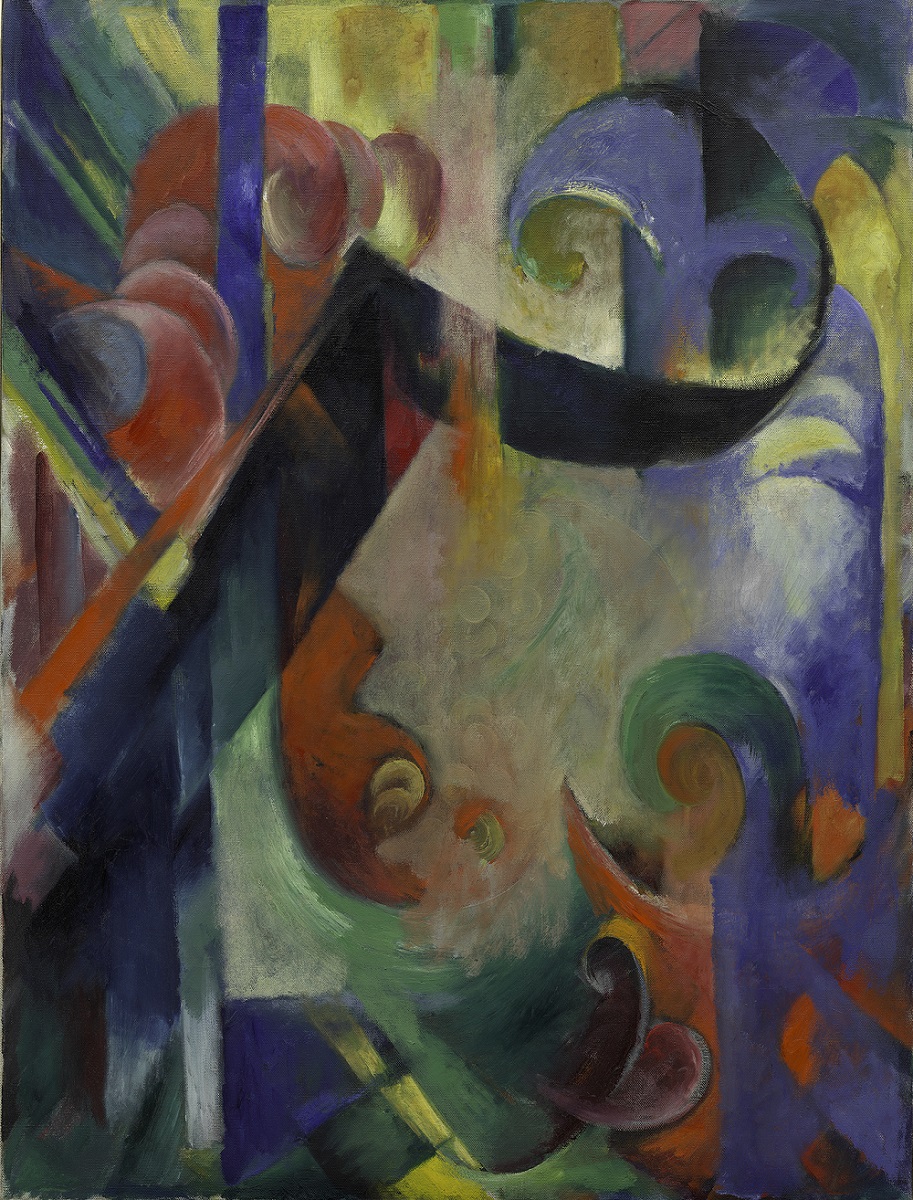
The exhibition displays several of the abstract works by Macke and Marc. These remarkable experiments show that both artists faced an impasse prior to exploring the realm of abstraction. Macke's investigations of color and light and Marc's symbolism had both reached the point where they must transcend their favored motifs or watch them atrophy. Pure abstraction represented a path to the future. Both Marc and Macke rose to the challenge.


August Macke, Colored Forms I, 1913 (top); Franz Marc, Broken Forms, 1914

These works are amazingly in "sync" given that the two artists saw little of each other from 1913 onward. This was due to conflicting schedules rather than a falling-out over the Blue Rider exhibitions. Macke was planning a painting trip to Tunisia. The future beckoned.

Neither Marc nor Macke had much future remaining when they painted these abstract works. War was coming and Marc appears to have been aware of the ominous developments. In 1913, he combined abstraction with his earlier symbolism in one of the greatest paintings of modern times, Fate of the Animals. A forest fire consumes Marc's beloved beasts. Paradise is lost again - perhaps forever.


Anne Lloyd, Photo (2018) Franz Marc's The Wolves (Balkan War), 1913
Fate of the Animals is not on view in the Neue Galerie exhibition. Given its iconic status, it is unlikely to ever travel from its home location in Switzerland. Marc painted The Wolves (Balkan War) around the same time and in the same vein. It is a powerful, haunting painting.

Given these two works, Marc should have recoiled from war when it did come in August 1914. Shockingly, he did not. Instead, he volunteered for military service in the belief that war would "cleanse" Europe. 

Despite his love of French culture and friendship for Kandinsky, Marc believed in Germany's role as leader of Europe and expected Kaiser Wilhelm's well-drilled army to win. Macke went to war reluctantly, Marc enthusiastically.

It is the word "cleanse" that really casts a shadow on an appraisal of Marc. He certainly did not mean any form of ethnic cleansing. In many ways, he hoped that the war would sweep away ossified political forms in the way that the "Generation of 98" had promoted beneficial change in Spain after that nation was defeated in 1898 by the United States.

The implications of his initial pro-war views were not in keeping with Marc's deep sense of humanity or his genuine spirituality. His wife, Maria, was alarmed by his naive, reckless patriotism and so, after a century, are art lovers like myself who hold Marc in high esteem.

Marc was quickly made aware of his folly. August Macke was killed in action on September 26, 1914. Stunned by Macke's death, Marc wrote, “It is truly the cruelest blow this war could have dealt me; I lost a piece of me when he died.”


Anne Lloyd, Photo (2018) August Macke's Little Walter's Toys, 1912

One of the most affecting paintings in the Neue Galerie exhibition is Macke's Little Walter's Toys. Painted in 1912, Macke shows the playthings of his young son, who was four years old when his father died. The unused toys have taken on a symbolism that was never intended at the time of the painting.

Little Walter's Toys is a precious relic of the "Lost Generation" of 1914-18, of August Macke, of Franz Marc, of the martyred soldiers of all the warring nations. And it is a reminder of all the little Walters, whose hearts were broken by the War to End All Wars.

***
Text: Copyright of Ed Voves, all rights reserved                                                                                           
Images courtesy of the Neue Galerie, New York City, and Anne Lloyd

Introductory Image:
Franz Marc (German, 1880-1916) The First Animals, 1913. Gouache and pencil on paper: 39.05 x 46.67 cm. Private Collection

Anne Lloyd, Photo (2018) Gallery view of the Franz Marc and August Macke, 1909-1914 exhibition, showing Franz Marc's The Yellow Cow, 1911. Oil on Canvas: 55 3/8 x 74 1/2 inches (140.7 x 189.2 cm  Solomon R. Guggenheim Museum, New York Solomon R. Guggenheim Founding Collection

Hulya Kolas, Photo (2018) Gallery view of the Franz Marc and August Macke, 1909-1914 exhibition. Courtesy of the Neue Galerie, New York City.

Anne Lloyd, Photo (2018) Gallery view of the Franz Marc and August Macke, 1909-1914 exhibition at the Neue Galerie, New York City

Anne Lloyd, Photo (2018) Franz Marc's The Dream, 1912. Oil on canvas. 100.5 x 135.5 cm Museo Nacional Thyssen-Bornemisza, Madrid Inv. no. 660 1978.15

Franz Marc (German, 1880-1916) Monkey Frieze, 1911. Oil on Canvas: 135.5 x 75.5 cm Hamburger Kunsthalle

Anne Lloyd, Photo (2018) August Macke's Forest Stream (Waldbach), 1910. Oil on canvas: 24 ¼ x 24 1/8 in. (61.6 x 61.3 cm) Indiana University, Eskenazi Museum of Art, Partial gift of the Robert Gore Rifkind Collection, 78.67

August Macke (German,1887-1914) Lady in a Park, 1914. Oil on canvas: 38 1/2 x 23 1/4" (97.8 x 58.9 cm).The Museum of Modern Art, New York. Gift of the Henry Pearlman Foundation, 1956   

August Macke (German, 1887-1914) Portrait with Apples, 1909. Oil on Canvas:  66 x 59.5 cm Städtische Galerie im Lenbachhaus und Kunstbau, Munich

August Macke (German, 1887–1914) Colored Forms I, 1913 Oil on board, mounted on panel: 53.1 x 38.5 cm. LWL-Museum für Kunst und Kultur, Westfälisches Landesmuseum, Münster, Germany Photo: LWL-LMKuk/Sabine Ahlbrand-Dornseif

Franz Marc (German, 1880-1916) Broken Forms,1914. Oil on Canvas: 44 x 33 1/4 inches (111.8 x 84.4 cm) Solomon R. Guggenheim Museum, New York

Anne Lloyd, Photo (2018) Franz Marc's The Wolves (Balkan War), 1913. Oil on Canvas: 70.8 x 139.7 cm  Albright-Knox Art Gallery Buffalo, NY 

Anne Lloyd, Photo (2018) August Macke's Little Walter's Toys, 1912. Oil on Canvas: 50 x 60 cm, Städel Museum, Frankfurt Germany