Thursday, March 24, 2022

Art Eyewitness Essay William Hogarth – The Printmaker’s Progress


William Hogarth - The Printmaker's Progress

An Art Eyewitness Essay

By Ed Voves

Original photos by Anne Lloyd

When the National Gallery in London was founded in 1824, its collection consisted of 38 paintings. These had been amassed by the financier, John Julius Angerstein, and then purchased by the British government when he died. Angerstein (1735–1823) had favored Old Master artists, Claude Lorrain, Anthony van Dyck, Rembrandt and Raphael. Hardly any works by British painters had graced the walls of his London town house.

There was only one British painter whom Angerstein esteemed on a par with Claude and van Dyck: William Hogarth.

Self-taught genius. Master printer and gifted painter. Chronicler of "modern moral subjects." Generous benefactor of noble causes, yet a man with no illusions. William Hogarth (1697-1764) was all of these. 

Hogarth was also a great "contrarian" and a rebel against the stranglehold of foreign Old Masters on British art. He famously denounced wealthy English visitors to Italy for purchasing "dead Christs, holy families, Madonnas, and other dismal dark objects."

Exhibitions of Hogarth's works are comparatively rare, especially in the United States I have only been to one, presented by the Morgan Library and Museum in 2019. Entitled Hogarth: Cruelty and Humor, the exhibition was based on the Morgan's trove of preparatory drawings of Hogarth's prints issued in 1751, Gin Lane and Beer Street, and The Four Stages of Cruelty.


The three stages of Gin Lane
Top: drawing with red chalk, over traces of black chalk, 1750-51; 
   Middle: copper plate, etched and engraved, 1751; 
Bottom: print of Gin Lane, third state , 1751

Although brilliantly curated, Hogarth: Cruelty and Humor was not an exhibit which induced me to linger in the gallery. Gin Lane and The Four Stages of Cruelty were unsparing critiques of the dark side of British society. Although Beer Street supplied a touch of humor, the emphasis on depravity was unsettling. Though motivated to correct glaring social vices, these prints reveal only one aspect of Hogarth's personality. As a result, I elected not to review this Morgan exhibit.

Hogarth embraced  life in all of its "humors." This we can see in his magnificent print, Southwark Fair (1733). 


                                     Anne Lloyd, Photo (2022)                                
 Detail of William Hogarth's Southwark Fair, 1733 

The whole human comedy/drama is represented here. Street brawlers and acrobats, a pickpocket next to a peep show, a beautiful young drummer girl attracting a bevy of admirers while a lonely, unappreciated bagpiper is about to be struck by actors tumbling down from a crashing stage.

Cruelty or humor?

How then to comprehend and appreciate William Hogarth? This little man (his height was just under five feet) was a towering figure during his lifetime and has grown in "stature" over time. This is especially true in the post-World War II era thanks to the devoted scholarship of Ronald Paulson. Several popular biographies have also served Hogarth well, including the recent Hogarth: Life in Progress by Jacqueline Riding (2021).

Despite the impressive quality of these modern-day resources, it was a unique opportunity to study the 1822 edition of Hogarth's collected prints, in the collection of the Free Library of Philadelphia, which enabled me to gain the measure of this amazing man and artist.

Thanks to Ms. Alina Josan, librarian for the Art Department of the Free Library,  I was able to closely study The Works of William Hogarth, reprinted from the original plates. The whole course of Hogarth's life and work was placed before us on the library table, enabling my wife Anne to take an array of close-up photos of these fantastic prints.


                                        Anne Lloyd, Photo (2022)                                      View of the Art Department of the Free Library of Philadelphia, Central Branch, showing The Works of William Hogarth, 1822.

It is a rare occasion to be granted hands-on access to a historic volume like this. An "elephant folio" in size, two centuries-old and, despite wear-and-tear on the covers, its pages are in magnificent condition. Anne and I were granted a time-travel ticket to Hogarth's world. Finally, I had the chance to grasp Hogarth's ideas and ideals, and to appreciate his skill as a media-savvy artist.

When Hogarth died in 1764, control of his prints and printer's plates went to his capable widow. Jane Hogarth eventually sold the plates to the prestigious printseller, John Boydell. In 1790, Boydell published The Original Work of William Hogarth. It was a magnificent endeavor, worthy of Hogarth himself.

Boydell was not content to merely reprint Hogarth's existing prints but also commissioned new engravings of several Hogarth works to present as complete a record of the revered artist's life as was possible. Detailed commentary on each of Hogarth's works in the book was provided by a noted art writer, John Nichols.

In 1818, the publisher Baldwin, Cradock and Joy purchased Hogarth's plates and had them restored by  the engraver James Heath. These were used to publish the 1822 edition which Ms. Josan “wrestled” from the storage vaults of the Free Library, so that I could appreciate Hogarth’s artistic achievement. 

The print quality of the 1822 edition is astonishing, permitting minute examination of Hogarth's technical skill in drawing and engraving. Hogarth was a master of the hatching process, by which black, white and gray "color" tones were imparted to his prints. He also had an incredible eye for the effect of light. His talent in both respects can be seen in his 1733 print, A Midnight Modern Conversation. 


                                      Anne Lloyd, Photo (2022)                                         Detail of William Hogarth's A Midnight Modern Conversation, 1733  

Notice the reflection of a window, lit by the light of dawn, on the brandy decanter in the hand of the befuddled drinker. On the table close by is an overturned candle stick.


         Detail of William Hogarth's A Midnight Modern Conversation 

With this small detail, Hogarth makes a telling point in this lampoon of tipsy gentlemen "deep in their cups." They have drunk the night away.

Over the course of the nineteenth century, the plates of the 1822 edition were used and reused until the print quality was negligible. This over-exposure, along with the bawdy details of many of Hogarth’s pictures, led to a partial eclipse of his reputation. A number of “eminent Victorians,” however, continued to uphold Hogarth’s creative genius. Charles Dickens was a huge admirer. The walls of his study were lined with Hogarth prints.

The best way to appreciate Hogarth’s place in the realm of art is to study his prints. Hogarth was first and foremost an engraver and a printmaker. He trained in this profession as a youth and worked his way from engraving business cards to creating original series of illustrated stories, such as A Harlot's Progress (1731-32), which gained him fame and fortune.


                                     Anne Lloyd, Photo (2022)                                  
 William Hogarth's A Harlot's Progress, I, 1731-32

Later in his career, Hogarth commissioned other artisans to do some of the labor involved in preparing the copper plates for his prints. This enabled Hogarth  to devote more time to painting  the original versions of new "progresses"  like the series, Marriage A-la-Mode, as well as portraits and large biblical scenes for charitable institutions like London's Foundling Hospital. Even so, Hogarth remained an engraver/printmaker at heart, reserving for his own hand the expressive facial features of the protagonists of his prints. 

Hogarth was extremely zealous in promoting and selling his prints and paintings. He endeavored to do so by his own efforts, rather than depend on agents or auction houses. Occasionally, he made a misstep in his marketing strategy. But the memory of the terrible poverty of his childhood and his father's imprisonment for debt drove him to rely on his own talents and to work without respite. 

One of the key details of Hogarth's prints is the statement "Published by Act of Parliament" which appears along the bottom of his prints beginning in 1735.


                                    Anne Lloyd, Photo (2022)                                   
Detail of Act of Parliament copyright, at bottom of a Hogarth print

Infuriated at the way that rival printers were pirating pictures like A Midnight Modern Conversation and his series, A Harlot's Progress. Hogarth petitioned Parliament to enact  legislation to protect his work and that of other legitimate artists. In 1735, Parliament passed the landmark bill, Engravers' Copyright Act (8 Geo.2 c.13). "Hogarth's Act" as it became universally known, remains the foundation of modern copyright protection law.

The opportunity to closely study the splendid 1822 edition of Hogarth's prints enabled me to ponder a question concerning Hogarth's painted and printed versions. When a painting or drawing is engraved and then printed, the result is a mirror image of the original.  Which is the stronger, more engaging version?

Several years ago, I had the chance to examine the Marriage A-la-Mode paintings at the National Gallery in London (Angerstein had bought the whole series).The arrangement and orientation of the printed versions, which I had seen seen in art books, seemed more effective than the painted originals. But given the reduced size of the book illustrations, it was difficult to reach a conclusion.


William Hogarth, Marriage A-la-Mode 2, After the Marriage, 1743


Anne Lloyd, Photo (2022) Print version of Marriage A-la-Mode 2

After studying the full-sized prints in the 1822 book, I think that Hogarth painted the originals with the "layout" of the intended print versions definitely in mind. Hogarth's paintings are superb works of art in their own right. That being said, when his paintings and prints are compared in terms of narrative movement, the verdict - in my estimation - is clear. The prints are stronger.

Earlier in his career, Hogarth created book illustrations which would have been viewed left-to-right, just as the text in books is "read." When painting the initial images of A Harlot's Progress, The Rake's Progress and Marriage A-la-Mode, Hogarth kept this matter of perception in mind. He generally configured the action in the paintings to insure that the printed versions would be viewed in the accustomed style, left-to-right. 

I closely studied numerous prints in the 1822 edition, cross-referencing them to illustrations of Hogarth's paintings. No matter how impressive the paintings are as independent works of art, the narrative flow of the prints is superior. Moreover, there is a real sense of a continuum in each print series. A story, a human drama, unfolds in each of these episodic "progresses," carrying us to the tragic, unforgettable denouement


                                   Anne Lloyd, Photo (2022)                                 
The print version of The Rake's Progress, 8, Bedlam, 1735

These reflections hold-true for Hogarth's one-off pictures, as well as the "progress" series.

A good example is the hugely comedic, Morning (1738).This was the first of a set of paintings called The Four Times of the Day. Hogarth created these for his friend, Jonathan Tyers, the impresario of the Vauxhall Gardens, London's premier resort. These paintings/prints depicted street scenes at different hours of the day and different seasons. The characters appear only once, unlike the protagonists of the "progresses."

In Morning, a prudish spinster, clad in a fashionable yellow dress is intent on "keeping-up-appearances." Despite the freezing cold and snow, she is marching-off to church, St. Paul's in Covent Garden, without a cape or coat.  Her shivering page boy trudges behind her, carrying her prayer book under his arm, his cold-numbed hands stuffed in his jacket and pocket. 


William Hogarth, 
 St. Paul's, Covent Garden, and part of the PiazzaMorning, 1738

The improbable pair is halted in their tracks by revelers carousing outside the door of an infamous dive, Tom King's Coffee House. These libertines are obviously not intent on keeping holy the sabbath and the look of consternation on the spinster's face is priceless.


                                    Anne Lloyd, Photo (2022)                                     
  The print version of Morning (detail), 1738

Once again, the printed version is more effective in conveying the sense of narrative flow, left-to-right. Hogarth, despite the pride he felt for his paintings, knew that many, many more people would see  - and buy - his prints. That is why he concentrated his prodigious creative energies, talent and insight on the design of the prints.

Hogarth demonstrated a virtuoso's skill in painting and printmaking. Yet his achievement does not stop there. It needs to be emphasized that Hogarth was creating a new form of visual story-telling, which in time would lead to cinema and graphic novels. 

The magnitude of Hogarth's innovations was grasped early on. William Hazlitt (1776-1830) considered Hogarth's compositions to be Epic Pictures. Hazlitt's commentary is worth quoting at some length.

His works represent the manners and humours of mankind in action, and their characters by varied expression. Everything in his pictures has life and motion in it. Not only does the business of the scene never stand still, but every feature and muscle is put into full play: the exact feeling of the moment is brought out, and carried to its utmost height, and then instantly seized and stamped on the canvas for ever.

Hogarth's achievements are all the more impressive when it is recalled how little he had to inform his efforts. There were no art museums in early 18th century London, just a few print shops selling Dutch genre scenes. We know that Hogarth studied the mural depictions of the life of St. Paul in London's new cathedral, but the primary sources of his unprecedented "progresses" were his own keen vision and retentive memory. 

Hogarth's drawing ability is evidenced by surviving sketches. He also created a system of mental note-taking and devised hieroglyph symbols, abstract combinations of lines and curls, to help jog his memory. Often, these were unneeded, as the power of his observation and ability to recall incidents of interest were phenomenal.

Hogarth was, undeniably, a genius. But there was another creative spark, outside the limited realm of the British art scene, which helped ignite his spectacular success.

On the night of January 29, 1728, John Gay's The Beggar's Opera debuted at the Lincoln's Inn Fields Theatre. This musical play struck British society like a double broadside of cannons of a ship-of-the-line. With the first volley, Gay aimed the guns of his satire at the conniving "screen master general, Prime Minister Robert Walpole. The second was directed at London's cultural savants who favored Italian opera companies at the expense of native English talent.

Hogarth was in the audience of The Beggar's Opera, as we know from a sketch of the climax of the play. This shows the two heroines, Lucy Lockit and Polly Peachum, begging for the highway robber hero, Captain Macheath, to be spared from the gallows.


William Hogarth, Sketch of a Scene in the Beggar's Opera, 1728-29

This sketch served as the template for Hogarth to attempt an ambitious effort in painting with oils, at which he was still inexperienced. (There are several drops of oil paint on the sketch.) Hogarth painted the celebrated scene from the play's third act several times, his skill in handling oil paint and pictorial composition gaining in strength with each effort.The version below, in the collection of the Yale Center for British Art, was painted in 1729.


William Hogarth, The Beggar's Opera, Version V, 1729

The Beggar's Opera struck a chord with Hogarth, whose political views were much like Gay's. Far more importantly, The Beggar's Opera phenomenon encouraged Hogarth to launch the first of his series, A Harlot's Progress. What Gay did with dialog and song, Hogarth would do with pictures.

Hogarth's The Beggar's Opera was his first major success as a painter. Yet, oddly, he did not make an engraving of this very impressive work. As a result, the British public remained unaware that Hogarth had painted the climax of Gay's play, an audience favorite for decades after its 1728 debut.

When Boydell started the process of publishing the huge folio edition of Hogarth's prints, he correctly saw the gap in the timeline of the artist's creative development. Boydell decided to commission an engraving after this vital work by Hogarth to include in The Original Work of William Hogarth. By what can only be described as an act of providential grace, Boydell assigned the job to another William, William Blake.


Anne Lloyd, Photo (2022) 
William Blake (after W. Hogarth) The Beggar's Opera, Act III, 1790

Blake's engraving of the Beggar's Opera climax is a sensational work of art, in its own right, as well as a mighty tribute to Hogarth. Art scholars regard it as a high point of Blakes's early career, along with his famous depiction of Chaucer's Canterbury Tales.


Anne Lloyd, Photo (2022) 
William Blake, The Beggar's Opera, (detail)

This print, however, marks a point of departure in Blake's style from Hogarth's. Boydell did not commission any further engravings after Hogarth from Blake,  who would soon devote his talents and energy to his own artistic vision utterly different from that of Hogarth.

Hogarth would, I think, have approved Blake's decision to follow his own muse, to blaze his own path through life and stick to it, regardless of the personal cost. 

In her superb new biography mentioned above, Hogarth: Life in Progress, Jacqueline Riding writes about Hogarth's approach to art and of life. For Hogarth this meant "life in the raw" rather than conforming to stale conventions of copying plaster casts and reworking allegorical motifs:

The combining of the elegant with the grotesque is precisely why Hogarth's work challenges, jars even ... and why he is so innovative and unusual. It is this combination that sets him and his paintings apart: a refusal to see  humour and the repugnant as separate from the great highs as well as the lows of human experience.

Perhaps the purest expression of Hogarth's celebration of the raucous London he loved is The Enraged Musician. This 1741 print was based on a monochrome oil sketch (as distinct from a full-color painting) and was a companion to another scene of life impinging on art, The Distressed Poet.

One may sympathize with the musician as he tries to practice. A squawking parrot, a barking dog, a bawling infant, a little drummer boy and an oboe-playing gypsy, a milkmaid singing her sales melody while a knife-sharpener grinds the blade of a meat cleaver. What is a man of culture to do?


Anne Lloyd, Photo (2022) 
William Hogarth, The Enraged Musician, 1741

There is no doubt what Hogarth would had advised the musician to do. Keep the window open and start playing. Add your tune to the music of the street, to the song of life. 

That is what Hogarth did with his paintings and engravings which, thanks to the magnificent 1822 volume in the Free Library collection, I was able to study and thoroughly enjoy. For a wonderful few hours, The Works of William Hogarth transported me back to London of long ago and to an exultation of life that can be embraced this very minute.

***

Text: Copyright of Ed Voves, all rights reserved. Original photos copyright of Anne Lloyd, all rights reserved. Permission to photograph images from the 1822 edition of William Hogarth's prints, courtesy of the  Art Department of the Free Library of Philadelphia

Introductory Image: Anne Lloyd, Photo (2022) Portrait of the Painter and his Pug, (painting by William Hogarth, 1745), engraved in 1795 by Benjamin Smith for John and Josiah Smith, publishers, London. From The Works of William Hogarth, 1822.

William Hogarth (British, 1697-1764) Gin Lane, 1750-51Drawing with red chalk, over traces of black chalk, on paper, incised with stylus, verso rubbed with red chalk: 15 1/2 inches x 12 1/8 inches (394 mm x 306 mm). Morgan Library and Museum.

William Hogarth (British, 1697-1764) Gin Lane, 1751. Copper plate (etched and engraved): 15 7/16 x 12 7/8 inches (39.2 x 32.7 cm). Metropolitan Museum of Art. Rogers Fund, 1921. #2155.3

William Hogarth (British, 1697-1764) Gin Lane, 1751. Etching and engraving, third state of three: 15 1/16 x 12 1/2 inches (38.3 x 31.7 cm). Metropolitan Museum of Art. Harris Brisbane Dick Fund, 1932. #32.35(124)

Anne Lloyd, Photo (2022) Detail of William Hogarth's Southwark Fair, 1733. Etching and engraving: 14 1/4 x 18 1/2 inches (36 x 47 cm). From The Works of William Hogarth, 1822. 

Anne Lloyd, Photo (2022) View of the Art Department of the Free Library of Philadelphia, Central Branch, showing the The Works of William Hogarth, 1822. 

Anne Lloyd, Photo (2022) Detail of William Hogarth's A Midnight Modern Conversation, 1733. Etching and engraving: 13 5/8 x 18 5/8 in. (34.6 x 47.3 cm )From The Works of William Hogarth, 1822.

Anne Lloyd, Photo (2022) William Hogarth's A Harlot's Progress, I, 1731-32. Etching and engraving: 12 3/8 x 15 1/8 inches (31.3 x 38.4 cm). From The Works of William Hogarth, 1822.

Anne Lloyd, Photo (2022) Detail of Act of Parliament copyright, at bottom of a Hogarth print. From The Works of William Hogarth, 1822.

William Hogarth, Marriage A-la-Mode: 2, The Tête à Tête, 1743. Oil on canvas: 27.5 x 35.7 inches (69.9 x 90.8 cm) National Gallery, London. #NG 114

Anne Lloyd, Photo (2022) Print version of Hogarth's Marriage A-la-Mode 2, 1745. Etched and engraved by Bernard Baron: 15 1/16 x 18 1/4 inches. From The Works of William Hogarth, 1822.

Anne Lloyd, Photo (2022) The print version of The Rake's Progress, 8, Bedlam, 1735. Etching and engraving: 12 1/16 x 16 1/8 in. (30.6 x 41 cm) From The Works of William Hogarth, 1822.

William Hogarth (British, 1697-1764) St. Paul's, Covent Garden, and part of the PiazzaMorning, 1738. Oil on canvas: 29 x 24 inches (737 x 610 mm) National Trust Collection, Upton House, Warwickshire. NT 446680. Image from Wikimedia Commons. 

Anne Lloyd, Photo (2022)The print version of Morning (detail), 1738. Engraving: 19 7/16 x 15 3/4  inches (49.3 x 40 cm.) From The Works of William Hogarth, 1822. From The Works of William Hogarth, 1822.

William Hogarth (British, 1697-1764) Sketch of a Scene in the Beggar's Opera, 1728-29. Black chalk with some white chalk on blue paper, some outlines pricked, splashed with oil paint: 37.3 x 49.2 cm (sheet of paper) Royal Collection Trust. #913487

William Hogarth (British, 1697-1764) The Beggar's Opera, version V, 1729. Oil on canvas: 23 1/4 x 30 inches (59.1 x 76.2 cm.) Yale Center for British Art.

Anne Lloyd, Photo (2022) William Blake (after W. Hogarth), The Beggar's Opera, Act III, 1790. Engraving: 17 15/16 x 23 1/16 in. (45.5 x 58.6 cm). From The Works of William Hogarth, 1822.

Anne Lloyd, Photo (2022) William Hogarth's The Enraged Musician, 1741. Etching and engraving: 14 3/16 x 14 3/16 in. (36 x 36 cm). From The Works of William Hogarth, 1822.


Wednesday, February 9, 2022

Art Eyewitness Review: Pompeii in Color: The Life of Roman Painting at the Institute for the Study of the Ancient World


    Art Eyewitness Review 

    Pompeii in Color: The Life of Roman Painting

      Institute for the Study of the Ancient World, New York

Reviewed by Ed Voves

When Mount Vesuvius erupted in the year 79, most of the unfortunate citizenry of Pompeii and nearby Herculaneum died quickly, if painfully. Deadly showers of blazing pumice and toxic gases ejected into the atmosphere from deep within the volcano killed thousands, perhaps as many 15,000, of the doomed inhabitants. 


Pompeii, general view to the north, looking toward Mount Vesuvius

The violent fury of Vesuvius ironically preserved a complete record of life in Pompeii at the very moment of its extinction. The layers of volcanic ash which buried the city acted as a conservator of the tools and objects of everyday use, even loaves of bread waiting to be removed from bake ovens.


Banquet Scene with Inscribed Words, 1st century CE. Pompeii
 Fresco from the House of the Triclinium

Remarkably, colorful paintings in the homes of Pompeii, which the hand of time has almost completely erased elsewhere in the ancient world, were saved from destruction by this "destroyer of worlds." 

Pompeii in Color: The Life of Roman Painting is a newly-opened exhibition of paintings from Pompeii, presented by the Institute for the Study of the Ancient World (ISAW). Located in New York City,  ISAW is affiliated with New York University and is dedicated to offering insightful examinations of the art and culture of antiquity, often from unusual vantage points which other museums have not explored.

The paintings created in the Greco-Roman world are one such category, though not by oversight or omission. There are few surviving paintings from antiquity to begin with and even fewer in the collections of American museums.  The frescoes from the villa of Boscoreale (located a few miles from Pompeii) are a highlight of the Metropolitan Museum's Greek and Roman galleries. These paintings are literally in a class of their own. 

There are 35 paintings and a number of related artifacts from Pompeii on view in the ISAW exhibition, generously loaned by the National Archaeological Museum of Naples. If you include the Met's Boscorale frescoes a couple of blocks away, this means that one of the most impressive displays of ancient painting ever organized outside of Italy is currently hanging on museum walls in the Big Apple.

However, there is a caveat to Pompeii in Color. ISAW remains closed to the public because of Covid-19 restrictions. Until the "all-clear" is sounded, art lovers will need to access the exhibition via the digital site prepared by the staff of ISAW. Thanks to this outstanding resource, we are able to immerse ourselves in the colorful world of ancient Rome.


Architectural Landscape, 1st century CE. Pompeii
 Fresco from the House of the Peristyle

Pompeii was surrounded by aristocratic country estates like that of Publius Fannius Synistor at Boscoreale. It also contained impressive "townhouses" such as the House of the Faun which occupied an entire square block within the city limits. The walls of these upper class homes proclaimed the artistic tastes of their owners with frescoes and mosaics, original works of art of the highest quality, or skillful versions of famous Greek paintings. Other dwellings, depending on the degree of affluence of the resident families, were decorated with copies of copies, of varying artistic merit.

The number and variety of paintings preserved at Pompeii comprise only a small sample of the vast array of paintings from the Greco-Roman world. Pompeii itself was not a particularly impressive or important city. The works of art which survived under the layers of volcanic ash which engulfed Pompeii are the tip of an "iceberg" which has long since melted away. 

Pompeii's location in Campania, a province in southern Italy settled in earlier centuries by waves of Greek colonists, is a significant factor. Visiting or living in Pompeii offered Romans the opportunity to taste Greek culture close to home. Roman society long retained a veneer of Republican morality. In Pompeii, however, it was easier to indulge in sensual pleasures which were frowned-upon (at least publicly) in Rome itself.


The Three Graces, 1st century CE. Pompeii

The fresco known as The Three Graces, dating to the century prior to the eruption of Mount Vesuvius, depicts a trio of nude young women, most likely allegorical representations of fertility. Or they might be the goddesses who took part in the judgement of Paris which triggered the Trojan War. But it is doubtful that any real religious sentiment was involved in creating this erotic work of art.

As Maxwell Anderson, a specialist on Roman art at the Metropolitan Museum of Art, noted:

The painted walls of Roman villas provide an unparalleled record of the life and world view of the well-to-do two millennia ago. They are not only the physical remains of a site, but also mirrors of the Romans' cultural and artistic concerns. Frescoed walls in private Roman houses seem to have been almost exclusively decorative, only rarely appearing to have served a cultic or religious purpose.

Many of the frescoes from Pompeii deal with subjects from Greek mythology which were interpreted with little in the way of authentic spiritual conviction. Some homes in Pompeii, notably the House of the Vetii, did have shrines with devotional paintings on the walls. Here, in the time-honored fashion of Roman religious practice, portrait statues of bygone ancestors would have been displayed.


Shrine fresco from the House of the Vettii, Pompeii

Along with "old-fashion" religion, another subject was notably absent from the art of Pompeii: military glory. Apart from the famous mosaic of Alexander the Great battling King Darius of Persia, located in the House of the Faun, works of art depicting scenes of warfare do not appear to have been a favored subject in Pompeii.  

This is worthy of some consideration, as Pompeii had been chosen as the site for retirement of a large contingent of the veteran soldiers of the Roman commander, Sulla. This took place following the revolt of southern Italian cities (including Pompeii) against Roman expansion. Pompeii was besieged by Sulla's legions and fell after prolonged resistance in 89 B.C. Land seizure, to provide homes for Sulla's demobilized troops, was widespread.

Perhaps, bitter memories of this uncivil war lingered in Pompeii, with the result that little effort was devoted to creating war memorials and triumphal arches which figured so prominently in Rome and other cities associated with the Roman military.

If several of the paintings on view in Pompeii in Color are any indication, a distinctly "unheroic" view of life characterized the paintings on villa and townhouse walls. Two pairs of paintings, both dated to the years just before the eruption of Vesuvius, are devoted to  incidents which are rich in human comedy, at the expense of mythic heroism.

The first of the paired paintings recounts the story of Hercules and Queen Omphale. Hercules, having murdered a friend in a fit of blind rage, was bound to serve a year of slavery as an act of penitence. As a double blow to his vanity, the muscle-bound hero was forced to serve a "barbarian" queen, Omphale of Lydia. Hercules had to perform all manner of deeds, from burying Icarus after he fell from the skies to assisting Omphale with her knitting.


Hercules and Omphale, 1st century CE. Pompeii
 Fresco from the House of Marcus Lucretius

In one of the paintings, the humiliation apparently got the best of Hercules, requiring several flagons of liguid courage. He is shown, unsteady on his feet, while Omphale looks on him with a dubious gaze. She is clad in Hercules' lion skin cloak and carries his formidable club. Clearly, the inebriated hero could not be trusted with his own weapons!

Love, in such tales, always finds a way to reach a happy ending. Eventually, Hercules and Omphale fell in love. They appear in a double portrait, which to me is the "show-stopper" of the entire exhibition. It is a moving evocation of the  bond between two people who truly care for each other. The emotion underpinning their mutual regard reminds me of the expressions on the faces of husband and wife in Rembrandt's The Jewish Bride.


Hercules and Omphale, 1st century CE (detail) Herculaneum

This heart-felt work of art must surely be the portrait of a real-life pair of lovers from Pompeii, in the guise of a hero and heroine from the mythic past!

The second pair of paintings concerns an incident leading to the Trojan War. The story of Achilles on the Island of Skyros does not appear in the Illiad, but comes out of the vast number of related legends or later "spin-offs" of the fabled war. It is a tale of gender-bending, mistaken-identity which has a greater affinity with Shakespeare's comedies than Homeric epic.

According to this story, Achilles' mother induces him to go into hiding on the Island of Skyros so that he will not be killed in the Trojan War. Achilles ditches his combat gear, donning women's clothing to avoid detection. Odysseus, sent to bring him to the Greek camp at Troy, tricks Achilles into reaching for a sword, thereby revealing his identity. 


Achilles on the Island of Skyros, 1st century CE. Pompeii
 Fresco from the House of Stronnius

Achilles' misadventures on Skyros likely served as the plot for a comic play in ancient times. It is pleasant to think of the citizens of Pompeii laughing at this hilarious send-up of the heroes of the Trojan War. Theater-going was popular in Pompeii and many of the painted narrative scenes on the walls of homes in the city or surrounding countryside villas likely depicted incidents from favorite plays. 


Fourth-style mural painting sequence from the House of the Vettii

Paintings created in the the two decades before the eruption of Vesuvius, 60-79, are known as Fourth Style paintings. These are notable for the  narrative scenes like those we discussed above, Hercules and Omphale and Achillies on the Island of Skyros. Earlier painting styles stressed architectural details and trompe-l'oeill effects.  

Most of the paintings on view in Pompeii in Color are Fourth Style works. But there are a number which feature elements from the First through Third styles which will make scholarly appraisal possible. 


Architectural Landscape, 1st century CE. Herculaneum

Still-life Fragments,  1st century CE. Herculaneum

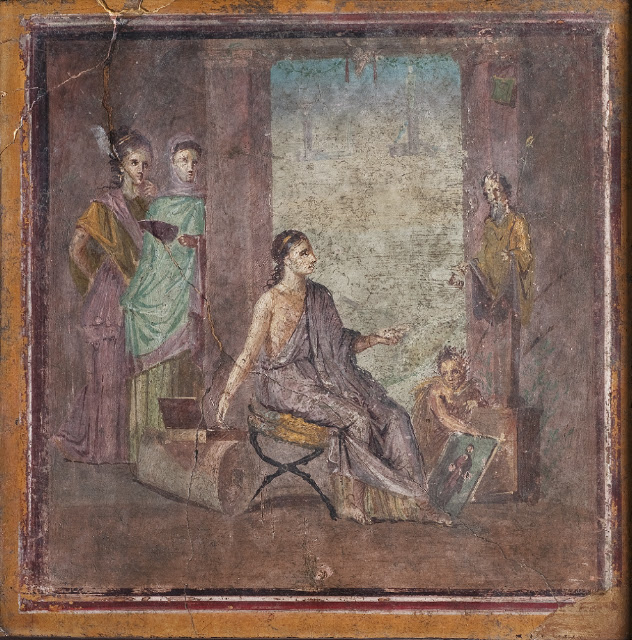
The Roman delight in such intricate detail and "trick of the eye" illusionism is rather overdone, to suit my taste. But the paintings stressing quiet moments of life, like the woman painter in her studio or the enigmatic face emerging from a canopy of a grape arbor, are unforgettable.


Painter at Work, 1st century CE. Pompeii 
 Fresco from the House of the Surgeon

And it is entirely appropriate that we remember the people of Pompeii, for it is impossible not to reflect on their tragic fate. 

Back in the late 1970's, I saw the spectacular Pompeii AD 79 exhibition at the American Museum of Natural History in New York. It was a "once in a lifetime" exhibit. But I remember feeling pensive and unsettled looking at the display of art and artifacts relating to people who had died en masse, suddenly and tragically. It was the height of the Cold War and apocalyptic thoughts were not uncommon in those days.

Later, I learned that the great Italian poet, Primo Levi, had been moved to write a searing poem comparing the death of a young child at Pompeii to victims of the Holocaust and Hiroshima. In The Little Girl of Pompeii, Levi, who had survived Auschwitz, began his poem with the gripping words: 

Since everyone’s anguish is our own

Levi went on to write:

Centuries have passed, the ash has petrified                                                

To imprison those delicate limbs forever.                                                     

In this way you stay with us, a twisted plaster cast,                                     

Agony without end, terrible witness to how much                                        

Our proud seed matters to the gods.

These haunting words - and the deeply humane sentiments the went into writing them - do "stay with us." It is hard for me to banish them from my mind when thinking about Pompeii and more recent tragedies which invite comparison, as Levi does so memorably in his poem.

Yet, I am happy to say that Pompeii in Color has had a liberating effect upon my feelings. This brilliant exhibition, filled with color and light, love and life, at the ISAW has helped me grapple with the ambivalent, troubled emotions I felt when viewing Pompeii AD 79 so long ago. Though I've yet to see the actual paintings at ISAW, the effect of this exhibition has been spirit and life affirming!

Now, when I think of Primo Levi's The Little Girl of Pompeii, I no longer view her in my mind's eye as "a twisted plaster cast." Rather, I see her as a face surrounded by ripening grapes and green leaves, a fey and ethereal face, emancipated from the hardened ash that entombed her bones. 

Mask amid Bunches of Grapes & Vines, 1st century CE. Pompeii
 Fresco from the House of V. Popidius

Pompeii's "agony without end" has ceased and these wondrous paintings on view at ISAW survive to remind us how delightful and rewarding life can be, even when lived in the shadow of Mount Vesuvius.

***

Text: Copyright of Ed Voves, all rights reserved                                            

Images courtesy of the Institute for the Study of the Ancient World, New York City, and the University of Michigan open access photos, https://quod.lib.umich.edu/a/aict?auth=world;sort=aict_ti;type=boolean;view=reslist;rgn1=ic_all;q1=aict

Introductory Image: Hercules and Omphale, 1st century CE. Herculaneum. Fresco: H. 40.3 cm; W. 41 cm. National Archaeological Museum of Naples: MANN 9004. Image © Photographic Archive, National Archaeological Museum of Naples.

Pompeii: general view to the north, showing paved street with pedestrian crossing blocks; in the background, Mount Vesuvius. University Of Michigan open access photo. ID RM055. Photo Date: June 1993 

Banquet Scene with Inscribed Words, 1st century CE. Pompeii. Fresco from the House of the Triclinium, East wall, central section: H. 77.5 cm; W. 77.6 cm. National Archaeological Museum of Naples: MANN 120029. Image © Photographic Archive, National Archaeological Museum of Naples

Architectural Landscape, 1st century CE. Pompeii. Fresco from the House of the Peristyle: H. 121.3 cm; W. 96.5 cm. National Archaeological Museum of Naples: MANN 8572. Image © Photographic Archive, National Archaeological Museum of Naples

The Three Graces, 1st century CE. Pompeii. Masseria di Cuomo – Irace,. Fresco: H. 60 cm; W. 53.3 cm. National Archaeological Museum of Naples: MANN 9231. Image © Photographic Archive, National Archaeological Museum of Naples.

Shrine fresco from the House of the Vettii, Pompeii: detail of Genius (spirit) of the Paterfamilias flanked by two lares. University Of Michigan open access photo. ID RM063. Photo Date: June 1993

Hercules and Omphale, 1st century CE. Pompeii. Fresco from the House of Marcus Lucretius, triclinium 16, east wall, central section: H. 203.2 cm; W. 162.6 cm. National Archaeological Museum of Naples: MANN 8992. Image © Photographic Archive, National Archaeological Museum of Naples

Hercules and Omphale, 1st century CE (detail). Herculaneum. Fresco (see data for introductory image.

Achilles on the Island of Skyros, 1st century CE. Pompeii. Fresco from the House of Achilles or House of the Skeleton or House of Stronnius, cubiculum u, north wall, central section: H. 156.5 cm; W. 148.6 cm. National Archaeological Museum of Naples: MANN 116085/ Image © Photographic Archive, National Archaeological Museum of Naples

Fourth-style mural painting sequence from the House of the Vettii, Pompeii. University Of Michigan open access photo. ID RM067. Photo Date: June 1993 

Architectural Landscape, 1st century CE. Herculaneum. Fresco from the Villa of the Papyri:, H. 71.1 cm; W. 90.5 cm. National Archaeological Museum of Naples: MANN 9423. Image © Photographic Archive, National Archaeological Museum of Naples

Still-life Fragments representing Vase, Scrolls, Landscape, and Fruit, 1st century CE. Herculaneum.  Fresco: H. 51.1 cm; W. 62.5 cm. National Archaeological Museum of Naples: MANN 9819. Image © Photographic Archive, National Archaeological Museum of Naples

Painter at Work, 1st century CE. Pompeii. Fresco from the House of the Surgeon: H. 45.4 cm; W. 45 cm. National Archaeological Museum of Naples: MANN 9018. Image © Photographic Archive, National Archaeological Museum of Naples.

Mask amid Bunches of Grapes and Vines, 1st century CE. Pompeii. Fresco from the House of V. Popidius or House of Mosaic Doves, triclinium 13, east wall, central section. H. 54.6 cm; W. 55.2 cm. National Archaeological Museum of Naples: MANN 9798. Image © Photographic Archive, National Archaeological Museum of Naples

Saturday, December 18, 2021

Art Eyewitness Review: A Modern Influence: Henri Matisse, Etta Cone and Baltimore


A Modern Influence: Henri Matisse, Etta Cone and Baltimore


Baltimore Museum of Art
October 3, 2021 - January 2, 2022

Reviewed by Ed Voves

Most great art museums, especially in the United States, aim to build representative collections of art from around the world, past to present. Some institutions, however, are known for having rich selections of the oeuvre of particular artists. 

The Whitney Museum in New York City, for instance, is the premier site for studying the works of Edward Hopper. Boston's Museum of Fine Arts is particularly well-endowed with paintings by Claude Monet and John Singer Sargent. But if you want to appreciate the art of Henri Matisse, you really need to make a pilgrimage to Baltimore.

The Baltimore Museum of Art (BMA) is currently presenting an outstanding exhibition highlighting the astonishing collection of modern art amassed by Claribel Cone and Etta Cone. These two sisters from Baltimore, born in the mid-1800's, lived outwardly conventional lives, while nurturing a passion for modern art, especially for the work of Matisse.


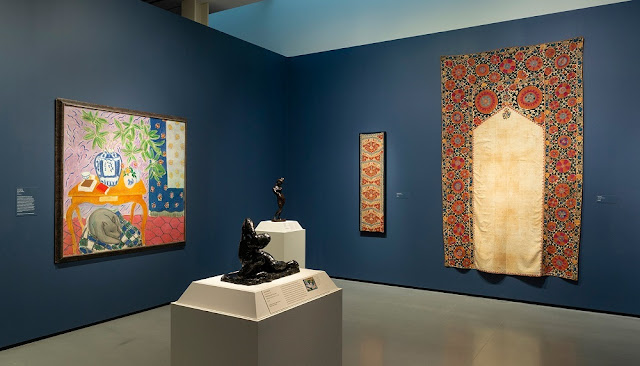
Gallery view of A Modern Influence at the Baltimore Museum of Art
Photo by Mitro Hood

The BMA exhibition is entitled A Modern Influence: Henri Matisse, Etta Cone and Baltimore, appearing from October 3, 2021–January 2, 2022. Approximately 160 works of art by Matisse - paintings, sculptures, prints, drawings, and illustrated books - are on view in this insightful examination of the partnership which transformed America's appreciation of modern art.

Also of note, a new facility for art scholarship, the Ruth R. Marder Center for Matisse Studies, has just opened at the BMA, enabling access to the BMA’s Matisse collection and related resources, after the exhibition closes.

 A Modern Influence focuses on the role of the younger of the sisters, Etta, and her enduring friendship with Matisse. But a brief introduction to the lives and joint endeavor of Claribel Cone and Etta Cone is in order.

The Cone family initially lived in the southern states of the U.S. before settling in Baltimore. The two sisters were expected to devote themselves to the realm of family and their Jewish faith. Claribel Cone, born in 1864, and Etta Cone, born in 1870, certainly maintained the ties of their large and loving family. But the strong-willed Claribel, who earned a medical degree in 1890, then a very rare accomplishment for women, and Etta found an unexpected way to assert themselves. They became quiet revolutionaries in the cause of modern art.

It was the more domestically-inclined Etta who initiated the creation of the Cone art collection in 1898. In that year, her brother Moses gave her $300 to renovate the family home in Baltimore. Etta, at age 28, was well on her way to being a Victorian maiden aunt, dutiful and dedicated to hearth and home. She was the perfect family member to buy new curtains, carpets and other accessories for the Cone residence at Eutaw Place in Baltimore.

Instead, Etta bought five paintings by the American Impressionist painter, Theodore Robinson.

In 1898, works by the French Impressionist masters were only beginning to be accepted in the United States. The cachet of European Old Master art in Gilded Age America reigned supreme, as wealthy Americans like Henry Frick purchased works by Holbein and Rembrandt by the cart-load.

Etta’s selection of Robinson’s impressionistic works, painted around 1888, was notable on two counts. As well as being an act of self-assertion on Etta’s part, her choice of Robinson’s paintings marked the beginning of a significant moment of transition in the American art scene. The tide had begun to turn away from ignoring contemporary artists, especially Americans. Etta Cone - perhaps instinctively - was one of the first to take advantage of this cultural shift.

The profits from the Cone family textile business provided a modest allowance to both Claribel and Etta, insuring their financial independence. By 1900, Dr. Claribel Cone was a highly regarded pathologist. Her work at Johns Hopkins University in Baltimore brought her into contact with an aspiring medical student named Gertrude Stein. As events were to show, Gertrude Stein’s future lay in the realm of the arts, not the sciences.

In 1901, Claribel and Etta took the first of many trips to Europe. The two sisters engaged in two of their favorite pursuits, visiting art museums and shopping for exquisite laces and other textiles, as well as small objects d’art. Where their limited funds allowed, they also purchased Japanese prints. Their guide during their early visits to Europe was Leo Stein, brother to Gertrude.


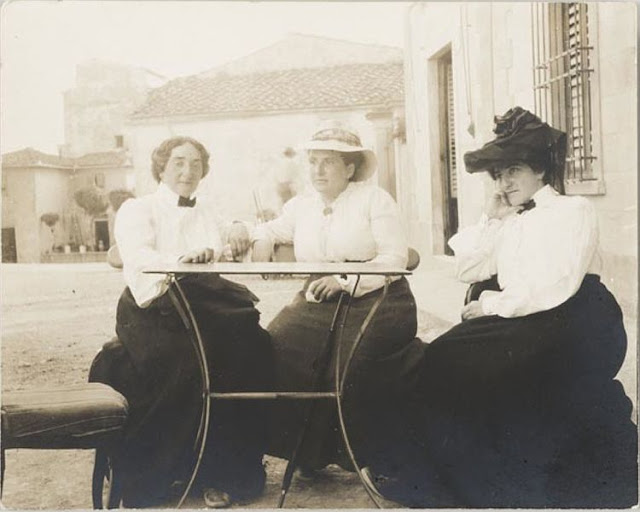
From left, Claribel Cone , Gertrude Stein, and Etta Cone in Italy, 1903

Four years later, now in the company of Gertrude Stein, these otherwise conventional ladies from Baltimore confronted the “shocking” rebellion of artists deemed the “New Barbarians” and “Fauves” or wild beasts. They visited the 1905 Salon d’Automne, the pivotal exhibition when the new art and “old guard” criticism dramatically crossed swords. Henri Matisse was particularly targeted for abuse.

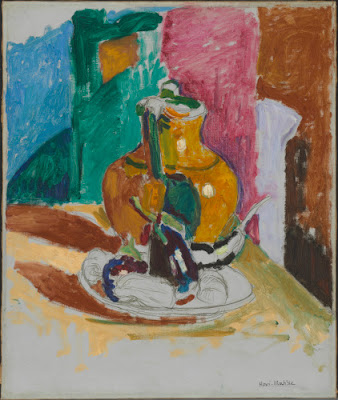
“We asked ourselves are these things to be taken seriously,” Claribel later noted. But when the Steins bought a work by Matisse, Etta followed suit, purchasing Yellow Pottery from Provence, remarkable for its color scheme, if conventional by the standard of other works by Matisse from the period.


Henri Matisse, Yellow Pottery from Provence, 1906

If Matisse hoped for further sales to the Cone sisters, it would many years before they opened their purses to make another significant purchase. Moses Cone died in 1908, leaving a grieving Etta with more family duties to perform. Claribel devoted increasing periods of her time to medical research, much of it in Germany. She was marooned in Germany in 1914 when World War I broke out, remaining there even when the U.S. entered the war.

Reunited with her family in 1918, Claribel now joined with Etta in their second and major round of art acquisitions. In 1922, the Cone sisters returned to Europe with ample funds provided by the huge profits the family company had made during the war. Though the sisters bought widely, including Claribel’s expenditure in 1925 of $18,860 for Paul Cezanne’s Mont Sainte-Victoire Seen from the Bibémus Quarry, their artist of choice was Henri Matisse.

The particular appeal of Matisse’s art for the Cones can be traced to several sources. Both Matisse and the Cone sisters loved the “outward appearance” of objects, particularly hand-woven textiles. The myriad ways in which fabrics can transform a physical environment or a person’s physique appealed to the French painter and his "Baltimore ladies."

Matisse was born in the town of Le Cateau-Cambrésis in northern France, a region that had been prominent in textile production as far back as the Middle Ages. He was the son and grandson of weavers. And of course, the Cone sisters’ disposable income for art purchases came from the cotton mills established by their brothers in North Carolina. Matisse and the Cones were kindred spirits in the love of beautiful cloth.


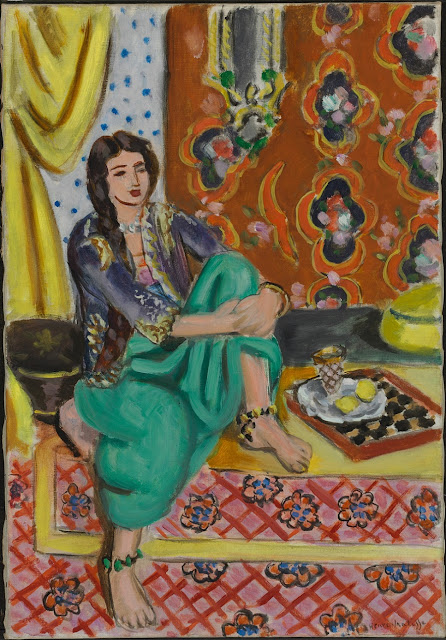
Henri Matisse, Seated Odalisque, Left Knee Bent,
 Ornamental Background  and Checkerboard, 1928

During the 1920′s, Matisse hearkened back to the Odalisque paintings of Ingres, Delacroix and other painters of the 19th century Romantic tradition. But as the decade progressed, Matisse began moving beyond the erotic appeal of the semi-clothed odalisques. Instead, Matisse evoked an amazing degree of sensuousness from textures of exotic clothing and draperies, carpets and wall hangings.


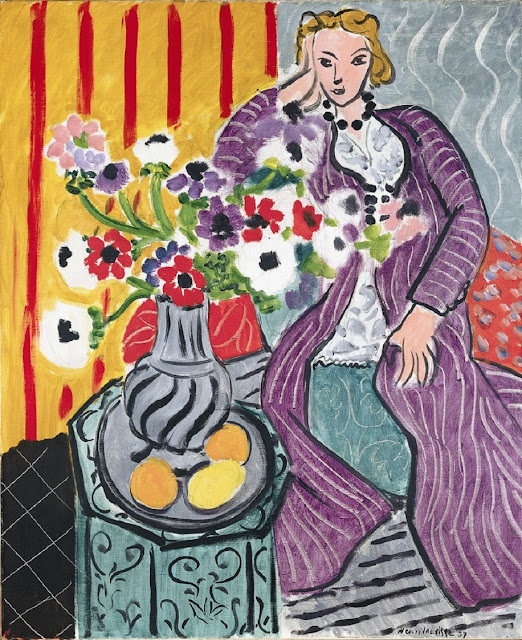
Henri Matisse, Purple Robe with Anemones, 1937

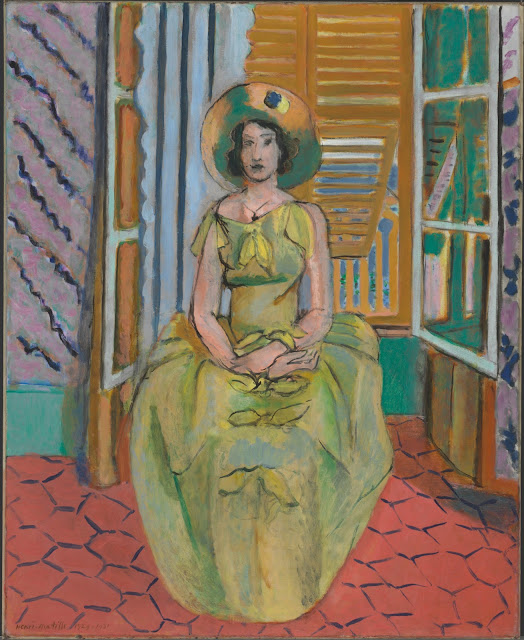
The emotional charge of the clothing of his models was to set the tone for many of Matisse’s mid-career works, several of which which Etta purchased. These include one of the "signature" works by Matisse in the BMA collection,  Purple Robe with Anemones (1937). Another painting, created over three years of exhaustive labor, is equally significant and, in some ways, more intriguing: The Yellow Dress (1929-31).


Henri Matisse, The Yellow Dress, 1929-31

There is an enigmatic element to The Yellow Dress. Matisse's model for this painting has a distant, dreamlike expression, as if she is focused on an other world. Her facial features lack the sharp definition of Matisse's odalisque or the young woman in Purple Robe with Anemones. Her face and arms seem to be fading away, leaving the shimmering yellow dress behind, wraith-like in the vibrant, well-articulated setting of the room

As Matisse labored on The Yellow Dress, Etta struggled too. Claribel's death in 1929 left her in a state of lingering shock. Etta lovingly preserved her sister’s rooms, placing fresh flowers, as if in expectation that Claribel would return. It may be reading a little too deeply into this incident, yet, I feel that The Yellow Dress may have served as testament of Etta's love for her sister and the emotional loss she felt at her passing.


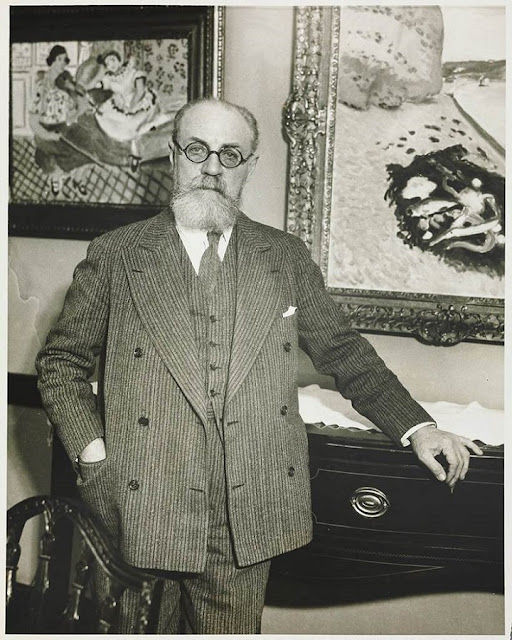
Henri Matisse at Etta Cone's apartment in Baltimore, Maryland, 1930
 
In 1930, Matisse came to the U.S. to execute a large commission for the Barnes Foundation in the suburbs of Philadelphia. He came down to Baltimore to express his sympathy to Etta Cone. Both artist and patron were compassionate human beings, kindred souls who grew closer in friendship as the troubled years of the 1930's rolled on. Shortly before World War II, Etta sent a brand new Schwinn bicycle as a gift to Matisse's grandson, Claude. After the Nazi invasion of France in 1940, this bicycle was the family's main mode of transport and food purchases.


Etta Cone in her apartment at the Marlborough Apartments, Baltimore, Maryland, c. 1930-1940

Following her sister's death, Etta Cone dedicated herself to make the Cone collection a major statement of the cultural ideals she shared with Claribel. Etta was also determined to make her own, unique mark as a patron of art. Despite the fact that she had been the first to purchase works of fine art, most people familiar with the two sisters assumed that Claribel was the driving force of their art collecting, rather than Etta's partner in this endeavor.

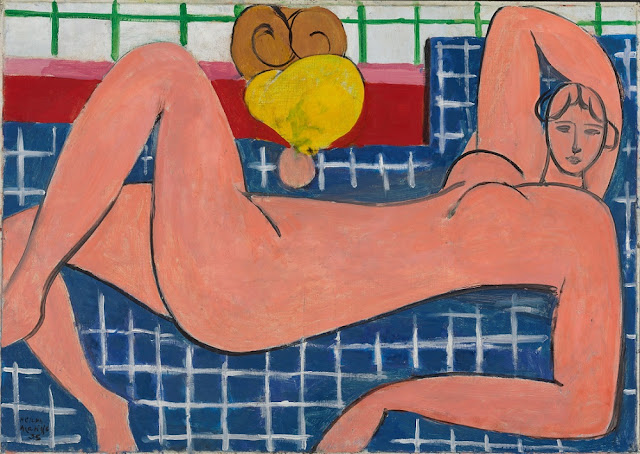
Matisse and Etta Cone thus created a new partnership, closely engaged in a joint effort to carry modern art to ever greater creative heights. The most remarkable work to emerge from this visionary initiative is Large Reclining Nude, painted in 1935. 

If Purple Robe with Anemones is a signature Matisse, the status of Large Reclining Nude is even higher. It is one of the true icons of Modern Art. And Etta Cone – assisted by the “ghost” of Claribel - played an important role in its creation.


Henri Matisse, Large Reclining Nude, 1935

When Matisse examined the massed array of his works in the Cone apartment rooms, he saw, for the first time in many years, one of his most notorious paintings, The Blue Nude (1907). This controversial work had been reviled when it was first presented, but Claribel had purchased it in 1926. After spending some time with his still infamous creation, Matisse determined to paint a matching nude, this time in a complementary color.

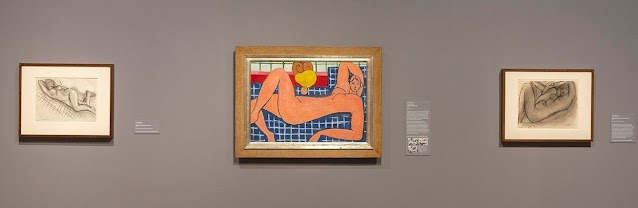
As he worked on Large Reclining Nude, Matisse took an elaborate series of 22 photos of the various stages or states of composition. These he sent to Etta in two letters, dated September 19th and November 16th, 1935. 

Etta responded enthusiastically, “I was touched by your attempt to take my mind off things... You’ve been very successful; the first time I looked at the drawings I spent two hours totally immersed in them.. I’m waiting impatiently for the opportunity to see the finished painting of the ‘Reclining Nude.’ . . . "


Gallery view of A Modern Influence, showing Matisse's Large Reclining Nude and preparatory sketches. Photo by Mitro Hood

By making Etta part of the creative process, Matisse recognized her aesthetic kinship. And by doing so, Matisse produced a very different masterpiece than what he had at first intended. What had begun as a naturalistic depiction of a nude woman, evolved into a new incarnation of the body, more of a symbolic presence of a body and spirit at rest. 

When Large Reclining Nude reached Baltimore, Etta hung it in a rather cramped room, facing The Blue Nude. The placement of the two paintings made them appear to be "squaring-off" in a confrontation. In a sense this was true. By placing the two paintings facing each other across the room, Etta was asserting herself as an equal to Claribel, as a force in the art world to be reckoned with.

Indeed, Etta was developing into a major art scholar, as well as a patron. The year before Large Reclining Nude arrived, Etta wrote and published the catalog of the works of art she and her sister had collected. And she began to plan for the future of their collection. 

Once again, she acted in concert with the spirit of Claribel. Perhaps in premonition of her death, Claribel had recommended to Etta that their joint collection be donated to the Baltimore Museum of Art “in the event the spirit of appreciation for modern art in Baltimore becomes improved.” 

Etta Cone continued to purchase works of art by Matisse, prints and sculptures, as well a paintings. In fact, she bought so many that she had to rent the adjacent apartment to her own, so that she could store the overflow. Among the later works she purchased was a copy of the limited edition book of Matisse's "cut-out" prints entitled Jazz, published in 1947. 


Henri Matisse, Icarus (Icare), 1947

One of the most notable images in Jazz was Icarus. I saw the original cut-out, created by the crippled, bed-ridden Matisse, in a fabulous exhibition at MOMA during the winter of 2015. It is an indelible image of the human condition. Daring the fates for the sake of soaring aloft (creativity), we may reach too far - and then fall to earth. But in the process, we create works of genius, which endure after we are gone.

Etta Cone died on August 31, 1949, having bought her final painting by Matisse five months before. Modern art was indeed appreciated in Baltimore by 1949 and Etta bequeathed the Cone Collection of over 3,000 works of art, (600 by Matisse) to the Baltimore Museum of Art. Along with this trove of Modernist masterpieces, Etta donated $400,000 to build a new wing to the museum which opened in 1957.

Such was the culminating act of vision and generosity of Matisse’s “Baltimore Ladies.” But there was more at work here than just enlightened patronage. 

Over the course of nearly a half century, Matisse and the Cone Sisters joined together in a grand enterprise of encouraging human empathy by sharing works of beauty. This was especially true in the case of Etta Cone. She transformed collecting art into an act of friendship, making her partnership with Henri Matisse a peerless work of art.

***
Text: Copyright of Ed Voves, all rights reserved 
Images courtesy of the  Baltimore Museum of Art 

introductory image: Henri Matisse (French, 1869-1954) Etta Cone (VI/VI). 1933-1934. (VI/VI) 1931-1934 Charcoal with stumping and erasing on two joined sheets of paper Sheet: 711 x 409 mm. (28 x 16 1/8 in.) The Cone Collection, formed by Dr. Claribel Cone and Miss Etta Cone of Baltimore, Maryland BMA 1950.12.70  © Succession H. Matisse/Artists Rights Society (ARS), New York

Gallery view of A Modern Influence: Henri Matisse, Etta Cone and Baltimore at the Baltimore Museum of Art. Photo by Mitro Hood.

Claribel Cone, Gertrude Stein, and Etta Cone sitting at a table in Settignano, Italy, June 26, 1903. The Baltimore Museum of Art: Dr. Claribel and Miss Etta Cone Papers, Archives and Manuscripts Collections, CG.12.

Henri Matisse (French, 1869-1954) Yellow Pottery from Provence, 1906.  Oil on canvas : 21 7/8 × 18 3/8 × 5/8 in. (55.6 × 46.7 × 1.6 cm.) The Baltimore Museum of Art: The Cone Collection, formed by Dr. Claribel Cone and Miss Etta Cone of Baltimore, Maryland, BMA 1950.227. © Succession H. Matisse/Artists Rights Society (ARS), New York

Henri Matisse (French, 1869-1954) Seated Odalisque, Left Knee Bent, Ornamental Background and Checkerboard, 1928. Oil on canvas: 21 5/8 × 14 7/8 in. (54.9 × 37.8 cm.) The Baltimore Museum of Art: The Cone Collection, formed by Dr. Claribel Cone and Miss Etta Cone of Baltimore, Maryland, BMA 1950.255. © Succession H. Matisse/Artists Rights Society (ARS), New York

Henri Matisse (French, 1869-1954) Purple Robe with Anemones. 1937.  Oil on canvas: 28 3/4 × 23 5/8 in. (73 × 60 cm.) The Baltimore Museum of Art: The Cone Collection, formed by Dr. Claribel Cone and Miss Etta Cone of Baltimore, Maryland, BMA 1950.261. © Succession H. Matisse/Artists Rights Society (ARS), New York

Henri Matisse (French, 1869-1954) The Yellow Dress, 1929-1931. Oil on canvas: 39 9/16 × 32 1/8 in. (100.5 × 81.6 cm.) The Cone Collection, formed by Dr. Claribel Cone and Miss Etta Cone of Baltimore, Maryland BMA 1950.256 © Succession H. Matisse/Artists Rights Society (ARS), New York

Henri Matisse in the dining room of Etta Cone's apartment at the Marlborough Apartments, Baltimore, Maryland, 1930. Claribel Cone and Etta Cone Papers, Archives and Manuscripts Collections, The Baltimore Museum of Art

Etta Cone in her apartment at the Marlborough Apartments, Baltimore, Maryland, c. 1930-1940. Claribel Cone and Etta Cone Papers, Archives and Manuscripts Collections, The Baltimore Museum of Art

Henri Matisse (French, 1869-1954) Large Reclining Nude, 1935. Oil on canvas: 26 1/8 × 36 3/4 in. (66.4 × 93.3 cm.) The Baltimore Museum of Art: The Cone Collection, formed by Dr. Claribel Cone and Miss Etta Cone of Baltimore, Maryland. BMA 1950.258 © Succession H. Matisse, Paris/Artists Rights Society (ARS) New York

Gallery view of A Modern Influence at the Baltimore Museum of Art, showing Matisse's Large Reclining Nude and preparatory sketches. Photo by Mitro Hood

Henri Matisse (French, 1869-1954) Icarus (Icare), 1947. From the unbound volume "Jazz" published in 1947. Color stencil print (pochoir) Book Edition 227/250 (270 total edition) Sheet: 420 x 324 mm. (16 9/16 x 12 3/4 in.) The Cone Collection, formed by Dr. Claribel Cone and Miss Etta Cone of Baltimore, Maryland BMA 1950.12.745.8