Tuesday, June 28, 2022

Art Eyewitness Review: Medieval Treasures from the Glencairn Museum at the Philadelphia Museum of Art


Medieval Treasures from the Glencairn Museum

Philadelphia Museum of Art

June 24, 2022 - Autumn 2023

Reviewed by Ed Voves  

Original photos by Anne Lloyd

In the prologue to Henry V, William Shakespeare asked if the "cockpit" of the Globe Theatre, shaped like a "wooden o", could provide the setting for retelling the story of the Battle of Agincourt.

We can well raise similar questions about the effectiveness of museums in presenting special exhibitions. When carefully chosen works of art are displayed in a gallery space, can they call forth a "Muse of fire" to ignite our imaginations as Shakespeare did?

In the case of a small, focused exhibition at the Philadelphia Museum of Art, Medieval Treasures from the Glencairn Museum, the answer is a resounding yes! 

A choice selection from Glencairn's renowned collection of art from the Middle Ages is on view in the exhibit, a long-term loan while building renovations are being made at Glencairn. 


Anne Lloyd, Photo (2022)
 Gallery view of Medieval Treasures from the Glencairn Museum

From masterpieces of carved ivory, the earliest dating to around the year 500, to luminous stained glass panels from the era of the Gothic Cathedrals, the exhibition distills the very essence of the culture of Christendom. 

Medieval art was overwhelmingly spiritual in orientation and intended for instructional purposes. But the core humanity of the people who populate the scenes of sacred history on the stained glass panels and church sculptures from Glencairn often transcend the boundaries of theological doctrines. 


Anne Lloyd, Photo (2022) 
The Visitation from the Church of St. Radegonde, c.1270-1275

When we view the greeting of the Virgin Mary and her older cousin, Anne, in  this depiction of the biblical episode known as the Visitation, we are moved to join in their embrace - and extend it to all humanity. Over and over again, the Glencain "treasures" banish all lingering prejudices regarding the medieval era as a "dark age."


Ed Voves, Photo (2021) View of Glencairn Museum, Bryn Athyn, PA

In the early summer of 2021, I visited the Glencairn Museum, located in Bryn Athyn, PA, about fifteen miles north of center city Philadelphia. I won't repeat the story of how the Bryn Athyn Cathedral and the Glencairn Museum came to be built by Raymond Pitcairn (1885-1966). But it has to be emphasized, once again, that "Pitcairn brought the passion and work ethic of the castle and cathedral builders of the Middle Ages to his great venture."  

Like Bishop Bernward, patron of the great German abbey church of St. Michael's at Hildesheim (built 1001-1031) and Abbot Suger, who pioneered the design of Gothic cathedrals a century later, Pitcairn believed in acquiring treasures of religious art to display in his magnificent edifice. 

Although Glencairn has excellent examples of ancient Egyptian, Graeco-Roman and religious art from around the world, medieval European art is the museum's premier attraction. Pitcairn collected approximately 600 works of art, mostly from the Romanesque and early Gothic periods in France, 1100-1300, with special attention to stone carvings and stained glass window panels.

From this world-class array of medieval art, curator Jack Hinton of the Philadelphia Museum of Art (PMA) chose 18 magnificent works of art. But before we examine these treasures from Glencairn, two important points need to be underscored. 

Medieval Treasures from the Glencairn Museum is the latest collaboration between the two museums, dating back to the 1930's. There are a number of other Glencairn works currently on view in the medieval galleries of the PMA. Indeed, some have been on long-term loan for so many years that these works appear to be permanent features of the PMA. 


Anne Lloyd, Photo (2021)
 Gallery view of the Philadelphia Museum of Art, showing Corpus of Christ, late 1200's, & Effigy of a Recumbent Knight, c.1230

This is the case for one of the museum's most effective displays, the pairing of a late thirteenth century crucifixion from Glencairn with the tomb effigy of a recumbent knight from the PMA's collection. 

This Corpus of Christ (as the painted wooden statue is also called) reflects the emphasis upon Jesus' humanity and suffering as preached by St. Francis of Assisi (1181/82-1226). When placed above the monument to an unknown knight of the Crusading-era, this sculptural ensemble symbolizes Europe's Age of Faith in a profoundly moving way.


                                        Anne Lloyd, Photo (2022)                                   Entrance to the Medieval Treasures from the Glencairn Museum exhibit at the Philadelphia Museum of Art

It is entirely fitting that Medieval Treasures from the Glencairn Museum is on display in one of the PMA's galleries devoted to the Middle Ages, only a moment's walk from the Corpus of Christ and the sleeping knight. Stepping through the doorway of Gallery 307 to view the exhibit evokes the feeling of arriving at journey's end on a medieval pilgrimage.


Anne Lloyd, Photo (2022)
 View of Stained Glass Panels from the Glencairn Museum Collection

The first works of art to strike the eye upon entering the exhibit is the bank of five radiant panels of stained glass from the early Gothic era. These are positioned on the wall opposite to the door, yet their appeal is impossible to resist.

I was drawn immediately to these wondrous art works, particularly to the central panel, The Flight into Egypt. Commissioned by Abbot Suger for the reconstruction of the royal chapel of France, the Abbey Church at Saint-Denis, it dates to 1140-1144. This rare, color-drenched panel is one of the earliest surviving pieces of stained glass in an American art collection.

The Flight into Egypt was also, for several years during the 1970's, a very controversial work of art. Scholarly opinion was divided on whether it was a forgery. It took a long, intensive campaign to prove its authenticity. The dogged determination of a Columbia University grad student, Michael Cothren, and the scientific analysis of Robert Brill of the Corning Museum of Glass insured that The Flight into Egypt regained its status as one of the world's greatest works of medieval art.
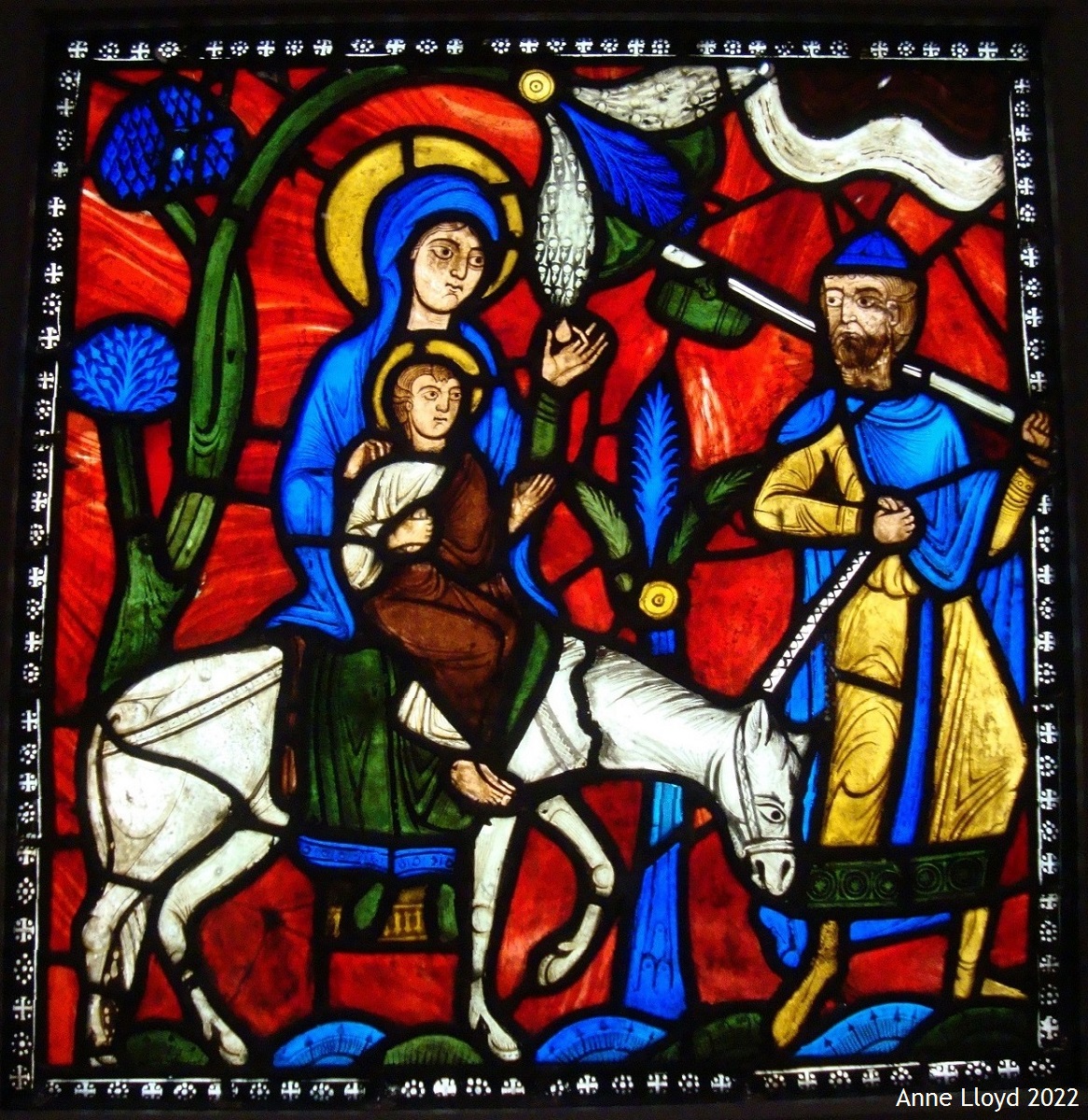

                                    Anne Lloyd, Photo (2022)                                      The Flight into Egypt, from the Chapel of St. Denis, c. 1145

To describe The Flight into Egypt as iconic is, for once, entirely appropriate. 

After only a few moments of viewing The Flight into Egypt, one can begin to reach a better understanding of the medieval world view. It was a state of mind where the biblical past was very much alive. Religious pilgrimages figured prominently as deeds of faith. And if one could not make the ultimate journey to Jerusalem, then a visit to a cathedral closer to home, emblazoned with stained glass windows depicting the lives of Jesus, his mother Mary and other saintly persons, would suffice.


Detail of The Flight into Egypt, St. Denis, c. 1145

Likewise, people during the Middle Ages had no problem in believing tales not found in sacred scripture. In The Flight into Egypt, we see Mary picking a fig from a tree which her infant son (who looks remarkably mature) had commanded to lower its branch for her convenience. Incredible, even ridiculous, to our minds, yet such a story would have given encouragement to pilgrims enduring an arduous journey to Chartres, Santiago or even Jerusalem.

Another of the Glencairn stained glass panels strikes an even more apocryphal note. In the legend of the Seven Sleepers of Ephesus, a group of early Christians, fleeing persecution, sought refuge in a cave, which was sealed-up by Roman soldiers. Instead of dying, they fall asleep, waking-up many years later like Rip van Winkle. 


Anne Lloyd, Photo (2022) 
 The Arrest of Malchus in The Seven Sleepers of Ephesus window from Rouen Cathedral, c.1200-1203

One of the seven, Malchus, is arrested for trying to buy bread for breakfast with a now-vintage Roman coin. Ephesus, his home town, had converted to Christianity while he and his companions slumbered, but Malchus, as we see in the charming scene, above, is once again on the wrong side of the law.

Miraculous or far-fetched - or somewhere in between - stories drawn from the Bible and popular religious tales were best told in pictorial format. Romanesque churches featured vigorous, colorful fresco paintings, but in the cold, damp climate of Europe, north of the Alps, these quickly lost their lustre. Stained glass, far more difficult to create, lasted longer. The master glass makers of the Gothic cathedrals, developed an eye for dramatic scene composition that modern-day film makers could not surpass.

The economy of creative effort used in creating narratives of Gothic-era stained glass is readily apparent in Salome Dancing at the Feast of Herod. This was one of a series of roundels depicting the life and death of St. John the Baptist from a church in northern France. While the series progresses like movie storyboards, each roundel is brilliantly self-contained, none more so than this one of sexy Salome's dance.


                                        Anne Lloyd, Photo (2022)                                     Salome Dancing at the Feast of Herod, c. 1235

Here we see the sword-wielding Salome, gyrating at the feet of Herod Antipas. Her mother, Herodias, urges the irresolute Herod to strike at John the Baptist. While the other scenes in the series, (Glencairn owns two more) are equally forceful, this brilliant episode is an absolute masterpiece.

This array of stained glass panels is so brilliant that it was hard to redirect my attention to the other works of art in Medieval Treasures from the Glencairn Museum. Yet, just a few feet away was a Romanesque sculpture, carved from limestone around 1150-60, which rivals the narrative inventiveness and emotional intensity of the stained glass panels.


Anne Lloyd, Photo (2022)
 Capital with the Story of Dives and Lazarus, c. 1150-60

Capital with the Story of Dives and Lazarus would have perched atop a column at the Abbey of Moutiers-Saint-Jean, France. It shows Jesus' parable of the pious, impoverished Lazarus and rich, selfish Dives. Lazarus dies in misery but is redeemed, coming to rest "in the bosom of Abraham." Dives, clutched in the jaws of damnation, begs that Lazarus dip his finger into water to relieve his agony.


                                       Anne Lloyd, Photo (2022)                                  Capital with the Story of Dives and Lazarus (detail)

Romanesque sculptures like this capital were once viewed as "primitive" but are now regarded as masterful interpretations of the conflict of good and evil. If outwardly simplistic in its moral judgement, the Lazarus/Dives carving conveys a degree of psychological intensity that certainly informed the mind and guided the hand of the sculptor who made it.  

The terror on the face of Dives when he realizes that he faces divine wrath for his cruel, heedless mistreatment of Lazarus is unforgettable, ranking with images from classic cinema of the 1920's or Francis Bacon's "screaming" popes.


Detail of Capital with the Story of Dives and Lazarus, c.1150-60

Skillful story-telling is indeed a prevailing theme of medeaval art. To an amazing degree, Medieval Treasures from the Glencairn Museum evokes the spirit of the Middle Ages. The "genius" is there in the details of these works and in their skillful juxtaposition in the display cases of the exhibition.


                                       Anne Lloyd, Photo (2022)                                      Gallery view of Medieval Treasures from Glencairn Museum, showing Ivory Box from Spain & Sculpted Head by Giselbertus

Two small artifacts - incredibly so - offer insight into the development of medieval art. The first is a small box, carved from ivory, in Spain, around the year 700. It is placed  next to a sculpted "crowned" head, hardly bigger than a man's clenched fist. Together, these diminutive works of art reveal much about the course of European art during the early Middle Ages.

The carving on the ivory box narrates two episodes in the life of King Solomon, including his crafty judgement of ordering  a baby sliced in two, so that rival women, each claiming to be the child's mother, coud have an equal share of the corpse. (The deed, thankfully, never was carried out.) 


  Anne Lloyd, Photo (2022) 
Box with Scenes from the Book of Kings, c. 700

Though the incident was biblical in origin, the carving on the box was entirely Germanic. Spain, following the collapse of Roman rule, was dominated by Visigothic kings. Brave in battle but inept as administrators, the Visigoths succumbed to the Moorish invasion of Spain in 711.

The ineffectual rule of the Visigoths is reflected in this curious ivory box. But the "crowned" head, displayed in the same  case, shows how far the artistic skill of Europe's sculptors had progressed by the time it was carved, sometime in the early 1100's. It too represents a king, perhaps King Solomon. But the identity of the maker, rather than the subject, is what counts.

The man who carved this Head of a King was almost certainly Giselbertus. His reputation as "one of the great geniuses of medieval art" is based on the astonishing carved scene of the Last Judgement which he sculpted for Autun Cathedral, 1125-1130. Skill alone, however, does not account for the renown of Giselbertus. At the base of his depiction of Christ at Autun, Giselbertus contributed an unexpected detail: his name.

Giselbertus hoc fecit. Giselbertus made this.


Anne Lloyd, Photo (2022)
 Head of a King. Attributed to Giselbertus, Mid-1100's

Looking at this small head reveals that its features are very similar to those on the figures of the Autun Last Judgement. This is the main reason that scholars believe it was carved by Giselbertus. For my part, I was struck by the mobility of expression of the face, of the fey quality of the character of the king, when viewed from different angles. He looks sly and devious on one side, impassive on the other. This might well be a portrait of King Solomon. 

In signing his name on the Autun sculpture, Giselbertus brought medieval art to the point where artists ceased being anonymous. Credit would be given where it was due. Centuries would pass before this process would be complete, but thanks to Giselbertus, artistic individualism had received a huge boost.

This transition in art, from Romanesque to Gothic, with growing public recognition for artists, is the endpoint of the Medieval Treasures from Glencairn exhibit. But the modern-day part of the story has a further chapter to relate: the important role which Raymond Pitcairn played in the development of the Philadelphia Museum of Art.

When the Philadelphia Museum of Art opened in 1927, its first director, Fiske Kimball, worked on a master plan to transform the museum's third floor into a chronological succession of galleries and period rooms. When complete, this would enable art lovers to follow the course of  Western art from the Middle Ages to modern times.


Anne Lloyd, Photo (2022)
 Gallery view of the Philadelphia Museum of Art, 
showing the Fountain from the Monastery of St Michel-de-Cuxa

Fiske Kimball, a brilliant scholar of architecture, was able to place in the museum galleries surviving remains from historic buildings in Europe such as the fountain from the Monastery of St Michel-de-Cuxa and the Portal of the Abbey of Saint-Laurent. This gives visitors a "you are there" passport to the Middle Ages. 

However, the PMA's master plan soon hit a major obstacle. The Stock Market collapse of 1929 and the ensuing Great Depression gravely affected donations of funds and works of art to the museum. Many of the galleries remained empty. As Fiske Kimball and his staff labored to achieve their audacious goal, critics lampooned the museum as a "Grecian parking garage."

Raymond Pitcairn helped Fiske Kimball deal with the dilemma of providing works of art for the fourteen galleries designated for the study of medieval art and culture. During the Depression decade, Pitcairn loaned approximately 70 art works to the PMA, along with several donations. The loans included many of his most treasured sculptures and paintings including the fourteenth century fresco, Christ in Majesty, from a church in Spoleto, Italy. 


Anne Lloyd, Photo (2021) Corpus of Christ, late 1200's

As noted earlier, in the case of the Corpus of Christ, many of Pitcairn's loaned art works graced the medieval galleries of the PMA for very long periods of time. Even after 1945, when funds became available for Fiske Kimball to purchase a large collection of medieval art for the PMA, Pitcairn continued to generously support the museum.

As I left Gallery 307, where Medieval Treasures from the Glencairn Museum will hang until repairs at Glencairn are finished in the fall of 2023, I was in a thoughtful mood. I reflected on the vital role of enlightened artists and patrons, whose contributions make civilized life meaningful - indeed possible. 


Anne Lloyd, Photo (2022)
 Border panel, from the Moses Window, Church of Saint-Denis, c. 1145

Where would we be without visionaries like Abbot Suger, without the stained glass masters who made The Flight into Egypt or gifted sculptors like Giselbertus?

Where would we be - in our own age of great wars, great plagues and great depression - without the likes of Raymond Pitcairn?

***

Text: Copyright of Ed Voves, all rights reserved                                              Images copyright of Anne Lloyd 

Introductory Image: 

Anne Lloyd, Photo (2022) The Flight into Egypt, from the Infancy of Christ Window (detail)

Anne Lloyd, Photo (2022) Gallery view of Medieval Treasures from the Glencairn Museum at the Philadelphia Museum of Art.

Anne Lloyd, Photo (2022)  The Visitation from the Church of St. Radegonde. Artist unknown, France. Stained glass. c. 1270-1275. 30 1/2 × 23 7/8 inches (77.5 × 60.6 cm). On loan from Glencairn Museum, Bryn Athyn, PA. 

Ed Voves, Photo (2021)  View of Glencairn Museum, Bryn Athyn, PA

Anne Lloyd, Photo (2021) Gallery view of the Philadelphia Museum of Art, showing Corpus of Christ, late 13th century, painted wooden statue on loan from the Glencairn Museum and Recumbent Knight from a Tomb Sculpture, France, c. 1230, from the Philadelphia Museum of Art collection.

Anne Lloyd, Photo (2022) Entrance to the Medieval Treasures from the Glencairn Museum exhibit at the Philadelphia Museum of Art.

Anne Lloyd, Photo (2022) View of Stained Glass Panels from the Glencairn Museum Collection.

Anne Lloyd, Photo (2022) The Flight into Egypt, from the Infancy of Christ Window (?), from the Abbey Church of St. Denis, France. Stained glass. c. 1145. 20 1/2 × 19 3/4 inches (52.1 × 50.2 cm). On loan from Glencairn Museum, Bryn Athyn, PA. 

Anne Lloyd, Photo (2022) The Flight into Egypt (detail)

Anne Lloyd, Photo (2022)  Malchus is Led before the Bishop and Prefect from The Seven Sleepers of Ephesus window of the nave aisle of Rouen Cathedral. Stained glass. c. 1200-1203.  24 1/2 × 23 1/4 inches (62.6 × 59 cm).On loan from Glencairn Museum 

Anne Lloyd, Photo (2022) Salome Dancing at the Feast of Herod, Stained glass roundel from the Church of Saint-Martin, Breuil-le-Vert, France, c.1235.  diameter: 47. 5 cm. (18 11/16 inches) On loan from Glencairn Museum, Bryn Athyn, PA.

Anne Lloyd, Photo (2022) Capital with the Story of Dives and Lazarus. Artist unknown, from the Abbey of Moutiers-Saint-Jean, France. Limestone. c. 1150-60. 25 × 11 × 14 1/2 inches (63.5 × 27.9 × 36.8 cm). On loan from Glencairn Museum, Bryn Athyn, PA.

Anne Lloyd, Photo (2022) Capital with the Story of Dives and Lazarus (detail)

Anne Lloyd, Photo (2022) Gallery view of Medieval Treasures from Glencairn Museum, showing Ivory Box from Spain & Sculpted Head by Giselbertus

Anne Lloyd, Photo (2022) Box with Scenes from the Book of Kings. Artist Unknown, Spain. Ivory. c. 700. Approx.: 3 × 6 × 3 inches (7.6 × 15.2 × 7.6 cm). On loan from Glencairn Museum, Bryn Athyn, PA.

Anne Lloyd, Photo (2022) Head of a King. Attributed to Giselbertus, from Autun, Burgundy. Limestone. Mid-1100's. 5 1/8 × 3 1/4 × 3 5/8 inches (13× 8.2 × 9.2 cm). On loan from Glencairn Museum, Bryn Athyn, PA.

Anne Lloyd, Photo (2022) Gallery view of the Philadelphia Museum of Art, showing the Fountain from the Monastery of St. Michel-de-Cuxa.

Anne Lloyd, Photo (2022) Corpus of Christ, late 1200's, from the Glencairn Museum collection, on view at the Philadelphia Museum of Art.

Anne Lloyd, Photo (2022) Border panel, from the Moses Window (?), Artist Unknown, Abbey Church of Saint-Denis, France. Stained glass. c. 1145. 19 1/4 × 9 inches (48.9 × 22.9 cm). On loan from Glencairn Museum

Friday, June 17, 2022

Art Eyewitness Book Review: Catholica: the Visual Culture of Catholicism


Catholica: the Visual Culture of Catholicism

By Suzanna Ivanic

Thames & Hudson, $35, 256 pages

Reviewed by Ed Voves

For over a thousand years, the Christian Church was the greatest patron of the arts and architecture in the world. Beginning in the year 312, when the Roman emperor Constantine embraced Christianity, almost every aspect of thought, culture and craft in Europe was dominated by the effort to build and maintain a civilization based on the life and teachings of Jesus of Nazareth.

Catholica, a brilliant new book published by Thames and Hudson, explores the visual record of Roman Catholicism. This was the dominant form of Christianity in Europe, until it was divided into warring camps by the publication of Martin Luther's radical views on religious doctrine in 1517. 

Despite the Reformation, Roman Catholicism survived - and thrived. This was due in no small part because of the impact of Catholic art and the religious convictions upon which it was founded. After losing control over parts of Germany, England and the Netherlands, Roman Catholicism spread to Latin America, much of sub-Saharan Africa and to Asian countries like the Philippines. 

Roman Catholicism still exerts a strong and inspiring influence over millions of faithful Christians the world over. Yet many of its works of art, or sacred objects like the vestments worn by Catholic clergy and vessels used in devotional ceremonies, have an unfamiliar, even unsettling, feel to them. 

For instance, many people today have no idea as to the significance of the golden vessel known as the monstrance. 


Diego de Atienza, Spanish artist in Ecuador & Peru, Monstrance, c. 1646 

The monstrance is used to display the Host, unleavened bread transformed into Christ's body during the Mass. The role and importance of this sacred object is, needless to say, difficult to grasp by those unacquainted with Roman Catholicism. Thanks to Catholica, the process of understanding and appreciating Christian art and ideas will be a great deal easier.

Catholica was written by Suzanna Ivanic, who teaches history at the University of Kent, England. Ivanic has excellent credentials for investigating the works of art, architecture and artifacts of Catholicism, for her research field (according to the publisher's blurb) is the "lived religion and material and visual culture in Central Europe."

Equally important, Ivanic writes with conviction and insight. Indeed, the sensitivity of her commentary and the scope of her knowledge are awesome and admirable.

Catholica is organized into three parts. Tenet surveys the basics of Roman Catholic religious doctrine; Locus examines the sites where Catholics worship, ranging from magnificent Gothic cathedrals to prayer sites in the homes of the faithful; Spiritus focuses on Christian devotion, as practiced by communities and by individuals.

As noted above, many Catholic works of art or devotional objects may be unfamiliar. In some cases, they are "wondrously strange" and Ivanic has her work cut-out to explain them. This she does in "decoding" units where baffling, arcane details of famous paintings and church architecture are analyzed. 


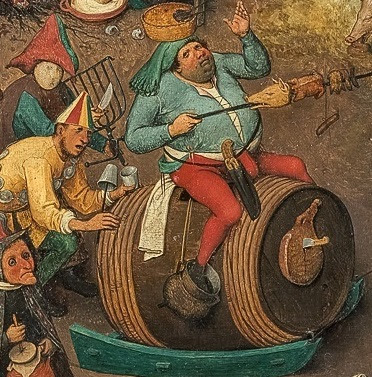
Pieter Bruegel the Elder, The Fight Between Carnival and Lent, 1559

The Fight Between Carnival and Lent, painted by Pieter Bruegel the Elder in 1559 is one of the masterpieces decoded by Ivanic. Indeed, it was created with exactly that purpose in mind. A wealth of examples of folly, greed, gluttony and social mayhem during Mardi Gras was included in Bruegel's painting. These are compared with the sober performance of Christian charity during the season of Lent.


Bruegel's The Fight Between Carnival and Lent (details)

Other "decoded" paintings include The Penitent Magdalen by Georges de la Tour (c. 1640) and Caravaggio's The Seven Works of Mercy (1607). 


Anonymous (Japan), The Arrival of the Europeans, early 1600's

A fascinating Japanese screen painting, dating to the early 1600's, shows Catholic missionaries from the Jesuit and Franciscan orders in one of its vignettes. Here we can see the global outreach of Christianity as seen - and very attentively examined - by non-Europeans.

Profiles of important themes in Christian culture also feature prominently in the book. These range widely from the important events and rites associated with the seasons of Christmas and Easter, the "roles" assigned to the Virgin Mary - Mother of Sorrows, Mary of the Rosary, etc. - and the Catholic ways of coping with Death. This last profile is especially compelling, as I will comment in more detail later in this review.

With this investigative format in mind, it might seem that Catholica is primarily a reference work. Indeed it is, but the best way to appreciate Catholica is to begin on page one and follow Ivanic as she guides us along the path of Roman Catholicism's engagement with art of the spirt.

The profoundly moving nature of Ivanic's text is due to more than her command of source material. She writes about matters of religious faith with a real sense of what Christian belief in God and the divine ordering of the universe is like. 

A brief quotation from Ivanic's discussion of the role of Abbot Suger (1081-1151) regarding the rise of Gothic cathedrals is indicative of the marvelous and moving narrative of Catholica:

Key to understanding the birth of the Gothic is Suger's emphasis on the transformative power of the liturgical performance. Just as during the Mass the bread and wine are turned into the body and blood of Christ, so does the ritual performance of the cathedral transform it from stones, glass and metal into a divinely powerful space... 

Christianity traces its origin to Judaism. Like Jews, Christians base their beliefs on the written (and sanctified) words of the Bible. But early in the history of the Christian Church, images of Jesus, the Virgin Mary and saints like the Apostle Peter were treated with an unprecedented sense of importance. 


Metalcut print showing The Mass of St. Gregory, late 1400's

Pope Gregory I (540-604) realized that visual representations of the episodes of Biblical history and the life of Jesus were essential teaching tools. Vast numbers of Christians were illiterate and thus excluded from reflecting upon and understanding what they heard preached by the Christian clergy.

Yet, images of Jesus and other saintly people from the Bible were potentially dangerous. Pope Gregory was aware that Christians might come to adore sacred pictures or religious objects, rather than worship God. It was a risk he felt compelled to take. Ivanic quotes Gregory's famous, and hugely influential, pronouncement.

It is one thing to worship a picture and another to learn from the story of a picture what is to be worshiped. For what writing conveys to those who can read, a picture shows to the ignorant ... and for that very reason a picture is like a lesson for the people.

To understand a picture, people need to identify with its subject and message. As a result, depictions of the great events of the Bible and the life of Jesus stressed relevancy rather than historical accuracy of setting and costume. Artists frequently showed biblical characters in contemporary attire, surrounded by details of architecture and artifacts similar to those of the people gathered together to view such works of art as part of Christian worship.

Catholic images were modified to suit geography and social convention as part of the Christian missionary movement. One of the book's most fascinating images comes from Ethiopia in the 1600's where Jesuit missionaries sought to influence the Christian population to embrace Catholicism, rather than the version they practiced which was based on the Coptic Church of Egypt.


Anonymous (Ethiopia) Diptych of Life of Virgin Mary, c. 1630's-1700

The diptych above presents episodes from the life of Mary, mother of Jesus.  The bottom scene of the left-hand panel presents Mary showing the infant Jesus to the Three Kings, who look like Ethiopian nobles rather than magi from the Middle East.  Above, shepherds, having already seen Jesus, play a hockey-like game called genna. 


Diptych of Life of Virgin Mary (detail)

Unfortunately, such culturally-sensitive artwork did not always convince. The mass of Ethiopia's people resisted conversion to Catholicism, even when the country's ruler, Emperor Susenyos, did so in 1622. After years of dissension and civil war, the Jesuit mission ended in failure. 

Spanish missionaries experienced greater success in grafting Catholic cultural forms onto native roots in Mexico, Peru and other Latin American nations. The process led to the creation of enduring expressions of Christian piety. The image of Our Lady of Guadalupe (below) was based on the religious visions of a Mexican native, Juan Diego, in 1531, only a few years after the Spanish conquest of the Aztecs. 


Anonymous artist (Mexican), Our Virgin & Child of Guadalupe, 1745

Juan Diego's vision of Mary was depicted in various amalgams of ethnic attributes and styles of clothing. The facial features of Our Lady of Guadalupe in this version, almost obscured by layers of sumptuous Spanish robes, bears a strong resemblance to the Aztec earth goddess, Tonatzin. 

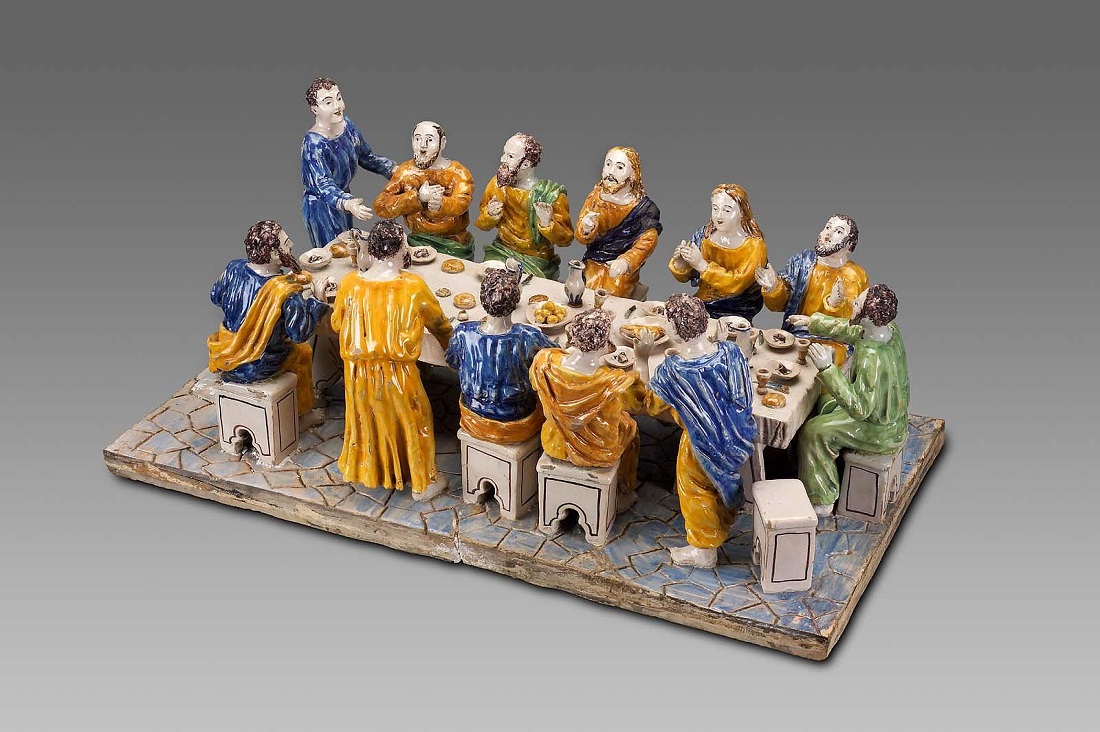
Roman Catholicism never missed an opportunity to present the guiding principles of Christianity in ways that believers and would-be believers could appreciate and enjoy. From soaring stained glass windows to the charming maiolica ensemble of movable figures at the Last Supper, Catholic art was on view everywhere one looked.


Maiolica model of the Last Supper, from Faenza, Italy, 1500's

Judged in this manner, Roman Catholic art represents an early - and very successful - form of corporate "branding." But there is one staggering difference. 

Modern-day public relations techniques emphasize sprightly images and upbeat banter to keep customers buying, consuming and buying some more in an endless cycle of happy days and Happy Meals. Roman Catholicism, by contrast, fixated upon the inevitable negation of earthly pleasure and human life by Death. 

The supreme symbol of Roman Catholicism is the Cross, the emblem based upon the crucifixion of Jesus. This form of torture and execution was reserved for slaves and criminals under Roman rule. 

Early Christians did not display the Cross, so terrible was the memory of Jesus' execution. Also, they lived in the daily expectation of the End Time. When the Apocalypse did not come, the brutal fact of Jesus' crucifixion remained. But so too, did the Christian believe that Jesus had secured redemption for them from sin, with the promise of immortal life for the souls of those who believed in him.

Death, Christ's death, has conquered death. 

This paradox, which St. Paul called the "scandal of the Cross," placed the reviled symbol of a slave's execution at the summit of human devotion, a place it still holds for millions. Christians, especially Roman Catholics, have created, collected and cherished works of art related to the Crucifixion since the Middle Ages and continue to do so. 


Aelbert Bouts, The Man of Sorrows, c.1525

From sublime depictions of the Crucifixion by Giotto and Velazquez to harrowing, nightmarish portraits of Jesus, like Aelbert Bouts' The Man of Sorrows, c. 1525, to tattooed images of the crucified Christ on human skin, the Cross is ubiquitous, recognizable to believers and detractors alike.

There will never - hopefully - be a final word on Christian art. For now, in a deeply troubled world, menaced by disease and war, Susanna Ivanic's Catholica is a much needed volume. To her, we will leave the final word.

The art of Catholicism is the art of the human condition. Devotional artworks that dwell on the gaze of the grieving mother or the lifeless body of Jesus resonate with the soul. They are designed to raise one's spirit and deepen one's reservoirs of faith, inspiring intense, reverential joy and pain.

***

Text: Copyright of Ed Voves, all rights reserved. 

Introductory Image: Cover art for Catholica by Suzanna Ivanic. Courtesy of Thames & Hudson

Diego de Atienza (Spanish, born in Ecuador, 1610) Monstrance, c. 1646. Silver gilt with enamel, cast, chased, and engraved: Height: 22 1/2 in. (57.2 cm) Metropolitan Museum of Art. The Friedsam Collection, Bequest of Michael Friedsam, 1931. #32.100.231a, b.

Pieter Bruegel the Elder The Fight Between Carnival and Lent, 1559,  Oil-on-panel: 118 cm × 164 cm (46 in × 65 in). Kunsthistorisches Museum, Vienna

Anonymous (Japan) The Arrival of the Europeans, early 1600's. Pair of six-panel folding screens; ink, color, gold, and gold leaf on paper: each screen: 41 3/8 in. × 8 ft. 6 5/8 in. (105.1 × 260.7 cm) Metropolitan Museum of Art.  Mary Griggs Burke Collection, Gift of the Mary and Jackson Burke Foundation, 2015. #2015.300.109.1, .2

Master of the Church Fathers' Border (German, late 15th century) The Mass of Saint Gregory, late 1400's. Metalcut with traces of hand-coloring; second state:  13-7/8 x 19-15/16 in.; 10-5/8 x 7-7/16 in. Metropolitan Museum of Art. Harris Brisbane Dick Fund, 1924 # 2448

Anonymous (Ethiopia) Diptych of Life of Virgin Mary, c. 1630's-1700. Wooden diptych: distemper, gesso and cloth, each painted panel having three registers, H x W x D: 51.7 x 43 x 2.5 cm (20 3/8 x 16 15/16 x 1 in.). Smithsonian National Museum of African Art. Gift of Ciro R. Taddeo in memory of Raffael and Alessandra Taddeo. #98-3-3

Anonymous (Mexico) Our Virgin & Child of Guadalupe, 1745. Oil on canvas:106 x 84.5 cm. Wellcome Library, London. #44828i

The Last Supper (Faenza, Italy), 1500's. Tin-glazed earthenware (maiolica): H. 8 1/2"; W. 12 5/6" (14 3/4" with base); L. 22 7/8" (24 1/2" with base) Museum of Fine Arts, Boston. Bequest of R. Thornton Wilson in memory of Florence Ellsworth Wilson  #1983.61

Aelbert Bouts & workshop (Netherlandish, ca. 1451/54–1549) The Man of Sorrows, c. 1525. Oil on oak: arched top, 17 1/2 x 11 1/4 in. (44.5 x 28.6 cm) Metropolitan Museum of Art.  The Friedsam Collection, Bequest of Michael Friedsam, 1931. # 32.100.55

Saturday, May 7, 2022

Art Eyewitness Review: Winslow Homer: Crosscurrents at the Metropolitan Museum of Art


Winslow Homer: Crosscurrents

Metropolitan Museum of Art
April 11 - July 31, 2022

Reviewed by Ed Voves

In the February 1878 issue of The Nation, the publication's art critic reviewed  the annual exhibition of the American Water-Color Society (AWS). One of the members of the AWS was Winslow Homer, famous as a war artist during the Civil War and now a leader among American watercolor painters. The art critic's assessment of Homer was extraordinarily perceptive: 

The always unexpected Mr. Homer, so certain to do something that nobody could have anticipated and that no inferior artist could do...

The Metropolitan Museum of Art has recently opened a new exhibition, Winslow Homer: Crosscurrents. The splendid array of 88 oil paintings and watercolors on view abundantly confirm Homer's status as one of America's greatest - and strikingly unconventional - artists. Focusing on one of the Met's signature works, The Gulf Stream, the exhibition makes a convincing case for Homer as a visionary painter with a strong social conscience.


Ed Voves, Photo (2022) Gallery view of Winslow Homer: Crosscurrents at the Metropolitan Museum of Art

A just-published biography, Winslow Homer: American Passage by Wlliam R. Cross (Farrar, Strauss and Giroux, 550 pages), provides much-needed detail to bolster this image of the great American artist. Together, the Met's exhibit and the new biography certainly help us to better understand Winslow Homer the man. Yet, despite the excellence of exhibition and book, the "always unexpected Mr. Homer" remains the ellusive, enigmatic Mr. Homer.

Winslow Homer (1836-1910) was born in Boston just as Ralph Waldo Emerson, Margaret Fuller and Henry David Thoreau launched the intellectual revolution known as Transcendentalism. Homer's family had only modest financial resources. This made Emerson's credo of "Self-Reliance" a necessity for Homer rather than a highminded style of living.

From early in his childhood, Homer demonsrated a remarkable skill in drawing. Just as he entered his teenage years, commercial opportunity beckoned. The newly devised lithograph process expanded the ablity to reproduce pictures for the mass-market publications being established in the U.S. during the 1850's. Homer's proficiency in drawing and designing for lithographs gained him commissions from Harper's Weekly, the New York-based journal which quickly came to dominate the American news industry. 


Thomas A. Gray, Portrait Photo of Winslow Homer, 1863.

So successful was the young artist from Boston that Harper's offered Homer one of its prestigious positions as a staff artist in 1860. With a regular salary and the cachet of Harper's name on his resume, Homer had scored a degree of professional success which was truly impressive.

And then, the "always unexpected Mr. Homer" confounded expectations. He rejected Harper's offer and set himself up as a freelance artist. He explained his audacious decision as being based on his "taste of freedom... I have had no master, and never shall have any."

The wisdom of preserving his autonomy was soon validated. Just as the Amercan union was fractured by the secession of the Southern slave-owning states in 1861, Homer was able to maintain an independent, unprejudiced eye on the ensuing events of the Civil War. Homer continued to sell Harper's illustrations, but he drew - and painted - what he saw, not what he was told to see by editors in New York.

Homer traveled to the front lines in early 1862 as the Union army struggled to advance toward Richmond, Virginia, capital of the insurgent Confederate States of America. Homer visited an elite unit of the Army of the Potomic, Berdan's Sharpshooters, and sent back a drawing to Harper's which appeared in its November 15, 1862 issue. 


After Winslow Homer. The Army of the Potomac - A Sharp-Shooter on Picket Duty, Harper's Weekly, Vol. VII, November 15, 1862

A Sharp-Shooter on Picket Duty was just the picture which readers in the North wanted to see: a combat-tested marksman, armed with the most advanced rifle of the day. The engraving testified to Union's willpower - and firepower - to achieve victory. 

That sentiment was not what Homer privately thought about the matter. 

When Homer interviewed the actual troopers of Berdan's regiment, they handed him one of their rifles so that he could peer through its telescopic sight. Through its lense, he could see a Confederate soldier stationed on the opposing side of the battle line. Homer was unnerved by the experience. 


Letter from Winslow Homer to George G. Briggs, 1896.
 Drawing shows Homer's view of a Confederate soldier though the telescopic sight of a sharpshooting rifle, 1862.

Years later, Homer wrote about this glimpse of war, with an illustrating sketch. "This is what I saw ... the above impression struck me as being near murder as anything I ever could think of in connection with the army & always had a horror of that branch of the service."


Anne Lloyd, Photo (2022) 
Winslow Homer's A Sharp-Shooter on Picket Duty, 1863

Homer's Civil War paintings, including a version of Sharp-shooter in oils, occupy a prominent place in the opening gallery of the Met exhibit. These include Prisoners from the Front, painted soon after the war ended in 1865. It was Homer's first "old master" caliber painting. Yet, this and his other war pictures proved to be a problematic achievement. 

For nearly three decades after the Confederate surrender, paintings related to the war remained out of favor. Overwhelmed by the scale of the wartime tragedy - an estimated 750,000 military deaths and uncounted civilian casualties - Americans wanted to forget. But the source of pain, like the sensation of an amputated leg or arm, remained. 

Homer needed to find a way to address this unspoken calamity and help his fellow Americans to rebuild their lives and their nation. Homer brilliantly succeeded, using an "unexpected" theme to do so. 

From witnessing impressions as "near murder as anything I ever could think of," Homer turned to recording the lives of children and young people. Humanity's life force, its joys and its challenges, was celebrated by Homer in oil paintings and watercolors that have come to be cherished as some of America's most beloved pictures.  

On the surface, paintings like Crossing the Pasture are exercises in nostalgia, depictions of childhood "innocence." There are certainly elements of "fond recall" in this wonderful painting, including personal memories. Homer maintained cordial relations with his own brothers, especially his older brother, Charles. But there was much more at work in this painting than merely hearkening back to boyhood memories.


Anne Lloyd, Photo (2022)  
Winslow Homer's Crossing the Pasture (Detail), 1871–72

Crossing the Pasture was painted in 1871-72. The date and the ages of the two boys are significant. The elder boy, carrying a switch to scare-off a menacing bull (not seen in this detail of the painting) is ten or eleven years old. He would have been born around the time of the Battle of Bull Run, the first great engagement of the war. The younger is aged about five or six years in age. His birth would have occurred around the time of General Lee's surrender at Appomattox.

The two boys in Crossing the Pasture, almost certainly brothers, might well be war orphans. But even if their father returned from the war, he was likely to have been crippled or emotionally shattered. Hundreds of thousands of Civil War vets, North and South, never fully recovered from their experience of combat.

These two youths live in a world largely devoid of older men. Despite the green fields and mountain air of Crossing the Pasture, the boys must make their way unaided through the first stages of life, confronting dangers with courage and mutual support.

The same is true for the girls and young women painted by Homer during the years following the Civil War - and Homer painted a lot of them. The war had opened the doors of economic and social opportunity to women, earning them widespread esteem. Though Homer never married, he held women in great respect, partly based on his affectionate relationship with his mother, a talented amateur artist.


Anne Lloyd, Photo (2022) Winslow Homer's Eagle Head, Manchester, Massachusetts (High Tide)(Detail),1870

Homer's young women are vigorous, self-reliant, not afraid to take risks. The protagonists in Eagle Head, Manchester, Massachusetts (High Tide) are anything but "shrinking violets." Yet, like the boys in Crossing the Pasture, the young women in Eagle Head live in decimated society. Men of their age are little in evidence. The military conflict is over but the "inner Civil War" stiil lingers on.

If an air of melancholy pervades many of Homer's paintings of children and young womanhood, he had achieved an admirable sense of emotional stability in several paintings created duiring the early 1870's. This balance was especially noticeable in works with a nautical theme. In outstanding paintings like Breezing Up, Homer evoked images of a harmonious, cooperative society. 


Anne Lloyd, Photo (2022)  
Winslow Homer's Breezing Up (A Fair Wind), 1876

Breezing Up, painted in 1876, the centennial year of America's independence from Great Britain, shows a catboat with a plucky crew of young boys and an older man, expertly sailing through choppy water. This is a vision of an America on course to greatness. 

Dangers, however, lurked beneath the waves. Despite his great 1870's success, Homer's mood began to darken. 


Anne Lloyd, Photo (2022)
 Winslow Homer's Undertow, 1886

n 1883, Homer witnessed the rescue of two women, caught in the undertow of the surf at the the resort of Atlantic City, New Jersey. The endangered women in his painting of the event might well be two of the protagonists from Eagle Head. This time they are rescured by heroic, well-muscled life guards, who had been absent from the earlier canvas.


Anne Lloyd, Photo (2022)
 Winslow Homer's Undertow (Detail), 1886

During the 1880's, there was a growing trend to depict heroic male figures, as in the popular frontier paintings of Frederic Remington. This is not likely to have been Homer's primary intention with Undertow. 

Homer had just returned from an extended two-year stay at a remote English fishing community when he observed the near-tragedy at Atlantic City. The experience of living in the village of Cullercoats, on the edge of the menacing North Sea, marked an important point of tranistion for the visiting American.


Anne Lloyd, Photo (2022)
 Winslow Homer's Inside the Bar (Detail), 1883

At Cullercoats, Homer painted a series of astonishing watercolors of strong women, wives, mothers and daughters of the fishermen who braved the cold, dangerous sea to earn their living. His theme with incredible pictures like Inside the Bar was the struggle of life, the often unequal confrontation of humanity with nature. 

In Breezing Up and other 1870's paintings, the protagonists of Homer's pictures seemed to be holding their own in the epic contest of human existence. The admirable fortitude of the Cullercoats "fishwives" continued the battle, with brave women and men still - if barely - winning. But with Undertow in 1883, the tide of fate, literally, began to change. 

Death was cheated of victory in Undertow - this time. Two years later, Homer painted three works, two in oils, the other a watercolor study, in which human survival is anything but assured.


Anne Lloyd, Photo (2022)
 Winslow Homer"s The Fog Warning (Halibut Fishing) (Detail),1885

The first work, The Fog Warning (Halibut Fshing) shows a Grand Banks fisherman rowing his catch-laden dory back to the fishing schooner as fog begins to settle over the sea. Two ominous "fingers" of the fog bank, rising in the sky, command his attention. Unless he can reach the schooner before the fog completely shrouds the sky, he will be doomed, as is the case in the second painting of the series, Lost on the Grand Banks.

The peril faciing the Grand Banks fishermen is made even more explicit in the 1885 watercolor, Sharks (the Derelict). A dismasted schooner, adrift in tropical waters, is being swarmed by a school of sharks. There is no sign of the crew. Have they been saved by a distant ship, barely visible on the horizon or have they met a grisley fate?


Winslow Homer, Sharks (the Derelict), 1885

Homer kept the watercolor for future reference. All the while, the existential struggle of human beings with nature, and by extention with modern industrial society, was reflected in his paintings. 

As the last decade of the nineteenth century progressed, Homer painted numerous seascapes, filled with surging waves and lashing sprays of salty foam. Then in 1899, Homer returned to Sharks (the Derelict) as he prepared to paint what many believe is his greatest masterpiece, The Gulf Stream.

Many of Homer's late-career seascapes show no trace of human beings, as is the case with Sharks (the Derelict). In The Gulf Stream, Homer has placed Man in all of his tragic nobility back on the center stage of the canvas. Moreover, this soletary hero is an African-American sailor, as classically proportioned as any Greek hero in Hellenistic art.


Winslow Homer, The Gulf Stream, 1899

The backstory of The Gulf Stream is brilliantly surveyed in the new biography,  mentioned above, Winslow Homer: American Passage by Wlliam R. Cross. As the book and the Met exhibit testify, Homer portrayed African-Americans in many pictures with a degree of respect and honesty rare for the late 1800's. But with The Gulf Stream, Homer transcended his earlier, positive appreciations of the humanity of African-Americans by making the imperiled sailor a stand-in for all human beings. He is Everyman.

The late 1890's were the heyday of Symbolism in art. Certainly, The Gulf Stream can be appreciated as an exploration of the mysteries of life and death. There are traces of Homer's personal life in the picture, as well. His father had died recently and his own health was beginning to fail. Mortality was knocking on his door.

Homer, in his later years, lived in difficult times. Like the fisherman in The Fog Warning, he was rowing against the tide, in his case, of current social events. I feel that that harsh economic conditions, beginning with the Crash of 1873, must have affected Homer's sensitive spirit. Likewise, the hopes of a "new birth of freedom" were fading as Reconstruction was curtailed in 1877.


Anne Lloyd, Photo (2022)
 Gallery view of the Winslow Homer: Crosscurrents exhibition at the Metropolitan Museum of Art, showing Homer's The Foxhunt

In 1893, during the gestation-period of The Gulf Stream, Homer painted The Fox Hunt. It is his biggest canvas, a fascinating, if bleak, view of nature oblivious of man or civilization. Yet the theme of Foxhunt is the same as in Homer's paintings with human protagonists. Life is a struggle. A hungry fox, floundering in the snow, is being pursued by equally hungry crows. The predator has become the prey.


Ed Voves, Photo (2022) 
Winslow Homer's The Fox Hunt (Detail), 1893

The Fox Hunt has been described as a Darwinian "survival of the fittest" picture. If combined with some of his other late career works, including The Gulf Stream, a case could be made that the aging Homer had surrendered to world-weary despair.

However, Winslow Homer: Crosscurrents at the Met offers abundant evidence that far from resigning himself to fate, or hiding away from the world, this great American artist embraced life's experiences, in fair wind and foul weather.


Anne Lloyd, Photo (2022)  Winslow Homer's Northeaster, 1895

Throughout his life, Winslow Homer was energized by the struggle of life, not repulsed by it. He waited until the beaches cleared of summer tourists and as the sea boomed and the ocean spray splattered him, he propped-up his easel.


Anne Lloyd, Photo (2022)  
Winslow Homer's Early Morning After a Storm at Sea, 1900–1903

Then Homer set to work, creating clear-eyed impressions of the natural world - as he saw it. These views we can still appreciate today, provided we are willing to look and to see and to feel with a degree of honesty equal to his.

***

Text and photos: Copyright of Ed Voves, all rights reserved. Original Photos: Copyright of Anne Lloyd                                                                                         

Images courtesy of the  Metropolitan Museum of Art

Introductory Image: Winslow Homer (American, 1836–1910) The Gulf Stream (Detail), 1899

Ed Voves, Photo (2022) Gallery view of the Winslow Homer: Crosscurrents exhibition at the Metropolitan Museum of Art

Thomas A. Gray (American, active 1860's) Portrait Photo of Winslow Homer, 1863. Albumen silver print: Image/Sheet: 9.4 x 5.6cm (3 11/16 x 2 3/16") National Portrait Gallery, Smithsonian Institution.

After Winslow Homer. The Army of the Potomac - A Sharp-Shooter on Picket Duty (from Harper's Weekly, Vol. VII, November 15, 1862) Wood engraving: 9 1/8 x 13 3/4 in. (23.1 x 35 cm.) Metropolitan Museum of Art. Harris Brisbane Dick Fund. #29:88.3(5).

Metropolitan Museum of Art exhibit wall-text. Letter from Winslow Homer to George G. Briggs, 1896. Drawing shows Homer's view of a Confederate soldier through the telescopic sight of a sharpshooting rifle, 1862.

Anne Lloyd, Photo (2022) Winslow Homer's A Sharp-Shooter on Picket Duty, 1863. Oil on canvas: 12 1/4 X 16 1/2 In.  Portland (Maine) Museum of Art. Gift of Barbro and Bernard Osher. #1992.41

Anne Lloyd, Photo (2022)  Winslow Homer's Crossing the Pasture (Detail), 1871–72. Oil on canvas: 26 1/4 × 38 in. (66.7 × 96.5 cm) Amon Carter Museum of American Art, #1976.37

Anne Lloyd, Photo (2022) Winslow Homer's Eagle Head, Manchester, Massachusetts (High Tide)(Detail), 1870. Oil on canvas: 26 x 38 in. (66 x 96.5 cm) The Metropolitan Museum of Art, Gift of Mrs. William F. Milton, 1923. # 23.77.2

Anne Lloyd, Photo (2022)  Winslow Homer's Breezing Up (A Fair Wind), 1876. Oil on canvas: height: 61.5 cm (24.2 in); width: 97 cm (38.1 in) National Gallery of Art, Washington D.C. #1943.13.1

Anne Lloyd, Photo (2022) Winslow Homer's Undertow, 1886. Oil on canvas: 29 13/16 x 47 5/8 in. (75.7 x 121 cm). The Clark Art Institute. #1955.4

Anne Lloyd, Photo (2022) Winslow Homer's Inside the Bar (Detail), 1883. Watercolor and graphite on off-white wove paper: 16 x 29 in. (40.6 x 73.7 cm)  The Metropolitan Museum of Art, Gift of Louise Ryals Arkell, in memory of Bartlett Arkell, 1954. #54.183

Anne Lloyd, Photo (2022) Winslow Homer"s The Fog Warning (Halibut Fishing), 1885. Oil on canvas:  30 1/4 x 48 1/2 in. (76.83 x 123.19 cm).  Museum of Fine Arts, Boston. #94.72

Winslow Homer (American, 1836–1910) Sharks (the Derelict), 1885. Watercolor over graphite on wove paper: 14 1/2 x 20 15/16 in. (36.8 x 53.2 cm.) Brooklyn Museum of Art. #78.151.4

Winslow Homer (American, 1836–1910) The Gulf Stream, 1899. Oil on canvas:  28 1/8 x 49 1/8 in. (71.4 x 124.8 cm). The Metropolitan Museum of Art, Catharine Lorillard Wolfe Collection, Wolfe Fund, 1906. # 06.1234

Anne Lloyd, Photo (2022) Gallery view of the Winslow Homer: Crosscurrents exhibition at the Metropolitan Museum of Art, showing Homer's The Foxhunt from the collection of the Pennsylvania Academy of the Fine Arts.

Ed Voves, Photo (2022) Winslow Homer's The Fox Hunt (Detail), 1893. Oil on canvas: 38 x 68 1/2 in. (96.5 x 174.0 cm). The Pennsylvania Academy of the Fine Arts, Joseph E. Temple Fund. #1894.9

Anne Lloyd, Photo (2022)  Winslow Homer's Northeaster, 1895; reworked by 1901.  Oil on canvas: 34 1/2 x 50 in. (87.6 x 127 cm) The Metropolitan Museum of Art, Gift of George A. Hearn, 1910. #: 10.64.5

Anne Lloyd, Photo (2022)  Winslow Homer's Early Morning After a Storm at Sea, 1900–1903.Oil on canvas: 30 1/4 x 50 in. (76.8 x 127 cm) The Cleveland Museum of Art, Gift of J. H. Wade (1924.195)