Sunday, January 22, 2023

Art Eyewitness Review: The Ronald S. Lauder Collection at the Neue Galerie


The Ronald S. Lauder Collection

The Neue Galerie, New York City

November 11, 2022 - March 20, 2023

Reviewed by Ed Voves

November 11, 2001 was not a particularly favorable moment to open a new art museum in New York City. Exactly one month before, terrorist attacks had destroyed the World Trade Center, the death toll eventually being reckoned at 2,753. Over two hundred more were killed in related acts of 9/11 terrorism. New York City, America and the civilized world were stunned.

Despite the shock, Ronald Lauder went ahead with opening the doors to his splendid museum, located at 1048 Fifth Avenue, at 86th Street. The Neue Galerie, named for a famous German art gallery from the 1920’s had been conceived nearly thirty years before to showcase art from one of the most glittering, yet controversial, eras in modern history, the art of Germany and Austria, 1890-1940. 


View of the Neue Galerie entrance. 
Photo: courtesy of Neue Galerie New York

When it opened in the autumn of 2001, the Neue Galerie achieved that goal and more. It quickly became a beacon of culture, an affirmation of civilization in a time of cruelty and horror.

Twenty-plus years later – the Neue Galerie remains so.

The Neue Galerie is currently hosting a special exhibition to celebrate its first two decades. The exhibit is not so much a look back, but rather surveys Ronald Lauder’s devotion to art and humanity, sixty-five years of collecting works of art from an impressive range of genres and historical eras. 

On view in The Ronald S. Lauder Collection are Greek and Roman portrait busts, works of medieval devotional art, gold-ground paintings from the early Renaissance in Italy, spectacular examples of knightly armor from the 1400's-1500's and, of course, Austrian and German art from that all-too-brief flowering of genius and creativity in the half-century before World War II.

The Ronald S. Lauder Collection, on view until March 20, 2023, might seem a slight departure from the thematic range of many of the nearly fifty special exhibitions which the museum curators at the Neue Galerie have mounted since March 2003. The premier exhibit examined the hard-hitting realism of German art during the 1920's, Christian Schad and the Neue Sachlicheit. 

Since then, Neue Galerie curators have addressed many provocative issues, such as the self-portraits created by German and Austrian artists during the run-up to World War II. Even with the 2018 exhibition of the paintings of Franz Marc and August Macke, one of the most beautiful art shows I have ever witnessed, the staff curators at the Neue Galerie have never flinched, never dodged serious, unsettling aspects of art.


German Weimar-era art from The Ronald S. Lauder Collection
  Photo: Hulya Kolabas, courtesy of Neue Galerie New York

One of the main galleries utilized for the present exhibition is devoted to the Neue Sachlicheit era, brilliant, brittle, sexually-charged. Aside from these often disturbing remains of Weimar Germany, this exhibit is a joy to behold. 


Entrance to The Ronald S. Lauder Collection at Neue Galerie New York Photo: Hulya Kolabas, courtesy of Neue Galerie New York

Beginning with its opening work of art, a wonderful late medieval tapestry, The Ronald S. Lauder Collection is a marvelous evocation of collecting, preserving and displaying cherished works of art.


Pasquier Grenier, Loggers Tapestry, 1460-1470

The galleries devoted to Ronald Lauder's collection of Renaissance-era armor and classical statuary are magnificent arrays of art, each piece a major work in its own right, and collectively part of a forthright assertion of the continuing importance of these masterpieces. The Neue Gallerie curators have displayed Lauder's treasures to brilliant effect, testifying that these time-honored pieces have lost none of their power.


Installation view of The Ronald S. Lauder Collection at Neue Galerie New York. Photo: Hulya Kolabas, courtesy of Neue Galerie New York

A skeptic visiting the Neue Galerie might take issue with including armor from the 1500's and ancient statues as being at odds with the impact of the Neue Galerie exhibits in the years since 2003. Might the display of gleaming Renaissance armor and the marble faces of Roman emperors be somewhat out-of-place (or out-of-date) in a museum noted for thoughtful examinations of the Nazi campaign against Modernism or insightful surveys of the sensual art of Egon Schiele? 


Egon Schiele, Triple Self-Portrait, 1913

The answer to any such fault-finding speculation is an emphatic no.

Each of the works of art on view in The Ronald S. Lauder Collection testifies to astute, judicious standards of selection. Each can provide serious matter for reflection, if we are willing to make the effort.

After considering this splendid collection as an integrated assemblage, I feel that that there is a common theme which links the interests of Ronald Lauder to the important issues which the Neue Galerie has explored in the years since its founding. This unifying theme is nothing less than the constant threat of disintegration and collapse facing Civilization and the resilience of artists and patrons when human society confronts a perilous future.

The great era of Austrian and German art, 1890-1940, was such an time.  Gustav Klimt, Kolomon Moser and other Neue Galerie luminaries lived in an age fraught with political and social tension, psychological anxiety and challenges to cultural norms whose roots stretched back to the Middle Ages. 


Carl Moll, White Interior, 1905

We marvel, for instance,  at the exquisite silver Coffee Service designed by Josef Hoffman and created by the Weiner Werkstatte in 1907-1908, or the goulash plates Hoffman designed for the Cafe Fledermaus. Looking at these gleaming objects or at Carl Moll's 1905 painting, White Interior, it is hard to conceive of this period of history as anything but a blissful time of  gemütlichkeit. 

And yet...

These were years lived in the shadow of the 1898 assassination of the Empress Elizabeth. These were years when the drumbeat of war would result in a needless, futile conflict which led to the total destruction of the Austro-Hungarian Empire. And finally, these years climaxed in the 1918 pandemic, the misnamed Spanish influenza, which killed thousands in Vienna including Egon Schiele and his pregnant wife.


Austrian gallery from The Ronald S. Lauder Collection
  Photo: Hulya Kolabas, courtesy of Neue Galerie New York

The contrast between such grim historical realities and artistic beauty is especially marked in the gallery devoted to Austrian artists and designers like Klimt and Hoffman. But if we look closely at the faces of the Greek and Roman leaders displayed in the room devoted to ancient art, we will find traces of anxiety and ironic feeling not far different from what we see in the modern German and Austrian portraits painted by Klimt, Schiele, Oskar Kokoschka, Otto Dix, George Grosz and Christian Schad. 

A brief look at the identity of just a few of the ancient "faces" in the Lauder collection will dispel any temptation to place them in some Olympian "hall of fame." 


Ancient portrait busts from The Ronald S. Lauder Collection
  Photo: Hulya Kolabas, courtesy of Neue Galerie New York

The top, left-hand, bust is that of Julius Caesar, struck-down by his colleagues in the Roman Senate. Next to Caesar is Alexander the Great, whom a number of historians conclude was likely poisoned by his generals. Who the tousled-hair individual on Alexander's left is not known, but his fearful expression hardly equates with any sense of ancient serenity. Appearing below this trio is Livia Drusilla, the "poisonous" empress well-known to readers of I, Claudius by Robert Graves. Next to Livia is Trajan Decius, the first Roman emperor killed in battle, when a wave of Germanic marauders breached Rome's frontier defenses in the year 251.

Did Ronald Lauder and the curators at the Neue Galerie organize this display of ancient portraits to make a statement on the fragility of political power or the fickleness of fate? Most-likely not, but the accompanying wall text shows a great awareness of two of the major features of classical sculpture, namely the constant probing of the human psyche and experimentation in depicting bodily movement and facial expression by ancient artists. 

The urge to escape the static sensibility of pre-Classical art, in order to better convey reality through the rendering of the human figure, gave impetus to experimentation. This resulted in the visual play that focused on the contrast between taut and relaxed forms and between balance and static equilibrium. The search for movement on the basis of observation resulted in the development of a new canon for the representation of the body.

This dynamism in charting the way that the human body looks and moves, as well as the powerful emotional forces at work beneath the skin, unite these ancient portraits with those of later eras. 


Monumental Head of a Goddess, mid-second century BCE

It is no coincidence that we are able to study the Hellenistic Greek masterpiece, Monumental Head of a Goddess in the same exhibition as Gustav Klimt's Adele Bloch-Bauer I, 1907, the "goddess" of the Neue Galerie collection. 


Gustav Klimt, Portrait of Adele Bloch-Bauer I, 1907

Between these ancient and modern depictions of human face and form, there was the thousand-year medieval era. These were the Dark Ages to scholars and art lovers of a certain cast of mind, an Age of Faith to others. What we can say is that around the time that the Emperor Justinian I ordered the closing of the Platonic Academy in the year 529, the conventions of art shifted almost exclusively to other-worldly, religious themes. 

Since the Neue Galerie collection and special exhibitions concentrate on German and Austrian art, 1890-1940, religious art is rather conspicuous by its absence at the museum. One could hardly expect otherwise, as one of the major thinkers of that era had declared that God was dead!

It comes as no small surprise that The Ronald S. Lauder Collection exhibition is graced by a magnificent display of treasures from the Middle Ages, the early Renaissance and the Baroque period in Italy. All three historical eras were notable for the religious sentiment of artists, scholars and the general populace. Almost all of the works displayed are devotional objects with the exception of a chess piece from the famous Lewis Hoard, discovered in Scotland, but most likely made in Norway, ca. 1200.


       Early Renaissance paintings from The Ronald S. Lauder Collection          Photo: Hulya Kolabas, courtesy of Neue Galerie New York

The range of art works in this stunning, golden-hued gallery include two sculpture fragments from the Romanesque period, Head of an Apostle, from Thérouanne in northeast France, ca. 1235, and Torso of Christ Crucified, Southern French, ca. 1140. There is also a striking bishop's staff or Crozier, carved from ivory, accented in paint and gold. The crozier, made in Tuscany, dates to the mid-1300's. 

When the bishop's crozier was first gripped in hand, a symbol of high clerical status, the religious doctrines and social concepts of Christendom were beginning to shift to a more "this-worldly" stance. This occurred initially in Italy. We can observe this trend in the striking array of gold-ground paintings, mounted to splendid effect on a simulated stone wall. 

Here we see small devotional scenes, mounted on backgrounds covered with delicate layers of gold leaf, as in Byzantine icons. Many of these works come from predella panels, series of episodes from the life of Christ or the Acts of the Apostles, painted at the base of altarpieces. 

These include paintings by artists whose pioneering contributions have been obscured by High Renaissance titans like Raphael and Michelangelo. Exceptional works are on view, like the small roundel depicting the Prophet Isaiah by Lorenzo Monaco, ca 1410-1415, and the powerful interpretation of the features of Saint Paul, attributed to Lippo Memmi, one of the masters of the distinctive style of painting in Siena during the 1300's. 


Bernardo Daddi, Madonna and Child with Four Angels, 1348

My favorite among these gold-ground masterpieces is the panel painting by Bernardo Daddi showing the Virgin Mary holding the infant Jesus, adored by four angels. Daddi, who is believed to have been trained by the great Giotto, was one of the leading Florentine painters of the 1300's. Combining  elements of Giotto's physicality with the gracefulness of Sienese painting, this is a pivotal work in the shift from the medieval conception of art to that of the Renaissance.

The four angels are almost entirely based on the canons of christian imagery. The golden halos of the angels in the foreground obscure the heads and necks of the angels in the rear. There is hardly any differentiation in the faces of the angels. Even the color of the robes match, light-green in front, creamy front. The bodies of the Virgin Mary, likewise, hearken back to medieval ideals, including Byzantine art. But with Daddi's depiction of the faces of the Virgin and Child, an awesome leap forward to a new art form, both human and divine, has been made.

Look closely at the eyes of Mary and Jesus. They focus upon each other, knowingly and tenderly. This is the electrifying moment in the lives of each mother and baby when they both recognize each other. However, there is an added note, a hold-over from Christian iconography. In that the perceptive look of the Christ child dawns the first moment of awareness of his destiny, again both human and divine.

If one is looking to pinpoint the moment of transition from the art of the Middle Ages to that of the Renaissance, a good choice would be Daddi's Madonna and Child, created around 1348. This was in the midst of the Black Death. It was a horrible time to live, but just when such inspirational art is needed most. 

If Bernardo Daddi's Madonna and Child represents the shift from medieval art to the Renaissance, to compare this painting with Kurt Schwitters' Untitled, 1921, would seem to be totally inexplicable. No two works of art, the Italian "primitive" of 1348 and the post World War I Dada collage, could be further apart. Or maybe not.


Kurt Schwitters, Untitled, 1921

Daddi's Madonna and Child is a devotional work, painted with rare color pigments and backed with tooled gold leaf. Kurt Schwitters' Untitled is one of his "Merz" constructions or collages. Merz was a word initially related to bits of refuse, to be used wherever and whenever needed. For Schwitters that became all the time. His Merzbilden (Merz pictures) led in due course to Merz sculptures, Merz buildings and Merz poems. When Schwitters had to flee Nazi persecution, he took his Merz theory of art with him into exile, first to Norway and then to England where he died in 1948.

Schwitters, like Daddi, lived during difficult, seemingly apocalyptic, times. But he endured and so did the motivational spirit impelling him to create art. Merz is the art of survival and of connecting with others. 

When I look at the abstract composition of Schwitters' Untitled from 1921, I see geometric forms and blocks of color coming together in a mutual embrace, in a manner very much like Daddi's Madonna cradling the Infant Jesus in her arms, their faces tenderly touching.

Am I correct in this unorthodox compare/contrast? Yes or no, there are certainly unifying threads - ideas and ideals, aspirations and inspiration -which draw great works of art and great artists together. This bond of unity is discernible in all of Ronald Lauder's treasures on view at the Neue Galerie. One can only be grateful to him and to the curators and staff of the Neue Galerie, itself a work of art.

This is the appropriate moment to highlight the role of Serge Sabarsky in the Neue Galerie saga. A great art curator and an enthusiast for German and Austrian art, Sabarsky played a crucial role in planning the Neue Galerie, but sadly died before it opened.


Anne Lloyd, Photo (2022) View of Cafe Sabarsky at the Neue Galerie

As a way to preserve Sabarsky's memory, the museum's restaurant is named in his honor. Cafe Sabarsky replicates a cafe from Old Vienna with light fixtures designed by Josef Hoffmann, furniture by Adolf Loos and upholstery from a 1912 Otto Wagner design. There are gleaming mirrors and a Bosendorfer grand piano which is used for cabaret, chamber and classical music performances. The menu serves outstanding Viennese cuisine and there is an endless supply of gemütlichkeit. 


Anne Lloyd, Photo (2022) Apple strudel at Cafe Sabarsky

I have never traveled to Vienna, nor has my wife, Anne. It does not look like we will be going there any time soon. 

However, to paraphrase a line from the movie, Casablanca (of which Ronald Lauder is a great admirer): "We'll always have the Neue Galerie."

***

Text: Copyright of Ed Voves. Original Photos: Anne Lloyd, All rights reserved      

Introductory image: Ronald S. Lauder in his home, 2022. Photo: Shahar Azran. Image courtesy Neue Galerie New York

View of the Neue Galerie entrance. Photo: courtesy of Neue Galerie New York

German Weimar-era art from The Ronald S. Lauder Collection. Photo: Hulya Kolabas, courtesy of Neue Galerie New York

Entrance to The Ronald S. Lauder Collection exhibition. Photo: Hulya Kolabas, courtesy of Neue Galerie New York

Workshop of Pasquier Grenier (Flemish, 1447–1493), The Loggers Tapestry, ca.1460–70, unbleached and polychrome wool. Private Collection. Image courtesy Neue Galerie New York

Installation view of The Ronald S. Lauder Collection exhibition. Photo: Hulya Kolabas, courtesy of Neue Galerie New York

Egon Schiele (Austrian, 1890-1918), Triple Self-Portrait, 1913. Watercolor, gouache, and pencil on paper. Private Collection. Image courtesy Neue Galerie New York

Carl Moll (Austrian, 1861-1945) White Interior, 1905. Oil on Canvas. Private Collection. Image courtesy Neue Galerie New York

Monumental Head of a Goddess, Greek, Hellenistic, ca. mid-second century BCE. Marble. Private Collection. Image courtesy Neue Galerie. Photo: Hulya Kolabas, courtesy of Neue Galerie New York. 

Gustav Klimt (Austrian, 1862–1918) Portrait of Adele Bloch-Bauer I,
1907. Oil, gold, and silver on canvas. Neue Galerie New York. Acquired
through the generosity of Ronald S. Lauder, the heirs of the Estates of
Ferdinand and Adele Bloch-Bauer, and the Estée Lauder Fund

Early Renaissance paintings from The Ronald S. Lauder Collection exhibition. Photo: Hulya Kolabas, courtesy of Neue Galerie New York

Bernardo Daddi (Italian, Florence, active ca. 1312/20; died 1348),
Madonna and Child with Four Angels (Central predella panel from the
San Giorgio a Ruballa altarpiece), Florence, 1348, tempera and gold on
panel. Private Collection. Image courtesy Neue Galerie New York

Kurt Schwitters (German, 1887-1948) Untitled (Yours Treufrischer),1921. Oil, paper, metal, cotton, wool, and button nailed on board. Private Collection. Image courtesy Neue Galerie New York

Anne Lloyd, Photo (2022) View of Cafe Sabarsky at the Neue Galerie.

Anne Lloyd, Photo (2022) Apple Strudel at Cafe Sabarsky.


Sunday, January 8, 2023

Art Eyewitness Looks at the Art Scene in 2022


Reflections on the Art Scene during 2022

Text by Ed Voves

Original Photography by Anne Lloyd

If it is possible to savor the events of a year like a fine wine, then 2022 was truly a vintage experience for Art Eyewitness. Indeed, the number of outstanding exhibitions was so great, especially during the final quarter of the year, that several reviews are still waiting to be posted.

During 2022, Art Eyewitness covered outstanding exhibitions of the work of Sean Scully, Winslow Homer, John Singer Sargent, Edward Hopper, Winold Reiss, Hans Holbein, Maxfield Parrish, Henri Matisse and Amedeo Modigliani. Just to name a few.


Anne Lloyd, Photo (2022) Gallery view of the Edward Hopper's New York exhibit at the Whitney Museum, New York City
2022 was also a year to celebrate great institutions. December 2022 marked the 100th anniversary of the Barnes Foundation; November was the 20th year since the Neue Galerie opened its welcoming doors to art lovers eager to see beloved works of German and Austrian art like Gustav Klimt's The Woman in Gold. 


                                  Anne Lloyd, Photo (2022)                                      Gallery view of the Barnes Foundation, showing Henri Matisse's The Dance mural, 1932-33.

The Barnes Foundation and the Neue Galerie have provided many memorable "art moments" and Art Eyewitness essays celebrating them will be forthcoming in the new year.

Ironically, the most significant Art Eyewitness encounter with great art during 2022 took place in a train station rather than a museum gallery.

This "learning experience" occurred on November 19th, the Saturday of the Philadelphia Marathon weekend. Oblivious of the scheduled race, my wife, Anne, and I ventured to downtown Philadelphia for an early morning photo shoot. 

To our surprise, all of our return bus connections were cancelled or redirected because of the Marathon. To get home, we had to travel via train from 30th Street Station.


Anne Lloyd, Photo (2022) 
The Pennsylvania Railroad World War II Memorial,
30th Street R.R. Station, Philadelphia, PA

Living in Philadelphia, Anne and I are no strangers to 30th Street Station. In the main concourse of 30th Street is an imposing monument to the employees of the Pennsylvania Railroad company who were killed during World War II. Incredibly, the names of 1,307 men from the "Pennsy" are listed on the bronze plaques at the base of the statue. Think of it, 1,307 human lives lost to war, all workers from just one company!

From atop the base of the Pennsylvania Railroad World War II Memorial, rises The Angel of the Resurrection. This 28-foot bronze sculpture depicts St. Michael the Archangel embracing the soul of a dead soldier or seaman, one of the casualties of the second "War to end all Wars." 

This deeply moving work of art was sculpted by Walker Hancock (1901–1998), long-time instructor at the Pennsylvania Academy of the Fine Arts. Hancock, one of the "Monuments Men" who helped save works of art stolen by the Nazis, created a masterpiece which literally halts one in their tracks - if you take the time to stop and look. 

That's the problem with Hancock's Angel of the Resurrection. The angel looms-up over the vast concourse, its wings folded behind, cradling the soul of the dead G.I. And we - whose freedom was safeguarded by this sacrifice - rush by the statue to hail a taxi or run for a bus.


Anne Lloyd, Photo (2022) 
Side view of Walker Hancock's Angel of the Resurrection

I have stopped, from time-to-time, to admire The Angel of the Resurrection. Mostly, though, I pass the winged guardian in a late afternoon hurry. What was different on that November Saturday was the time of day when we were at 30th Street - a little before noon - and the light conditions. Sunlight was pouring through the South-facing, four-story widows.

The light bathing the two figures set the left side of the statue aglow. The bronze wing, facial features, the robed figure of the angel and the nude torso of the slain warrior were caressed by the southern light, contrasting with the veil of shadows on the opposite side. This incredible contrast, almost conflict, between light and dark, calls to mind a state of war and the ultimate sacrifice of the citizen soldiers whose names appear below.


Anne Lloyd, Photo (2022) 
Detail of Walker Hancock's Angel of the Resurrection

The shock-effect of viewing Walker Hancock's Angel of the Resurrection was made even more profound when we looked at the photos Anne took. Being "in the right place, at the right time" assumed a deeper significance with later reflection. This effect keeps on increasing in the vein of thought and feeling, the more we think and feel about it.

In short, the attention-grabbing sight of The Angel of the Resurrection on a Saturday morning in November 2022 perfectly illustrates the "Art Moment." From the retina of our eye to our brain to our soul, Art becomes part of our lives. 

The year 2022 brought quite a few of these moments, along with the joy of returning to art museums and galleries, enjoying the company of fellow art lovers and observing their evident pleasure.


Anne Lloyd, Photo (2022) Gallery view of the Philadelphia Museum of Art, showing patrons viewing Claude Monet's Japanese Footbridge and the Water Lily Pool, Giverny, 1899

Over and over again, Anne and I encountered large, enthusiastic crowds in the galleries. The long lines of visitors waiting to see the Matisse in the 1930's exhibit at the Philadelphia Museum of Art, during the Christmas-New Year holiday week, was truly a sight to behold.


Anne Lloyd, Photo (2022)
 Interior view of the Philadelphia Museum of Art, Dec. 28, 2022, showing patrons waiting to see the Matisse in the 1930's exhibit

We especially noted large numbers of children and young people in the galleries during 2022. I was particularly touched to see a dad explaining a  painting to a very-young art lover at the Whitney Museum's Edward Hopper’s New York exhibition (October 19, 2022–March 5, 2023). 


Anne Lloyd, Photo (2022) Gallery view of Edward Hopper's New York, showing Hopper's House at Dusk, 1935

Crowded galleries were also a feature of the Met's long-awaited exhibit, The Tudors: Art and Majesty. But the sight of a young woman, deep in thought before a portrait of the much maligned monarch, Queen Mary, is one of the most vivid memories I have of this memorable exhibition.


                                     Ed Voves, Photo (2022)                                    Gallery view of The Tudors: Art and Majesty

In many ways, the Metropolitan Museum of Art set the tone for 2022 with a major exhibition, earlier in the year, Winslow Homer: Crosscurrents. The exhibit later traveled to the National Gallery in London.


Anne Lloyd, Photo (2022)
Gallery view of Winslow Homer: Crosscurrents
at the Metropolitan Museum of Art

Born in Boston, Winslow Homer (1836-1910) first made his mark as an artist for popular magazines like Harper's Weekly shortly before the outbreak of the Civil War. From being a talented recorder of current events, Homer immortalized America's "new birth of freedom."


Anne Lloyd, Photo (2022)
 Winslow Homer's A Sharp-Shooter on Picket Duty (detail), 1863

The drawings Homer made at the battle front and the paintings he produced on his return are some of the most important visual records of the Civil War. The 1861-65 conflict marked Homer for life - even his lyrical paintings of children produced in the years afterward were a reaction to the horror of the war.


Anne Lloyd, Photo (2022)
 Winslow Homer's The Gale, 1883-1893

The aftershock of the Civil War and the difficult realities of life during the Gilded Age infused Homer's oeuvre. His seascapes were beset by storms and shipwrecks, culminating in The Gulf Stream (1899). 


Ed Voves, Photo (2022)
 Winslow Homer's The Gulf Stream, 1899

This painting of the stoical courage of an African-American sailor in the face of calamity anchored the Met's exhibit. There seldom was a time during my two visits to Winslow Homer: Crosscurrents when there was not a throng of fascinated visitors grouped before it.

Adversity is a feature of all great artists' lives, usually at the beginning of their careers, with a "dry" period after some hard-earned success. That was certainly true of Henri Matisse during the late 1920's. While his paintings were earning him a comfortable income, Matisse was increasingly condemned by his fellow Modernists for producing "play safe" works recalling Old Masters like Ingres.


Anne Lloyd, Photo (2022) 
Gallery view of Matisse in the 1930's at the Philadelphia Museum of Art, showing The Chant Fireplace mural (1938)

Matisse in the 1930's at the Philadelphia Museum of Art (October 20, 2022–January 29, 2023) details the great French master's decade-long campaign of reinvention. The curators of the Philadelphia Museum of Art and the two French museums where the exhibition will travel later in 2023 collected a huge array of signature Matisse "Thirties" paintings but also works of sculpture, drawings for limited edition books and set designs for the ballet. 

 Art lovers able to come to Philly for Matisse in the 1930's have the opportunity to see the key work of Matisse's "decisive" decade, which will not be travelling to France. This is the mural, The Dance, created for Dr. Albert Barnes. It's on view - permanently - at the Barnes Foundation, a couple blocks from the Philadelphia Museum of Art.  


Anne Lloyd, Photo (2022) 
Gallery view of the Modigliani Up Close exhibition at the Barnes Foundation, showing Amadeo Modigliani's Head, 1911-12

Also on view at the Barnes is the exhibit, Modigliani Up Close. This examination of Modigliani's brief career did not stress his personal difficulties and private demons - of which he had many. Instead, the curators analyzed Modigliani's technique and his use of blocks of limestone, secured from Parisian building sites, and second-hand canvases to create a new "temple of beauty."

Although Modigliani's brief, tortured life was not used as a morality tale by the Barnes curators, there is one lesson which it is appropriate to mention here. Artists must work with a finite supply of time as well as paint, canvas, clay and stone. "Modi" had very little time to make his mark. The same is often true for art scholars and museum curators. 

Alan Solomon (1920-1970) had less than three years at the Jewish Museum of New York to propel the rather staid museum into the vanguard of 1960's-style Modernism. The board of directors of the Jewish Museum were often perplexed by the dynamic Solomon's support for up-and-coming artists like Richard Rauschenberg, Roy Lichtenstein and Marjorie Strider. But as shown in the sensational 2022 exhibit, New York, 1962-1964, the effect of Solomon's controversial tenure was transformative. 


Anne Lloyd, Photo (2022) 
Gallery view of New York:1962-1964, showing Roy Lichtenstein's Thinking of Him,1963, & Marjorie Strider's Girl with Radish,1963

New York, 1962-1964 shared a feature with all of the exhibitions mentioned here. At least in part, these phenomenal displays of art were planned and organized during the Covid-19 pandemic years. In the case of New York, 1962-1964, preparing the exhibition was made vastly more difficult by the death of the great Italian scholar leading the project. Germano Celent died from Covid-19 before seeing the project to completion. The 2022 exhibition at the Jewish Museum was a worthy testimonial.

2022 is already in the rear-view mirror and there is much to look forward to as we prepare for 2023. I don't have a crystal ball to predict the future events. But, as the sun comes up on a new year and the hard-working staff of the museum PR departments begin to post notices of coming exhibitions, I can share a few tips on what's in store for the coming year.


Anne Lloyd, Photo (2023)
 Winter Dawn and Prism, January 2023

A host of exhibits are being prepared to honor Picasso, fifty years after his death in 1973. The Guggenheim has one planned, Young Picasso in Paris, May 12, 2023 - August 7, 2023. Georgia O’Keeffe: To See Takes Time will debut at MOMA, April 09, 2023 – August 12, 2023. An exhibition of ancient art, which I am particularly looking forward to, entitled Tree and Serpent, Buddhist Art in Early India, is scheduled to open July 17, 2023 - December 3, 2023 at the Met. 

I have all three of these exhibits marked on my calendar, but I am finding it hard to let go of the fabulous 2022 exhibitions, especially since some still have a few weeks to go and I have reviews to post!

So, let's take a few more moments to reflect on 2022. Let's summon up our memories of great art and great people. Let's not rush by, ignoring The Angel of the Resurrection and other memorials and testimonials to those who have sacrificed so much for our welfare.


Anne Lloyd, Photo (2022) 
 Gallery view of Matisse in the 1930's, showing two versions of Henri Matisse's Window at Tahiti, 1935

I am going to pause and meditate on the miracle of human creativity. I am going to sit down and meditate, like the fellow in the jaunty jacket at the Matisse in the 1930's exhibit (above). 

 "Let Freedom Ring!" That is what the letters spell-out on his colorful jacket. I am going to take some time to think on those words, to remember and to be grateful for the gifts of art and life and liberty. 

***

Text: Copyright of Ed Voves, all rights reserved                                      Images copyright of Anne Lloyd, all rights reserved.

Introductory Image: Anne Lloyd, Photo (2022) Walker Hancock's The Angel of the Resurrection (detail) from the Pennsylvania Railroad World War II Memorial, 30th Street Station, Philadelphia, PA., August 10, 1952. 

Anne Lloyd, Photo (2022) Gallery view of Edward Hopper's New York at the Whitney Museum, showing Edward Hopper's Self-Portrait,1925–30. Oil on canvas: 25 3/8 × 20 3/8 in. (64.5 × 51.8 cm). 

Anne Lloyd, Photo (2022)  Gallery view of the Barnes Foundation, Philadelphia, PA., showing Henri Matisse's The Dance mural, 1932-33.

Anne Lloyd, Photo (2022) The Pennsylvania Railroad World War II Memorial. Walker Hancock's Angel of the Resurrection, sculpted, 1950, and dedicated, August 10, 1952 at 30th Street Station, Philadelphia, PA. Bronze statue: 28 ft (8.53 m.) on 11 ft. (3.35) black granite base. The base has two inscribed dedications and four bronze plaques listing the  1,307 Pennsylvania Railroad employees who were killed in World War II.

Anne Lloyd, Photo (2022) Gallery view of the Philadelphia Museum of Art, showing patrons viewing Claude Monet's Japanese Footbridge and the Water Lily Pool, Giverny, 1899.

Anne Lloyd, Photo (2022) Interior view of the Philadelphia Museum of Art, December 28, 2022, showing patrons waiting to see the Matisse in the 1930's exhibition

Anne Lloyd, Photo (2022) Gallery view of Edward Hopper's New York, showing Hopper's House at Dusk, 1935.

Ed Voves, Photo (2022)  Gallery view of The Tudors: Art and Majesty, showing Patron viewing Hans Eworth's Mary I, 1554. Collection of the Society of Antiquaries, London

Anne Lloyd, Photo (2022) Gallery view of Winslow Homer: Crosscurrents at the Metropolitan Museum of Art

Anne Lloyd, Photo (2022) Winslow Homer's A Sharp-Shooter on Picket Duty (detail), 1863. Oil on canvas: 12 1/4 x 16 1/2 in. Portland (Maine) Museum of Art #1992.41

Anne Lloyd, Photo (2022) Winslow Homer's The Gale, 1883-1893. Oil on canvas: 30 1/4 x 48 5/16 in. (76.8 x 122.7 cm)  Worcester Museum of Art, Museum Purchase. #1916.48

Ed Voves, Photo (2022) Winslow Homer's The Gulf Stream, 1899. Oil on canvas: 28 1/8 x 49 1/8 in. (71.4 x 124.8 cm). The Metropolitan Museum of Art

Anne Lloyd, Photo (2022)  Gallery view of the Matisse in the 1930's exhibition at the Philadelphia Museum of Art, showing The Chant Fireplace mural (1938) painted by Matisse for Nelson Rockefeller.

Anne Lloyd, Photo (2022) Gallery view of the Modigliani Up Close exhibition at the Barnes Foundation, showing Amadeo Modigliani's Head, 1911-12. Limestone: 25 x 6 x 8 1/4 in. ( 63.5 x 15.2 x21 cm.) Guggenheim Museum. #55.1421

Anne Lloyd, Photo (2022) Gallery view of New York:1962-1964, showing Roy Lichtenstein's Thinking of Him, 1963. Collection of Yale University Art Gallery, New Haven, and Marjorie Strider's Girl with Radish,1963. Ruth and Theodore Baum Collection.

Anne Lloyd, Photo (2023) Winter Dawn and Prism, January 2023. 

Anne Lloyd, Photo (2022)  Gallery view of the Matisse in the 1930's exhibition at the Philadelphia Museum of Art, showing two versions of Henri Matisse's Window at Tahiti, 1935.


Saturday, December 31, 2022

Art Eyewitness Review: Portraits of the Tudor Dynasty


Art Eyewitness Review:
 Portraits of the Tudor Dynasty


Reviewed by Ed Voves
Original photography by Anne Lloyd

The Tudor Dynasty has been holding court at the Metropolitan Museum of Art since early October 2022. The Tudors: Art and Majesty is a magnificent display of royal patronage of the arts during the Renaissance. The exhibition spans five reigns, 1485-1603, one of the most tumultuous eras of British history. 

When The Tudors: Art and Majesty closes at the Met on January 8, 2023, most of its treasures will be transported to the Cleveland Museum of Art and then to the Legion of Honor Museum in San Francisco. The concept of a traveling exhibition like this is worthy of Tudor court procedure. The Tudors were restless sovereigns, moving from one palace to another in a seasonal cycle of pleasure-seeking and political control.

Under Elizabeth I, the range of these journeys was extended to the country estates of the English nobility and the leaders of the Church of England. These visits or "progresses" by Her Majesty were more like military invasions. Elizabeth and hundreds of her court officials, ladies-in-waiting, guardsmen, grooms and servants would descend upon the selected country house in the expectation of being wined, dined, entertained - and obeyed.

Since every English aristocrat of standing might have the dubious honor of "hosting" Elizabeth and her court, it was imperative to be prepared. The first order of business was to commission a portrait of Queen Bess and keep it ready for prominent display when - and if - the occasion required.


Anne Lloyd, Photo (2022)
 Queen Elizabeth I (The Darnley Portrait), 1576

Very few country houses dating to the Tudor era exist today, many of them having been put to the torch during the English Civil War, 1642-51. But a large number of portraits of Elizabeth I have survived and an astounding number of these have been gathered together for display in The Tudors: Art and Majesty. 


Nicholas Hilliard, The Heneage Jewel, ca. 1595-1600

By my count there are a dozen portraits of Elizabeth I, in various media, on display in this remarkable exhibition. These form a mini-exhibit within the overarching Tudors: Art and Majesty, grouped for the most part in an imposing array in the final gallery. 


Anne Lloyd, Photo (2022)
 Elizabethan portraits on view at The Tudors: Art and Majesty 

Portraits of the Tudor monarchs are a unifying thread throughout the exhibition. Several depict Elizabeth's formidable father, Henry VIII. Two of these are of outstanding merit, a small, but psychologically penetrating, oil study by Hans Holbein the Younger; the other is a full-length portrait by Holbein and his assistants.


Anne Lloyd, Photo (2022)
 Hans Holbein the Younger's Henry VIII of England, ca. 1537

Every member of the Tudor family has at lest one portrait on view in the exhibition with the exception of Lady Jane Grey, who was the great-niece of Henry VIII and nominated to the succession list by Henry and later by Henry's short-lived son, Edward VI. Lady Jane was indeed placed on the throne by palace intrigue - much to her reluctance - after Edward died in 1553. She only lasted nine days. A counter-coup ousted her in favor of Edward's Catholic sister, Mary. 

Lady Jane, the "Nine Days Queen" was beheaded before she could have her official portrait painted.

Portraits were hugely important to the Tudors as a sign of their legitimacy. Despite their vast power, the Tudors were never entirely secure on the throne of England. Henry VIII literally moved "heaven and earth" to get a male heir to succeed him. 

At the cost of severing England's ties to the Roman Catholic faith, Henry achieved his goal, as we can see in the portrait of his son and heir, the infant Edward VI by Hans Holbein the Younger. 


Anne Lloyd, Photo (2022)
 Edward VI as a Child by Hans Holbein the Younger, 1538

This picture of chubby-cheeked health was an exercise in wishful-thinking. Edward was frail and sickly throughout his short life. 


Ed Voves, Photo (2022)
 Edward VI, attributed to Guillim Scrots, ca. 1547-50

Soon after he succeeded Henry VIII in 1547, Edward was painted again, this time by a Flemish artist named Guillim Scrots. Much less talented than Holbein, who had died in 1543, Scrots had the difficult task of making Edward appear to be much more healthy than he was. He therefore depicted the young monarch in profile, basking in the rays of the Sun - whose questioning expression rather undermines the ploy.

The Tudor monarchs, like most of the European dynasties of the time, commissioned portraits of their eligible princes and princesses for the "marriage market." Sending such portraits was the initial step in arranging marriages and military alliances. 

This brings us to one of the most fascinating paintings on view in The Tudors: Art and Majesty. Long thought to be a portrait of Katherine of Aragon, Henry VIII's ill-fated first wife, it has recently been established that the red-haired princess is Mary Tudor, sister to Henry VIII.


Anne Lloyd, Photo (2022)  
Michael Sittow's portrait of Mary Tudor, ca. 1514

As befitted a Tudor princess, Henry's favorite sister was fondly known as Mary Rose. She was reputed to be the most beautiful princess in Europe, but her handsome looks proved to be less than a blessing. In 1514, Mary Rose was married to King Louis XII of France, an elderly widower in his fifties. Three months after the wedding, Louis suddenly died.  

Mary Rose was left in an intolerable position - an eighteen year-old widow, with no children and thus no standing in French court politics. Because of her youth and beauty, Mary Rose retained some value as a bargaining "chip" for Henry to use for another marriage-alliance. But she was a strong-willed Tudor and determined to take charge of her own life. Defying Henry's rage, Mary Rose married her secret lover, the Duke of Suffolk.


Anne Lloyd, Photo (2022)  
Michael Sittow's portrait of Mary Tudor, and, at right, Mary's Book of Hours, created by the Master of Claude de France, ca. 1495-1500

In a nice touch, the Met's curators re-united Mary Rose's portrait with her prayer book, displayed side-by-side in the exhibition. This is very appropriate, as Mary Rose was very devout and opposed Henry's break with Rome. She died of natural causes in 1533, before being forced to take the oath of allegiance to Henry as Head of the Church of England. 

Mary Rose Tudor secured her personal freedom by marrying the man of her choice. Another Tudor queen achieved unparalleled political power by remaining unwed and independent. This was, of course, Elizabeth I, the "Virgin Queen."

Elizabeth's portraits reflect her decision to remain unmarried. Initially, while there were diplomatic moves to secure a suitable husband for her, Elizabeth's features remained fairly close-to-life on her early portraits. The Darnley Portrait, painted in 1575 by an unknown, probably Flemish, painter and The Hampden Portrait (1567), by the English-born George Gower, are notable examples of early, accurate likenesses of Elizabeth.


Ed Voves, Photo (2022) 
 Elizabeth I (The Hampden Portrait), attributed to George Gower, 1567

As Elizabeth's reign progressed, a cult of the "Virgin Queen" was instituted to  promote a unified, Protestant culture in England in opposition to the Papacy and Roman Catholicism. Traditionally, there had been great reverence in England for images of the Virgin Mary, mother of Jesus, but this now was supplanted by extreme manifestations of patriotic loyalty, verging on idolatry, for Elizabeth. Little room remained for Holbein's style of portrait painting - majestic to be sure, but also astutely revealing of the inner self of his subjects.

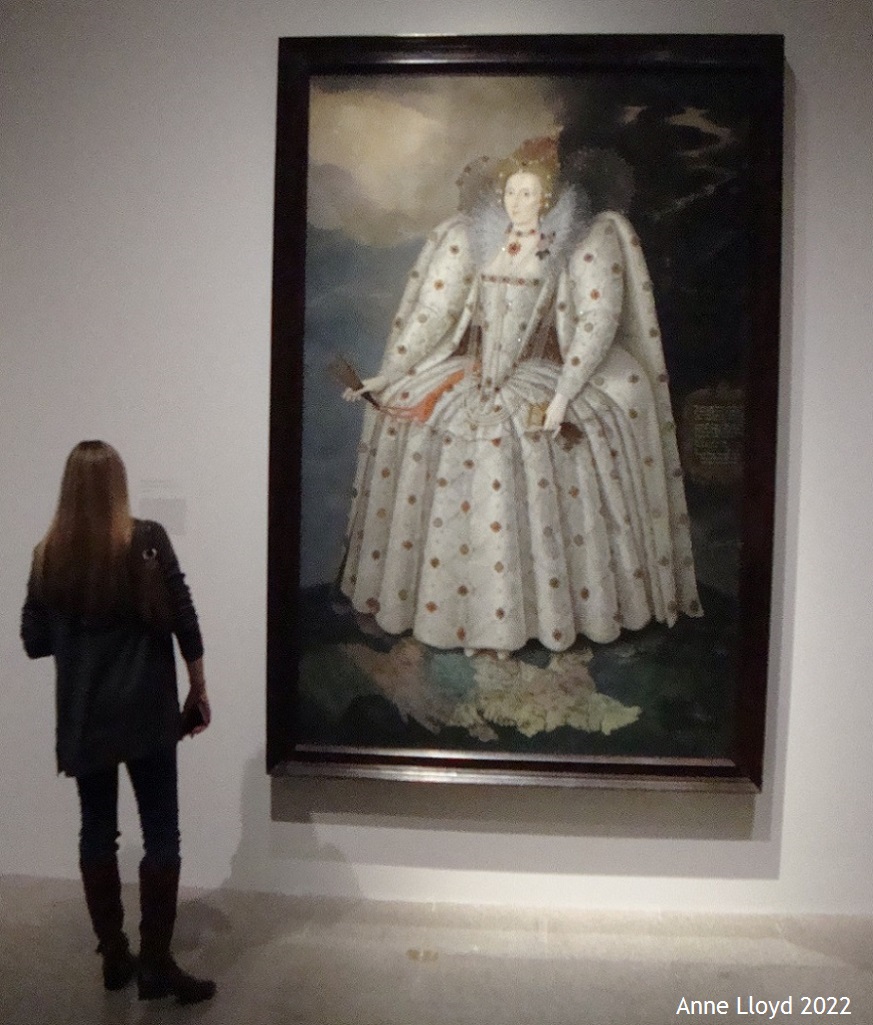
A sense of humanity began to drain away from the facial features of Elizabeth, especially following the defeat of the Spanish Armada in 1588. Over and over again, a strange, sharp-featured doll's face emerges from under a bejewelled red wig and extravagant lace collars. 


Anne Lloyd, Photo (2022)
 Gallery view of The Tudors: Art and Majesty showing Queen Elizabeth I (The Ditchley Portrait), by Marcus Gheeraerts the Younger, ca.1592

The very fabric of Elizabeth's gowns was laden with symbolic representations. On the skirt of the Hardwick Portrait, dating to 1598-99, an astonishing array of embroidered land and sea creatures testifies to the expansion of English power under Elizabeth.


Anne Lloyd, Photo (2022) Detail of the Hardwick Portrait of Elizabeth I. Attributed to the Workshop of Nicholas Hilliard, ca.1598-99
 
Interestingly, a dragon is prominently displayed on the Hardwick Portrait skirt. Dragons were associated with India during the 1500's. 


Plans were under discussion for organizing an English merchant company to trade with India around the time this painting, attributed to Nicholas Hilliard, was created. The East India Company received its charter from Elizabeth I in 1600, the first step towards British rule of India during the 1800's. 


Anne Lloyd, Photo (2022)
 The Rainbow Portrait of Elizabeth I.
 Attributed to Marcus Gheeraerts the Younger, ca. 1602

The process of transforming Elizabeth into an Icon of State culminated with the 1602 Rainbow Portrait. It is a surreal, unsettling work. The doll's face has been discarded for a human likeness, but not one that really resembled the elderly Elizabeth. This is not merely an idealized portrait but is, rather, the image of a "Fairie Queen" as the poet Edmund Spensor called Elizabeth. 


A coiled snake, supposedly representing wisdom, appears on one sleeve of this mythological Elizabeth who wields a rainbow in her right hand. A bizarre motif of eyes and ears is stitched on to Her Majesty's gown. Sovereign over land, sea and sky, able to see all and hear all, such is "Glorianna."

A year later, the Virgin Queen was dead. 

The last of the Tudors left no direct heir. The Scottish king, James Stuart, did have some Tudor blood in his veins. Equally important, James had a brilliant, handsome and charismatic son, Prince Henry Frederick. The English government swallowed their pride and invited James - and by extension young Prince Henry - to take the crown.

All signs pointed to future success. The legacy of the Tudor dynasty, a strong Protestant England, now loosely united to Scotland, seemed assured, provided Prince Henry succeeded James.


Anne Lloyd, Photo (2022)
 Henry Frederick, Prince of Wales, by Robert Peake the Elder, 1603

The final work of art, on view in The Tudors: Art and Majesty, is a magnificent portrait of Prince Henry as he draws his sword to deliver the coup d'grace to a wounded stag. It was painted in 1603, soon after his father assumed power as King James I of England. 


The future promise, which seemed so certain with this fascinating portrait of a model Renaissance prince, never transpired. 

In 1612, Prince Henry fell ill from typhoid fever and died. His brother Charles, whose character was a dangerous mixture of obstinate stubbornness and irresolution, tried and failed to create a Renaissance Arcadia when he was crowned King of England, Scotland and Ireland in 1625. The English Civil War and the Puritan Revolt under Oliver Cromwell followed in due course, with the execution of Charles I in 1649 as the ultimate result.

When Prince Henry perished, the last vestiges of the Tudor dynasty died with him, leaving only a few, rare talismans of their glory to hang on museum walls. The fact that so little remains of the lost world of England during the 1500's, makes The Tudors: Art and Majesty a truly "once in a lifetime" museum experience.


Anne Lloyd, Photo (2022) Gallery view of The Tudors: Art and Majesty exhibition at the Metropolitan Museum of Art

Like the monarchs of the fabled dynasty it celebrates, The Tudors: Art and Majesty will not be soon forgotten.

***
Text and photos: Copyright of Ed Voves, all rights reserved                        Original photos: Copyright of Anne Lloyd, all rights reserved

Introductory Image: Anne Lloyd, Photo (2022) Detail of The Rainbow Portrait of Elizabeth I. 

Anne Lloyd, Photo (2022) Queen Elizabeth I (The Darnley Portrait), by an Unknown Netherlandish Painter, 1576. Oil on canvas: 44 1/2 x 31 in. (113 x 78.7 cm) National Portrait Gallery, London.
 
Nicholas Hilliard (British, 1547-1619) The Heneage Jewel, ca. 1595-1600. Enameled gold, table-cut diamonds, Burmese rubies, rock crystal, and a miniature on vellum: 2 3/4 x 2 in. (7 x 5.1 cm) Victoria and Albert Museum, London

Anne Lloyd, photo (2022) Elizabethan portraits on view at The Tudors: Art and Majesty, Metropolitan Museum of Art. 

Anne Lloyd, Photo (2022) Hans Holbein the Younger's Henry VIII of England, ca. 1537. Oil on panel, 11 × 7 7/8 in. (28 × 20 cm) Museo Nacional Thyssen-Bornemisza, Madrid (191 [1934.39])

Anne Lloyd, Photo (2022) Edward VI as a Child by Hans Holbein the Younger,  1538 Oil on panel: 22 3/8 × 17 5/16 in. (56.8 × 44 cm) National Gallery of Art, Washington, D.C. (1937.1.64)

Ed Voves, Photo (2022) Edward VI, attributed to Guillim Scrots, ca. 1547-50.  Oil on panel: 22 13/16 × 26 3/4 in. (58 × 68 cm) Compton Verney  Art Gallery and Park, Warwickshire, U.K.

Anne Lloyd, Photo (2022) Mary Tudor, Later Queen of France and Duchess of Suffolk Michel Sittow (1468–1525/26) ca. 1514 Oil on panel, 11 5/16 × 8¼ in. (28.7 × 21 cm) Gemäldegalerie, Kunsthistorisches Museum, Vienna (GG 5612)

Anne Lloyd, Photo (2022) Gallery view of The Tudors: Art and Majesty showing  Michael Sittow's portrait of Mary Tudor, and, at right, the Book of Hours of Mary of England, Queen of France, created by the Master of Claude de France, ca. 1495-1500, with additions: 1514. Tempora on vellum: 5 3/8 x  3 3/16 x  9/16 in. (13.7 x 9.7 x 1.5 cm).  Bibliotheque Municipale de Lyon.

Ed Voves, Photo (2022) Gallery view of of The Tudors: Art and Majesty, showing Elizabeth I (The Hampden Portrait). Attributed to George Gower, Oil on canvas: transferred from panel: 77 3/16 × 55 1/8 in. (196 × 140 cm) Private collection. 

Anne Lloyd, Photo (2022) Gallery view of The Tudors: Art and Majesty showing Queen Elizabeth I (The Ditchley Portrait), by Marcus Gheeraerts the Younger, ca. 1592. Oil on canvas: 95 x 60 in. (241 x 152 cm) National Portrait Gallery, London. 

Anne Lloyd, Photo (2022) Details of the Hardwick Portrait of Elizabeth I, ca.1598-99. Attributed to the Workshop of Nicholas Hilliard. Oil on canvas: 91 7/16 × 66 1/4 x 1 7/16 in. (232.3 × 168.3 x 3.7 cm) National Trust, Hardwick Hall, the Devonshire Collction.

Anne Lloyd, Photo (2022) The Rainbow Portrait of Elizabeth I. Attributed to Marcus Gheeraerts the Younger, ca. 1602. Oil on canvas: 50 3/8 × 40 in. (128 x 101.6 cm) Marquess of Salisbury, Hatfield House, Hertfordshire, U.K.

Anne Lloyd, Photo (2022) Henry Frederick, Prince of Wales, with Sir John Harington on the Hunting Field, by Robert Peake the Elder, 1603. Oil on canvas: 79 1/2 × 58 in. (201.9 x 147.3 cm) Metropolitan Museum of Art.