Showing posts with label Thomas Cole. Show all posts

Monday, July 8, 2019

From the Schuylkill to the Hudson: Landscapes of the Early Republic at the Pennsylvania Academy of Art


 From the Schuylkill to the Hudson: Landscapes of the Early Republic


Pennsylvania Academy of the Fine Arts
June 28–December 29, 2019

Reviewed by Ed Voves
Original photos by Anne Lloyd

'"Thus in the beginning all the World was America."

This often-quoted statement by John Locke in his Second Treatise of Government (published in 1689) is acutely relevant to an outstanding exhibition on the birth of landscape art in the United States. This splendid, beautifully-mounted exhibit recently opened at the Pennsylvania Academy of the Fine Arts in Philadelphia (PAFA).


Anne Lloyd, Photo (2019) 
Gallery views of the From the Schuylkill to the Hudson: Landscapes of the Early Republic exhibition at the Pennsylvania Academy of the Fine Arts 

Locke commented on the way that human beings originally lived in a state of nature.  He contrasted this primal life-style with habitation in a civil society based on legal codes enforced by the rule of political authority.

"America" for Locke was the great example of the state of nature. God, Locke wrote. "who hath given the World to Men in common, hath also given them reason to make use of it to the best advantage of Life, and convenience. The Earth, and all that is therein, is given to Men for the Support and Comfort of their being."

A century later, after the English-speaking colonists had asserted political independence from Britain, their relationship to the natural world became a matter of great importance. The Patriots having won the War of Independence, "America" was now theirs to "make use of it to the best advantage of Life, and convenience."

Charles Thomson, secretary of the Continental Congress, proposed in 1782 that a quote from the Roman poet Virgil be modified to appear on the Great Seal of the United States, Novus Ordo Seclorum. The motion passed but the idea of "a New Order of the Ages" no longer corresponded to Locke's conception of "America" as a virgin wilderness. After a century of using the lands along the Atlantic seaboard for "the Support and Comfort of their being," few Americans now lived in a "state" of nature.


Anne Lloyd, Photo (2019) Joshua Shaw’s Landscape with Farmhouse and Castle, 1818

In 1790, George Washington and the freshly-minted United States Government launched into the serious business of nation-building. The U.S. capital was the most-populous and centrally-located of America's cities, Philadelphia. As Washington's administration and the First Congress wrestled with the many problems facing the fledgling nation, Philadelphia-based artists addressed the challenges of visually representing "a New Order of the Ages" for their country.

This crucial moment in the history of the United States is where the PAFA exhibition comes in. The exhibit has a rather unusual name (which we will discuss) but it really is vital to think of it in terms of the birth of landscape art in the U.S and of the cultural identity crisis which occurred during the 1820's and 1830's.

The PAFA exhibition is entitled From the Schuylkill to the Hudson: Landscapes of the Early Republic. The Hudson River, because of its relation to New York City, is well-known, but what or where is the Schuylkill?


Pierre VarlĂ©, Plan of the City and Its Environs, 1798

This map of Philadelphia shows the grid of the city between the shallow, meandering Schuylkill River on the left and the deep-water Delaware on the right.

The Schuylkill is one of two rivers which flow around the central and oldest part of Philadelphia. Schuylkill means "hidden creek," a name conferred on it by Dutch explorers in the 1600's. Unlike the much larger Delaware River, the Schuylkill is a shallow stream, limiting its use by ocean-going ships. To make the Schuylkill more usable for "the Support and Comfort of their being," Philadelphians tried a number of economic strategies like the use of steamboats and the digging of one of the first canals in the U.S., opened in 1825.

Philadelphia's claim to greatness during the early 1800's, once the political capital had moved to Washington D.C., was the Fairmount Water Works.

Designed in 1812, the Fairmount Water Works consisted of a pumping station and reservoir to supply the city with fresh water from the Schuylkill. Ironically, this impressive facility was conceived and approved on the mistaken assumption that the devastating 1793 Yellow Fever epidemic, which killed half of Philadelphia's population, had been caused by polluted water. Mosquitoes were the real culprit, but the "Watering Committee" had indeed acted wisely. Even Charles Dickens, no great admirer of Americans, was impressed with the Fairmount Water Works when he visited the United States in 1842.


Anne Lloyd, Photo (2019)  Detail of Thomas Birch's Fairmount Water Works, 1821

The stately, neoclassical  edifice of the Fairmount Water Works became so famous that the image was used to decorate Chinese export porcelain, made for the U.S. market.


Unknown artist (China), Cup and Saucer showing the Philadelphia Water Works, 1825

The image of "American" nature which the early Philadelphia artists used time-and-again was one of "progress" and utility, as well as charm and beauty. Philadelphia's merchant elite built country homes on the banks of the Schuylkill and the Delaware where they could watch the movement of their steamboats and coal-laden canal barges.

To give them credit, Philadelphia's "movers and shakers" devoted a considerable amount of effort and money on the arts. The redoubtable Peale brothers, Charles and James, played a dual role as major portrait painters and civic leaders. Not only did the Peales paint the proud "face" of America's prominent leaders and citizens, they also depicted the countryside of the new American nation as we can see in the setting of this family portrait by James Peale.


James Peale, The Artist and His Family, 1795

The Peale brothers were leaders in the founding in 1805 of the Pennsylvania Academy of the Fine Arts. The first art school in the U.S., PAFA provided budding artists with the skills to paint or sculpt images of "progress" for the new Republic.

What should have been a straightforward American success story quickly became rather complicated. For one thing,  most of the painters involved  in the Philadelphia-based landscape movement were named Thomas: Thomas Birch, Thomas Doughty, Thomas Cole and Thomas Moran.

The real wrinkle in this story is the fact that three of these artists named "Thomas" were born in England. A number of early America's leading artists like Benjamin West and John Singleton Copley had traveled to Britain around the time of the Revolution, never to return. These young British-born artists looked to the New World to make their fortune.

Thomas Birch's panoramic view of the Fairmount Water Works and the Schuylkill River is perhaps the greatest of the "landscapes of progress" which preoccupied American artists during the early 1800's. Birch painted this exceptional landscape in 1821, epitomizing the virtue and hard work needed to create the Novus Ordo Seclorum in America.


Thomas Birch, Fairmount Water Works, 1821

Birch, however, had achieved success painting naval battles featuring U.S.S. Constitution, "Old Ironsides," during the War of 1812. Increasingly, Birch favored maritime drama over the domestic harmony of the Fairmount Water Works and country homes. This yearning for adventure was the American equivalent of the celebration of the "sublime" in nature taking place in British art at the same time.

America had plenty of "sublime" of its own. Upstream of the Fairmount Water Works was the "Falls of the Schuylkill" and for those willing to venture into the frontier region of the U.S. there was the breath-taking Niagara Falls. Already famous from drawings made by British military engineers during the 1700's, Niagara with its awesome, cascading streams of water began nudging the Fairmount Water Works off the sketch-books and easels of American artists. 


William Russell Birch, Falls of Niagara, 1827

Thomas Birch's father, mercifully name William, caught a case of "Niagara" fever. Highly regarded for a series of urban views of Philadelphia which he created shortly after arriving in the U.S., Birch, Senior, plunged headlong into the wilderness with this 1827 enamel on copper view of  Niagara Falls. Interestingly, he chose a close-cropped focus for this miniature scene, with an Iroquois warrior to give a sense of scale. This was an appreciation of "America" worthy of John Locke - and of a rising generation of Americans whose gaze was increasingly directed westwards. 

"Stay-at-homes" could also savor the sublime with views of Niagara Falls on their dinnerware as with this magnificent lead-glazed earthenware serving dish. It was made by the British firm, William Adams and Sons, at some point between 1834 to 1850. 


Anne Lloyd, Photo (2019) 
William Adams & Sons Factory & Thomas Cole, The Falls of Niagara, U.S., 1834-1850

The image on the Adams and Sons serving dish was based on a painting by Thomas Cole (1801-1848).  Born in Lancashire, Cole came to America in 1817. His family's fortune had been ruined in an economic downturn in England. Though largely self-taught, Cole did study for a time at PAFA from 1823 to 1825. He then departed for an extensive sketching and painting tour of New York state, at that time still heavily-forested and sparsely populated. It was Cole who made the definitive turn in U.S. art from "Arcadia" inspired landscapes to the rugged, authentic American scene of the Hudson River School.

That is the canonical version of U.S. art history. A major exhibition in 2018, presented by the Metropolitan Museum of Art and the National Gallery in London, examined Cole's decisive contributions to American culture. Thomas Cole's Journey: Atlantic Crossings also investigated the influence of J.M.W. Turner, John Constable and other leading British artists upon Cole when he returned to Britain for a study-visit in 1827. Atlantic Crossings was a wonderful exhibit - but did not address in any detail the early formative contributions of the Philadelphia art scene to Cole's success.

That the "Schuylkill River School" laid the foundation of the more famous Hudson River School is the theme of the PAFA exhibition. It would be incorrect, however, to assume that PAFA's From the Schuylkill to the Hudson was planned as a rebuttal to Atlantic Crossings at the Met. Exhibitions take many years to plan. For over a decade, Dr. Anna O. Marley, PAFA's Curator of Historical American Art, has been studying the origins of American landscape art, dating back well before 1800.


Anne Lloyd, Photo (2019)
 Dr. Anna O. Marley, PAFA's Curator of Historical American Art. Dr. Marley stands next to Thomas Birch’s The Residence of James Craig, Bristol, Pennsylvania, ca.1820-21

No less an authority than Thomas Cole would have agreed with Dr. Marley on the accomplishments and example of the Philadelphia-based landscape artists. Speaking later in his life to the art historian, William Dunlap, Cole said as a young artist that "his heart sunk as he felt his deficiencies in art when standing before the landscapes of Birch."

Cole more than made-up for his "deficiencies." He became a national cultural figure and that is how we should view the rise of landscape painting in the early Republic. This was not an either/or process, Philadelphia vs. New York. The artists involved, whether the many "Thomases" or John Lewis Krimmel, Joshua Shaw, Russell Smith  and Asher Durand, all had one objective. It was to discover and accurately depict the authentic American landscape.

The key discovery was the need to go back to primal nature, Locke's "America," or as close as the artists could reach. It did not matter whether they were members of a Schuylkill River School or a Hudson River School. Their paintings played a leading role in a national trend. Beginning In the 1820's, Americans began to search for their identity in art, literature, religion and philosophy. James Fenimore Cooper, after writing dull English-style novels, dropped this derivative format, selecting American frontier history as the subject for his immortal "Leatherstocking" tales.
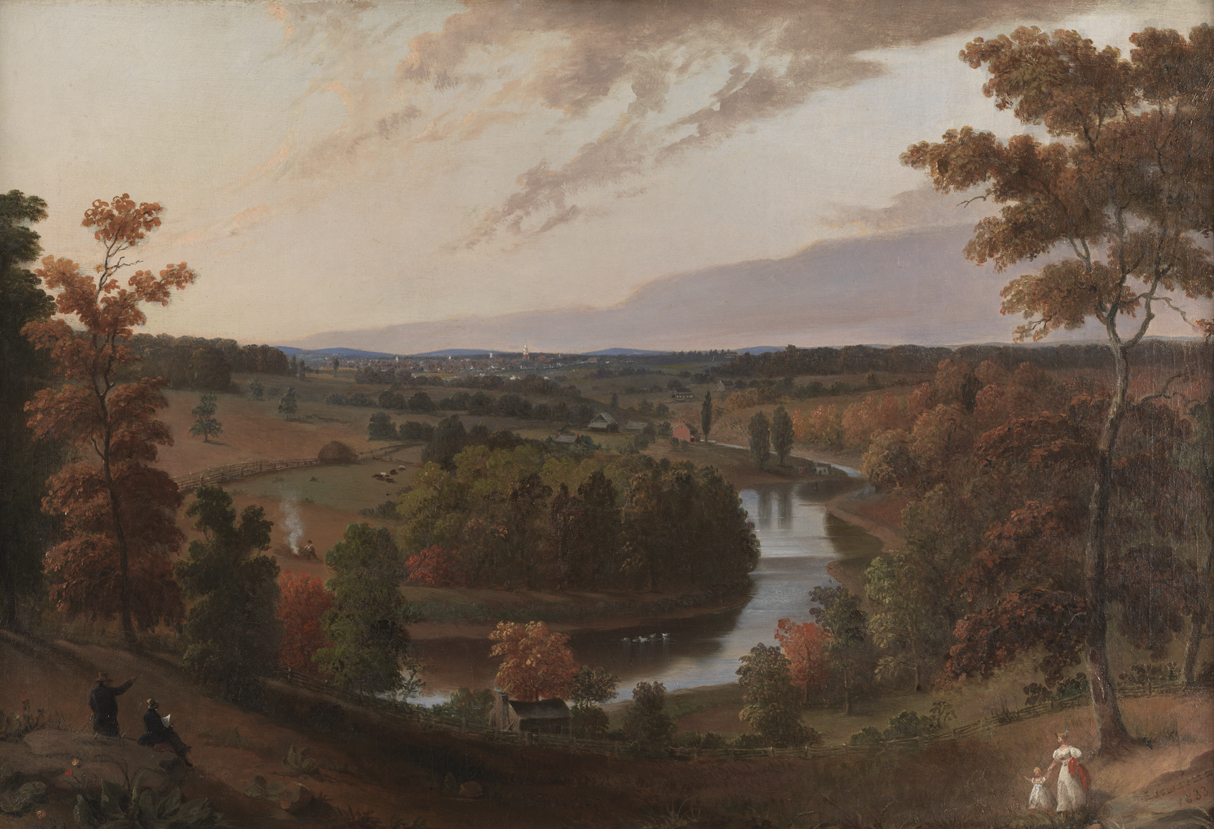


Jacob Eichholtz, Conestoga Creek and Lancaster, 1833


Albert Bierstadt, Niagara, 1869

Cooper was writing The Last of the Mohicans in 1825, the year that Cole first traveled up the Hudson. The Pennsylvania-born Jacob Eichholtz (1776-1842) and the German-born Albert Bierstadt (1830-1902) followed Cooper and Cole to the "backcountry" for the same purpose. All sought to discover the real America and the true meaning of American life.

It is delightful to be able to report that this journey of discovery continues with From the Schuylkill to the Hudson at PAFA.

Most of the works of art on view in the exhibition come from PAFA's extensive collection. Dr. Marley conducted a thorough audit of PAFA's paintings from the 1800's and came across a magnificent mid-nineteenth century landscape which had been forgotten or overlooked for decades. Research showed that the painting had quite a tale to tell, directly relevant to the theme of From the Schuylkill to the Hudson.


Anne Lloyd, Photo (2019) Paul Weber’s Landscape: Evening, 1856

The huge oil-on-canvas was entitled Landscape: Evening. A now obscure German artist, Paul Weber (1823-1916), had created this masterpiece in 1856. It is a tour-de-force depiction of the American wilderness and was so-regarded during the 1850's. A subscription was taken among Philadelphia's art lovers to purchase the painting for PAFA.

Who was this virtually unknown painter? Gottlieb Daniel Paul Weber had fled Germany after the 1848 democratic revolutions in Western Europe had been crushed by military  forces. He emigrated to the U.S., settling in Philadelphia. He  exhibited widely throughout the U.S. and won the Silver Medal from PAFA in 1858.

Weber was also an influential teacher. Two of the greatest American landscape painters of the 1800's, William Trost Richards and William Stanley Haseltine, studied with Weber. Both are now relatively forgotten, as is Weber. 


Anne Lloyd, Photo (2019) Detail of Paul Weber’s Landscape: Evening

Landscape: Evening is a revelation. This is not only a technical marvel, as can be seen in the incredible way that Weber handled the golden glow of the setting sun on the topmost branches of the trees. More significantly, Weber transformed a relatively undistinguished patch of woodland into a setting for profound meditation on the mysteries of creation, the cosmos, the passage of time.

 There are no landmark features of nature here or man-made monuments, no Niagara Falls or Fairmount Water Works, to distract your attention. It's just you and God. 

 With this rediscovered masterpiece, Paul Weber places each of us in that much-discussed realm, the state of nature, where "in the beginning all the World was America."


***
Text: Copyright of Ed Voves. Original Photos: Anne Lloyd. All rights reserved                                                                                           
Images courtesy of the Pennsylvania Academy of the Fine Arts, Philadelphia, PA

Introductory Image:

Anne Lloyd, Photo (2019) Detail of Thomas Birch's Fairmount Water Works, 1821. Oil on canvas:  20 1/8 x 30 1/16 in. (51.1175 x 76.35875 cm.) Pennsylvania Academy of the Fine Arts collection. #: 1845.1. Bequest of Charles Graff.

Anne Lloyd, Photo (2019) Gallery views of the From the Schuylkill to the Hudson: Landscapes of the Early Republic exhibition at the Pennsylvania Academy of the Fine Arts. 

Anne Lloyd, Photo (2019) Joshua Shaw’s Landscape with Farmhouse and Castle, 1818. Oil on canvas: 15 1/4 x 21 1/2 in. (38.7 x 54.6 cm.) Pennsylvania Academy of the Fine Arts collection, #1879.8.21. Bequest of Henry C. Carey (The Carey Collection).

Pierre Varlé. Plan of the City and Its Environs, 1798. Watercolor on paper: 18 x 20 in. (45.72 x 50.8 cm.) Private collection, Chestnut Hill

Anne Lloyd, Photo (2019) Detail of Thomas Birch's Fairmount Water Works, 1821.

Artist/maker unknown, Chinese, for export to the American market. Cup and Saucer showing the Philadelphia Waterworks,1825. Hard-paste porcelain with cobalt underglaze decoration and gilt cup: 2 5/8 x 4 3/8 x 3 5/8 in. (6.6675 x 11.1125 x 9.2075 cm.); saucer: 1 1/8 x 5 1/2 in. (2.8575 x 13.97 cm.) Philadelphia Museum of Art

James Peale, (1749 -1831) The Artist and His Family, 1795.Oil on canvas: 31 1/4 x 32 3/4 in. (79.4 x 83.2 cm.) Pennsylvania Academy of the Fine Arts collection, #1922.1.1. Gift of John Frederick Lewis, 1922.1.1.

Thomas Birch, (1779-1851) Fairmount Water Works, 1821. Oil on canvas: 20 1/8 x 30 1/16 in. (51.1175 x 76.35875 cm.) Pennsylvania Academy of the Fine Arts collection, #1845.1. Bequest of Charles Graff.

William Russell Birch, (1755-1834) Falls of Niagara, 1827. Enamel on copper: 2 1/2 x 2 1/4 in. (6.4 x 5.7 cm.) Pennsylvania Academy of the Fine Arts collection, #1860.1. Bequest of Eliza Howard Burd.

Anne Lloyd, Photo (2019) William Adams and Sons Factory & Thomas Cole, The Falls of Niagara, U.S., 1834-1850. Earthenware (white) and lead glaze 1 11/16 x 19 7/8 x 16 3/8 in. (4.318 x 50.546 x 41.656 cm.) Winterthur Museum, Bequest of Henry Francis du Pont

Anne Lloyd, Photo (2019) Dr. Anna O. Marley, Curator of Historical American Art at the Pennsylvania Academy of the Fine Arts, Dr. Marley stands next to Thomas Birch’s The Residence of James Craig, Bristol, Pennsylvania, as seen from the Delaware River, ca. 1820-21, PAFA collection.

Albert Bierstadt, (1830-1902) Niagara, 1869.Oil on paper laid down on canvas: 19 x 27 in. (48.26 x 68.58 cm.) Pennsylvania Academy of the Fine Arts collection, #2015.18. Joseph E. Temple Fund.

Jacob Eichholtz, (1776-1842) Conestoga Creek and Lancaster, 1833. Oil on canvas: 20 1/4 x 30 1/4 in. (51.4 x 76.8 cm.) Pennsylvania Academy of the Fine Arts collection, #1961.8.10. Gift of Mrs. James H. Beal.

Anne Lloyd, Photo (2019) Paul Weber’s Landscape: Evening, 1856. Oil on canvas: 60 1/4 x 86 in. (153.0 x 218.4 cm.) Pennsylvania Academy purchase, by subscription, #1857.1.


Monday, December 31, 2018

Art Eyewitness Looks at the Art Scene in 2018


Reflections on the Art Scene during 2018


By Ed Voves
Original Photos by Anne Lloyd

 A new year beckons on the horizon and, like Corot's Curious Little Girl, we strain to look over the wall to get a sneak peek. But at the moment of truth, she - and we - look back to see what we are leaving behind. 

That's human nature for you. We want to experience the new while preserving all that we can of the familiar, "comfortable" world of experience. During 2018, I came across a profoundly moving quote that comments upon the way that we appreciate beauty and attempt to integrate it into our art and our lives.

"When a beautiful rose dies", Agnes Martin (1912-2004) wrote, "beauty does not die because it is not really in the rose. Beauty is an awareness in the mind."


Pierre-Auguste Renoir, Roses, c. 1912

Martin wrote those words in an essay, Beauty is the Mystery of Life (1989). Reading them - initially as a wall text at the Philadelphia Museum of Art - was a great comfort to me during a difficult year. The quote brought to mind a painting of roses by Pierre Renoir, created late in life when he was crippled by arthritis and confined to a wheelchair. 


Anne Lloyd, Photo (2018)
 Film frame from Pierre-Auguste Renoir: Painter, 1920 Silent Film

A film of the aged Renoir, made shortly before his death in 1919, was displayed in the Barnes Foundation's outstanding spring 2018 exhibition, Renoir: Father and Son, Painting and CinemaThe Barnes exhibit showed the close relationship of Renoir and his film director son, Jean Renoir. 

During the First World War, Jean Renoir was badly wounded and spent six months home leave recovering from his wounds. During the time he spent with his aged father, he was inspired to go on to become a great artist himself, albeit with a movie camera rather than a paint brush. In my review, I wrote:  

This life force, what the French during the World War I era called elan vital, was the great gift which the elder Renoir gave to his wounded son during the six months of convalescence. It lasted Jean Renoir a lifetime, during which he shared this gift with the world.

As I reflected on Renoir's last years, my own father, Ed Voves, Sr., was confined to a wheelchair and in rapidly declining health. He died in November, aged 96. A veteran of World War II, my dad had a special gift for helping others. It was hard to watch him in his final days, but the spark of his elan vital did not flicker out until near the very end.

And when it did ... well elan vital like beauty is an "awareness in the mind" and it lives on the memory of the people we help, either with good deeds or great art... which can be the same thing.

The art exhibitions of 2018 surveyed the varieties of artistic experience (to borrow a phrase from William James) to an extraordinary degree. Indeed, it was often difficult to shift mental "gears" from one insightful exhibition to another. Yet all, in their way, showed how the creative spirit, the sense of the beautiful, is extended and shared from artists to art lovers across the span of generations and centuries.


Ed Voves, Photo (2018)
 Gallery view of the Between Worlds: the Art of Bill Traylor exhibition 

Between Worlds: The Art of Bill Traylor, which continues until March 2019 at the Smithsonian American Art Museum, was a particularly powerful examination of art at its most elemental. Traylor, born a slave in the pre-Civil War South, began painting mystical, often mystifying, scenes late in life when he could do no other work. These singular images, he declared, "just come to me."  Through his painting, Traylor transmitted elements of African and African-American culture, along with talismans of his personal experience. His was an elan vital which would not be denied. 

Traylor was not a "primitive" painter. He was a "primal" artist, as was Alberto Giacometti.

The vast exhibition of Giacometti's all-encompassing oeuvre - sculpture, painting and sketches- at the Guggenheim Museum, New York was easily the most spectacular exhibition of 2018. 


Anne Lloyd, Photo (2018), Gallery view of the Giacometti exhibit  

Art work is Giacometti's Man Pointing (1947)


Seldom has the main rotunda of the Guggenheim with its spiraling ramp and galleries been utilized to better effect. Not only was the evolution of Giacometti's art brilliantly charted, but so too was the struggle of this deeply civilized man, who battled with his inner demons amid the near collapse of Western civilization during the Second World War and after the dawn of the nuclear age. 

What made the struggle and despair of "civilized" human beings so desperate during the 20th century was the terrible sense of loss. This applied to what was destroyed in the apocalyptic wars and also what never had a chance to be created. Towering masterpieces never painted, great novels never written, vital achievements lost because death robbed their would-be creators of life and the opportunity to create. 


Anne Lloyd, Photo (2018)
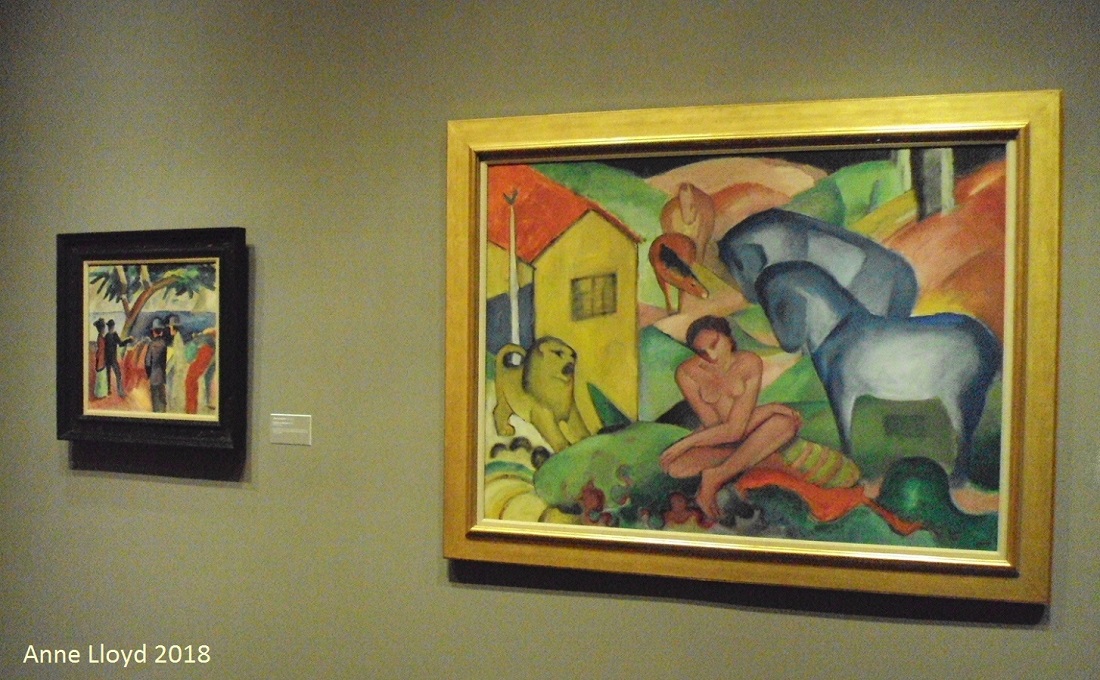
August Macke's Strollers at the Lake II, 1912, (left) and Franz Marc's The Dream, 1912

2018 marked the one hundredth anniversary of the end of World War I. The Neue Galerie, the splendid museum of German and Austrian art in New York City, marked this solemn occasion with a much needed exhibition devoted to Franz Marc and August Macke. These close friends and brilliant Expressionist painters were both killed in battle on the Western Front. Despite their importance in the development of modern art, works by these great German Expressionists are rarely shown in the U.S. Incredibly, this beautifully mounted exhibition was the first ever major display of Macke's paintings in America. 

Trying to find a unifying context for 2018's special exhibitions is a rather fruitless endeavor. However, two seemingly contradictory trends were very much apparent. 

This past year highlighted the absolute necessity of collaboration between museums for mounting major "shows."  In marked contrast, a growing number of successful exhibitions were drawn exclusively from the resources of individual institutions. This self-reliance in exhibition presentation is likely to become the dominant model for museums in the future.

CĂ©zanne Portraits illustrated the first of the two trends. It was a "once-in-a-lifetime" exhibition - a display of a lifetime's creative output by one of the greatest artists of all time. 


Anne Lloyd, Photo (2018) Detail of Paul Cézanne's Self Portrait, c.1875.

The CĂ©zanne show was a triumph, in no small part because of the difficulty of bringing together so many seminal works by CĂ©zanne for such a long period. The traveling exhibition was shown over the course of 2017 and 2018 at the MusĂ©e d’Orsay in Paris, the National Portrait Gallery in London and finally at the National Gallery of Art in Washington D.C., where Anne and I saw it in March 2018. It was organized by John Elderfield, Chief Curator Emeritus of Painting and Sculpture at MOMA, working with curators Mary Morton of the National Gallery of Art and Xavier Rey of the MusĂ©e d’Orsay. Talk about a team effort!


Anne Lloyd, Photo (2018) Eagle Pendants, Chiriqui culture, 800-1519 A.D

The same could be said about Golden Kingdoms: Luxury and Legacy in the Ancient Americas. This fabulous survey of the creative genius of the Native American kingdoms was originally presented by the J. Paul Getty Museum as part of a series on Latin American culture, "Pacific Standard Time: LA/LA." It then traveled to the Metropolitan Museum in New York, which also presented a first-rate exhibition on Spanish colonial painting at the same time. The effect of these collaborative efforts was magical.


Anne Lloyd, Photo (2018) 
Curators of the Berthe Morisot exhibition. From left: Nicole R. Myers, Dallas Museum of Art, Sylvie Patry, Musée d'Orsay, and Cindy Kang of the Barnes Foundation

Also of note was the Berthe Morisot exhibition, a joint effort by four museums, the Musée national des beaux-arts du Québec, the Dallas Museum of Art, the Musée d'Orsay in Paris and Philadelphia's Barnes Foundation. On view at the Barnes until mid-January 2019, the exhibition is a much needed retrospective of an artist who was regarded as a great painter by her fellow Impressionists. Following her death in 1895, Morisot was marginalized by art historians for much of the twentieth century. This exhibition sets the record straight.

The contrasting tendency of mounting exhibitions with local resources has a lot to be said for it. The Metropolitan Museum mounted an impressive exhibition, Public Parks, Private Gardens: Paris to Provence, almost entirely based on its collection. In October 2018, the Met staff also created a long-term special display of its "Golden Age" Dutch paintings. I will be reviewing this sensational exhibit of "only at the Met" paintings early in 2019.


Anne Lloyd, Photo (2018),
Gallery view of Fabulous Fashion at the Philadelphia Museum of Art. 
 The dress is a 1962 palazzo pants ensemble designed by Irene Galitzin.

The Philadelphia Museum  of Art, midway through a massive renovation project, mounted three outstanding exhibitions during 2018, all drawn exclusively from its vast holdings.  These were Old Masters Now (November  2107 to February 2018), Modern Times: American Art 1910–1950 (April to September 2018) and its current blockbuster, Fabulous Fashion: From Dior’s New Look to Now, which runs to March 3, 2019.

Under very challenging circumstances, the Philadelphia Museum of Art staff covered themselves in glory during 2018. Spring 2019 will be welcomed with a similar "home-grown" exhibition on the techniques of the Impressionists
.
Both trends represent good news. Only a kill-joy would go searching for a negative point of view regarding the mounting of special exhibitions. Yet, there certainly are ominous factors regarding the wonderful art exhibits we have grown so accustomed to. The one which really concerns me is the demographic factor of age of museum visitors.

My concern isn't based on age in terms of years. I didn't begin seriously studying art until I was thirty or thereabouts. Young people have a lot of life challenges to meet and the admission charge to an art museum can be a daunting prospect for someone with college loans to repay or young children to rear.


Anne Lloyd, Photo (2018) Gallery view of the Barnes Foundation, Philadelphia, PA

Quite often, I see very few young art patrons in the museum galleries. I wonder if, having grown-up in a digital world,  young adults will continue to derive inspiration from seeing original works of art. Certainly, interactive technology is helping redefine art exhibitions for a computer-savvy audience. I think we will see more touch screens and  computer simulations - and fewer visiting masterpieces - in future exhibitions.

I still retain hope in "expecting the unexpected." The Metropolitan Museum of Art and the National Gallery in London presented an outstanding exhibition on the Anglo-American landscape painter, Thomas Cole (1801-1848) during 2018.


Thomas Cole, View of the Round-Top in the Catskill Mountains, 1827

Cole, who grew-up in the industrializing region of Lancashire, was moved by the splendor of the American wilderness to embrace landscape painting. This was a defining moment in art history and one that could not have been predicted a half-century before when landscape painting hardly figured in the appreciation of fine art.

Cole, the founder of the Hudson River School, was not alone in his passion for the majesty of nature during the early 1800's. The emphasis on landscape painting - first apparent in Holland in the late 1600's, then later in Great Britain and finally in the U.S. - was largely based upon a sense of "paradise lost." 


Detail of Thomas Coles's View from Mount Holyoke, Northampton, Massachusetts,        after a Thunderstorm — The Oxbow, 1836

By the late 1700's, there was growing unease at the encroachment of cities, factories and mines on the precious realm of nature.  A sensitive and visionary artist, Cole grasped the fragility of the natural world and made this awareness the presiding theme of his art.

Hopefully, as artificial Intelligence, robotics and late-stage mechanization impinge on society, a new generation of art lovers will arise to appreciate the great works of art and support the museums which care and exhibit them.

Ultimately, the health and well-being of the art world takes us back to Agnes Martin's quote on beauty. I explored her comments further and found a wealth of insight - some of it unsettling - but filled with soul-enriching truth.
  
The path to great art does not proceed from Point A to Point B to Point C, from a great idea to painting a masterpiece to a place on a gallery wall. Art is not dependent on art museums, art exhibitions or even upon a need for visual representation. 

Great art can be composing an outstanding piece of music as Leonard Bernstein did - or listening intelligently to the music of a great composer. Great art comes from planting and nurturing a rose or a sunflower. Great art is standing back and seeing the rose or sunflower, appreciating it as a seed of beauty which will continue to flower in our minds. 


Anne Lloyd, Photo (2018) Sunflower at the Saul Agricultural School, Philadelphia

Art, in a myriad of differing creative expressions, is based on a healthy, emotional response to life. Art is a reflection of what we see in life and give back to life. 

That thought, art as a reflection, was literally reinforced by an extraordinary work of art which Anne and I saw several times this past year in New York City. 


Anne Lloyd, Photo (2018) Tear sculpture by Richard Hudson at Plaza 33 in Manhattan

Tear, an enormous sculpture made polished steel, is the creation of British artist, Richard Hudson. It is displayed, not in a museum but smack in the middle of Plaza 33, outside Penn Station. Not a place given to introspection but now a site for reflection!

With this image and these moving words of Agnes Martin, Art Eyewitness bids you a Happy 2019.

Beauty is an awareness in the mind. It is a mental and emotional response that we make. We respond to life as though it were perfect. When we go into a forest we do not see the fallen rotting trees. We are inspired by a multitude of uprising trees. We even hear a silence when it is not really silent. When we see a new born baby we say it is beautiful – perfect. The goal of life is happiness and to respond to life as though it were perfect is the way to happiness. It is also the way to positive art work.

***
Text: Copyright of Ed Voves, all rights reserved                                                                                           
Images courtesy of the Metropolitan Museum of Art, the Barnes Foundation, the Museum of Fine Arts, Boston, and Anne Lloyd

Introductory Image:
Camille Corot (French, 1796–1875) The Curious Little Girl, 1860–64. Oil on cardboard, laid down on wood: 16 1/4 x 11 1/4 in. (41.3 x 28.6 cm). Metropolitan Museum of Art. The Walter H. and Leonore Annenberg Collection, Gift of Walter H. and Leonore Annenberg, 1999, Bequest of Walter H. Annenberg, 2002. Accession Number:1999.288.2 © The Metropolitan Museum of Art

Pierre-Auguste Renoir (1841-1919) Roses, c. 1912. Oil on canvas:  8 7/8 x 17 5/8 in. (22.5 x 44.7 cm) Barnes Foundation, Philadelphia. Accession Number BF1168 © The Barnes Foundation


Anne Lloyd, Photo (2018)  Film frame from Pierre-Auguste Renoir: Painter, 1920 Silent Film produced by Gaumont Actualities. Distributed by Gaumont PathĂ© Archives. Film was shown at the Renoir: Father and Son exhibit at the Barnes Foundation, Philadelphia, PA.

Ed Voves, Photo (2018) Gallery view of Between Worlds: the Art of Bill Traylor exhibition at the Smithsonian American Art Museum, Washington D.C. Photo shows Bill Traylor's Man and Large Dog, ca. 1939-1942.

Anne Lloyd, Photo (2018) of Alberto Giacometti's Man pointing, 1947 (cast by 1949).  Bronze, 70 1/16 x 37 3/8 x 20 1/8" (178 x 95 x 52 cm) Tate Museum, London. # 2016.136. Photo shows Man Pointing in the Giacometti exhibition at the Guggenheim Museum, N.Y.

Anne Lloyd, Photo (2018) August Macke's Strollers at the Lake II, 1912, (left) and Franz Marc's The Dream, 1912. Photo shows these works at the Neue Galerie exhibition, Franz Marc and August Macke, 1909-1914.

Anne Lloyd, Photo (2018) Detail of Paul Cézanne's Self Portrait, c.1875. Musée d'Orsay, Paris. Gift of Jacques Laroche.

Anne Lloyd, Photo (2018) Gallery view of Golden Kingdoms: Luxury and Legacy in the Ancient Americas exhibition, showing Eagle Pendants, Chiriqui culture,  800-1519  A.D. Gold. Collection of the Metropolitan Museum of Art.

Anne Lloyd, Photo (2018)  Curators of the Berthe Morisot, Woman Impressionist exhibition at the Barnes Foundation. From left: Nicole R. Myers, Dallas Museum of Art, Sylvie Patry, MusĂ©e d'Orsay, Paris, and Cindy Kang of the Barnes Foundation.

Anne Lloyd, Photo (2018), Gallery view of the Fabulous Fashion: From Dior’s New Look to Now exhibition at the Philadelphia Museum of Art. The dress shown is a 1962 palazzo pants ensemble designed by Irene Galitzin.

Anne Lloyd, Photo (2018) Gallery view of the Barnes Foundation, Philadelphia, PA.

Thomas Cole (American (born in England), 1801–1848) View of the Round-Top in the Catskill Mountains - Sunny Morning on the Hudson, 1827. Oil on panel: 47.31 x 64.45 cm (18 5/8 x 25 3/8 in.) Museum of Fine Arts, Boston  # 47.1200. © The Museum of Fine Arts, Boston.

Thomas Cole (American, 1801-1848) Detail of View from Mount Holyoke, Northampton, Massachusetts, after a Thunderstorm—The Oxbow, 1836. Oil on canvas, 51 1/2 x 76 in. (130.8 x 193 cm). The Metropolitan Museum of Art, New York, Gift of Mrs. Russell Sage, 1908 (08.228). Image © The Metropolitan Museum of Art

Anne Lloyd, Photo (2018) Sunflower at the Saul Agricultural School, Philadelphia, PA.

Anne Lloyd, Photo (2018) Tear sculpture by Richard Hudson (British, born 1954) at Plaza 33 in Manhattan near Penn Station and Madison Square Garden. Polished stainless steel: height: 250 cm. 


Tuesday, February 6, 2018

Thomas Cole's Journey: Atlantic Crossings at the Metropolitan Museum of Art


    Thomas Cole's Journey: Atlantic Crossings


Metropolitan Museum of Art  

 January 30, 2018 - May 13, 2018


Reviewed by Ed Voves

The rise of landscape painting  during the first half of the nineteenth century is a familiar story. Usually told from a French perspective, the standard narrative acknowledges British innovators like J.M.W. Turner and John Constable, before proceeding to the struggle and eventual triumph of Impressionism.

A recently-opened exhibit at the Metropolitan Museum of Art, Thomas Cole's Journey: Atlantic Crossings, studies the embrace of landscape art during the 1800's from a different perspective. Instead of looking toward France, this superb exhibition directs our attention to the developing art scene in the young American Republic.

The key figure in bringing the landscape "school" to the United States was Thomas Cole (1801-1848). Cole was born in Lancashire, just as this region in the north of England experienced the first effects of full-scale industrialization. The volatile economic climate of the Industrial Revolution enriched some families, while devastating others. Cole's family, though well-to-do, was ruined  and sought to regain their fortune in the United States.

When the young Cole reached America in 1817, he had to earn his living and this search for employment took him and his family on a journey around the northern states of the U.S. Cole's artistic ability, already apparent in England, kept surfacing.  Fortunately, he was able to study at the Pennsylvania Academy of Art for a short period and then to make a bid to become a full-fledged artist.


Matthew Brady, Thomas Cole, ca.1845

In 1825, Cole exhibited several works in New York City, winning applause from the last of "founding Fathers" of American art, John Trumbull. More to the point, Trumbull purchased one of Cole's paintings - the highest praise one artist can give to another. This stroke of good fortune confirmed that a career in the arts was Cole's destiny.                                                                                                                            
The key to appreciating Cole's career path is that he focused on landscape painting from the start. Portrait painting was never a consideration. Cole fell in love with the face of American nature, both cultivated areas like the Hudson Valley and the "back country" which had yet to tamed by the pioneer's ax and plow. Surprisingly, no other American artist had made landscape painting their primary oeuvre. The field was open to Cole and he never looked back.

The Metropolitan exhibition displays a number of Cole's early works. His talent was evident from the first, though by European standards these first efforts were competent at best. But this was America and national pride was on the rise, particularly as the U.S. celebrated its fiftieth anniversary in 1826. Americans were proud of their nation and appreciated rising literary talents, with Washington Irving in the lead, who celebrated American themes.


Thomas Cole, Scene from "The Last of the Mohicans," 
Cora Kneeling at the Feet of Tamenund,1827

Cole was quick to capitalize on the rising sense of America heritage. One of his early landscapes refers to James Fenimore Cooper's bestselling novel, Scene from “The Last of the Mohicans,” Cora Kneeling at the Feet of Tamenund, 1827. 

Given the diminutive size of the human figures, the action in the painting might just as well be a religious revival or a political rally. It really is the spectacular natural setting that counts. Cole cleverly used the appeal of Cooper's novel to get cultured Americans to take a look at the landscape around them. 

Cole's landscapes were highly-esteemed and began to sell. In 1826, Cole along with other American artists and cultural leaders joined ranks to found the National Academy of Design in New York City. Less than a decade after emigrating to the United States, Cole had become one of the leading lights of American art.


Thomas Cole, From Nature, 1823

Cole might have chosen a scene from “The Last of the Mohicans” as inspiration but there was a dark, nightmare lurking on the edge of many of his other paintings. In 1823, Cole sketched a withered, gnarled tree, with knotted bark resembling human features. Instead of a Fenimore Cooper novel, this tree would have been better suited to a story by Edgar Allen Poe.


Thomas Cole, Detail of The Oxbow, 1836

A version of this gaunt, twisted tree would reappear in many of Cole's paintings, most notably in his greatest work, The Oxbow (1836).  Even as he extolled the progress and promise of his adopted country, Cole began to worry that the American Eden might become Paradise Lost. 

Lurking fears did not prevent Cole from taking the bold move of travelling to England in 1829, followed by a sojourn in Italy.  At this point in the exhibit timeline, the distinctive nature of Cole's achievement can truly be appreciated. Cole profited enormously from his studies in Europe but he went there as an already successful artist, the essential features of his oeuvre already well defined .

On display are an impressive array of paintings by Turner, Constable, John Martin and other contemporary artists whose works Cole studied. Cole met several of these English masters in person and we can trace influences on his evolving style. 

Turner, like Cole, incorporated moral lessons and historical references as the themes of his major paintings. Turner's Snow Storm: Hannibal and His Army Crossing the Alps has a lot more snow than Hannibal and his elephants, but this famous painting certainly conveys Turner's obsessive thoughts on the "fallacies of hope."


J.M.W. Turner, Snow Storm: Hannibal and His Army Crossing the Alps, 1812

In keeping with Cole's experiences in England, the exhibit on view at the Met will travel to the National Gallery of Art in London during the summer of 2018.

While in England, Cole also studied the great harbor scene by the seventeenth century master, Claude Lorraine, Seaport with the Embarkation of Saint Ursula, 1641. This fabulous painting was one of the original anchors of the collection of the National Gallery, founded in 1824. Claude's masterpiece was a favorite of Turner's. It ranked high on Cole's list too, so high that when he visited Italy, he made a point to rent Claude's old studio. 


 Claude Lorraine, Seaport with the Embarkation of Saint Ursula, 1641

That feeling of self-assurance is significant. But the fact that Cole returned at all from Europe is more telling. The allure of Europe was hard to resist and many of America's greatest artists, Benjamin West, John Singleton Copley and Mather Brown, had traveled to the Old World, never to return. Cole came back. He was truly an American painter upon his return in 1832.

When Cole stepped-off the boat, he found that some of his fears for America were coming true. Industry was starting to replace agriculture, party politics was ramping-up, the  differences between North and South were proving  to be hard-set convictions not passing opinions. In Italy, Cole had seen and painted the ruins of a once-great republic, Rome. Might this be the eventual fate of the United States?


Thomas Cole, Aqueduct near Rome, 1832

Cole was not the only person who foresaw the future of the U.S. in the sun-bleached debris of ancient Rome. In 1834, a wealthy New York merchant, Lumen Reed, commissioned Cole to create a series of paintings showing the rise and fall of a classical civilization, a mix of fantasy and a close reading of Edward Gibbon's history of Rome's downfall. The resulting series, The Course of Empire, is displayed to spectacular effect in the Metropolitan's exhibit. I have seen The Course of Empire before, but never in such a striking way.

Beginning with The Savage State, in which tribal folk live in huts shaped like American Indian wig-wams, The Course of Empire proceeds to heights of material splendor, followed by destruction and desolation. Each of these brilliantly-realized paintings features a Gibraltar-like mountain peak. This distinctive massif appeared earlier in Scene from “The Last of the Mohicans.” Cole based its shape on sketches he had made of Mount Chocorua in New Hampshire.

While Cole painted this meditation on history, he was a work on his greatest single painting. It is one of the most important works in the collection of the Metropolitan Museum - which says a great deal. Cole gave a Turner-like title to his depiction of a meandering river:  View from Mount Holyoke, Northampton, Massachusetts, after a Thunderstorm—The Oxbow


Thomas Cole, View from Mount Holyoke, Northampton, Massachusetts, after a Thunderstorm —The Oxbow,1836

The real subject of this inspiring painting is the retreat of the American frontier before the  advance of ax-wielding pioneers and the farming families who followed in their wake. We can see Cole himself in the detail of the painting which introduces this review. He sits at his easel, a few feet from his umbrella which is planted on the cliff-face like a regimental banner waving over a conquered redoubt. Cole shows himself painting the beginning of the end of the "savage state" which inwardly he found hard to relinquish.

According to meticulous research of The Oxbow, Cole also used the actual setting of this painting for The Course of Empire paintings. Cole made an oil study of the river valley, which he used to plot the location of the magnificent temples, monuments and piers. 


Thomas Cole, The Course of Empire - The Consummation of Empire, 1835 - 1836

Whenever - or wherever - Cole and his patron, Lumen Reed, conceived the idea for their "rise and fall" series, contemporary events likely supplied some vivid details. On December 16, 1835, a fire from a warehouse in lower Manhattan, ignited an inferno that torched seventeen city blocks, including most of the financial district, of the city of New York. Remarkably only two people were killed but the conflagration may well have informed Cole's apocalyptic vision in The Course of Empire - Destruction.


Thomas Cole, The Course of Empire - Destruction,1836

Sadly, Lumen Reed died in 1836 just as the paintings were being prepared for display. The Course of Empire was so well received that Cole painted a second landscape series, The River of Life. He was in the process of painting a third series when he died, suddenly, of pleurisy in 1848. He was only 47 years old and at the height of his powers.

Cole's sudden death was a heavy blow to American culture. Fortunately, Cole had begun training talented pupils like Frederic Edwin Church, whose works would take American painting to sublime heights. Furthermore, Cole's great friend, Asher B. Durand, picked up the  reigns of leadership and guided the Hudson River movement during its time as America's major school of art, the years just before and after the Civil War.

The moralizing content of Thomas Cole's paintings is out of favor today. Likewise, Durand's beautiful tribute to Cole, Kindred Spirits, seems impossibly remote from our experience of life in the over-urbanized twenty-first century. 


Asher B. Durand, Kindred Spirits, 1849

Yet, when we leave the Metropolitan Museum in New York City, we have only to look a short distance to see the welcoming "wilderness" of Central Park. From the rear entrance of the Philadelphia Museum of Art, a "river of life" view greets our eyes, in this case Fairmount Park and the Schuylkill River. Most American art museums are built adjacent to green spaces. And then, there is the National Park System, which preserves a wide swathe of the natural world for the enjoyment and inspiration of all U.S. citizens

None of these wondrous things  - art museums, urban green spaces and National Parks  - might ever have taken root in the United States except for the art-inspired journeys that Thomas Cole made across the Atlantic and his exploration into the soul of America.

***
Text: Copyright of Ed Voves, all rights reserved                                                                Photos courtesy of the Metropolitan Museum of Art and the National Portrait Gallery, Smithsonian Institution

Introductory Image

Detail of View from Mount Holyoke, Northampton, Massachusetts, after a Thunderstorm —The Oxbow, 1836, by Thomas Cole (American, 1801-1848) Oil on canvas, 51 1/2 x 76 in. (130.8 x 193 cm). The Metropolitan Museum of Art, New York, Gift of Mrs. Russell Sage, 1908 (08.228). Image © The Metropolitan Museum of Art

Mathew B. Brady, American, (1823?-1896) Thomas Cole,c.1845, Photograph, Half-plate daguerreotype on silver-coated copper plate. Plate: 13.7 x 10.2cm (5 3/8 x 4") Credit Line  National Portrait Gallery, Smithsonian Institution; gift of Edith Cole Silberstein Object number NPG.76.11

Thomas Cole (American, 1801–1848) Scene from “The Last of the Mohicans,” Cora Kneeling at the Feet of Tamenund, 1827. Oil on canvas, 25 3/8 x 35 1/8 in. (64.5 x 89.1 cm). Wadsworth Atheneum Museum of Art, Hartford, Connecticut, Bequest of Alfred Smith (1868.3). Photo: Allen Phillips\Wadsworth Atheneum

Thomas Cole (American, 1801–1848)  From Nature, 1823. Ink on paper, 9 5/8 x 7 1/4 in. (24.4 x 18.4 cm). Albany Institute of History & Art, Gift of Edith Cole (Mrs. Howard) Silberstein (1965.68.1) Photography provided by the Albany Institute of History & Art

Detail of View from Mount Holyoke, Northampton, Massachusetts, after a Thunderstorm — The Oxbow, 1836, by Thomas Cole (American, 1801-1848)

Joseph Mallord William Turner (British, 1775– 1851) Snow Storm: Hannibal and His Army Crossing the Alps, 1812. Oil on canvas, 57 1/2 × 93 1/2 in. (146 × 237.5 cm). Tate Britain, London, Accepted by the nation as part of the Turner Bequest 1856 (N00490). © Tate, London 2017

Claude Lorrain (French, 1604/5?–1682) Seaport with the Embarkation of Saint Ursula, 1641. Oil on canvas, 44 1/2 x 58 3/4 in. (112.9 x 149 cm). The National Gallery, London. Bought, 1824 (NG30). © The National Gallery, London/Art Resource, NY

Thomas Cole (American,1801–1848) Aqueduct near Rome, 1832. Oil on canvas, 45 x 68 1/8 in. (114.3 x 173 cm). Mildred Lane Kemper Art Museum, Washington University, St. Louis, University purchase, Bixby Fund, by exchange, 1987 (WU 1987.4)

Thomas Cole (American, 1801–1848) View from Mount Holyoke, Northampton, Massachusetts, after a Thunderstorm—The Oxbow, 1836. Oil on canvas, 51 1/2 x 76 in. (130.8 x 193 cm). The Metropolitan Museum of Art, New York, Gift of Mrs. Russell Sage, 1908 (08.228). Image © The Metropolitan Museum of Art

Thomas Cole (American, 1801–1848) The Course of the Empire: The Consummation of Empire, 1835–36. Oil on canvas, 51 1/4 x 76 in. (130.2 x 193 cm). New-York Historical Society, Gift of The New-York Gallery of the Fine Arts (1858.3). Digital image created by Oppenheimer Editions

Thomas Cole (American, 1801–1848 ) The Course of Empire: Destruction,1836. Oil on canvas, 39 1/4 x 63 1/2 in. (99.7 x 161.3 cm). New-York Historical Society, Gift of The New-York Gallery of the Fine Arts (1858.4). Digital image created by Oppenheimer Editions


Asher Brown Durand (American,1796–1886) Kindred Spirits, 1849. Oil on canvas, 46 x 36 in. (111.8 x 91.4 cm). Crystal Bridges Museum of American Art, Bentonville, Arkansas (2010.106). Photography by The Metropolitan Museum of Art