Showing posts with label Alberto Giacometti. Show all posts

Monday, June 8, 2020

Art Eyewitness Essay: The Etruscans and Ancient Art


The Etruscans and Ancient Art
An Art Eyewitness Essay, Part I


By Ed Voves

The word "mysterious" is often used to describe the Etruscans. These ancient people, who lived in central Italy, certainly offer many features of their way of life and religion which are difficult to interpret or explain. Yet, there is nothing essentially "mysterious" about the Etruscans.

The Etruscans were not an Indo-European people as were the Greek and Romans. They emerged, as a group of prosperous city-states at the end of the "Dark Age" following the fall of the Bronze Age civilizations, 1200-900 B.C.

Basing their power and wealth on huge reserves of iron ore and copper, the Etruscans traded readily with the Greeks and the Phoenicians. Masters at adaptation, as we will discuss, the Etruscans borrowed artistic motifs when these struck their fancy, rejected those that didn't and maintained a distinctive cultural style for almost five hundred years, 750 to 300 B.C.


Appliqué depicting the Sun God Usil, 500–475 B.C. © Getty Museum 

Unlike other non-Indo-Europeans, such as the Finns and Hungarians, the Etruscan language has yet to be traced to its origins. But the same is true of the Basques, another non-Indo-European people. There is no link, however, between the Basques and the Etruscans, further heightening the "mystery" of the latter.

One of the truly perplexing aspects about the Etruscans is the scarcity of museum exhibitions dealing with their remarkable civilization. In 1985, cultural officials in Italy proclaimed the "Year of the Etruscans." A full-slate of exhibitions was organized but, to the best of my knowledge, none traveled to the United States. Although I have been on the lookout for a major exhibit on the Etruscans over the last decade or more, I have yet to spot one.

I have done a good bit of reading about the Etruscans, notably Michael Grant's authoritative 1980 account. But there is no substitute for looking at art!

Fortunately, several museums in the U.S. have magnificent collections of Etruscan art and artifacts. It was at the Museum of Fine Arts (MFA) in Boston that I first encountered the Etruscans in 1986. Since then, visits to the Metropolitan Museum of Art, the University of Pennsylvania Museum and several other art collections have enabled me to study the rise of the Etruscans and their "fall" to the power of Rome.

In the autumn of 1986, I made a brief trip to Boston to see some friends. I decided to visit the MFA to view their great collection of European paintings only to discover that the European wing was being renovated. This left me with time to explore the rest of the museum but once I entered the galleries for ancient art, I stayed there for the rest of the day.


Etruscan sarcophagi from the Museum of Fine Arts, Boston © MFA Boston

There I discovered the Etruscans. Two burial structures - sarcophagi - gripped my imagination - and have never let go. 

These stone coffins testify to the Etruscan focus on death and the afterlife. Discovered during the 1840's, both had been created for members of the same family. The sarcophagus on the right (above) is inscribed with the names "Thanchvil Tarnai and her husband Larth Tetnies, son of Arnth Tetnies and Ramtha Vishnai." Scholars believe that the couple on the older, less-finely sculpted, sarcophagus are the named parents, Arnth Tetnies and Ramtha Vishnai.

Deciphering Etruscan writing is no small feat, as I will briefly comment on below. However important, these details about the powerful Tetnies clan are less significant than the overwhelming sensation of sharing in the spiritual lives of people long dead. This was very palpable to me, when I found myself in their "presence" back in 1986.

What is portrayed on each sarcophagus lid is the "eternal embrace." Here we see two human beings who shared life and love during their distant era. They are united in death but also in everlasting life. It is worth noting that the equality in the relative size, husband and wife, reflects the fact that women in Etruscan society enjoyed social freedoms far beyond those of their counterparts in Athens during the late fourth to early third century B.C.


Etruscan Bronze Chariot, 6th century B.C © Metropolitan Museum of Art

A similar "stand-out" Etruscan experience comes by way of the Metropolitan Museum of Art. The Monteleone Chariot has been a fixture of the Met since 1903 and I never cease to marvel at it during my many visits to that wonderful museum.

The Monteleone Chariot was made early in the sixth century B.C., at the height of Etruscan power. The Etruscans were formidable warriors, but generally fought on foot. Chariots were used for ceremonies and celebrations of war victories. However, the era of the chariot's construction also witnessed the first stirring of Rome. Rising in revolt, the Romans cast out their Etruscan king, Tarquinius, in 507 B.C. Etruscan victory parades were to diminish in number as the Republic of Rome grew in power.

The bronze metalwork of the chariot was mounted on a wooden frame. Except for a tell-tale fragment of oak, none of the timber survived the long centuries during which the chariot rested in an underground tomb. Unearthed by accident in 1902, it was quickly purchased by Italian art dealers. The first director of the Metropolitan Museum, Luigi de Cesnola, was a well-connected archaeologist and he bought the chariot  - legally - before the Italian government could intervene.


Detail of Etruscan Bronze Chariot © Metropolitan Museum of Art

This spectacular bronze vehicle is decorated with scenes from the life of the Greek hero, Achilles. The front of the chariot car shows Achilles receiving a new set of armor, helmet and shield from his mother Thetis. With this battle gear, Achilles will fight his famous duel with the Trojan hero, Hektor. 

The artistic style of the chariot's Achilles motifs is an almost pure example of Greek-Archaic era art. Some scholars have speculated that the chariot might have been made in one of the Greek colonies of southern Italy and then sold or sent as a gift to the Etruscans. However, the Etruscans greatly favored the Archaic style in their own art, so much so that they retained it even after the Greeks had innovated more natural and humanistic representation during the fifth century B.C.


Bronze Statuette of a Young Woman, 6th century B.C. 
© Metropolitan Museum of Art

The Etruscans borrowed widely from the Greek merchants and city-state builders in southern Italy and Sicily. The Etruscans also maintained close trading and cultural relationships with the Phoenicians, so much that their ethnic origins have been frequently - and  mistakenly - traced to the Middle East. Yet, the Etruscans'  basic attitudes to life and the after-life, society and eternity, were formed long before the interaction with seafarers from Greece and the Phoenician city-states began in earnest during the seventh century B.C. 

Of the Etruscans, Michael Grant wrote:

They were temperamentally different from the Greeks, and in consequence had different needs and customs... Far from requiring the delineations of the human body, whether idealized or realistic, the Etruscans' own conception of art involved highly formalized, dream-like patterns, and sometimes, grotesquely caricatured exaggerations and elongations. The balances and proportions, the clear frameworks and logical formal principles that were the essential features of Attic classicism held no interest for them at all.

The Etruscans also adapted the Greek alphabet for their unique language. Since the Greeks had done the same, borrowing the Phoenician lettering system, this cultural transfer does not denote a failure on the part of the Etruscans to innovate or create for themselves.


Terracotta Vase in the Shape of a Cockerel, ca. 650–600 B.C.
 © Metropolitan Museum of Art

One of the most delightful - and significant - Etruscan artifacts in the Met's collection is a small vase, inscribed with the twenty-six letters of the Etruscan alphabet. It almost certainly was an ink bottle since the head acts as a stopper and could be attached to the bird’s body by a cord. The missing tail, curving downward to form a third foot, would have kept the ink bottle from tipping over.


Detail of Terracotta Vase in the Shape of a Cockerel
© Metropolitan Museum of Art

When the Etruscans adapted the Greek alphabet for their own use, the process followed the same pattern as their incorporation of elements of Greek art. The Etruscans found writing a key tool in managing their expanding trade with Greek and Phoenician merchants and with their Latin neighbors and subjects. Literacy, likewise, was valued for its uses in religious practices, the Etruscans being notably devoted to the rituals and traditions honoring their gods.

This emphasis on putting their faith into practice may account for the large number of "speaking objects" which record the names of Etruscans in association with specific artifacts. These inscriptions are likely to have been written, painted or incised on objects of value to record the names of donors of gifts to Etruscan temples. 


Terracotta inscribed Alabastron, ca. 600 B.C. © Metropolitan Museum
 
Alternatively, inscribing one's name on a precious commodity like the perfume vessel or alabastron (above) might also signify that it was a high-status present (or bribe) to an influential person who might need to be reminded who the gift was "speaking" for. In the case of this alabasteron from the Met's collection, it is incised on the rim with the words "I am the gift of Licinius Hirsunaie."

The Etruscan alphabet undoubtedly played a large role in the transactions of a collaborative religious "league' or council which was held once a year at a sacred site called the Fanum Voltumnae. 

The Etruscans, however, never developed any comparable degree of political unity. The individual Etruscan city-states made alliances with the Greeks and with the Phoenicians, based in Carthage, but seldom cooperated among themselves. In 396 B.C., the Roman Republic launched a devastating assault on Veii, one of the leading Etruscan cities. Despite the fact that the Romans had been besieging Veii for years, none of the other Etruscan city-states made any effort to assist Veii. The destruction of Veii marked the first great military victory of Rome - and the eventual downfall of Etruscan civilization.

This lack of political unity among the Etruscans is reflected in the lack of evidence that they composed sophisticated works of history or philosophy as did the Greeks and Romans. Nothing of their literature, such as it was, has survived - only a mass of inscriptions, most of which are still undeciphered.

Long after the Etruscan city states fell under the hegemony of Rome, the Emperor Claudius (10 B.C.-54 A.D) wrote a twenty-volume history of the Etruscans but sadly it was not preserved. Had this tome by Claudius survived, it would likely have included a sermon or two reproving the Etruscans for their love of the "good life." 

The Etruscans did indulge themselves in golden jewelry and prestige imported goods from Greece and the Middle East. They became supremely gifted goldsmiths themselves, making it often difficult to tell if spectacular works such as the golden bracelet (below) were imported or made in an Etruscan workshop. 


Gold Votive Bracelet, ca. 675 B.C.-650 B.C. © British Museum

This bracelet, one of a pair in the collection of the British Museum, is a classic example of the "orientalizing" influence of the Phoenicians on the Etruscans, and the Greeks, too, which  occurred during the seventh century B.C. Close inspection of the bracelet shows designs of a "Master of Animals" flanked by lions  and three women, each grasping a tree-like plant. These motifs are clearly of Phoenician or Syrian origin but the bracelet could well have been made by an Etruscan craftsman.


Detail of Gold Votive Bracelet, ca. 675 B.C.-650 B.C. © British Museum

We have vivid evidence of the Etruscan love of the "good life" in the spectacular tomb paintings which have been preserved. These rare surviving paintings show how the Etruscans viewed life after death as a continuation of the delights of this life.


"Tomb of the Leopards," TarquinaUniv.of Michigan Art Images 

Depictions of feasting and revelry on the walls of Etruscan tombs appealed mightily to modern-day writers and artists. So too, did the Etruscans' quirky, unconventional rejection of "Golden-age" Greek classicism. D.H. Lawrence wrote that "if you love the odd spontaneous forms that are never to be standardized, go to the Etruscans,"

Alberto Giacometti was certainly one of the premier twentieth century artists who heeded Lawrence's advice. Giacometti closely studied ancient art, as was noted in the major retrospective held at the Guggenheim Museum in 2018. The elongation of such Etruscan works as the third century bronze now called "Shadow of the Evening" was such an influence on Giacometti's signature figures that it might seem too obvious to merit commentary here.


 (Top) "Shadow of the Evening" Statue, Volterra, 3rd century B.C.

Anne Lloyd, Photo (2018) Alberto Giacometti's The Chariot, 1950

The close artistic affinity of Giacometti's The Chariot for "Shadow of the Evening" should not distract us from grasping the creative process displayed in both. Each of these works confirms Lawrence's appraisal of the Etruscan rejection of "standardization" in favor of an art aesthetic of their own.  And just as Etruscan artists adapted Greek and Phoenician art to suit their practice, so did Giacometti respond to the Etruscans. The result in both cases was a strikingly unusual and appealing work of art.

The Etruscan achievement in the visual arts is too vast to be properly treated in a short essay like this. I plan to follow with further essays, focusing on aspects of Etruscan art such as their masterful Bucchero pottery which was popular throughout the ancient world. 

For the present, let us conclude with Michael Grant's assessment of Etruscan art:

Uninterested in the classical principles of propriety, they went all out to capture the instant, unrepeatable visual flash... In a world of overpowering divine forces, what had gone before or would come after did not interest their artists. Instead, they expressed the world of their imaginings by inconsequential improvisations, characterized by force and fantasy and charm.

***
Text: Copyright of Ed Voves. Original Photo: Anne Lloyd. All rights reserved                                                                                           
Images courtesy of the Metropolitan Museum of Art, New York, Museum of Fine Arts, Boston

Introductory Image:
Terracotta Statue of a Young Woman, late 4th century B.C. Terracotta H. 29 /7/16 (74.8 cm) Metropolitan Museum of Art. purchased with Rogers Fund, 1916. #16:141 © The Metropolitan Museum of Art

Appliqué depicting the Sun God Usil, 500–475 B.C. Bronze: 20.7 × 16.5 cm, 1340 g (8 1/8 × 6 1/2 in., 2.9542 lb.). Getty Museum # 2017.126 © The J. Paul Getty Museum, Villa Collection, Malibu, California

Sarcophagus and Lid with Portraits of Husband and Wife, from Vulci, late 4th–early 3rd century B.C. Volcanic tuff stone: Height : 88 cm (34 5/8 in.); width: 73 cm (28 3/4 in.); length: 210 cm (82 11/16 in.). Museum of Fine Arts, Boston. Museum purchase with funds by exchange from a Gift of Mr. & Mrs. Cornelius C. Vermeule III. #1975.799
Sarcophagus and Lid with Husband and Wife, from Vulci, 350–300 B.C. Travertine stone: Height: 93.3 cm.(36 3/4 in.); width: 117.4 cm. (46 1/4 in.); length: 213.8 cm  (84 3/16 in.) Museum of Fine Arts, Boston. Museum purchase with funds donated by Mrs. Gardner Brewer & by contribution & the Benjamin Pierce Cheney Donation. #86.145a-b

Etruscan Bronze Chariot inlaid with Ivory, 2nd quarter of the 6th century B.C. Bronze, ivory: H. 51 9/16 in. (130.9 cm), length of pole 82 1/4 in. (209 cm). Metropolitan Museum of Art. purchased with Rogers Fund, 1903. #:03.23.1 © The Metropolitan Museum of Art

Bronze Statuette of a Young Woman, late 6th century B.C. Bronze: H. 11 9/16 in. (29.4 cm). Metropolitan Museum of Art. Gift of J. Pierpont Morgan, 1917. #17.190.2066 © Metropolitan Museum of Art

Terracotta Vase in the Shape of a Cockerel, ca. 650–600 B.C. Terracotta bucchero ware: H. 4 1/16 in. (10.31 cm). Metropolitan Museum of Art. Fletcher Fund, 1924. #24.97.21a,b   © The Metropolitan Museum of Art

Detail of Terracotta Vase in the Shape of a Cockerel, showing the Etruscan alphabet. © The Metropolitan Museum of Art

Terracotta inscribed Alabastron (perfume vase), ca. 600 B.C. Terracotta: H. 5 5/16 in. (13.5 cm) Metropolitan Museum of Art. Fletcher Fund, 1926.  #26.60.94

Gold votive bracelet, ca. 675  B.C.-650 B.C. One of Pair, likely found in Palestrina,Italy, Galeassi Tomb.  Gold -  granulation, embossed, stamped: Length: 18.50 centimetres (excl. head and clasp); Weight: 419 grammes; Width: 5.60 centimetres.British Museum. #1872,0604.699 and #1872.6-4.700. © The Trustees of the British Museum

Detail of Gold votive bracelet, ca. 675  B.C.-650 B.C., showing designs of a "Master of Animals" flanked by lions  and three women, each grasping a tree-like plant

"Tomb of the Leopards," detail of banqueting scene, Tarquinia, Italy. University of Michigan Art Images for College Teaching. #ETR 108.  

Etruscan Statue (Modern name - "Ombra della sera" or "Shadow of the Evening"), 3rd century B.C. Bronze: 57.5 cm (about 22.6 inches) Guarnacci Museum of Volterra https://upload.wikimedia.org/wikipedia/commons/f/f5/Ombra_della_Sera_Volterra.jpg

Anne Lloyd, Photo (2018) Alberto Giacometti's The Chariot, 1950. Bronze on wood base: 65 3/4 x 27 3/16 x 27 3/16 inches (167x 69 x 69 cm) 


Monday, December 31, 2018

Art Eyewitness Looks at the Art Scene in 2018


Reflections on the Art Scene during 2018


By Ed Voves
Original Photos by Anne Lloyd

 A new year beckons on the horizon and, like Corot's Curious Little Girl, we strain to look over the wall to get a sneak peek. But at the moment of truth, she - and we - look back to see what we are leaving behind. 

That's human nature for you. We want to experience the new while preserving all that we can of the familiar, "comfortable" world of experience. During 2018, I came across a profoundly moving quote that comments upon the way that we appreciate beauty and attempt to integrate it into our art and our lives.

"When a beautiful rose dies", Agnes Martin (1912-2004) wrote, "beauty does not die because it is not really in the rose. Beauty is an awareness in the mind."


Pierre-Auguste Renoir, Roses, c. 1912

Martin wrote those words in an essay, Beauty is the Mystery of Life (1989). Reading them - initially as a wall text at the Philadelphia Museum of Art - was a great comfort to me during a difficult year. The quote brought to mind a painting of roses by Pierre Renoir, created late in life when he was crippled by arthritis and confined to a wheelchair. 


Anne Lloyd, Photo (2018)
 Film frame from Pierre-Auguste Renoir: Painter, 1920 Silent Film

A film of the aged Renoir, made shortly before his death in 1919, was displayed in the Barnes Foundation's outstanding spring 2018 exhibition, Renoir: Father and Son, Painting and CinemaThe Barnes exhibit showed the close relationship of Renoir and his film director son, Jean Renoir. 

During the First World War, Jean Renoir was badly wounded and spent six months home leave recovering from his wounds. During the time he spent with his aged father, he was inspired to go on to become a great artist himself, albeit with a movie camera rather than a paint brush. In my review, I wrote:  

This life force, what the French during the World War I era called elan vital, was the great gift which the elder Renoir gave to his wounded son during the six months of convalescence. It lasted Jean Renoir a lifetime, during which he shared this gift with the world.

As I reflected on Renoir's last years, my own father, Ed Voves, Sr., was confined to a wheelchair and in rapidly declining health. He died in November, aged 96. A veteran of World War II, my dad had a special gift for helping others. It was hard to watch him in his final days, but the spark of his elan vital did not flicker out until near the very end.

And when it did ... well elan vital like beauty is an "awareness in the mind" and it lives on the memory of the people we help, either with good deeds or great art... which can be the same thing.

The art exhibitions of 2018 surveyed the varieties of artistic experience (to borrow a phrase from William James) to an extraordinary degree. Indeed, it was often difficult to shift mental "gears" from one insightful exhibition to another. Yet all, in their way, showed how the creative spirit, the sense of the beautiful, is extended and shared from artists to art lovers across the span of generations and centuries.


Ed Voves, Photo (2018)
 Gallery view of the Between Worlds: the Art of Bill Traylor exhibition 

Between Worlds: The Art of Bill Traylor, which continues until March 2019 at the Smithsonian American Art Museum, was a particularly powerful examination of art at its most elemental. Traylor, born a slave in the pre-Civil War South, began painting mystical, often mystifying, scenes late in life when he could do no other work. These singular images, he declared, "just come to me."  Through his painting, Traylor transmitted elements of African and African-American culture, along with talismans of his personal experience. His was an elan vital which would not be denied. 

Traylor was not a "primitive" painter. He was a "primal" artist, as was Alberto Giacometti.

The vast exhibition of Giacometti's all-encompassing oeuvre - sculpture, painting and sketches- at the Guggenheim Museum, New York was easily the most spectacular exhibition of 2018. 


Anne Lloyd, Photo (2018), Gallery view of the Giacometti exhibit  

Art work is Giacometti's Man Pointing (1947)


Seldom has the main rotunda of the Guggenheim with its spiraling ramp and galleries been utilized to better effect. Not only was the evolution of Giacometti's art brilliantly charted, but so too was the struggle of this deeply civilized man, who battled with his inner demons amid the near collapse of Western civilization during the Second World War and after the dawn of the nuclear age. 

What made the struggle and despair of "civilized" human beings so desperate during the 20th century was the terrible sense of loss. This applied to what was destroyed in the apocalyptic wars and also what never had a chance to be created. Towering masterpieces never painted, great novels never written, vital achievements lost because death robbed their would-be creators of life and the opportunity to create. 


Anne Lloyd, Photo (2018)
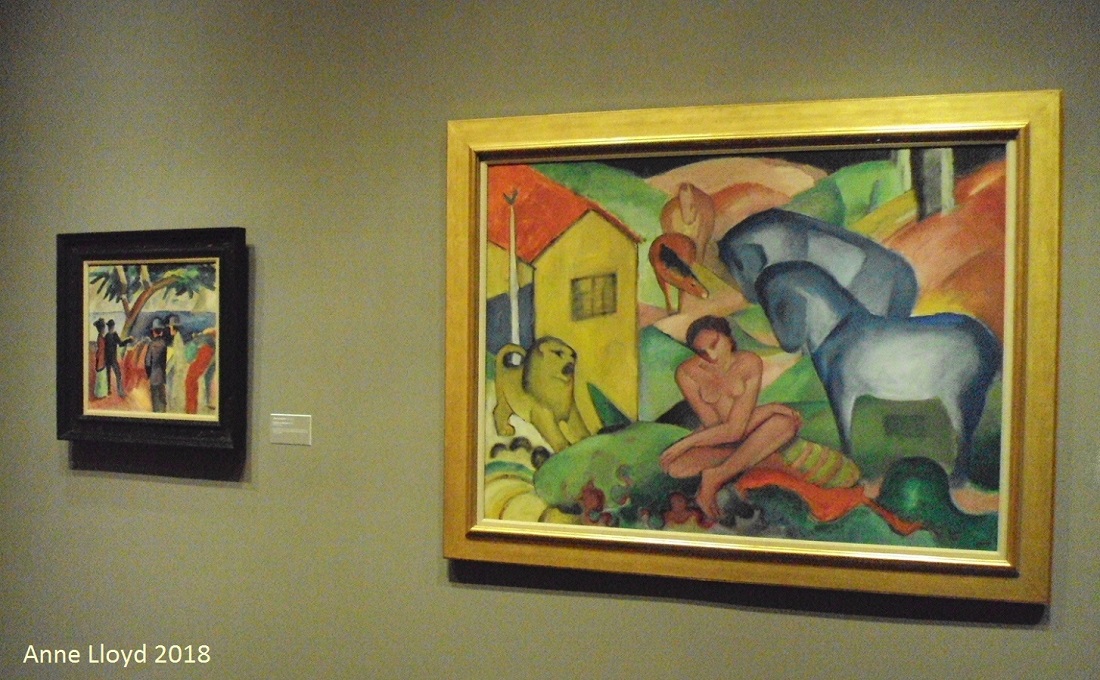
August Macke's Strollers at the Lake II, 1912, (left) and Franz Marc's The Dream, 1912

2018 marked the one hundredth anniversary of the end of World War I. The Neue Galerie, the splendid museum of German and Austrian art in New York City, marked this solemn occasion with a much needed exhibition devoted to Franz Marc and August Macke. These close friends and brilliant Expressionist painters were both killed in battle on the Western Front. Despite their importance in the development of modern art, works by these great German Expressionists are rarely shown in the U.S. Incredibly, this beautifully mounted exhibition was the first ever major display of Macke's paintings in America. 

Trying to find a unifying context for 2018's special exhibitions is a rather fruitless endeavor. However, two seemingly contradictory trends were very much apparent. 

This past year highlighted the absolute necessity of collaboration between museums for mounting major "shows."  In marked contrast, a growing number of successful exhibitions were drawn exclusively from the resources of individual institutions. This self-reliance in exhibition presentation is likely to become the dominant model for museums in the future.

Cézanne Portraits illustrated the first of the two trends. It was a "once-in-a-lifetime" exhibition - a display of a lifetime's creative output by one of the greatest artists of all time. 


Anne Lloyd, Photo (2018) Detail of Paul Cézanne's Self Portrait, c.1875.

The Cézanne show was a triumph, in no small part because of the difficulty of bringing together so many seminal works by Cézanne for such a long period. The traveling exhibition was shown over the course of 2017 and 2018 at the Musée d’Orsay in Paris, the National Portrait Gallery in London and finally at the National Gallery of Art in Washington D.C., where Anne and I saw it in March 2018. It was organized by John Elderfield, Chief Curator Emeritus of Painting and Sculpture at MOMA, working with curators Mary Morton of the National Gallery of Art and Xavier Rey of the Musée d’Orsay. Talk about a team effort!


Anne Lloyd, Photo (2018) Eagle Pendants, Chiriqui culture, 800-1519 A.D

The same could be said about Golden Kingdoms: Luxury and Legacy in the Ancient Americas. This fabulous survey of the creative genius of the Native American kingdoms was originally presented by the J. Paul Getty Museum as part of a series on Latin American culture, "Pacific Standard Time: LA/LA." It then traveled to the Metropolitan Museum in New York, which also presented a first-rate exhibition on Spanish colonial painting at the same time. The effect of these collaborative efforts was magical.


Anne Lloyd, Photo (2018) 
Curators of the Berthe Morisot exhibition. From left: Nicole R. Myers, Dallas Museum of Art, Sylvie Patry, Musée d'Orsay, and Cindy Kang of the Barnes Foundation

Also of note was the Berthe Morisot exhibition, a joint effort by four museums, the Musée national des beaux-arts du Québec, the Dallas Museum of Art, the Musée d'Orsay in Paris and Philadelphia's Barnes Foundation. On view at the Barnes until mid-January 2019, the exhibition is a much needed retrospective of an artist who was regarded as a great painter by her fellow Impressionists. Following her death in 1895, Morisot was marginalized by art historians for much of the twentieth century. This exhibition sets the record straight.

The contrasting tendency of mounting exhibitions with local resources has a lot to be said for it. The Metropolitan Museum mounted an impressive exhibition, Public Parks, Private Gardens: Paris to Provence, almost entirely based on its collection. In October 2018, the Met staff also created a long-term special display of its "Golden Age" Dutch paintings. I will be reviewing this sensational exhibit of "only at the Met" paintings early in 2019.


Anne Lloyd, Photo (2018),
Gallery view of Fabulous Fashion at the Philadelphia Museum of Art. 
 The dress is a 1962 palazzo pants ensemble designed by Irene Galitzin.

The Philadelphia Museum  of Art, midway through a massive renovation project, mounted three outstanding exhibitions during 2018, all drawn exclusively from its vast holdings.  These were Old Masters Now (November  2107 to February 2018), Modern Times: American Art 1910–1950 (April to September 2018) and its current blockbuster, Fabulous Fashion: From Dior’s New Look to Now, which runs to March 3, 2019.

Under very challenging circumstances, the Philadelphia Museum of Art staff covered themselves in glory during 2018. Spring 2019 will be welcomed with a similar "home-grown" exhibition on the techniques of the Impressionists
.
Both trends represent good news. Only a kill-joy would go searching for a negative point of view regarding the mounting of special exhibitions. Yet, there certainly are ominous factors regarding the wonderful art exhibits we have grown so accustomed to. The one which really concerns me is the demographic factor of age of museum visitors.

My concern isn't based on age in terms of years. I didn't begin seriously studying art until I was thirty or thereabouts. Young people have a lot of life challenges to meet and the admission charge to an art museum can be a daunting prospect for someone with college loans to repay or young children to rear.


Anne Lloyd, Photo (2018) Gallery view of the Barnes Foundation, Philadelphia, PA

Quite often, I see very few young art patrons in the museum galleries. I wonder if, having grown-up in a digital world,  young adults will continue to derive inspiration from seeing original works of art. Certainly, interactive technology is helping redefine art exhibitions for a computer-savvy audience. I think we will see more touch screens and  computer simulations - and fewer visiting masterpieces - in future exhibitions.

I still retain hope in "expecting the unexpected." The Metropolitan Museum of Art and the National Gallery in London presented an outstanding exhibition on the Anglo-American landscape painter, Thomas Cole (1801-1848) during 2018.


Thomas Cole, View of the Round-Top in the Catskill Mountains, 1827

Cole, who grew-up in the industrializing region of Lancashire, was moved by the splendor of the American wilderness to embrace landscape painting. This was a defining moment in art history and one that could not have been predicted a half-century before when landscape painting hardly figured in the appreciation of fine art.

Cole, the founder of the Hudson River School, was not alone in his passion for the majesty of nature during the early 1800's. The emphasis on landscape painting - first apparent in Holland in the late 1600's, then later in Great Britain and finally in the U.S. - was largely based upon a sense of "paradise lost." 


Detail of Thomas Coles's View from Mount Holyoke, Northampton, Massachusetts,        after a Thunderstorm — The Oxbow, 1836

By the late 1700's, there was growing unease at the encroachment of cities, factories and mines on the precious realm of nature.  A sensitive and visionary artist, Cole grasped the fragility of the natural world and made this awareness the presiding theme of his art.

Hopefully, as artificial Intelligence, robotics and late-stage mechanization impinge on society, a new generation of art lovers will arise to appreciate the great works of art and support the museums which care and exhibit them.

Ultimately, the health and well-being of the art world takes us back to Agnes Martin's quote on beauty. I explored her comments further and found a wealth of insight - some of it unsettling - but filled with soul-enriching truth.
  
The path to great art does not proceed from Point A to Point B to Point C, from a great idea to painting a masterpiece to a place on a gallery wall. Art is not dependent on art museums, art exhibitions or even upon a need for visual representation. 

Great art can be composing an outstanding piece of music as Leonard Bernstein did - or listening intelligently to the music of a great composer. Great art comes from planting and nurturing a rose or a sunflower. Great art is standing back and seeing the rose or sunflower, appreciating it as a seed of beauty which will continue to flower in our minds. 


Anne Lloyd, Photo (2018) Sunflower at the Saul Agricultural School, Philadelphia

Art, in a myriad of differing creative expressions, is based on a healthy, emotional response to life. Art is a reflection of what we see in life and give back to life. 

That thought, art as a reflection, was literally reinforced by an extraordinary work of art which Anne and I saw several times this past year in New York City. 


Anne Lloyd, Photo (2018) Tear sculpture by Richard Hudson at Plaza 33 in Manhattan

Tear, an enormous sculpture made polished steel, is the creation of British artist, Richard Hudson. It is displayed, not in a museum but smack in the middle of Plaza 33, outside Penn Station. Not a place given to introspection but now a site for reflection!

With this image and these moving words of Agnes Martin, Art Eyewitness bids you a Happy 2019.

Beauty is an awareness in the mind. It is a mental and emotional response that we make. We respond to life as though it were perfect. When we go into a forest we do not see the fallen rotting trees. We are inspired by a multitude of uprising trees. We even hear a silence when it is not really silent. When we see a new born baby we say it is beautiful – perfect. The goal of life is happiness and to respond to life as though it were perfect is the way to happiness. It is also the way to positive art work.

***
Text: Copyright of Ed Voves, all rights reserved                                                                                           
Images courtesy of the Metropolitan Museum of Art, the Barnes Foundation, the Museum of Fine Arts, Boston, and Anne Lloyd

Introductory Image:
Camille Corot (French, 1796–1875) The Curious Little Girl, 1860–64. Oil on cardboard, laid down on wood: 16 1/4 x 11 1/4 in. (41.3 x 28.6 cm). Metropolitan Museum of Art. The Walter H. and Leonore Annenberg Collection, Gift of Walter H. and Leonore Annenberg, 1999, Bequest of Walter H. Annenberg, 2002. Accession Number:1999.288.2 © The Metropolitan Museum of Art

Pierre-Auguste Renoir (1841-1919) Roses, c. 1912. Oil on canvas:  8 7/8 x 17 5/8 in. (22.5 x 44.7 cm) Barnes Foundation, Philadelphia. Accession Number BF1168 © The Barnes Foundation


Anne Lloyd, Photo (2018)  Film frame from Pierre-Auguste Renoir: Painter, 1920 Silent Film produced by Gaumont Actualities. Distributed by Gaumont Pathé Archives. Film was shown at the Renoir: Father and Son exhibit at the Barnes Foundation, Philadelphia, PA.

Ed Voves, Photo (2018) Gallery view of Between Worlds: the Art of Bill Traylor exhibition at the Smithsonian American Art Museum, Washington D.C. Photo shows Bill Traylor's Man and Large Dog, ca. 1939-1942.

Anne Lloyd, Photo (2018) of Alberto Giacometti's Man pointing, 1947 (cast by 1949).  Bronze, 70 1/16 x 37 3/8 x 20 1/8" (178 x 95 x 52 cm) Tate Museum, London. # 2016.136. Photo shows Man Pointing in the Giacometti exhibition at the Guggenheim Museum, N.Y.

Anne Lloyd, Photo (2018) August Macke's Strollers at the Lake II, 1912, (left) and Franz Marc's The Dream, 1912. Photo shows these works at the Neue Galerie exhibition, Franz Marc and August Macke, 1909-1914.

Anne Lloyd, Photo (2018) Detail of Paul Cézanne's Self Portrait, c.1875. Musée d'Orsay, Paris. Gift of Jacques Laroche.

Anne Lloyd, Photo (2018) Gallery view of Golden Kingdoms: Luxury and Legacy in the Ancient Americas exhibition, showing Eagle Pendants, Chiriqui culture,  800-1519  A.D. Gold. Collection of the Metropolitan Museum of Art.

Anne Lloyd, Photo (2018)  Curators of the Berthe Morisot, Woman Impressionist exhibition at the Barnes Foundation. From left: Nicole R. Myers, Dallas Museum of Art, Sylvie Patry, Musée d'Orsay, Paris, and Cindy Kang of the Barnes Foundation.

Anne Lloyd, Photo (2018), Gallery view of the Fabulous Fashion: From Dior’s New Look to Now exhibition at the Philadelphia Museum of Art. The dress shown is a 1962 palazzo pants ensemble designed by Irene Galitzin.

Anne Lloyd, Photo (2018) Gallery view of the Barnes Foundation, Philadelphia, PA.

Thomas Cole (American (born in England), 1801–1848) View of the Round-Top in the Catskill Mountains - Sunny Morning on the Hudson, 1827. Oil on panel: 47.31 x 64.45 cm (18 5/8 x 25 3/8 in.) Museum of Fine Arts, Boston  # 47.1200. © The Museum of Fine Arts, Boston.

Thomas Cole (American, 1801-1848) Detail of View from Mount Holyoke, Northampton, Massachusetts, after a Thunderstorm—The Oxbow, 1836. Oil on canvas, 51 1/2 x 76 in. (130.8 x 193 cm). The Metropolitan Museum of Art, New York, Gift of Mrs. Russell Sage, 1908 (08.228). Image © The Metropolitan Museum of Art

Anne Lloyd, Photo (2018) Sunflower at the Saul Agricultural School, Philadelphia, PA.

Anne Lloyd, Photo (2018) Tear sculpture by Richard Hudson (British, born 1954) at Plaza 33 in Manhattan near Penn Station and Madison Square Garden. Polished stainless steel: height: 250 cm. 


Sunday, June 17, 2018

Giacometti at the Guggenheim


Giacometti


Solomon R. Guggenheim Museum, New York City

June 8, 2018 - September 12, 2018


Reviewed by Ed Voves
Photos by Anne Lloyd 

One of the first sculptures on display at the Guggenheim Museum's new exhibit of the lifework of Alberto Giacometti (1901–1966) is entitled Walking Man I. It is one of Giacometti's signature pieces, a notable example of the gaunt, featureless beings that have come to symbolize the post-Auschwitz, nuclear-weaponized world which emerged from the carnage of World War II.

The Giacometti exhibit at the Guggenheim is little short of sensational, with nearly two hundred works of art on view, sculptures, drawings, paintings. The works of art are mostly from the collection of the Fondation Giacometti in Paris. Among these generous loans, Walking Man I is a "standout" in many respects.

The significance of Walking Man I extends beyond the apocalyptic years of the Second World War back to the sculptor's youth. It is worth pausing a brief moment from reviewing the marvelous exhibit at the Guggenheim to look at an incident vividly described in the great biography of Giacometti by James Lord. 

Giacometti was a precocious fifteen year-old student at a elite Swiss boarding school when the event occurred. On the way home for the Christmas 1915 holiday, Giacometti stopped in a bookstore. He chanced upon an illustrated volume about the artwork of Auguste Rodin. The sight of the pictures of Rodin's sculptures filled the young Giacometti with awe. He bought the expensive book, even though this left him short of money to get home.

Clutching his book on Rodin, Giacometti trudged the final ten miles home over a mountain pass on a freezing, snowy night to his hometown of Stampa in rural Switzerland. That perilous journey set the tone for the rest of his life.

Striding forward, trudging onward, advancing against the winter winds, Giacometti became the Walking Man he would later sculpt. Rodin, himself, early in his career, had sculpted a figure with the same title. It is quite likely that there was a picture of this Rodin statue in Giacometti's book. Giacometti eventually became the new Rodin, an art traditionalist with a revolutionary vision. 


Giacometti painting in his Paris studio, 1958. Photograph by Ernst Scheidegger 

As if that legacy were not enough, Giacometti took on the role of the Walking Man for all of Western art.  Making our way up the ramps of the Guggenheim Museum, we are given the privileged opportunity to explore the course of Giacometti's engagement with ideals of art going back to the ancient Egyptians and the Cycladic art of the very earliest Greek cultures. We are enabled also to join in Giacometti's dialogue with other great artists and thinkers of the twentieth century.

A friend of Jean-Paul Sartre, Samuel Beckett and Jean Genet, Giacometti was in many ways an existentialist figure. However, Giacometti denied aiming to create definitive Existentialist art works. The same role had earlier applied to his short-lived Surrealist career during the early 1930's. Giacometti was and wasn't a new Rodin, was and wasn't a Surrealist or an Existentialist artist. 

Why the seeming contradictions?  Giacometti held to a singular, individualistic course of art that precluded him from ever joining, much less leading, a school of art, a new "ism."

"I am very interested in art but I am instinctively more interested in truth," Giacometti declared. "The more I work, the more I see differently.”

Giacometti was haunted by anxieties and nightmares that surfaced in his art. These were both personal and prophetic. Death, the negation of life and art, was a hovering specter. 


Anne Lloyd, Photo (2018), Gallery view of the Giacometti exhibit
Giacometti's The Forest (1950) appears in front

Giacometti feared that his oeuvre represented the final chapter of the great age of Western art. This disturbing reflection, brilliantly explored in James Lord's biography, was not founded upon an arrogant self-regard. Instead, by the 1950's, Giacometti believed that the dominant creed of modern art, Abstract Expression, was headed in the direction of a cul-de-sac.

James Lord quotes Giacometti around the time of his MOMA exhibit in 1965, a year before he died.

How can one talk here about copies of works of art, frail and ephemeral works of art that exist here and there on continents, works of art that decay, disintegrate, that wither away day after day, and many of which - among them those that I prefer - have already once been buried, hidden beneath sand, earth, and stones? And they all follow the same path.

Frail and ephemeral are appropriate words to use in describing many of the works of art created by Giacometti. His favorite medium for creating statues was initially clay, but switched to using plaster in his later years. When he was satisfied with an image (Giacometti was very exacting), his brother Diego would then cast the statues in bronze which we encounter in museums all over the world. Six versions of Walking Man I were cast in 1960; the one on view in the Guggenheim exhibit was done later in 1982.


Anne Lloyd, Photo (2018), Gallery view of the Giacometti exhibit
In the foreground, is Giacometti's Woman Leoni, 1947-58

The Guggenheim exhibit features a massive array of Giacometti's works in all media. The plaster originals are much in evidence and it is a special treat to be able to study so many of them in one showing. In the case of several of these delicate plasters. These include Woman Leoni which curators restored, using laser technology to remove the layer of shellac which was applied during the casting process. 

Now we can see these "frail and ephemeral" and spiritually forceful works of art exactly as Giacometti saw them before instructing Diego to begin casting them in bronze. In their finished state, Giacometti's sculptures seem to exist in several time periods at once. 

Giacometti's The Chariot (1950) is a key example of the "time-bending" nature of Giacometti's art. After a visit to an archaeological museum in Italy, Giacometti became intrigued with ancient Egypt. The thin wheels on The Chariot replicate those of Egyptian war chariots from the New Kingdom. Yet, nothing in Giacometti's art can be reduced to a single element or influence.


Anne Lloyd, Photo (2018), Alberto Giacometti's The Chariot (1950)

Giacometti stated that a memory of pharmacy cart which he saw during a stay in the hospital played a role in the creation of The Chariot. He also declared that he aimed to create a work of art with a figure posed in empty space "in order to see it better and to situate it at a precise distance from the floor."

The answer to the source of The Chariot would therefore seem to be "all of the above." Yet, I cannot help but think that there is a spiritual level still waiting to be exposed after we peel away all the other layers of explanation. 

The Chariot was created in 1945 after Giacometti had spent the war years creating sculptures of tiny figures, mostly women, positioned on massive bases. These small figures are imprisoned by their bases while the female driver of The Chariot seems poised to launch into space. There is a real sense of awakening to freedom here which is rendered even more brilliant by the effect of the shadows cast by the chariot wheels and by the queen or goddess driver. She stands ready to command the vehicle forward in a bid for liberation.

I spent a lot of time looking at The Chariot. This incredible work of art was first displayed in the U.S. in 1950 at the Pierre Matisse Gallery in New York. It's only a "slight" exaggeration to say that I would not have been surprised to look back and see its gallery space at The Guggenheim vacant and Giacometti's magical cart on its way down the Guggenheim's ramp toward the door to Fifth Ave.


Anne Lloyd, Photo (2018), Gallery view of the Giacometti exhibit
at the Solomon Guggenheim Museum, New York City

Truthfully, the "magic" of this sensational exhibit has much to do with the Guggenheim's design and the history which the museum and New York City shares with Giacometti. This is the third major exhibit of his work at the Guggenheim. The first took place in 1955 before the present Frank Lloyd Wright-designed building was constructed. The second was a major retrospective held in 1974. Along with the trailblazing Matisse Gallery show in 1950 and the 1965 MOMA exhibit, New York City's role in the Giacometti story is second only to that of Paris.


Anne Lloyd, Photo (2018), Gallery view of the Giacometti exhibit
Three of Giacometti's Women of Venice sculptures are shown here.

The special "magic" of this Giacometti exhibit is due to the fact that the spiraling ramp of the Guggenheim rotunda is the perfect display space for a retrospective emphasizing sculpture. The numinous shadow effect, mentioned in relation to The Chariot, appears and reappears. And often, due to the superb lighting, spacious display area and reflective surfaces of the display cases, we glimpse an interaction between museum goers and works of art. Anne caught such a unique moment with this picture of City Square (1948).


Anne Lloyd, Photo (2018), Alberto Giacometti's City Square sculpture (1948)

When I mentioned how impressed I was with the Giacometti exhibit to the Guggenheim curator, Megan Fontanella, she paused for a moment and replied, "Sculpture sings at the Guggenheim."

When you look closely at key Giacometti in the exhibit, you cannot help but agree. Viewing Spoon Woman, influenced by the Cycladic art of early Greece, creates an atmosphere where the resonance of ancient ritual and music is almost palpable.


Anne Lloyd, Photo (2018), Alberto Giacometti's City Spoon Woman (1927)

If Spoon Woman "sings" then a full chorus is needed for Suspended Ball. In its shimmering case, Suspended Ball is one of the most animated and articulated of Giacometti's works on display. The only thing "suspended" about it is the string that holds it up in its supporting frame. 


Anne Lloyd, Photo (2018), Gallery view of the Giacometti exhibit 
Work at center is Giacometti's Suspended Ball (1930-31).

"Suspense" rather than "suspended" is a more meaningful adjective to apply to Suspended Ball. The work exist in the millisecond before action takes place, while we wait anxiously and at the ready. The next moment, the ball in its crescent-shaped support will start "rocking" like a baby in its cradle. 

That is an irrational concept. Indeed it is a surreal thought. André Breton, the "Pope of Surrealism" sought a meeting with Giacometti after seeing Suspended Ball. Giacometti, open to new experience, joined the Surrealist movement, but it was to prove a brief association. Giacometti, like almost all of the first-rank artists involved in Surrealism, could only tolerate Breton's doctrinaire ideology and insufferable manipulation for so long. This is one of the themes of the recent book, The Lives of the Surrealists by Desmond Morris.

Giacometti is in many ways the ultimate "Surrealist" because his works transcends tangible reality. Deeply moved by dreams - and nightmares - Giacometti often drew-upon the unconscious to inform and inspire his work. 

Giacometti's Surrealist period produced one of his key, transitional works, Hands Holding the Void (Invisible Object)


Anne Lloyd, Photo (2018),Details of Hands Holding the Void (Invisible Object)

In 1934, he created the plaster original (now in the collection of the Yale University art museum) of the first length human statue. Giacometti was partly influenced by the art of the Pacific Islands, but the face was modeled on a World War I gas mask and the eyes from Byzantine mosaics.


While pointing toward his later statues, Hands Holding the Void remains a Surrealist work. There is a nightmarish quality to this remarkable sculpture. The figure seems trapped by the setting which appears to be some sort of chair with a prie-dieux or "kneeler" as you find in chapels. Is this a protest against the confining structure of organized religions or perhaps, slyly, the "religion" of Surrealism?

Giacometti did not, would not, cut his ties with the immediate world around him. As the world in 1945 revealed images of concentration camp survivors - emaciated, gaunt, blank-eyed - Giacometti responded with works that utilized the people and objects in his immediate orbit to create universal statements on life. 

Giacometti's portraits were the primary means by which he depicted ultimate realities of the world after World War II. He posed his brother Diego, his wife Annette, luminaries like Simone de Beavoir and now-forgotten acquaintances to create existential icons - and for once the term "icon" is not misused.

Giacometti's portraits are so fascinating - and involved - that I am going to treat them in detail in a later, focused review. The Giacometti exhibit at the Guggenheim, truly one of the best I have ever seen, defies a single review. There are too many worlds of experience here, calling for our attention.

For now, I will conclude with a reflection on Man Pointing from 1947. If there is one, essential, Giacometti work of art, i believe that this is it. I feel that a lot of art lovers would agree, though perhaps for different reasons.

Man Pointing was created during the grim aftermath of World War II and the equally grim opening round of the Cold War. Giacometti's "thin man" gestures toward the sky and points earthward. This sculpture is an embodiment of the basic contradictions of life. It reminds me of the title of the medieval philosophy treatise, Sic et Non, by Peter Abelard. Yes or no. 

Abelard, during the twelfth century, sought to reconcile conflicting points of religious doctrine. Giacometti, with his persevering search for truth, endeavored to do the same for the arts and society during the twentieth century. However, there is only so much reconciling, so much negotiating that people can do in life before we become the slaves of expediency. Ultimately, a choice must be made.


Anne Lloyd, Photo (2018), Gallery view of the Giacometti exhibit
Art work is Giacometti's Man Pointing (1947).

That is what Man Pointing "said" to me as I confronted him at the Guggenheim gallery. Reaching toward heaven, Man Pointing pointed at me. 

"Make your choice", Man Pointing declared. "The choice is yours."

***


Text: Copyright of Ed Voves, all rights reserved 


Images courtesy of Anne Lloyd and the Solomon R. Guggenheim Museum, New York City 


Introductory Image:    
Anne Lloyd, Photo (2018) Photo of Alberto Giacometti's Walking Man I, 1960 (cast 1982) Bronze: 71 1/16  x 10 5/8  x 38 3/16 inches  (180.5 x 27 x 97 cm). Collection Fondation Giacometti, Paris. # 2016.177


Ernst Scheidegger (Swiss, 1923-2016) Giacometti painting in his Paris studio, 1958. © 2017 Stiftung Ernst Scheidegger-Archiv, Zurich Courtesy of Solomon R. Guggenheim Museum

Anne Lloyd, Photo (2018) Gallery view of the Giacometti Exhibition at the Guggenheim Museum, New York. Giacometti's The Forest (1950) appears in the foreground.

Anne Lloyd, Photo (2018)  Photo of Giacometti exhibition at at the Guggenheim Musseum. Statue is foreground is Woman Leoni, 1947-58.  Plaster:  66 15/16 x 7 1/2  x 16 9/16 inches  (170 x 19 x 42 cm). Collection Fondation Giacometti, Paris. # 2016.10513

Anne Lloyd, Photo (2018) Photo of Alberto Giacometti's The Chariot, 1950. Bronze on wood base: 65 3/4 x 27 3/16 x 27 3/16 inches (167x 69 x 69 cm) Denise & Andrew Saul # 2016.144


Anne Lloyd, Photo (2018), Gallery view of the Giacometti exhibit at the Solomon R, Guggenheim Museum, New York City

Anne Lloyd, Photo (2018), Gallery view of the Giacometti exhibit, showing three of the Women of Venice statues, dating to the 1950's. On view at the Solomon Guggenheim Museum, New York City

Anne Lloyd, Photo (2018) Photo of Alberto Giacometti's City Square,1948. Bronze: 8 1/2 x 25 3/8 x 17 1/4" (21.6 x 64.5 x 43.8 cm) Private collection. x 2016.10647


Anne Lloyd, Photo (2018) Photo of Guggenheim Exhibit showing Alberto Giacometti's  Suspended Ball,1930-1931 (version of 1965). Plaster, painted metal and string: 23.7/8 x 14 x 14.3/16 in. (60.6 x 35.6 x 36.1 cm) Collection Fondation Giacometti, Paris. # 2016.92

Anne Lloyd, Photo (2018) Photo of Alberto Giacometti's Hands Holding the Void (Invisible Object)(Detail), 1934 (cast ca. 1954-55).  Bronze:  59 7/8 x 12 7/8 x 10 in. (152.1 x 32.7 x 25.4cm) Museum of Modern Art Louise Reinhardt Smith Bequest # 775.1995 © 2018 Artists Rights Society (ARS), New York / ADAGP, Paris

Anne Lloyd, Photo (2018) of Alberto Giacometti's Man pointing, 1947 (cast by 1949).  Bronze, 70 1/16 x 37 3/8 x 20 1/8" (178 x 95 x 52 cm) Tate Museum, London. # 2016.136