Friday, August 24, 2018

Leonardo: Discoveries from Verrocchio’s Studio at Yale University Art Museum


Leonardo: Discoveries from Verrocchio’s Studio


Yale University Art Gallery
June 29, 2018–October 7, 2018

Reviewed by Ed Voves

History has not been kind to Andrea del Verrocchio (1435–1488). It has been Verrocchio's fate to dwell in the shadow of Leonardo da Vinci. An excellent exhibition, on view at the Yale University Art Gallery, casts some beams of light on their relationship.

Verrocchio shares his ill-luck with Pietro Perugino (1450-1523) and Domenico Ghirlandaio (1448/49–1494). Each of  these artists was a great Renaissance master.Today they are best known, not for the art they created, but rather for the fame of an apprentice in their studios.

Perugino, an early master of oil painting in Italy, taught Raphael the foundations of art. Ghirlandaio, an extremely skilled fresco painter, briefly had a very young - and very headstrong - Michelangelo as a studio assistant. Michelangelo seldom mentioned his time with Ghirlandaio, nurturing the mystique of his own singular genius.


Ed Voves, Photo (2018) View of Leonardo: Discoveries from Verrocchio’s Studio 

Andrea del Verrocchio was even more unlucky than Perugino and Ghirlandaio. His student/assistant was none other than Leonardo da Vinci.  

"Poor is the pupil that does not surpass his master," Leonardo later wrote. Art historians, beginning with Giorgio Vasari, agreed with this remark, to the detriment of Verrocchio's reputation.

In his Lives of the Artists, Vasari wrote that Verrocchio announced he was giving-up on painting after seeing how superb was the work of his acolyte, Leonardo. This is demonstrably false but people love "tall tales." This one has grown all the taller for its constant retelling.


Ed Voves, Photo (2018) Virgin and Child with Angel by Verrocchio & studio, c.1475–85

Verrocchio was especially gifted as a sculptor. The Yale exhibit gives us a sample of his talent by displaying a marble relief credited to the Verrocchio studio. Virgin and Child with Angel was created at some point between 1475-85. Many hands were most likely involved in crafting this exquisite work, perhaps the young Leonardo's among them. But Verrocchio was the presiding master and his art studio was one of the best in Florence.

The Yale exhibit displays two works commissioned from Verrocchio's studio during its heyday. One of them, a depiction of the Annunciation, is now believed to be entirely the work of the young Leonardo. The other features two religious figures, one of such transcendent skill that it has recently  been assigned to the canon of art work by Leonardo.


Leonardo da Vinci, The Annunciation, ca. 1475–79

To discover two paintings by Leonardo is a very big deal. He is currently credited with painting a total of fifteen paintings. Others no doubt have not survived or have yet to be identified. Yet fifteen is a small number for such a long life (1452-1519). 

One of these  paintings on view at Yale is The Annunciation, on loan from the Louvre. The other, A Miracle of St. Donatus of Arezzo, has recently been deemed a jointly-painted work with another assistant in Verrocchio's studio, Lorenzo di Credi (c.1457/1459-1536).
Each of these paintings filled  a panel or predella at the base of an ornate altar for a church in Pistoia, Italy. 


Lorenzo di Credi & Leonardo da Vinci, A Miracle of Saint Donato of Arezzo, c.1479-85

Verrocchio's studio was given the commission for the altar in 1474 and the maestro himself painted the central panel, The Piazza Madonna (or at least most of it). For many years, Lorenzo di Credi was given credit for painting the remaining altar panels, with only minimal contributions by Leonardo.

Opinions have begun to shift and it is not difficult to grasp why. Di Credi was a mediocre painter, as we can see by one of his solo works on view in the Yale exhibit. It is an Annunciation like the one now credited to Leonardo. But it is a banal, unconvincing piece. Not for a moment do you believe that an angel is addressing the Virgin Mary. With Leonardo, the piety and humility of his Virgin Mary, even in this small-sized work, is overwhelming.


Lorenzo di Credi, The Annunciation ca. 1500

The most dramatic "discovery" in the Yale exhibition is the attribution to Leonardo of the right hand figure in A Miracle of St. Donatus of Arezzo. This work has been in the collection of the Worcester Art Museum since 1940, listed as a work by Lorenzo di Credi.  

Laurence Kanter, Chief Curator of European Art at the Yale University Art Gallery, believes it is a collaborative work, some of it done by di Credi certainly. However, the right-hand figure, St. Donatus, was handled with a degree of psychological depth far beyond di Credi's modest attainments. All the indicators point to Leonardo.

The careworn, other-worldly countenance of  St. Donatus was well within Leonardo's range of talent. However, the facial features of St. Donatus bear some similarity to the treatment  of the faces of St. John the Baptist and Jesus in another famous Verrocchio studio collaboration. This was The Baptism of Christ, painted around 1475. It is an impressive work, but chiefly famous today for one of the angels in the picture is credited to Leonardo. 


Leonardo da Vinci, A Miracle of Saint Donato of Arezzo (detail), ca.1479-85

If painted by Leonardo, the figure (and face) of St. Donatus is a testament to his ripening skill. The affinities to Verrocchio's style do not detract from the youthful Leonardo's achievement. After all, Leonardo worked in Verrocchio's studio for a considerable period and it would only be natural that his early work retain traces of the older artist's influence. 

Leonardo actually remained in Verrocchio's studio longer than he needed to. This is a very intriguing situation. To a remarkable degree, it reveals Leonardo's habit of working for a patron or "master" - Ludovico Sforza, Duke of Milan, for instance - rather than establishing and managing a studio of his own.

Born in 1452, Leonardo entered into his apprenticeship with Verrochio in 1466, at the age of fourteen. He continued working in Verrocchio's studio until 1476. Yet, Leonardo was admitted to the prestigious artist's guild of Florence, the Confraternity of St. Luke, in 1472. This was the moment for a now established artist to strike out on his own. Why the delay of four years? 

From the very beginning, Leonardo's astonishing range of talent was clearly in evidence.  Verrocchio's studio was the best environment for a gifted "all-rounder" like Leonardo to experiment with different forms of art. That is the kind of artist that Verrocchio was himself: goldsmith, painter and sculptor. Leonardo and Verrocchio were well-matched.

The Yale exhibit displays a wide range of works from Verrocchio's studio during the 1470's-80's. These show the points at which the lives and career paths of Leonardo and Verrocchio intersected. Most of all, the great creative environment of Florence during the Quattrocento is revealed.
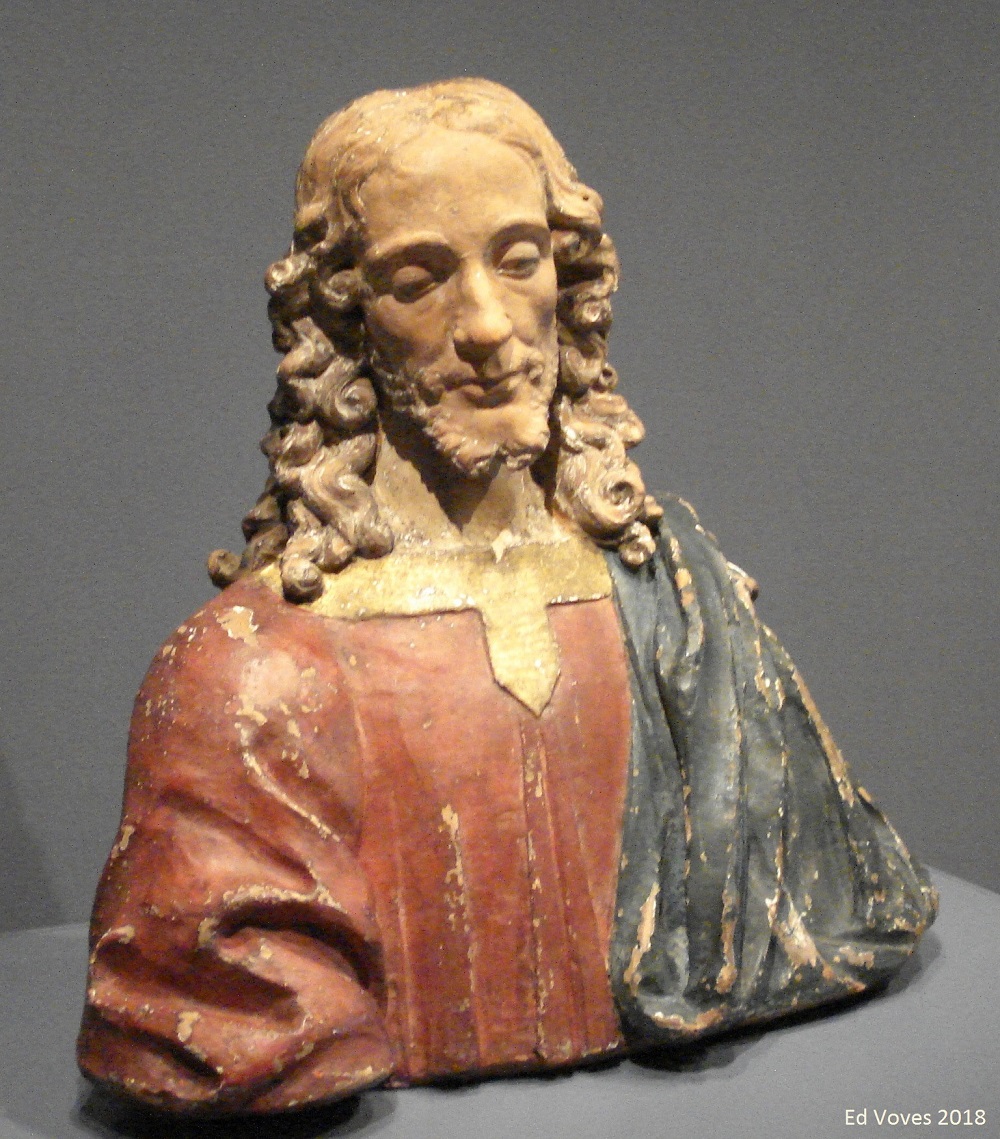


Ed Voves, Photo (2018) Andrea del Verrocchio's Bust of Christ. ca. 1470–83 

Of these works of art on view at Yale, the terracotta Bust of Christ by Verrocchio made a lasting impression on me. According  to the museum exhibit caption, considerable effort went into its creation:

The core structure of the head and torso appears to have been cast in a mold. Thick slabs of clay were then added by hand and vigorously molded to form the draperies and the animated curls of the hair, while the delicate features of the face were carved into the clay surface to refine their expressive character.

The dedication and skill which went into this powerful portrait of Christ derived in part from  one of Verrocchio's most celebrated sculptures. This was the bronze statue group, The Doubting of Saint Thomas. A full length work, it had been created to be placed in a niche near the entrance of one of Florence's most famous buildings, the Orsanmichele. An influential business association, the Mercanzia, commissioned Verrocchio to sculpt this scene from the New Testament where Christ reveals his identity to a skeptical disciple, St.Thomas.

Verrocchio revealed the true extent of his artistic talent with this bronze masterpiece, which still exists today, though safely removed from the wall of the Orsanmichele. Copies of this portrait bust of Jesus proliferated, many of them substandard replicas. This one, on loan to Yale from a private collection, is so superb that there can be no doubt that it was made in Verrocchio's studio, either by him or under his close supervision.

The Mercanzia commissioned the bronze portrait group of Christ and St.Thomas in 1466-67. The terracotta bust was made between 1470-1483. Most likely it was created during the early part of this date range. During the 1480's, Verrocchio's time was consumed by his work on a great equestrian statue of the Venetian military leader, Bartolomeo Colleoni. Sadly, Verrocchio died in 1488 before this mighty "man on horseback" could be cast in bronze.

Leonardo would therefore have working in Verrocchio's studio during the long hours of inspired, dedicated labor which produced The Doubting of Thomas and the Bust of Christ. The effect on a young artist of being part of the team creating such masterful sculptures had to be powerful - and long lasting.


Ed Voves, Photo (2018) Andrea del Verrocchio's Bust of Christ. ca. 1470–83 

While I was at the YaIe exhibit, I kept looking and looking at the terracotta Bust of Christ. Finally, it dawned on me that this portrait of Jesus, communing with God, with his "Father in Heaven" according to Christian belief, was very close in spirit and in form to Leonardo's depiction of Christ in The Last Supper.


Ed Voves, Photo (2018) Andrea del Verrocchio's Bust of Christ. ca. 1470–83 

Of course, The Last Supper is one of the greatest, most revolutionary works of art of all time. Of course, Leonardo da Vinci is a singular genius, a "magus" as Andrew Graham Dixon called him in his great study of the Renaissance. Yet, even a High Renaissance master must be taught the basics, the essentials of art. Even a magus must learn the correct amount of perspiration to mix with inspiration.

Leonardo da Vinci first achieved mastery of art working in the studio of Andrea del Verrocchio. This excellent exhibition at Yale, Leonardo: Discoveries from Verrocchio’s Studio, is undeniable proof of the genesis of his genius. 

***
Text & Photos : Copyright of Ed Voves, all rights reserved                                                  
Photos courtesy of the Yale University  Art Gallery

Introductory Image
Leonardo da Vinci, The Annunciation (detail), ca. 1475–79. Oil on panel. Musée du Louvre, Paris, inv. no. M.I. 598. Photo: Centre de Recherche et de Restauration des Musées de France (C2RMF), Jean-Louis Bellec

Ed Voves, Photo (2018) Gallery view of the Leonardo: Discoveries from Verrocchio’s Studio exhibit at the Yale University Art Gallery.

Ed Voves, Photo (2018) Virgin and Child with Angel by Andrea del Verrocchio and studio, ca. 1475–85.  Marble: 97.8 x 74.9 x 16.5 cm (38 1/2 x 29 1/2 x 6 1/2 in.) Diameter and weight: 133.8 kg (295 lb.) Museum of Fine Arts, Boston. Gift of Quincy Adams Shaw, through Quincy Adams Shaw Jr. and Mrs. Marian Shaw Haughton. #17.1467

Leonardo da Vinci (Italian, 1452–1519), The Annunciation, ca. 1475–79. Oil on panel. Musée du Louvre, Paris, inv. no. M.I. 598. Photo: Centre de Recherche et de Restauration des Musées de France (C2RMF), Jean-Louis Bellec

Lorenzo di Credi (Italian,1459-1537) and Leonardo da Vinci (Italian, 1452–1519) A Miracle of Saint Donato of Arezzo , ca.1479-85. Painting on panel. Worcester Museum of Art, Massachusetts. Theodore T. and Mary G. Ellis Collection. 1940.29

Lorenzo di Credi (Italian,1459-1537) The Annunciation ca. 1500. Oil on panel. Alana Collection, Newark, Delaware. Photo: Christopher Gardiner

Leonardo da Vinci (Italian, 1452–1519)  A Miracle of Saint Donato of Arezzo (detail), ca.1479-85. Painting on panel. Worcester Museum of Art, Massachusetts. Theodore T. and Mary G. Ellis Collection. 1940.29

Ed Voves, Photo (2018) of Andrea del Verrocchio's Bust of Christ. ca. 1470–83. Polychrome terracotta 68 x 71 x 40 cm (26 3/4 x 27 15/16 x 15 3/4 in.) base: 8.9 x 86.3 x 33 cm (3 1/2 x 34 x 13 in.)   Private collection  ILE2011.17.91


Wednesday, August 15, 2018

Henri Cartier-Bresson: The Decisive Moment at the International Center of Photography


Henri Cartier-Bresson: The Decisive Moment


International Center of Photography 
New York City May 23, 2018 – Sep 02, 2018

Reviewed by Ed Voves

This summer, the International Center of Photography (ICP), located in lower Manhattan, is presenting an exhibition of one of the twentieth's century greatest photographers: Henri Cartier-Bresson (1908–2004). His name has become synonymous to the English-speaking world with the expression "the Decisive Moment."

Cartier-Bresson might well have become a great film director rather than a  renowned "still" photographer, for he briefly worked for one of the legends of the cinema. In 1936, Jean Renoir hired the promising young photographer to serve as second assistant director for his film, Une partie de campagne (A Day in the Country). Except for a handful of short films, however, Cartier-Bresson was destined to be the master of a Leica 35 mm camera rather than a director's clip-board. 

To modern-day art lovers, Une partie de campagne brings to mind recollections of the Impressionist paintings of Renoir's father, such as Luncheon of the Boating Party. But there is another point of comparison. Not long after the filming was completed, a year or so  later, Cartier-Bresson revisited this theme. His photo, Sunday on the Banks of the Seine, shows a group of working-class people enjoying a glass of wine and last few nibbles of a picnic lunch overlooking a quiet river scene.

There the similarities end. Sunday on the Banks of the Seine (some prints refer to the river as the Marne) is not just a photo homage to a great film. It is a great work in its own right. It shows a "peak" experience in life and art: the decisive moment.


Henri Cartier-Bresson, Sunday on the Banks of the Seine, 1938

What is so "decisive" about this moment? There are five ordinary people finishing-up lunch. One of them, evidently a young woman, is almost unseen except for a wave of hair just visible in front of the cloth-capped gent. There's a row boat tied up to a fishing pier on which we can see two empty seats and a couple of dangling fishing poles. Nothing much is happening here.

Everything is happening here. Cartier-Bresson has captured one of the rarest occasions in human life: a moment of true contentment and real joy. Breathe in the country air. Drink a  glass of red wine. Eat that last bit of cheese. Savor the joie de vivre.

Then the fleeting moment is gone. Yet the memory of happiness remains, nurturing our souls, fortifying our hearts to survive the dark times.

The five people in this photo almost certainly were alive during the terrible spring of 1940, when Hitler's blitzkreig devastated France. I wonder if any of them remembered this sunny aftenoon during the grim Nazi Occupation? Cartier-Bresson was captured by the Germans, though he later escaped in 1943 to join the Resistance. Did he think of this picture as he planned his breakout from behind the barbed wire of the stalag?

Cartier-Bresson certainly remembered this brilliantly-composed photograph in 1952. That year, he published a large format collection of his photos. His American publisher, Simon and Schuster, entitled the book, The Decisive Moment. Those three words would define Cartier-Bresson for the remainder of his life.


Anne Lloyd, Photo (2018)  Reading a first edition copy of The Decisive Moment 

Paging through the phenomenal book, in its first edition, is a unique experience. Although a faithful, high-quality facsimile of The Decisive Moment was published in 2015, I think it is fair to say that they don't make books like this anymore.

One could also make the carping criticism that great photographers like Cartier-Bresson are not around either. That would be both untrue and unfair.There a quite a number of outstanding "lensmen" and "lenswomen" still at work. The disturbing fact about contemporary photography is that the media heirarchy no longer rewards the kind of intiative and independence exemplified by Henri Cartier-Bresson.

As the ICP exhibition text notes, the French edition of Cartier-Bresson's book (with a cover designed by Henri Matisse) had a different title. It was called  Images à la Sauvette or “images on the run.” This was entirely appropriate given Cartier-Bresson's roving, globe-trotting picture taking. There was added irony, however, in that Images à la Sauvette literally defines one of his earliest masterpieces, Behind the Gare St. Lazare, 1932.

Cartier-Bresson used  his 35mm Leica camera to record the extraordinary image of a man leaping over an enormous pool of water. In the background is the Gare St. Lazare railway station in Paris. In 1873, Eduard Manet had immortalized the station, shrouded by steam, as the object of a little girl's curiosity. Here the mystery of Manet's "cathedral of progress" is revealed and deflated. It's just a mundane warehouse.


Henri Cartier-Bresson, Behind the Gare St. Lazare, 1932

Or so it seems. In a delicious stroke of irony, Cartier-Bresson shows a circus company advertisement hanging from the iron fence. The name of the circus, Railowsky, and a silhouette of an acrobat, are reflected in the water. In that mirrored image, the sense of magic returns. From being a pedestrian trying to keep his shoes dry, the leaping man is transformed into a real acrobat performing in the three-ring circus of life.

How did Cartier-Bresson manage to take this incredible photo? It wasn't posed or staged. Nor was it the result of luck. In the introduction to The Decisive Moment, Cartier-Bresson wrote about the experience of discovering the Leica 35 mm camera in 1932 and his experiments in creating his "decisive moment" style:

I had just discovered the Leica. it became the extension of my eye, and I have never been separated from it since I found it. I prowled the streets all day, feeling very strung-up and ready to pounce, determined to "trap" life - to preserve life in the act of living. Above all, I craved to seize the whole essence, in the confines of one single photograph, of some situation that was in the process of unrolling itself before my eyes.

Cartier-Bresson soon became an absolute master of encompassing entire universes of action and feeling in a single frame. And these photos speak for themselves.


Henri Cartier-Bresson, Downtown, Manhattan, New York, United States, 1947

Long scholarly articles could be written analyzing Cartier-Bresson's amazing photo of a man and a cat sitting, face-to-face, in a New York City ally in 1947. What's going on here? Is this a  glimpse of the soul-crushing anonymity of modern urban life?  Or does this photo record an act of caring by a sensitive human for a stray cat - or vice versa?

Does it matter which explanation is correct - or maybe another one we haven't considered? What matters is that this photo recorded a raw, unpredictable moment of life.

Looking at this, and Cartier-Bresson's other photos, we soon comprehend his "secret" for taking a "decisive moment" picture. The "secret" was always to being ready to open his heart and mind, as well as his eyes, to the scene that was "in the process of unrolling itself" before him.

But when to snap the picture? Cartier-Bresson explained:

In photography there is a new kind of plasticity, product of the instantaneous lines made by movements of the subject. We work in unison with movement as though it were a presentiment of the way in which life unfolds. But inside movement there is one moment at which the elements in motion are in balance. Photography must seize this moment and hold immobile the equilibrium of it.

To "seize this moment," Cartier-Bresson co-founded the Magnum Photo Agency in 1947. Fascinated by Oriental philosophy, he went to Asia where he photographed world-altering events like the Communist takeover of China in 1949. The juxtaposition of the timely, newsworthy, event, with timeless moments of apparent harmony was a notable feature of his work in Asia.


Henri Cartier-Bresson, The Last Days of the Kuomintang, Shanghai, China, 1948

When we look at this desperate scene of people trying to redeem their savings during  the Shanghai bank collapse in 1948, the "decisiveness" of the event is readily apparent. But the "decisiveness" of Rice Field, Sumatra, Indonesia, is there as well. Photographed not long after the more dramatic Shanghai picture, it shows an Asian nation which had just achieved independence from Dutch colonial rule. 


Henri Cartier-Bresson, Rice Field, Sumatra, Indonesia, 1949

The "timeless" quality of Rice Field, Sumatra, Indonesia invites further reflection. Working in the immediate aftermath of World War II, Cartier-Bresson recorded scenes of human life, little changed for thousands of years. When we open the pages of The Decisive Moment, published sixty-six years ago, we might almost be looking at photos taken in biblical times, of the people and flocks of Abraham or Moses on their journeys to the Promised Land.

As it turns out, the subject of Egypt, 1950 is as fascinating as any scene of an Old Testament patriarch gathering his followers for a trek to Canaan. In the caption to this double-spread photo, Cartier-Bresson explained that the scene was:

A village market held on graveyard county across the Nile at Luxor. The people are called “rats of the grave,” for they  are continually  digging and finding new graves to raise their meager income.

The grave diggers in Egypt,1950 explained to Cartier-Bresson that they refused to live in government-subsidized villages because they were concerned that the burial site they were digging-up for artifacts to sell might be "pillaged" by "invaders."


Anne Lloyd, Photo (2018) Henri Cartier-Bresson's photo, Egypt,1950

What an amazing photo! Looking at Egypt,1950 brings to mind the saying "you can't make this stuff up!" Now, nearly seventy years later, it would be much more difficult to find such scene. 

However, Egypt,1950 is still a timely photo. Ever timely in fact. It is an astonishing look at the combination of courage and folly, tenacity and self-immolation that is human nature. Any photographer might - with luck - take one or two photos of this caliber in a lifetime. But Cartier-Bresson spent most of his lifetime taking such pictures.

Most of his lifetime. The emphasis is on most because Cartier-Bresson began to distance himself from photography toward the end of his life. Cartier-Bresson had trained as an artist during the 1920's before taking up the camera. As he grew older, Cartier-Bresson spent more time drawing than taking photos. By the 1990's, he had largely shifted his focus entirely to sketching. 

David Hockney was introduced to Cartier-Bresson during the years as he drifted away from photography. In his book-long conversation with Martin Gayford, A Bigger Message, Hockney made a very perceptive comment on Cartier-Bresson:  

Cartier-Bresson's era was the technological epoch between the invention of the 35 mm and the beginning of the era when computers began to have an effect around 1980. He was the master of that period: a fantastic eye.He began when the Leica was invented, and he gave it up a little before Photoshop was invented.

Does this mean that the "decisive moment" in photography has passed? Hockney believes that a "pictorial crisis" is taking place in photography and in film. While agreeing with Hockney on the crisis in contemporary cinema, I am more hopeful regarding street photography.


Anne Lloyd, Photo (2018) Henri Cartier-Bresson's The Decisive Moment, 1952

I believe that the deep-rooted humanity that we see on display in the ICP's Cartier-Bresson exhibit continues to hold true. Photography can still achieve "decisive" moments, regardless of the type of camera used. If the heart and mind of the photographer remain open, the camera lens will be open too.

But don't take my word as proof. Go look at Cartier-Bresson's magnificent snapshots of humanity in action and in repose. The ICP exhibit is on view until September 2, 2018. 

Follow the lead of the protagonist in Behind the Gare St. Lazare. Run, don't walk.

***

Text: Copyright of Ed Voves, all rights reserved                                                                Photos courtesy of the International Center of Photography, New York City, & Anne Lloyd.

Introductory Image:
Henri Cartier-Bresson, The Decisive Moment (Simon & Schuster, 1952), cover. © Henri Cartier-Bresson/Magnum Photos.

Henri Cartier-Bresson, The Decisive Moment (Simon & Schuster, 1952), p. 19-20, Sunday on the Banks of the Seine, France, 1938.  © Henri Cartier-Bresson/Magnum Photos.

Anne Lloyd, Photo (2018) Ed Voves reading a first edition copy of Henri Cartier-Bresson's The Decisive Moment (Simon & Schuster, 1952)

Henri Cartier-Bresson, The Decisive Moment (Simon & Schuster, 1952), p. 39, Behind the Gare St. Lazare, Place de l'Europe, Paris, France, 1932. © Henri Cartier-Bresson/Magnum Photos.

Henri Cartier-Bresson, The Decisive Moment (Simon & Schuster, 1952), p. 57, Downtown, Manhattan, New York, United States, 1947. © Henri Cartier-Bresson/Magnum Photos

Henri Cartier-Bresson, The Decisive Moment (Simon & Schuster, 1952), p. 127-128, The Last Days of the Kuomintang, Shanghai, China, December 1948-January 1949. © Henri Cartier-Bresson/Magnum Photos.

Henri Cartier-Bresson, The Decisive Moment (Simon & Schuster, 1952), p. 119-120, Rice Field, Sumatra, Indonesia, 1949. © Henri Cartier-Bresson/Magnum Photos.

Anne Lloyd, Photo (2018) Henri Cartier-Bresson's photo, Egypt,1950, from The Decisive Moment (Simon & Schuster, 1952)

Anne Lloyd, Photo (2018) Henri Cartier-Bresson, The Decisive Moment (Simon & Schuster, 1952), p. 39-40.  Images shown are the 1932 photos, Behind the Gare St. Lazare, Place de l'Europe, Paris, France (left) and Allées du Prado, Marseille. The copy of The Decisive Moment, held by Ed Voves, is part of the Collection of the Free Library of Philadelphia.


Wednesday, August 8, 2018

Art Eyewitness Book Review: The Wyvern Collection


The Wyvern Collection

Medieval and Renaissance Sculpture and Metalwork


By  Paul Williamson

Thames & Hudson/ 384 pages/$95

Reviewed by Ed Voves

Many of the great art museums in Europe and North America preserve significant collections of Christian devotional art from the Middle Ages. A few institutions like the Cloisters Museum in New York City and the Musée de Cluny in Paris specialize exclusively in the magnificent art of Christendom, created during the ten centuries from the fall of Rome to the rise of the Renaissance.

One of the great, modern-day, assemblages of medieval art, however, cannot be found in a museum. The Wyvern Collection was amassed by an unknown - or at least unnamed - art enthusiast over the last thirty years. Thames and Hudson has just published a splendid catalog, highlighting 213 works of art from the Wyvern Collection.

The decades-long act of amassing the Wyvern Collection is an astonishing example of single-minded devotion to preserving - and sharing - the treasures of the past.  In the preface to the book, the personal motivation for collecting these talismans of medieval civilization is explained:

For me, collecting has always been about the wonder of the creative process and awe at the skill of the artist, although most of those who are represented in this volume are anonymous.

Fittingly, the identity of the Wyvern collector remains anonymous.

Superlatives are quickly exhausted after paging through The Wyvern Collection. I was particularly impressed with several of the more "primitive" pieces, statues of the Virgin Mary and Infant Jesus from Catalonia and Umbria in Italy, both dating, c.1230-60. 

The new Thames and Hudson book is a work of art, as well. The large format of the illustrations, along with their clarity and fidelity to color tones, enable readers to appreciate art treasures they are unlikely to see anytime soon.  

Part of the Wyvern collection was displayed in a special exhibit in 2005 at the Victoria and Albert Museum in London. Until the happy day when a repeat presentation is mounted, the Thames and Hudson volume is as good as it gets and this book is superlative.

Special credit should go the author of the accompanying text, Paul Williamson. For many years the curator of medieval sculpture at the V & A, Williamson is one of the world's leading authorities on the art of the Middle Ages. His informative commentary is a model of close analysis and of wide-ranging references to similar works of art.

Before we examine some of the  treasures of the Wyvern collection, it important to recognize a salient fact about the Christian art of the Middle Ages. The wonder about the medieval art of Christendom is that any has survived at all.  

Over the centuries, Christian art has been subjected to savage campaigns of destruction. The Vikings, the Mongols and the Ottoman Turks inflicted great damage during the Middle Ages and early modern era. But the worst perpetrators of violence against Christian art were themselves Christians.

The very act of Christian vandalism of Christian art gave rise to the term Iconoclasm. The inspiring Icons of the Greek Orthodox Church were subjected to widespread destruction from 754 to 843 AD. A group of militaristic Byzantine emperors tried to "purify" the very religion they had sworn to defend.

The Wyvern collection has only a few works of art from the Byzantine Empire. Most of the Wyvern treasures date from the era of the building of the great cathedrals in Western Europe during the twelfth through the fourteenth century. 

In medieval art, form followed function - and faith. An excellent example is the Plaque with the Crucifixion, which is likely to have served as the cover for that rarest of treasures - a sacred book. 


Plaque with the Crucifixion. Northern Spain, c. 1150-75

Created in the north of Spain, c. 1150-75, the plaque was made by the repoussé technique. A sheet of copper was hammered from the reverse side to form the low relief image of the  crucifixion. Forward-facing images of personifications of the sun and moon hover above the extended arms of the crucified Christ. These recall the way that saints posed in Byzantine icons. They also testify to the tenacious staying power of pagan motifs. 

Plaque with the Crucifixion also points to the future of European art. The flanking positions of the Virgin Mary and St. John would be used time and again in paintings of the Crucifixion by Flemish masters like Rogier van der Weyden and his Renaissance successors. 

Here, in this one object d'art, we can see the progression of the Western artistic tradition.

Such exquisite works of art from the Gothic era are survivors of two of the worst acts of Iconoclasm in history: the Protestant Reformation and the French Revolution. The Plaque with the Crucifixion likely escaped destruction because the power and religious fervor of the Spanish monarchy held Iconoclasm at bay in Spain. Other nations were not so fortunate.

Destruction of Christian art was carried out with particular ruthlessness in England during the Reformation and the related Puritan revolt of the 1640's. A document from that tragic time illustrates the zealous bigotry common to "Iconoclasts" throughout history.

In 1547, the government of Edward VI, the sickly, young successor to Henry VIII, ordered the clergy of England:

To take away, utterly extinct and destroy all shrines, coverings of shrines, all tables, candlesticks, trindles or rolls of wax, pictures, paintings, and all other monuments of feigned miracles, pilgrimages, idolatry, and superstition: so that there remain no memory of the same in walls, glass-windows or elsewhere within their churches or houses. And they shall exhort their parishioners to do the like within their several houses.

Similar instructions were issued by the Republican tribunals during the French Revolution. While Robespierre and the Committee of Public Safety were busy sending “enemies of the state” to meet Madame Guillotine, their henchmen were decapitating statues of biblical characters, Hebrew kings like David or Solomon and New Testament figures like Joseph of Arimathea.                   

The Wyvern collection contains several such severed heads. One especially battered example, from France, c, 1160 , shows the head of an apocalyptic figure. Similar examples have been traced to the church of Notre-Dame de la Couldre in Parthenay. These, dispersed to museum collections around the world, are believed to have been hacked down during the French Revolution.  Certainly the damage to this "elder" would support this conclusion. 


Head of a Young Man. France or, c. 1300 

Another head (c.1300), perhaps of an angel, bears comparison with the damaged elder. With an enigmatic smile recalling a kouros of archaic Greece, this striking work of art shows no sign of desecration. It was clearly removed from a stone structure but not, according to Williamson, severed from a statue.
  
Might it have been "removed" from a medieval church during the early years of the Gothic Revival of the nineteenth century? Collectors are not iconoclasts but when a medieval work of art is wrenched from its surroundings, the effect is the same.

To continue commenting on the subject of Iconoclasm would be a disservice to the Wyvern collection. These medieval treasures can be viewed from a number of vantage points. In terms of the number of first-rank works of art, statues of the Virgin Mary with Christ Child dominate the Wyvern collection. These remind us of the revolutionary change in the appreciation of women that took place in Europe during the Middle Ages and the Renaissance - thanks in large part to the Christian reverence for the mother of Jesus.

Goddess or Gorgon. In the ancient world, Greek and Roman art had little place for women save in these two conflicting roles. With the rise - and survival - of Byzantine icons that changed. 

Acknowledgement as saints in heaven and a positive role model in this world were achieved for women through veneration of the Virgin Mary. Her status as Theotokos Hodegetria, "Mother of God who shows the way," influenced art throughout Christendom and inspired unparalleled levels of beauty during the Gothic era and the Renaissance.


The Virgin and Child. France or South Netherlands (Belgium), c. 1380-1400

An especially fascinating example is The Virgin and Child, crafted from fruitwood in the southern Netherlands (modern-day Belgium) or northern France, c.1380-1400. Pious and demure, the Virgin Mary bows her head to the infant Jesus who seems older and wiser than his years would allow. Jesus raises his hand in benediction and Mary lowers her gaze in acknowledgement of God's favor.

This role reversal is difficult to understand in our secularized world. Yet a Christian during the Middle Ages would have understood that this image of a beautiful, girlish Mary was not created to tempt us to "worship" her. Rather, this sculpture was intended to remind us that the salvation of all believers , including the Virgin Mary, comes from the divine child she holds in her arms. 

By comparison, images of the Christ Child as an individual are comparatively rare. The Infant of Prague, which dates to the late sixteenth century, springs readily to mind. The Wyvern collection has an Infant Christ, carved from Walnut wood, and painted and gilded. It was lovingly preserved, perhaps as part of a chapel or convent collection. It would never have been displayed nude, as we see here, but would have been clothed in rich garments, depending on the dates of the Christian liturgical calendar.


The Infant Christ. South Netherlands (Belgium), c. 1500-10

This charming sculpture does represent a "humanization" of the idea of God. This was a  theological innovation of St. Francis of Assisi during the early thirteenth century. Christian teaching has always affirmed that humans are created "in the image and likeness" of God. But the practice of setting up Christmas nativity scenes, credited to St. Francis, was controversial. 

To the Reformation leaders the "humanization of God" turned Christian doctrine inside-out. God was being re-cast, in their offended view, in man's image.

That inversion did not trouble the French revolutionaries who as devout Utopians aimed to make man into a god. But Christian devotional images disturbed them greatly for these provided human beings with an alternative route to self-fulfillment and to a cosmic vision where the State was not the ultimate reality.

As a result, Iconoclasts of both camps went to war against Christian images. What we see of the Wyvern collection in this beautiful book is a mere remnant, a testament to what was lost.

One of my cultural heroes, Carl Sagan, wrote, "History is full of people who out of fear or ignorance or the lust for power have destroyed treasures of immeasurable value which truly belong to all of us.” 

History also raises-up human beings, of generous spirit and enlightened minds, who dedicate themselves to saving and sharing "treasures of immeasurable value which truly belong to all of us.” 

Mr. "Wyvern" (if I may be so bold)... many thanks.

***
Text: Copyright of Ed Voves, all rights reserved                                                               
Photos Courtesy:  The Wyvern Collection and Thames & Hudson

Introductory Image:                                                                                                          The Wyvern Collection Book Cover: Courtesy Thames & Hudson

Plaque with the Crucifixion.  Northern Spanish (Aragon or Navarre), c. 1150-75.                 Copper; repoussé, over a wood core; h. 31cm, w. 21 cm.  No. 0614. © 2018 The Wyvern Collection
Provenance: Bought from Bruno Speybrouck, Kortrijk, Belgium, September 2006. Formerly in the Parra collection, Zaragoza, until 2003; Luis Elvira, Castelló; Jan Pareyn, Brussels

Head of a Young Man.  French (Île-de-France, or possibly Burgundy or Champagne), c. 1300  Limestone, painted; h. 24 cm  No. 1565  © 2018 The Wyvern Collection
Provenance: Bought at Delorme & Collin du Bocage auction, Cannes, 2 August 2011, lot 25, through Sam Fogg, London. On loan to the Metropolitan Museum of Art, New York, 1993-2000; Sotheby’s, New York, 22 May 2001, lot 15; Hôtel Drouot, Paris, 10 December 2010, lot 230.

The Virgin and Child.  French or South Netherlandish, c. 1380-1400. Fruitwood (possibly pear), painted and gilded; h. 21.5 cm. No. 1696. © 2018 The Wyvern Collection
Provenance: Bought from Sam Fogg, London, May 2012. Formerly in a Dutch private collection; Jan Roelofs, Maastricht.

The Infant Christ. South Netherlandish (Mechelen and Brussels), c. 1500-10. Walnut, painted and gilded (figure); oak, gilded, with applied lead ornaments (base); h. 33.4 cm (figure), 4.7 cm (base). No. 1819. © 2018 The Wyvern Collection
Provenance: Bought from Bernard Descheemaeker Works of Art, Antwerp, January 2013. Formerly in a Belgian private collection.

Saturday, July 28, 2018

A World of Art: Art Eyewitness Fifth Anniversary


A World of Art 

Art Eyewitness Fifth Anniversary

2013-2018


By Ed Voves
Photos by Anne Lloyd

Why do people create? Why do people "do" art? After five years of working on Art Eyewitness, I'm no closer to understanding the wellspring of creativity than when I started this blog in 2013.

Five years, on a human timeline, is both a short interval and a sizable chunk of life. It seems appropriate to reflect upon what have I seen and shared about art in these five years. But in taking stock of how much more I "know" about creativity, then I'm forced to confess to being "five years older and not a bit wiser." 


I am not alone when it comes to being mystified about creativity and the arts. Leonard Bernstein, whose centennial is being celebrated with a wonderful exhibit at the National Jewish Museum in Philadelphia, reflected upon the spark of creativity and declared:


That, thank Heaven, is still a glorious mystery; and it is a mystery that enshrouds every good artist I know, rich or poor, successful or not, old or young. They write, they paint, they perform, produce, whatever, because life to them is inconceivable without doing so.


Bernstein went on to plead with God to " leave us this one mystery, unsolved: why man creates."


The great maestro's prayers have so far been answered. The mystery of human creativity still eludes us, as it did during Rembrandt's final, tragic decade. 


Rembrandt, The Jewish Bride, 1665

Why did Rembrandt continue to paint, as his world crashed down about him during the 1660's? Bankrupt, his style no longer popular with middle class patrons, haunted by the death of his son,Titus, the chain of disaster was only broken by his death in 1669. Yet, during this time of woe, Rembrandt created the supreme masterpieces that were displayed in the 2014 exhibit at London's National Gallery. 

How Rembrandt painted such works is no mystery. Why he did it, is.

I couldn't agree more with the sentiments of Bernstein's plea that the question of creativity remain unresolved. Art Eyewitness is an attempt to understand how people create in the realm of the visual arts rather than why they do so.

Yet, the voice of why keeps trying to make itself heard.

Bernstein's comment that "life to them (artists) is inconceivable" without art is absolutely true. I would add that art is also a way for human beings to make death conceivable.


        Anne Lloyd, Photo (2016) Gallery view of the Metropolitan Museum of Art        (Center) Fragmentary Colossal Marble Head of a Youth, 2nd century B.C.

So much of the art that I have studied and written about over the past five years can be traced to the effort to comprehend the mysteries of life and death - and life hereafter.  The ancient Greek quest to "know thyself" constantly encounters the even more ancient Egyptian concern to secure the eternal well-being of the soul, the ka.

Transience or transcendence. We see these epic themes on display in great art museums and their wonderful special exhibits. We see these themes at work in our daily lives and in the special challenges that life sends our way. To properly understand art, you need to see works of art in person and in the company of other people, who are grappling with their own daily dose of "outrageous fortune."


    Anne Lloyd, Photo (2018)
   Gallery view of the Greek & Roman Galleries at the Metropolitan Museum of Art           
A quiet moment at the Metropolitan Museum a few months ago reinforced how vital is the companionship of other museum patrons to appreciating art. Here in the Greek and Roman galleries, some students were sketching a statue of Hercules. Here, I could see the Greek and Egyptian quests for self-awareness and spiritual transcendence taking place. Art was happening.

Down the hall, curators at the Metropolitan were at work setting mannequins in place for the Heavenly Bodies: Fashion and the Catholic Imagination exhibit. I was struck by the subversive thought that the draped mannequins had a tale of their own to tell before being adorned in high style for the exhibit.


Anne Lloyd, Photo (2018) Gallery view of preparations for the Heavenly Bodies Exhibit

The sight of those mannequins, "blithe spirits" hovering in the Met gallery, made me think of all the generations of patrons and art lovers who have climbed the steps and thronged the galleries of the Met, of the Philadelphia Museum of Art, of your favorite art museum wherever it may be. 


Anne Lloyd, Photo (2018)
Modern Times: American Art, 1910-1950, Phila. Museum of Art

Patrons come to art museums to sketch or to paint, to commune with the higher spirits, to know themselves, to write a school term paper, to record their experience with digital photos, to have fun.

All of these activities are part of the process of sharing in art. I plan to do an essay at some point about the role of the art patron, but for now I can't think of a better work of art to symbolize the paramount importance of the art lover/patron than Woman Viewed from Behind (Visit to a Museum) by Edgar Degas. 


Edgar Degas, Woman Viewed from Behind (Visit to a Museum), c. 1879-1885

In true Impressionist style, Degas gives a only suggestive hint of the paintings on the gallery wall. Here - and always - it is the interaction of the art lover with the work of art that really matters. Art appreciation is how a patron experiences art.

It is a rich and rewarding experience to be able to view, study and reflect upon a work of art and then come back for another look. I always pay a visit to Jules Bastien-Lepage's Joan of Arc.


Jules Bastien-Lepage, Joan of Arc, 1879

Painted in 1879, this image of the Maid of Orleans and her heavenly visitors is one of the oldest works of art in the collection of the Metropolitan Museum of Art. It was a favorite of my mother's and I always experience something new or meaningful about life when I see it.

The "experience" of art in special exhibitions is even more compelling and immediate because there will never again be an exhibit quite like the one you are seeing right now. This moment.

Special exhibitions at art museums take years to plan and organize. In the case of the fantastic 2017 Michelangelo exhibit at the Metropolitan Museum, the curator, Dr. Carmen Bambach, worked for eight years to secure the nearly two hundred works of art which appeared in the exhibit. Never before had so many of Michelangelo's drawings and smaller sculptures appeared in one exhibition. Never have the ceiling frescoes of the Sistine Chapel been so convincingly evoked than by the lighted scale model on view in the Met's exhibition galleries.


Anne Lloyd, Photo (2017) Gallery view of Michelangelo: Divine Draftsman and Designer

"This moment" for Michelangelo: Divine Draftsman and Designer lasted three months. It is safe to say that there will not be such a vast and brilliantly curated exhibit devoted to the work of Michelangelo for many years, perhaps decades. Eight years work for a three month display is a sobering thought.

That's where Art Eyewitness comes in. The aim of this blog is to spread the word about great exhibitions like Michelangelo: Divine Draftsman and Designer. We encourage art lovers to make the pilgrimage to see for themselves. Just as importantly, Art Eyewitness aims to make available a "virtual visit" to these exhibits for those unable to make the trip.

It has been - and continues to be - a great experience to recreate the sights and spirit of these magnificent evocations of human genius and creativity. Beginning with a visit in July 2013 to Diaghilev and the Ballets Russes, 1909–1929 at the National Galley in Washington D.C., Art Eyewitness aims to share the appreciation of art from all cultures and historical epochs.


Valentin Serov, Ballet Russes poster showing Anna Pavlova from Les Sylphides, 1909

It is rather ironic that the first review of Art Eyewitness dealt with Serge Diaghilev (1872-1929). Before he became the impresario of the ballet world, Diaghilev co-founded the art magazine, Mir iskusstva in 1899. Diaghilev's endeavor included mounting art exhibitions and lectures in order to promote liberal cultural values in Russia and ultimately throughout the world.

Mir iskusstva  translates as "World of Art." What Diaghilev and his colleagues, the miriskusniki, endeavored  to achieve, the curators and exhibit design teams of our great museums are doing now. These visionary and incredibly accomplished people open up the World of Art to us.

Trying to pick "stand-out" exhibitions from the crowded canvas of Art Eyewitness reviews is a foolhardy enterprise. I won't try to do so. Instead, I will highlight three: Lost Kingdoms: Hindu-Buddhist Sculptures of Early Southeast Asia, 5th to 8th Century at the Metropolitan Museum of Art (2014), Power and Pathos: Bronze Sculpture of the Hellenistic World at the National Gallery of Art in Washington D.C. (2015) and Charlotte Brontë: an Independent Will at the Morgan Library and Museum (2016).


Buddha Offering Protection, Pre-Angkor period, 6th century

These exhibitions opened a portal to the respective historical periods being surveyed. I knew little about the art of the bygone realms of ancient Asia when I walked into the astonishing Lost Kingdoms exhibit gallery at the Met. When I left, I felt as if I had been transported to these Hindu and Buddhist kingdoms and I wanted to learn more.


Anne Lloyd, Photo (2016) Gallery view of Charlotte Brontë: an Independent Will

Though I am more familiar with Victorian England and a huge fan of the Brontës, my mental and spiritual universe was expanded by the sensational Morgan exhibit celebrating the two hundred year anniversary of the birth of Charlotte Brontë. That might sound like extravagant praise but in the case of Charlotte Brontë: an Independent Will it was thoroughly deserved.

There was a powerful religious element to Lost Kingdoms. Likewise, Charlotte Brontë was not just a strong-willed woman, an early feminist according to current views. She was a devout Christian. Divinity and the human craving for transcendence cannot be ignored. 

This phenomenon accounts for the rejection of classical art forms during the later stages of the Roman empire. Depictions of the Greek ideal of the "body beautiful" were discarded for a less sophisticated, yet intensely devotional art. 


Unknown Artist, Portrait Statue of an Aristocratic Boy, 27 BC-AD 14

For over a thousand years, religious icons and images were the supreme statements of Western art. This was a theme I addressed in several Art Eyewitness posts, notably Power and PathosBronze Sculpture of the Hellenistic World.


Crucifixion, Panel of the Maskell Passion Ivories, C. 420-430 AD

To offer a "virtual visit" to these great exhibits, as I mentioned earlier, would be an empty gesture were it not for the phenomenal photos which my wife, Anne Lloyd, has been taking for Art Eyewitness since the summer of 2014. 


Anne Lloyd, Photo (2018) Gallery view of the Philadelphia Museum of Art
Rodin's Thought is in the foreground, Renoir's Portrait of Madam Renoir behind

Anne is an accomplished artist in several media. Thanks to her skill with a camera and her artist's eye, Anne has raised the level of visual reportage of Art Eyewitness to a superlative degree.

It was thanks to Anne's ability and determination that Art Eyewitness achieved what I (humbly) claim is a "show-stopper" caliber photo of the great David Hockney. The legendary Yorkshire painter appeared, unannounced, at the press preview of the Metropolitan Museum's Hockney retrospective in November 2017. Hockney was an illusive subject but Anne was not to be denied. 


Anne Lloyd, Photo (2017) David Hockney at the Metropolitan Museum, Nov. 20, 2017

"Astound me!" That quote from Serge Diaghilev to the set designers of the Ballet Russes were the opening words of my first review for Art Eyewitness five years ago.

Astound me!

Well, I have been astounded and inspired many times in the last five years. I hope for more such moments to come. It may, however, be outrageous to say in this blog devoted to art exhibitions, that you don't need to go to museums to be astounded by beauty. Just look out your front door.


Anne Lloyd, Photo (2017) Butterfly Garden, 2017
***

Text: Copyright of Ed Voves, all rights reserved                                                              Photos courtesy of Anne Lloyd, the Metropolitan Museum of Art, New York City, and the National Gallery of Art, Washington D.C.

Introductory Image
Anne Lloyd (2016), Gallery view of Paint the Revolution: Mexican Modernism, 1910–1950 at the Philadelphia Museum of Art, 2016. Painting shown is Pieta in the Desert by Manuel Rodriguez Lozano. Fresco (removed by strappo from Lecumberri Prison) 6 ' 6 3/8" x 7'  9/16" (2.6 x 2.3 m) Museo del Palacio de Bellas Artes, INBA, Mexico City

Rembrandt van Rijn (Dutch, 1604-1669) Portrait of a Couple as Isaac and Rebecca, known as ‘The Jewish Bride’, about 1665 Oil on canvas 121.5 x 166.5 cm Rijksmuseum, on loan from the City of Amsterdam (A. van der Hoop Bequest) © Rijksmuseum, Amsterdam. 

Anne Lloyd, Photo (2016), Gallery View of the Metropolitan Museum of Art, New York City, showing Fragmentary Colossal Marble Head of a Youth, Greek, Hellenistic period, 2nd century B.C. Discovered at Pergamon, on upper terrace of gymnasium, 1879. On loan from the Antikensammlung, Staatliche Museen zu Berlin (AvP VII 283) Cat. 58

Anne Lloyd, Photo (2018), Gallery View of the Greek and Roman Galleries at the Metropolitan Museum of Art, New York City.

Anne Lloyd, Photo (2018), Gallery View of Preparations for the Heavenly Bodies: Fashion and the Catholic Imagination exhibit at the Metropolitan Museum of Art, New York City.

Anne Lloyd, Photo (2018) Gallery view of the Modern Times: American Art 1910–1950 exhibit at the Philadelphia Museum of Arts.

Edgar Degas (French,1834 1917) Woman Viewed from Behind (Visit to a Museum), c. 1879-1885) Oil on canvas, 81.3 x 75.6 cm (32 x 29 3/4 in.) National Gallery of Art, Washington D.C. Collection of Mr. and Mrs. Paul Mellon, # 1985.64.11

Jules Bastien-Lepage (French, 1848–1884) Joan of Arc, 1879. Oil on canvas, 100 x 110 in. (254 x 279.4 cm) The Metropolitan Museum of Art, New York, Gift of Erwin Davis, 1989 (89.21.1 ). Image © The Metropolitan Museum of Art

Anne Lloyd, Photo (2017) Gallery view of Michelangelo: Divine Draftsman & Designer exhibition at the Metroplitan Museum of Art, New York City.

Valentin Serov (Russian, 1865-1911) Anna Pavlova from Les Sylphides, poster for the first Russian season, 1909. Color lithograph framed:  256.2 x 201.5 cm (100 7/8 x 79 5/16 in.)  V&A, London. Displayed at the Diaghilev and the Ballet Russes, 1909-1929 exhibit at the National Gallery of Art, Washington D.C., 2013)

Buddha Offering Protection, Southern Cambodia, Pre-Angkor period, second half of the 6th century. Sandstone with traces of lacquer and gilding. Lent by the National Museum of Cambodia, Phnom Penh, to the Metropolitan Museum of Art for the 2014 exhibit, Lost Kingdoms: Hindu-Buddhist Sculptures of Early Southeast Asia, 5th to 8th Century

Anne Lloyd, Photo (2016) Gallery view of Charlotte Brontë: An Independent Will (the "Thackeray dress") at the Morgan Library and Museum, New York City. 2016.

Unknown Artist, (Hellenistic Bronze), Portrait Statue of an Aristocratic Boy, 27 BC-AD 14, Bronze, H 132.4 cm; W 50.8 cm D 41.9 cm Lent by The Metropolitan Museum of Art, inv. no 14.130.1

Unknown Artist, Crucifixion, Panel of Maskell Passion Ivories, Circa 420-430 AD, Carved Ivory, H: 75 mm W: 98 mm W: 106 grams, British Museum, 1856,0623.5

Anne Lloyd, Photo (2018) Gallery view of the Philadelphia Museum of Art

Anne Lloyd, Photo (2017) David Hockney at the Metropolitan Museum, Nov. 20, 2017

Anne Lloyd, Photo (2017) Butterfly Garden, 2017.